


Education Check Product Datasheet
A full overview of SpringVerify's education check - instant screening and Regional Partner Verification, data points, TAT, and pricing.
Fake certificates and inflated grades don't show up in an interview. SpringVerify confirms the degree, straight from the source.
Trusted by 8,000+ companies




















India has 1,000+ universities and 40,000+ colleges — and hundreds of institutions the UGC has flagged as fake. A degree on a resume is a claim, not a fact.

Flag certificates from de-recognized, non-existent, or UGC-blacklisted institutions before an offer goes out.

Regulated industries require documented proof of qualification. Keep a verifiable, timestamped record for every hire.

Catch inflated CGPA, altered marksheets, and stretched graduation years that don't match university records.

Automated checks across 10,000+ institutions mean no manual registrar calls, even at high hiring volume.
Run an instant AI-powered first pass on every hire, and escalate to direct registrar verification only where it's genuinely needed.
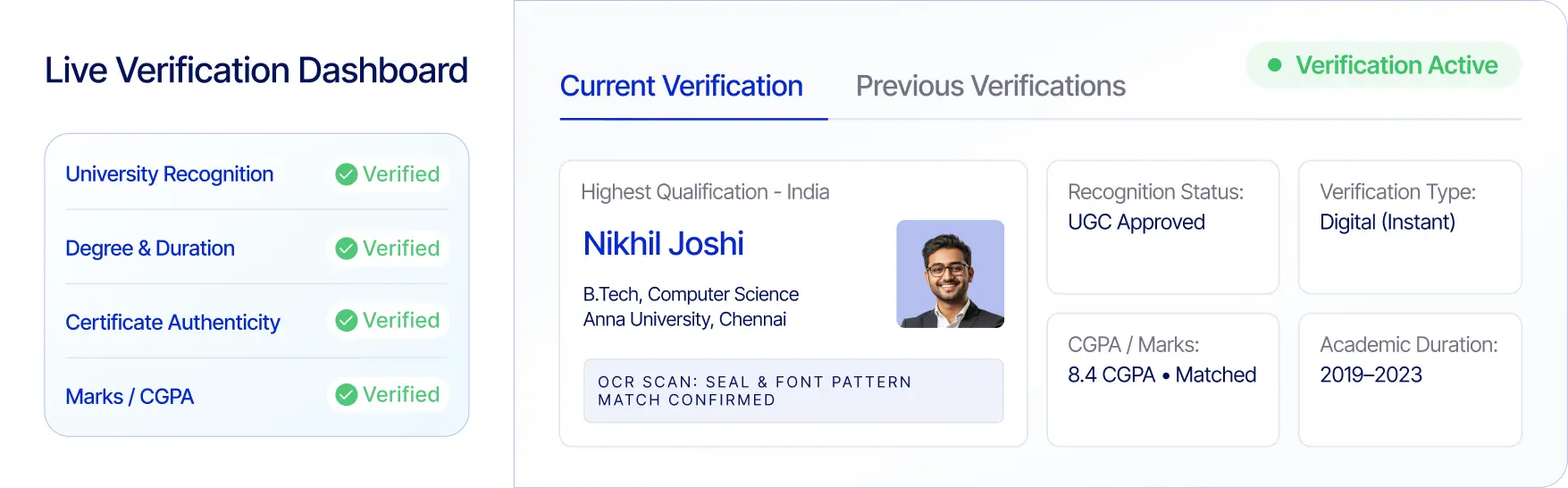
AI + OCR, results in minutes
Certificate Uploaded
Candidate uploads their degree certificate and marksheet through the verification portal.
OCR Extraction Performed
Name, university, degree, year, and marks are extracted directly from the document.
Tamper Detection Applied
AI models flag pixelation, font, and seal inconsistencies that signal a forged or altered certificate.
University Recognition Checked
Institution is cross-checked against UGC/AICTE/DEB recognition lists automatically.
Confirmed through university-connected partners
Regional Partner Engaged
A verification partner with an established contact at the institution checks the candidate's records.
Enrollment Records Checked
Roll number, admission and graduation year, and degree details are cross-confirmed against the institution's records.
Escalation to Registrar, If Needed
If the institution is unrecognized, non-cooperative, or records look suspicious, we engage the registrar directly through an official letterhead request.
Built for enterprise HR teams that need accuracy, speed, and compliance - without the complexity.
Launch identity checks in minutes. No complex setup or IT involvement required.
ISO 27001 certified and PCI compliant. All location and identity data encrypted end-to-end.
No hidden fees. Clear per-check pricing - choose Digital, Physical, or both.
Trigger checks automatically via your ATS or HRMS. Zero manual intervention needed.

AI and OCR clear clean certificates automatically, saving manual review for cases that truly need it.
Complete audit trails and AI-driven cross-referencing for accurate, defensible results.
Configure check sequences, SLA alerts, and report formats to match your hiring process.
A guided candidate portal keeps completion rates high and the process frustration-free.






Everything you need to understand, evaluate, and share employment verification - in one place.
A full overview of SpringVerify's education check - instant screening and Regional Partner Verification, data points, TAT, and pricing.
How AI and OCR catch fabricated certificates and clear genuine ones automatically.
A practical walkthrough of how degree verification works and what to check for.