Education Check (Preliminary) is SpringVerify’s instant, AI-powered education verification check that flags tampered certificates and unaccredited degrees in seconds — before full manual background verification even begins. The moment a candidate uploads their certificate, it uses OCR and AI to scan for tampering (pixelation, inconsistent fonts, altered seals, mismatched formatting) and simultaneously cross-checks whether the degree and specialisation actually exist at the named institution.
At a glance:
It doesn’t replace full education verification — it’s the intelligent first pass that runs before it. Here’s why that matters in India today.
You’re three days from an offer letter. The candidate looks perfect — strong interview, solid references, the right specialization. Then education verification comes back flagged. A degree that didn’t exist. A university that was never accredited. A seal that someone altered in Photoshop. It happens more often than anyone in HR wants to admit — and by the time you find out, you’ve already invested weeks of pipeline effort.
India has over 1,000 universities and more than 40,000 colleges. A significant number of degrees in circulation belong to institutions that are de-recognised, non-existent, or operating under names designed to sound legitimate. According to UGC data, hundreds of fake universities have been identified across the country — and that list keeps growing. For hiring teams working at scale, manually cross-referencing every candidate’s degree against UGC records, university portals, and accreditation databases is not just slow — it’s operationally unsustainable.
The standard workaround has been to push every document into a full verification queue, wait for ops teams to manually review it, and hope the turnaround doesn’t stall your offer timeline. The result is a process that typically takes days, adds unnecessary cost for documents that are obviously clean, and still misses subtle tampering that an untrained eye won’t catch. There’s been no smart middle layer — until now.
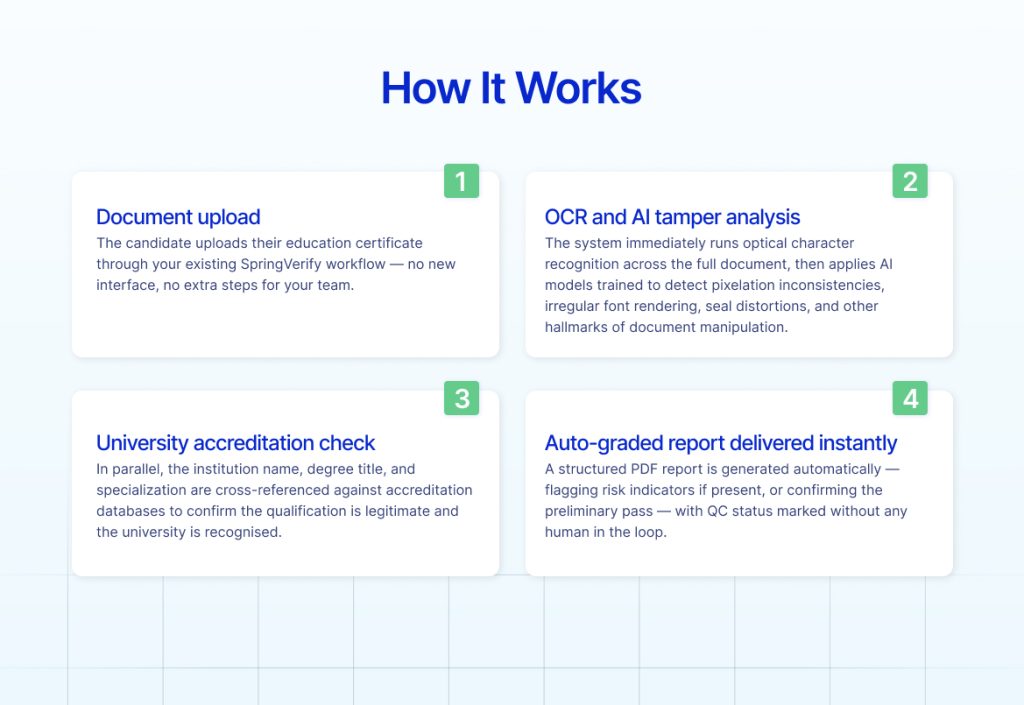
Education Check (Preliminary) is a new instant verification check from SpringVerify that uses OCR and AI analysis to evaluate an education document the moment it’s uploaded. In seconds, it scans the document for signs of tampering — pixelation artefacts, inconsistent fonts, altered seals, mismatched formatting — and simultaneously confirms whether the degree and specialization actually exist at the institution named on the certificate.
It is not a replacement for full education verification. It is the intelligent first pass that should happen before anything else — a check that catches the obvious fraud early, clears the clean documents automatically, and ensures your ops bandwidth is only spent where it genuinely matters. The entire process is auto-graded, a preliminary PDF report is generated without any manual intervention, and QC is marked automatically. Zero ops effort on the happy path.
For hiring teams processing hundreds of candidates a month, the numbers add up quickly. Documents that would previously sit in a queue for two to three days now return a result in seconds. Tampered certificates that might have been missed by a rushed manual review are caught before they ever reach a recruiter’s desk. And candidates with clean, legitimate documents move through the process faster — which means a measurably better experience for the people you actually want to hire.
The accreditation check alone closes a gap that most companies don’t realise they have. Degrees from non-recognised institutions look entirely legitimate on paper. Without automated cross-referencing, the only way to catch them is to know what to look for — and to have the time to look. Education Check (Preliminary) does that work automatically, every time, at a cost that makes it viable to run on every single candidate rather than selectively.
Education Check (Preliminary) is available on the SpringVerify platform. If you want to see it in action before you roll it out across your hiring process, our team will walk you through it.