















































Court Check Datasheet
A full overview of SpringVerify's court check, grading matrix, PCC escalation path, data points.
Every candidate's court record, checked and clearly explained - so you always know the real risk before you decide, not just a name that happened to match.
Trusted by 8,000+ companies























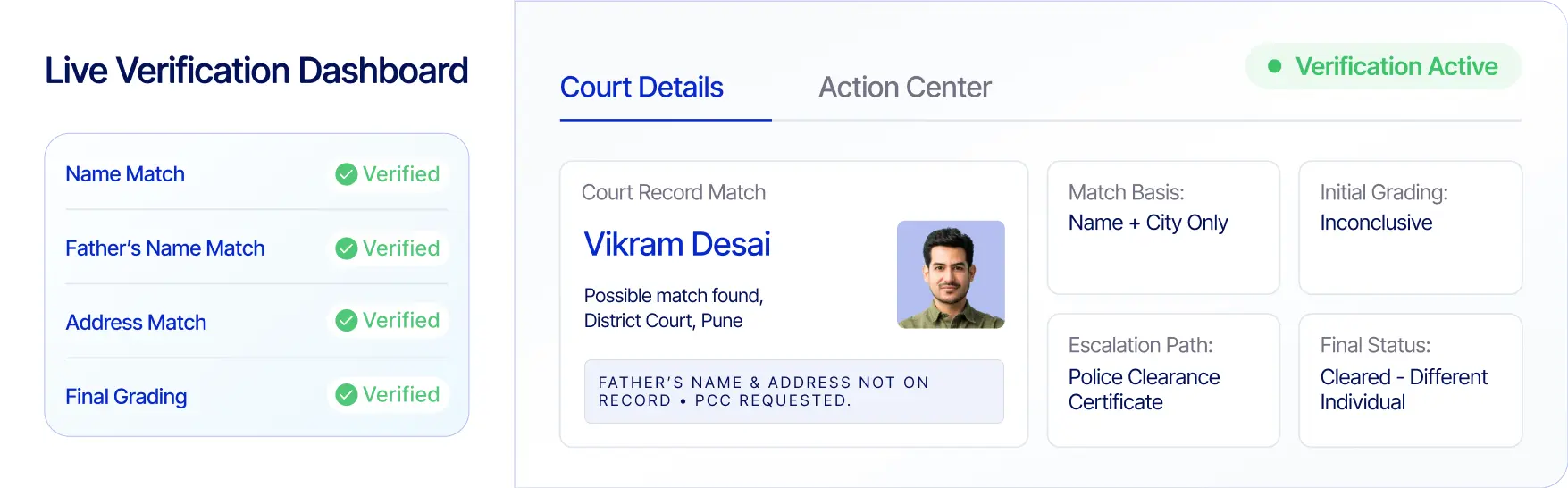
A name match on India's public court records isn't proof of anything by itself. How you grade that match is what separates a fair hiring decision from a false flag.

Common names return common -name matches. Grading against father's name and address stops a stranger's case from becoming your candidate's problem.

Decide how strict grading should be - only exact name-and-address matches flagged, or every partial match escalated for review.

Inconclusive matches don't stall - they follow a clear Police Clearance Certificate process to a definitive answer.

Every match category and grading decision is logged, so you can show exactly how a hiring call was made.
The same digitised search, an advocate-signed version of it, or an attorney-conducted deep dive - pick what fits the role.
Automated search, vendor letterhead
Source
Digitised eCourts database
Report On
Vendor letterhead
TAT
1–2 hours
Coverage
Pan-India digitised courts
Records Period
Since 2000
Grading
Automatic
Best For
Standard BGV
Same automated search, advocate-signed report
Source
Same as Court Check
Report On
Advocate letterhead
TAT
1–2 hours
Coverage
Pan-India digitised courts
Records Period
Since 2000
Grading
Automatic
Best For
Clients requiring advocate letterhead
Attorney-conducted, physical police station visit
Source
Police station - physical visit
Report On
Law firm letterhead
TAT
2 working days
Coverage
Defined jurisdiction only
Records Period
Last 7 years
Grading
Manual review
Best For
BFSI, banking, blue-collar
SpringVerify's court check goes beyond a keyword search. Every case surfaces the full context behind a match.
Whether the result is an Exact Match, Partial Match, Possible Match, or fully Clear.
Whether the matter is pending or convicted, and whether it's civil or criminal in nature.
The specific court and jurisdiction where the record was found.
Key dates on record, giving context on how recent or active the matter is.
Every available identifier is checked against the candidate’s details, not just the name.
For escalated cases, record Police Clearance Certificate review and final regrading.
Built for enterprise HR teams that need accuracy, speed, and compliance - without the complexity.
Set your own threshold for what counts as a flaggable match, from strict to lenient.
Ambiguous matches are graded Inconclusive rather than guessed at, avoiding false positives on namesakes.
Inconclusive matches follow a defined process - no duplicate vendor cost, no dead end.
Court checks trigger automatically the moment a case is submitted - no manual initiation needed.

No hidden fees, and no duplicate charges when a case is re-graded through the PCC process.
Immutable audit trails and AI-driven cross-referencing for tamper-proof, court-admissible results.
Configure SLA alerts and report formats to match your compliance process.
Candidates asked for a PCC get clear guidance on why and how, keeping completion rates high.


.png)
.png)


Everything you need to understand, evaluate, and share employment verification - in one place.
A full overview of SpringVerify's court check, grading matrix, PCC escalation path, data points.
What shows up in a criminal record check report, from convictions to pending matters.
Why Loadshare Networks switched vendors after critical court cases went unflagged, and what changed with SpringVerify.