

Workforce planning is all about making sure you have the right people, with the right skills, in the right roles, at precisely the right time. Think of it as creating a strategic blueprint for your team, ensuring your talent strategy is perfectly aligned with your long-term business goals.
Table of Contents
What Is Workforce Planning in Simple Terms

Let’s use an analogy. Imagine you’re coaching a sports team with a clear goal: win the championship in three years. You wouldn’t just hire players based on who’s available today. You’d be scouting for future stars, developing the skills of your current players, and planning for upcoming retirements. That same forward-thinking approach is exactly what workforce planning brings to a business.
It’s a huge leap from the day-to-day grind of recruitment, which is often reactive—filling a seat only after it becomes empty. Instead, workforce planning is a proactive strategy that connects your people directly to your company’s biggest objectives. The main idea is to anticipate what you’ll need down the road and prevent talent crises before they can even start.
Building Your Future Team Today
Good workforce planning isn’t a one-and-done task; it’s a continuous cycle of analysis and action. It involves taking a hard look at your current team’s skills, forecasting what capabilities you’ll need in the future, and then creating a solid plan to close that gap. This isn’t just about filling empty seats. It’s about building an organisation that’s resilient and agile enough to handle whatever comes next.
This process helps you answer mission-critical questions, like:
- Do we have the right leadership talent in the pipeline for our five-year growth plan?
- Which roles might become redundant due to automation, and how can we reskill those employees for new opportunities?
- What new skills will our product team need to develop to stay ahead of the competition next year?
By tackling these questions proactively, you sidestep costly mistakes. Without a plan, companies often find themselves scrambling to fill sudden skill shortages that bring projects to a grinding halt. On the flip side, they can end up overstaffed during an economic downturn, forcing painful and disruptive layoffs.
Key Takeaway: Workforce planning isn’t just an HR function; it’s a fundamental business strategy. It transforms talent management from a reactive cost centre into a proactive driver of growth and a serious competitive advantage.
Ultimately, this strategic foresight ensures that your most valuable asset—your people—is perfectly positioned to carry your business into the future. It’s all about building the team you’ll need tomorrow, not just managing the one you have today.
Why Workforce Planning Is a Business Imperative
Let’s move past the textbook definition for a moment. It’s time we saw workforce planning for what it really is: a core business function, not just another HR task. Think of it as your company’s strategic defence against uncertainty. It’s what helps you handle market shifts, tech disruptions, and economic curveballs with confidence, instead of just reacting when a crisis hits.
Without a solid plan, businesses often get stuck in one of two equally damaging spots. They either face crippling talent shortages for critical roles, which stalls innovation and growth. Or, they find themselves overstaffed during a downturn, leading to painful layoffs that destroy morale and tarnish the company’s reputation.
Effective workforce planning is the bridge between your big-picture business goals and the people you need on the ground to make them happen. It’s how you connect your talent strategy directly to real, tangible results.
Gaining a Competitive Advantage
Companies that truly master this don’t just survive the chaos; they thrive in it. By looking ahead and anticipating their talent needs, they gain a serious competitive edge. This proactive approach helps them build a resilient, agile organisation that’s ready for whatever comes next.
For instance, this kind of strategic foresight allows businesses to:
- Reduce Hiring Costs: When you spot skill gaps early, you can focus on targeted recruiting and developing your internal talent. This avoids the sky-high costs of last-minute hiring for in-demand roles.
- Improve Employee Retention: A clear plan shows your team there’s a path for growth within the company, which naturally boosts engagement and loyalty.
- Increase Profitability: Aligning your people with business objectives means you have the right talent driving your most important initiatives. This optimises labour costs and drives up productivity.
In today’s dynamic market, failing to plan your workforce is the equivalent of planning to fail. It transforms your people strategy from a reactive necessity into a powerful engine for sustainable growth.
Navigating the Future of Work
The importance of workforce planning is even more pronounced in a rapidly evolving economy like India’s. Technology is changing jobs at an incredible pace, making proactive skill development an absolute must.
In fact, it’s estimated that around 39% of core job skills in India will change by 2030. That single statistic screams urgency. It shows why organisations have to get serious about upskilling and reskilling their teams just to stay in the game.
Ultimately, this process elevates the entire human resources function from an operational support role to a strategic business partner. When you know where the business is headed, you can make sure the right team is in place to get it there, turning your people into your greatest asset.
The Four Stages of the Workforce Planning Cycle
Effective workforce planning isn’t a one-off task you can tick off a list. It’s a continuous, structured cycle. Breaking the process down into four distinct stages makes it far more manageable and repeatable, giving you a clear roadmap to line up your talent with your business goals. This framework turns what feels like a complex strategy into a series of clear, actionable steps.
Think of it as a logical progression, starting with understanding where you are now before you can effectively plan for where you need to go.
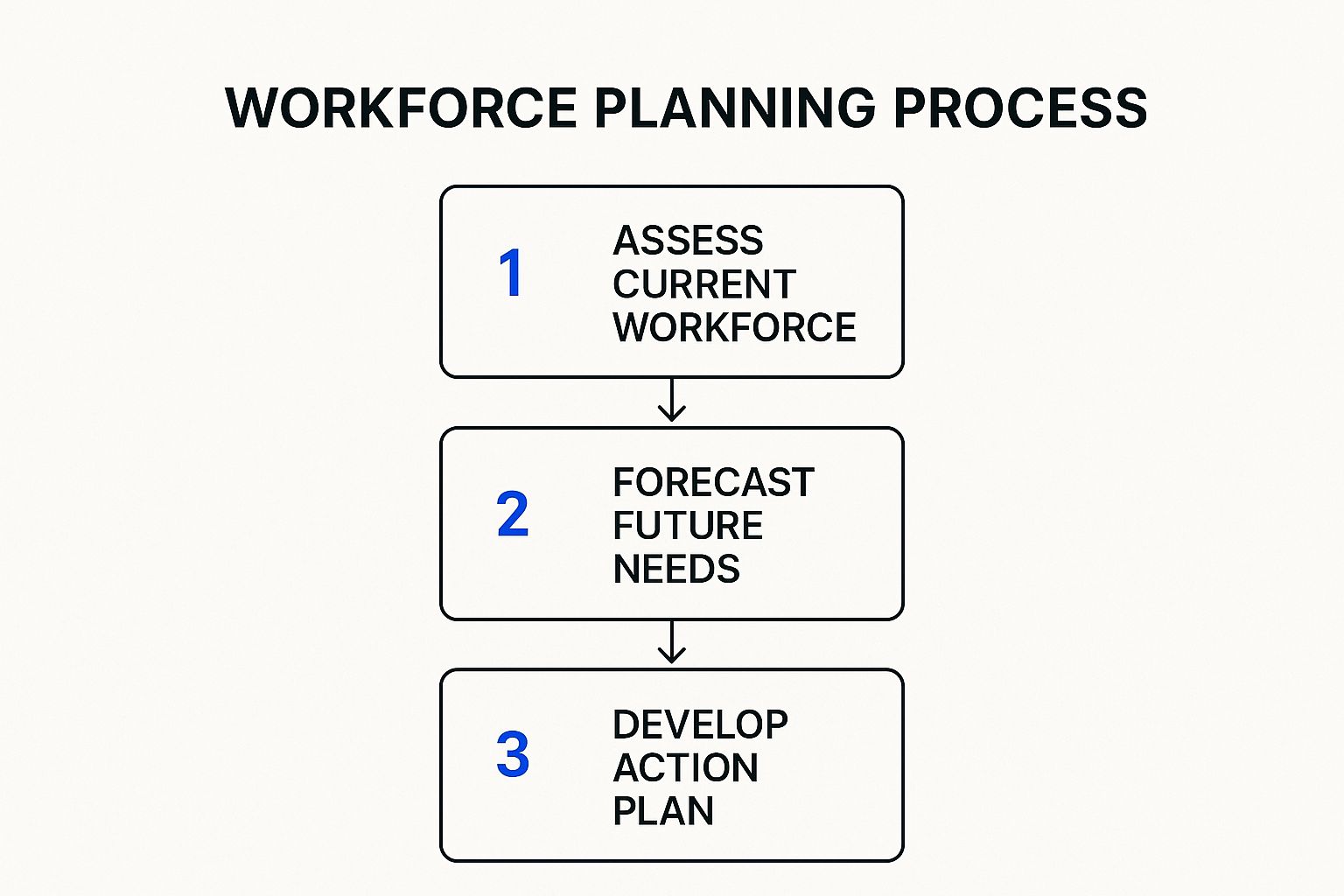
This simple flow shows how each stage builds on the last, moving from assessment all the way through to action.
Stage 1: Supply Analysis
First things first: you need a clear, honest picture of your current team. This isn’t just about getting a headcount. It’s a deep dive into the skills, competencies, demographics, and performance levels of your existing people.
The goal here is to answer one fundamental question: “Who do we have now?”
To do this properly, you’ll need to conduct a thorough internal talent audit. This usually involves:
- A Skills Inventory: Catalogue the specific skills and qualifications of every employee. Think technical abilities, certifications, languages spoken, and any leadership experience.
- Performance Data: Analyse performance reviews to spot your top performers and identify those who might need a bit more development.
- Demographic Analysis: Get a handle on the age, tenure, and diversity of your workforce. This helps you anticipate retirements and spot any diversity gaps you need to address.
This detailed analysis gives you a comprehensive map of your current talent landscape.
Stage 2: Demand Forecasting
Once you know what you have, the next stage is all about predicting what you’ll need. Demand forecasting looks to the future to answer the question: “Who will we need?” This is where you connect your people strategy directly to your organisation’s big-picture objectives.
Forecasting isn’t about gazing into a crystal ball. It’s a data-informed process that considers several key factors:
- Business Goals: Are you launching a new product, expanding into a new market, or bringing in new technology? Each of these moves will demand new roles and skill sets.
- Market Trends: Look at industry growth, technological shifts, and what your competitors are doing. For instance, the explosion of AI is creating a massive demand for data scientists and machine learning specialists.
- Historical Data: Analyse your own past trends in employee turnover, promotions, and hiring to predict future movement within the company.
By blending your internal business plans with external market data, you can build a realistic picture of the talent you’ll need to either find or develop to hit your future goals.
Stage 3: Gap Analysis
With a clear view of your current supply and future demand, you can now see the difference between the two. This is the gap analysis stage, where you pinpoint the specific shortages—or surpluses—of talent your organisation is going to face.
The question here is simple: “What’s the difference?”
A talent gap can show up in a few different ways:
- Skill Gap: You have enough people, but they don’t have the skills needed for future tasks.
- Headcount Gap: You simply don’t have enough people in a critical role.
- Surplus Gap: You have too many people in a role that is slowly becoming obsolete.
This analysis is arguably the most critical part of what is workforce planning, because it turns all your data into specific, real-world problems that need solving.
Stage 4: Solution Implementation
Finally, it’s time to take action. This last stage is all about creating and executing a plan to bridge the gaps you’ve identified in the previous step. The goal is to answer the final question: “How do we close the gap?”
Your action plan will likely involve a mix of different strategies. For example, to fix a skill gap, you might roll out targeted training programmes or create a mentorship scheme. To close a headcount gap, your plan could involve a mix of external hiring and promoting from within. This is the point where your workforce plan becomes a real, tangible driver of change in your organisation.
To pull it all together, here’s a quick summary of the entire cycle.
The Workforce Planning Process at a Glance
| Phase | Objective | Key Activities |
|---|---|---|
| 1. Supply Analysis | To understand the current workforce’s skills, size, and demographics. | Creating a skills inventory, analysing performance data, reviewing demographics. |
| 2. Demand Forecasting | To predict future talent needs based on business goals and market trends. | Analysing business strategy, studying market trends, reviewing historical data. |
| 3. Gap Analysis | To identify the differences between current talent supply and future demand. | Comparing supply vs. demand, identifying skill and headcount shortages or surpluses. |
| 4. Solution Implementation | To develop and execute strategies to close the identified talent gaps. | Creating action plans for recruitment, training, internal mobility, and succession planning. |
By following these four stages, you create a living strategy that ensures you always have the right people with the right skills in the right place to drive your business forward.
Unlocking the Real-World Benefits of Workforce Planning
Investing in strategic workforce planning isn’t just some administrative box-ticking exercise. It delivers powerful, measurable returns that strengthen your entire organisation from the ground up. Let’s move past the theory and look at the tangible benefits that build a compelling business case for leadership to get on board.
At its core, a solid plan flips the switch from reactive, panicked hiring to proactive talent acquisition. Instead of scrambling to fill a sudden vacancy, you’re building a pipeline of skilled people before you even need them. That foresight alone leads to smarter, more cost-effective recruitment.
Drive Smarter Recruitment and Reduce Costs
By getting an early read on your future skill needs, you can slash hiring costs in a big way. We’ve all been there—rush hiring for a specialised role is expensive and often means you have to compromise on quality. A workforce plan lets you focus on targeted sourcing and internal development, dodging the premium you’d otherwise pay for urgent, last-minute searches.
This proactive approach also means you can:
- Optimise Your Hiring Budget: You get to put your money where it matters most, allocating resources to the roles that will be critical for your future.
- Improve Quality of Hire: When you aren’t racing against the clock, you can be more selective and find candidates who are a genuinely great fit.
- Reduce Reliance on Agencies: Building your own internal muscle to source and attract top talent directly saves a fortune in the long run.
Enhance Employee Engagement and Retention
A clear path for career development is a direct result of good workforce planning, and it dramatically improves how your employees feel about their future with the company. When people can actually see a path for growth, they are far more likely to stick around and stay committed. This is a huge deal in the current talent market.
Consider this: workforce engagement in India plummeted to just 19% in 2025. Engagement is tightly linked to things like flexibility and real opportunities to learn new skills—exactly the elements a strategic workforce plan helps you build. To get a better handle on these trends, you can read the full report from ADP Research.
When you align your people strategy with your financial goals, workforce planning helps you get a grip on labour costs and improve overall profitability. It ensures every Rupee spent on talent is a direct investment in your company’s future.
Ultimately, by showing your team you’re invested in their careers, you foster a culture of loyalty that cuts down on costly turnover. This creates a stable, skilled, and motivated workforce that’s ready to tackle whatever comes next and drive sustainable growth.
How to Implement Your Workforce Plan
A brilliant workforce plan on paper is just that—paper. It’s completely useless until you put it into action. Moving from theory to the real world needs a clear, methodical approach, and it all starts at the top.
The first and most critical step is getting your senior leadership on board. You have to frame the plan in their language. Don’t talk about HR metrics; talk about business outcomes. Connect your workforce strategy directly to things they care about: revenue growth, market expansion, and profitability. Show them how the right people in the right roles will make those goals happen.
Once leadership gives the green light, your next job is to bring the plan to life on the ground. This means working hand-in-hand with department managers. They’re on the front lines and have the insights you desperately need to make sure your forecasts and skill assessments actually reflect the day-to-day needs of the business. Their involvement is what turns your plan from a top-down mandate into a shared, strategic tool that everyone feels a part of.
From Annual Report to Agile Process
For your plan to have any real impact, it has to be woven into the core functions of the business. It can’t be treated as some standalone HR project that gets dusted off once a year. This means aligning it directly with your annual budgeting and financial forecasting cycles. When your talent needs are baked right into the financial plan, hiring and training become proactive investments, not reactive expenses you have to scramble for.
Remember, effective workforce planning isn’t a static, once-a-year report. It needs to be a continuous, living process. You have to regularly review and adjust your plan based on what’s actually happening.
- Market Shifts: Sudden changes in your industry can flip your talent needs overnight. You need to be ready to pivot.
- Business Performance: If growth is soaring past expectations or you hit unexpected roadblocks, your plan has to adapt.
- Internal Data: Keep a close eye on your own numbers—turnover rates, promotion velocity, and hiring success. This data will help you fine-tune your forecasts and make them more accurate over time.
To ensure your plan is as robust as it can be, it helps to lean on proven methods. For anyone looking for a solid framework, these 7 Workforce Planning Best Practices are a great starting point for building a resilient strategy.
Future-Proofing Your Team
A huge part of implementation is future-proofing the talent you already have. With the rapid pace of change, especially in technology, upskilling isn’t just a nice-to-have; it’s non-negotiable. Think about this: roughly 63% of Indian workers will need significant training by 2030 just to keep up with industry demands in areas like AI and automation.
This reality has already pushed many Indian employers to adopt skills-based hiring. In fact, around 30% have started reducing degree requirements to fill critical roles, focusing instead on what a candidate can do.
Key Insight: Implementation is where your strategy meets reality. It’s about turning data-driven forecasts into tangible actions like targeted training programmes, strategic hiring, and succession planning that build a resilient and future-ready organisation.
This is where your plan directly connects to your hiring efforts. By identifying skill gaps before they become critical problems, you arm your hiring teams with the information they need to be strategic, not just reactive. To learn more about optimising this function, check out our guide on how to improve your talent acquisition process.
By transforming your workforce plan into a living, breathing part of your business operations, you create a powerful competitive advantage that will set you apart.
Navigating Common Workforce Planning Challenges
Even the most meticulously crafted plans hit a few bumps in the road, and workforce planning is no exception. Knowing what these common roadblocks look like is the first step to navigating around them and making sure your plan actually drives results, instead of just gathering dust on a shelf.
One of the biggest gremlins in the machine is incomplete or unreliable data. It’s a classic catch-22: you need good data to make smart decisions, but all your systems are siloed and messy. The answer isn’t to wait around for a perfect, utopian data warehouse.
Instead, start small with the information you have. Use it to score a few early, tangible wins. This creates a bit of momentum and makes it much easier to build a business case for investing in better data tools down the line.
Another huge hurdle is getting buy-in from managers who are laser-focused on hitting their short-term targets. From their perspective, spending time on long-range planning can feel like a distraction from the immediate pressure of their quarterly numbers.
Key Insight: To get these managers on board, you have to speak their language. Frame the workforce plan in terms of their immediate pain points. Show them exactly “what’s in it for them”—like filling critical roles faster or cutting down on team turnover.
When you connect the dots for them, you turn potential sceptics into your biggest supporters.
Forecasting in a Volatile Market
Trying to predict your talent needs years from now in a market that changes by the quarter can feel like reading tea leaves. Business priorities pivot so fast that long-term forecasts can seem outdated the moment you print them. The secret isn’t to predict the future perfectly, but to build agility into your plan from the ground up.
Here’s how you can get a better handle on forecasting:
- Plan for different futures. Don’t just create one rigid forecast and cross your fingers. Map out a few different scenarios—what happens if things go great (optimistic), what if they go south (pessimistic), and what’s the most likely path? This prepares you for a whole range of outcomes.
- Think capabilities, not just job titles. Instead of trying to guess the exact roles you’ll need in five years, zoom out. Focus on the core skills and capabilities your business will need to thrive, like sharp data analysis, adaptive project management, or creative problem-solving.
- Make it a living document. Your workforce plan shouldn’t be a “set it and forget it” exercise. Schedule regular check-ins, maybe once a quarter, to see what’s changed. Use new business data and market trends to tweak and adjust your forecasts.
By taking a more flexible, iterative approach, you can navigate uncertainty without getting paralysed. This problem-solving mindset helps you get ahead of obstacles, turning common challenges into opportunities to build a tougher, more resilient organisation that’s ready for whatever comes next.
Common Questions About Workforce Planning

As you start to get your head around workforce planning, a few common questions almost always pop up. Let’s tackle them head-on so you can move forward with a clear picture.
Workforce Planning vs Recruitment
It’s easy to mix these two up, but they’re fundamentally different. The simplest way to think about it is that recruitment is a reactive tactic, while workforce planning is the proactive strategy that steers it.
Recruitment is all about filling an open role right now. Workforce planning, on the other hand, is about looking into the future. It’s the process of figuring out which roles you’ll need in one, three, or even five years, so you can start building a talent pipeline long before a vacancy ever appears.
How Often Should a Plan Be Reviewed?
The old idea of creating a workforce plan once a year and then shoving it in a drawer is completely outdated. In today’s fast-moving world, the best approach is continuous monitoring and agile adjustment. Your plan should be a living, breathing document.
A good rule of thumb is to set aside time every quarter to review your plan against actual business performance and shifts in the market. This keeps you flexible and responsive, ensuring you’re never caught flat-footed by unexpected changes.
Key Takeaway: A workforce plan isn’t a rigid document you create once and file away. It’s a dynamic strategic tool that evolves with your business, helping you adapt to change proactively rather than reactively.
Can Small Businesses Use Workforce Planning?
Absolutely. It might sound like a complex process reserved for huge corporations, but the core principles are incredibly scalable. In fact, you could argue it’s even more critical for smaller teams. For a startup or SME, every single hire has a massive impact on the company’s direction and culture.
A simplified workforce plan helps small businesses make smarter hiring decisions, avoid costly mis-hires, and ensure they have the right skills on board to fuel their growth. For high-growth companies, getting every hire right is non-negotiable, which is why many now rely on comprehensive enterprise background verification solutions to build their teams with confidence.


