

A job screening test is a quick, standardised assessment used by employers early on in the hiring process. Its main job is to see if candidates have the basic skills and qualifications needed for a role before anyone spends time on in-depth interviews.
Think of it as an initial filter. It helps companies efficiently sort through a large pool of applicants to find the most promising ones.
Table of Contents
What Is a Job Screening Test?

Let’s use an analogy. Imagine you’re casting a movie. A director wouldn’t audition every single person who walks through the door for the lead role, right? Of course not. They’d first hold a preliminary screening to find actors who fit the basic description—like a certain height, age, or look. A job screening test works the exact same way: it’s a fast-track method to see who has the fundamental abilities required for the part.
For example, a company hiring a graphic designer might use a short test to check a candidate’s grasp of design software. Likewise, a data entry role might kick off with a typing speed and accuracy test. This first step isn’t about judging a person’s entire potential; it’s simply about confirming they have the baseline skills to succeed.
The Role of Screening in Modern Hiring
When a single job opening attracts hundreds, sometimes even thousands, of applications, manually reviewing every resume is simply not practical. Screening tests automate this initial filtering, making the process far more efficient and objective.
This data-driven approach helps to level the playing field. It shifts the focus from how well a resume is written to what a candidate can actually do, giving everyone a fair shot to demonstrate their skills.
To help you place these tests within the bigger picture, below is a table that breaks down their core functions.
| Function | Description | Primary Goal |
|---|---|---|
| Initial Filtering | Quickly narrows down a large applicant pool to a manageable number of qualified individuals. | To save time and resources by focusing only on promising candidates. |
| Skill Validation | Objectively measures a candidate’s proficiency in specific skills required for the job. | To confirm that candidates possess the necessary baseline abilities. |
| Objectivity | Reduces unconscious bias by using standardised, data-driven assessment criteria. | To ensure a fair and equitable evaluation process for all applicants. |
| Efficiency | Automates the early stages of recruitment, freeing up HR teams for more strategic tasks. | To streamline the hiring workflow and reduce time-to-hire. |
By serving these functions, screening tests have become a cornerstone of modern hiring, ensuring the recruitment process is both effective and fair.
Understanding the role of these assessments is a key part of the broader talent acquisition strategy. For deeper insights into building a robust hiring process, this comprehensive guide on how to hire contact center employees offers some excellent, practical advice.
Ultimately, these tests benefit everyone involved. Companies save valuable time and resources by focusing on the most qualified applicants. At the same time, candidates with the right skills get a direct opportunity to stand out from the crowd. This initial check ensures that the people who move on to interviews are a genuinely good fit, setting the stage for more meaningful conversations about experience, culture, and long-term goals.
The Shift to Digital Screening in India

The world of job screening in India has gone through a massive transformation. Not so long ago, hiring managers were buried under towering stacks of paper résumés, a painfully manual and slow process. Fast forward to today, and the scene is dominated by intelligent, tech-driven platforms that handle recruitment with remarkable speed and accuracy.
This shift wasn’t just a matter of choice; it was driven by necessity. India’s booming job market, especially in fast-paced sectors like technology and finance, created a desperate need for smarter hiring methods. When a single job opening can pull in thousands of applicants, old-school methods just can’t cope. This is where the question of what is a screening test for a job finds its modern answer: it’s an automated, scalable solution built for today’s hiring volumes.
Driving Efficiency and Fairness
Technology now gives recruiters the power to sift through huge volumes of applications without falling prey to human error or unconscious bias. AI-powered tools can instantly compare candidate profiles against job requirements, ensuring every single applicant gets a fair shot based purely on their qualifications and skills.
This digital approach levels the playing field. It makes sure the best candidates are spotted based on merit, not just how fancy their résumé looks or who they know.
Think about it. An automated coding test for a software developer role can objectively rank candidates on their problem-solving skills. In the same way, an online situational judgement test for a customer service position can instantly pick out individuals with the right temperament for the job.
This digital shift has another incredible benefit: it shatters geographical barriers. Companies are no longer restricted to the talent pools in major metro cities like Mumbai or Bengaluru.
Unlocking Talent Across the Nation
With online screening, businesses can now find and assess skilled professionals from smaller towns and remote corners of the country. This democratisation of opportunity is vital for building a more inclusive and diverse workforce.
- Wider Talent Reach: Companies can now tap into skilled labour markets that were previously out of reach, uncovering hidden gems all over India.
- Cost-Effective Hiring: Digital screening slashes the logistical costs tied to conducting preliminary interviews in person.
- Standardised Evaluation: Every candidate, no matter where they are, goes through the exact same fair and consistent assessment process.
This expansion is particularly important as India’s job market continues its explosive growth. Recent reports indicate the market is poised to grow by roughly 9%, with huge demand in IT, retail, and BFSI. You can learn more about these hiring trends in India to grasp the sheer scale of this expansion. This rapid growth makes efficient, tech-driven screening not just a nice-to-have, but an absolute must for any modern recruitment strategy.
Decoding the Different Types of Screening Tests
Ever wondered what kind of test you’ll face after applying for a job? It’s a common question. Companies don’t just pick one generic test; they use specific types of screening tests to measure different things. Knowing the “what” and “why” behind each one can help you feel much more prepared.
Think of it like a doctor choosing the right diagnostic tool. You wouldn’t expect them to use a stethoscope to check your eyesight. In the same way, an employer picks a test that directly relates to the demands of the role. For instance, a sales job might involve a test to gauge your personality and resilience, while a finance position will probably focus more on your numerical accuracy and attention to detail.
Generally, these tests fall into three broad categories: cognitive, personality, and skills-based.
This diagram breaks down the main families of job screening tests that recruiters use.
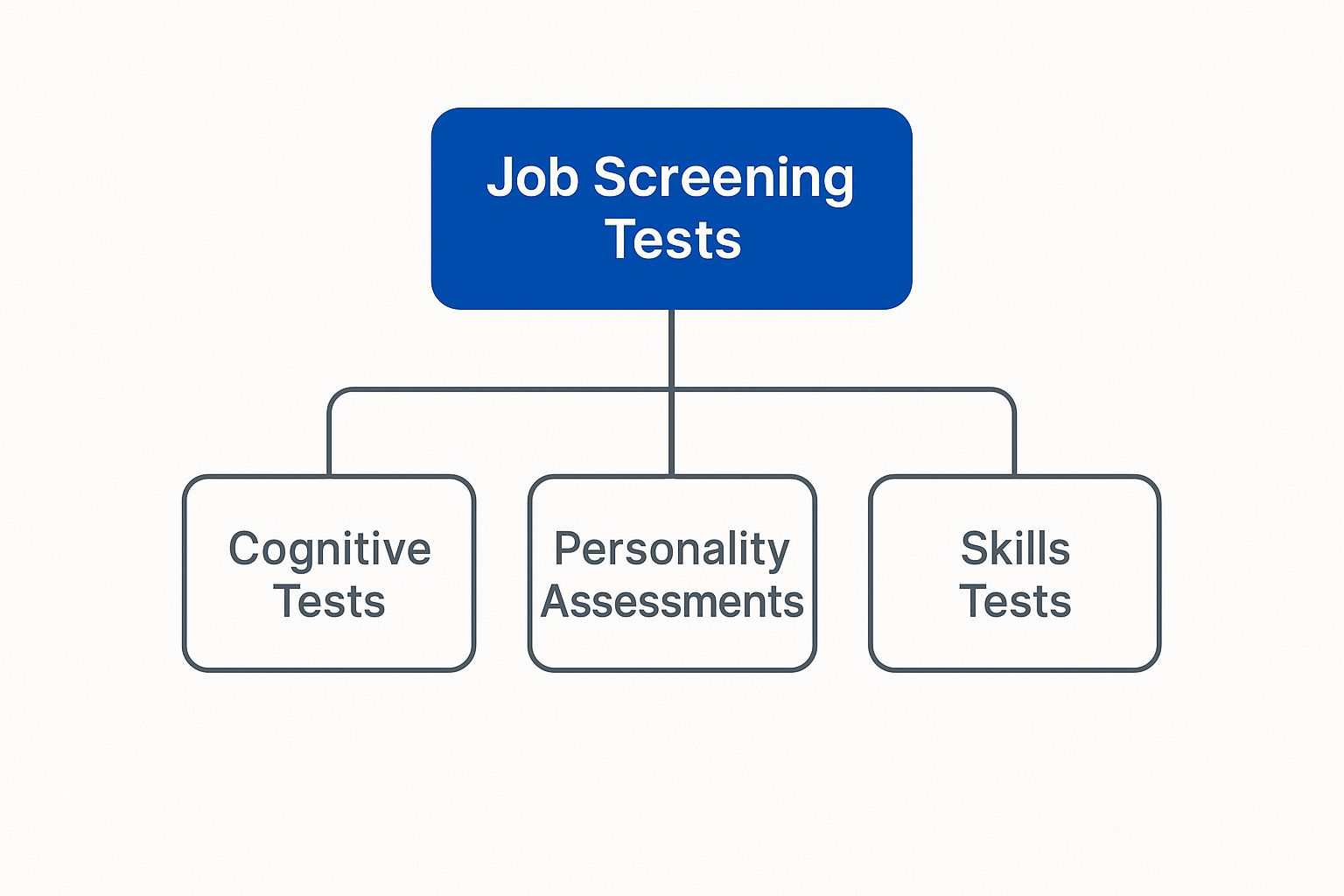
As you can see, each category has a distinct purpose in painting a complete picture of a candidate’s potential.
Aptitude and Cognitive Ability Tests
Aptitude or cognitive ability tests aren’t about what you already know. Instead, they’re designed to assess your potential to learn and solve new problems. These tests evaluate your core thinking skills, like logical reasoning, numerical ability, and verbal comprehension.
So why do employers lean on them? Because strong aptitude often means you can adapt, pick up new skills quickly, and handle complex challenges on the job. They’re a powerful predictor of future performance, regardless of your specific background.
A consulting firm, for example, might use a logical reasoning test to see how well you can analyse complex business problems and come up with structured, effective solutions.
Skill-Based and Technical Tests
Unlike aptitude tests, skill-based challenges are all about what you can do right now. They’re practical assessments designed to verify your proficiency in a specific area. These are incredibly common in technical fields but are used across many different industries.
Some common examples include:
- Coding Challenges: For software developers to show their programming chops.
- Writing Assignments: For content creators to showcase their communication and creative flair.
- Data Analysis Tasks: For financial analysts to prove their command of spreadsheets and data interpretation.
These tests give employers solid proof of your capabilities, moving beyond just a list of skills on your résumé. They want to see your talent in action.
By directly testing job-related skills, companies can ensure that the candidates who move forward have the practical abilities needed to perform from day one. This minimises the risk of a new hire not meeting technical expectations.
Psychometric and Behavioural Tests
Finally, we have psychometric and behavioural tests. These assessments dig into your personality, work style, values, and motivations. The goal here isn’t to find a “right” or “wrong” personality, but to see how well you might fit into the company’s culture and the specific team you’d be joining.
For a customer-facing role, an employer might look for traits like empathy and patience. For a leadership position, they could screen for assertiveness and strategic thinking. These tests help predict how you’ll behave in various work situations and collaborate with others, which is absolutely crucial for building a cohesive and productive team.
Why Screening Tests Are a Win-Win for Hiring
It’s easy to see a screening test as just another hoop for candidates to jump through. But in reality, it’s a powerful tool that benefits everyone involved in the hiring dance. For companies, these assessments are about much more than just weeding people out; they’re about making smarter, data-driven decisions that build stronger, more successful teams.
When every single applicant takes the same standardised test, you create a fair and objective starting line for everyone. This structured approach goes a long way in reducing hiring bias, making sure decisions are based on actual ability, not just a polished résumé or unconscious preferences. The outcome? A more diverse and genuinely capable talent pool.
For Companies: A More Strategic Approach
By bringing screening tests into the mix, companies can see a dramatic improvement in the quality of their hires. A well-designed test can confirm a candidate has the non-negotiable hard skills for the job—like coding proficiency or financial accuracy—long before they even get to the time-consuming interview stage. Just think of the countless hours this saves your hiring managers.
This efficiency is absolutely crucial in today’s competitive markets. By quickly pinpointing the top contenders, you can shorten your hiring cycle and snap up talented people before another company does. It fundamentally shifts recruitment from a reactive, résumé-sifting chore to a proactive, strategic hunt for proven skill and future potential.
For Candidates: A Chance to Shine
As a candidate, a screening test is your moment to prove what you’re made of in a tangible way. Your résumé can only say so much, but a test lets you show what you can do. It’s a stage where your real-world abilities can speak much louder than your past job titles or educational background.
For many, this is the great equaliser. It offers a level playing field where the most capable person for the job gets a real chance to move forward, regardless of other factors.
This is especially true for professionals in the early stages of their careers. Data from the India Skills Report reveals that screening tests are vital across all experience levels, but there’s a special focus on candidates with one to five years under their belt. This group makes up a massive 47% of all new hires in India, which highlights the huge demand for professionals whose skills have been properly verified. You can dig deeper into Indian hiring intent on Statista.com.
Ultimately, if you get an invitation to take a screening test, take it as a good sign. It shows the company values objective proof of skill and is serious about running a fair hiring process. It’s not just a test; it’s your opportunity to show them your true potential.
How Screening Tests Shape the Tech Industry
Nowhere is the power of a job screening test more visible than in India’s fast-paced tech industry. In a sector where innovation moves at lightning speed, finding the right talent isn’t just a priority—it’s a critical business necessity. Companies simply can’t afford to get it wrong, especially when hiring for highly specialised roles.
This is exactly why generic, one-size-fits-all tests just don’t cut it anymore. Tech firms now rely on hyper-specific assessments that mirror the real, day-to-day challenges of the job. You won’t find vague personality quizzes here; instead, you’ll see practical, hands-on challenges designed to find out who can actually do the work.
The New Standard for Tech Talent
For key roles, the screening process has become rigorous and highly tailored. Candidates should expect to face a variety of demanding evaluations designed to showcase their real-world capabilities.
- Live Coding Platforms: Aspiring software developers are often asked to solve complex algorithmic problems in real-time. This isn’t just about their coding proficiency, but also about seeing their problem-solving thought process in action.
- Simulated Project Challenges: A data scientist might be handed a raw dataset and tasked with cleaning, analysing, and pulling insights from it, simulating an actual project they would handle on day one.
- Cybersecurity Drills: For security expert roles, tests often involve identifying and neutralising threats in a controlled, simulated network environment.
These practical tests are vital for separating the truly skilled professionals from a vast sea of applicants. With a booming job market driven by AI, cloud computing, and other emerging technologies, screening has become the gatekeeper of talent. Strong growth is expected in entry-level tech hiring, and these tests are the primary way to identify candidates with the right aptitude for high-demand fields like data analysis and project management. You can learn more about this trend by exploring how to get a tech job in India in 2025.
Fuelling Growth Beyond the Metros
Another huge impact of digital screening is its role in democratising talent acquisition. Thanks to remote online assessments, companies are no longer limited to hiring from established tech hubs like Bengaluru or Hyderabad. They can now discover and recruit top-tier developers, engineers, and analysts from any corner of the country.
This shift empowers companies to build diverse, geographically distributed teams. It connects brilliant minds from smaller cities and towns with world-class opportunities, fuelling a more inclusive national tech ecosystem.
This ability to screen talent remotely is a genuine game-changer. It helps businesses scale efficiently while making sure every candidate, regardless of their location, is evaluated on a level playing field. Understanding these dynamics is crucial for any company operating in this space. For more details on navigating these challenges, our guide on background verification in the technology industry provides further context. Ultimately, these advanced screening methods help ensure that the architects of our digital future are chosen for their skill, not their postcode.
Your Questions About Job Screening Tests Answered
Coming up against a screening test can feel a little intimidating. It helps to remember that it’s just one piece of the hiring puzzle. Plenty of candidates have the same questions, so let’s walk through the most common ones to clear the air and help you go in with confidence.
Knowing what to expect is half the battle. Our goal here is to give you clear, straightforward answers that turn any anxiety you might have into a solid preparation strategy.
How Can I Best Prepare for These Tests?
Preparation is less about cramming facts and more about getting familiar with the format. You wouldn’t run a marathon without a few practice runs, and the same idea applies here. The best way to get ready is to figure out what kind of test you’ll be taking and then find practice versions online.
For instance, if you’re facing a cognitive ability test, look for sample questions covering logical reasoning, number puzzles, and verbal comprehension. If it’s a technical skills test, like for coding, platforms such as HackerRank or LeetCode are fantastic for practicing on similar problems.
The whole point is to get comfortable with the format, the types of questions, and the time limits. This practice cuts down on surprises and helps you manage your time much better when the real test day arrives.
Do My Test Results Define My Entire Application?
This is a big worry for a lot of people, but the answer is almost always no. A screening test is just a single data point, not the whole story. Recruiters use these tests as an initial filter, but they always look at your application as a complete package.
A strong test score can definitely make you stand out, but a slightly lower score isn’t necessarily a deal-breaker if your experience, skills, and interview performance are exceptional.
Employers are looking for the best overall fit. Your résumé, cover letter, portfolio, and how you come across in interviews all play a huge part. Think of the test as the key that gets you through the door to the next stage, where all your other strengths can really shine. Managing these stages is a core part of modern human resources management, where multiple factors are weighed to find the right person.
What Happens if I Have a Bad Day and Perform Poorly?
We all have off-days, and recruiters are human—they generally get it. If you genuinely feel something significant threw you off, like a technical glitch or a sudden illness, it’s worth letting the recruiter know politely and professionally. A little honesty can go a long way.
Most of the time, though, it’s best to focus on what you can control. If you don’t move on to the next round, use it as a learning moment.
- Reflect on the test: What parts did you struggle with? Were there specific kinds of questions that tripped you up?
- Identify weak spots: Use what you learned to guide your practice for the next opportunity.
- Don’t get discouraged: A single test result doesn’t define your skills or your career potential. Every application is a chance to learn and get better.
Are Drug Screening Tests Common?
In certain industries, yes, they are. Pre-employment drug screening is often standard practice in fields where safety is the number one priority, like construction, manufacturing, and transport. The data shows that workplace accidents can sometimes be linked to substance use, so companies use these tests to help maintain a safe environment for everyone.
The goal isn’t to be intrusive; it’s about managing risk and looking out for everyone’s well-being at work. If a role requires a drug screen, it will almost always be stated clearly in the job description or mentioned during the initial hiring conversations, so it won’t be a surprise.
Remember, a screening test is just another chance to show what you can do. With the right preparation and a positive mindset, you can navigate it successfully and get one step closer to landing that role you want.
Ready to build a trustworthy team with confidence? SpringVerify offers fast, accurate, and compliant background verification services, making it easier to make informed hiring decisions. Streamline your screening process by visiting https://in.springverify.com.


