

At its core, police verification for a passport is a mandatory background check carried out by your local police. This crucial security step is designed to confirm an applicant’s identity, address, and to check for any criminal history. It’s a non-negotiable part of the process for most new passports in India, ensuring these powerful travel documents only go to legitimate citizens.
Table of Contents
What Is Passport Police Verification Really About?
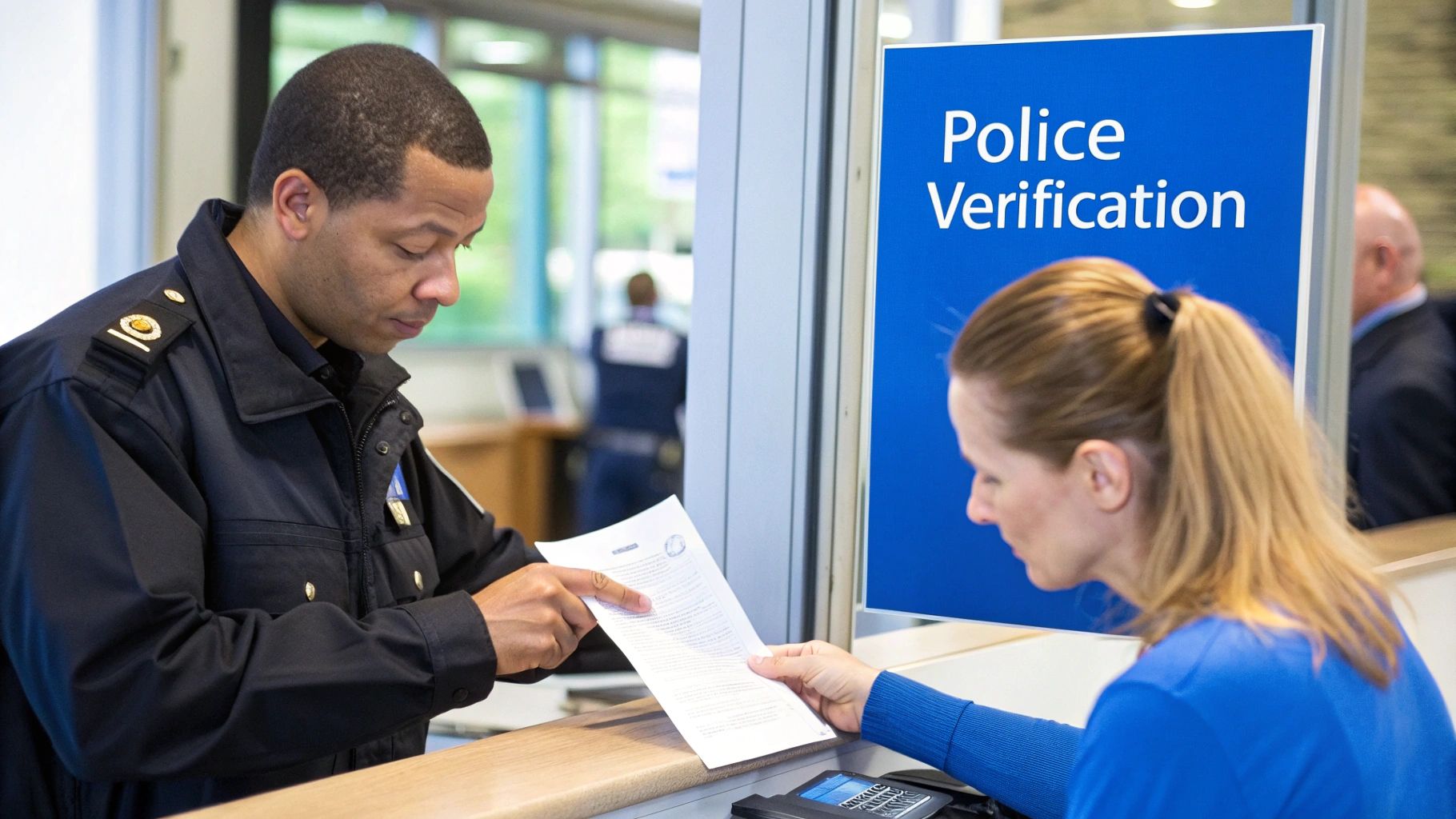
Think of police verification as the government doing its homework on you. It’s not just a box-ticking exercise; it’s a fundamental procedure meant to uphold national security and prevent serious issues like identity fraud. Before handing you a document that allows international travel, the authorities need to be completely sure you are who you say you are.
Once your application is submitted at the Passport Seva Kendra (PSK), this process kicks off. Your file is forwarded to the police station that covers your address, where an officer is assigned to personally validate the details you provided.
The Three Pillars of Verification
The entire verification procedure hinges on confirming three key things about you. Each one is a critical piece of the puzzle, safeguarding the integrity of the whole passport system.
The table below breaks down these core components and why each one is so important for your application’s success.
Key Elements of Police Verification
| Verification Aspect | What It Involves | Why It Matters for Your Application |
|---|---|---|
| Identity Verification | Confirms your name and personal details match official documents. | Ensures the passport is issued to a genuine person, preventing impersonation. |
| Address Verification | A police officer physically visits the address on your application. | Confirms you reside where you claim to, preventing the use of fake addresses. |
| Criminal Record Check | Reviews local and national police databases for any pending criminal cases. | Ensures you are not legally barred from travelling abroad due to criminal proceedings. |
In short, the police are double-checking that all the information you’ve given is authentic and that there are no red flags.
By confirming these three pillars, the government drastically reduces the risk of passports falling into the wrong hands, where they could be used for all sorts of illegal activities.
Getting to grips with the full passport lifecycle is useful, and this includes processes beyond just the first application. For example, the checks involved in a Nigerian passport renewal process also have security checks to maintain document integrity. For businesses and HR teams, understanding these official procedures is also important, which is why many use specialised services for their own passport verification needs.
Ultimately, seeing the verification not as a bureaucratic hurdle, but as a necessary layer of protection, helps put the whole thing in perspective.
The Real Reason Police Verification Is Mandatory
Ever found yourself wondering why police verification for a passport is such a non-negotiable step? It’s easy to see it as just another bureaucratic hoop to jump through, but it’s actually much more than that. This process is a foundational element of national security and one of our best defences against identity fraud on a global scale.
Think of it like a bank’s ‘Know Your Customer’ (KYC) process. Before a bank gives you a credit card or a loan, they need to be sure you are who you say you are. The government applies the same logic before handing over a passport—a powerful document that grants international travel. Both systems are there to stop fraud in its tracks.
The Three Pillars of Trust
At its core, police verification is all about confirming three key pillars of your application. It’s not just about checking boxes; it’s about ensuring the information you’ve provided is real, accurate, and can be verified out in the real world. This is what keeps the entire passport system secure.
The main goals are to:
- Confirm Your Identity: This is the most basic check. It proves you are a genuine person and not someone trying to fraudulently obtain a passport using a fake or stolen identity.
- Validate Your Address: A police officer’s physical visit to your home confirms that your stated address is a real place and that you actually live there. It anchors your application to a physical location.
- Screen Your Background: The process involves a check for any criminal history that might legally prevent you from getting a passport and travelling internationally.
This triple-check system is the government’s way of making sure that passports—your ticket to the world—are only given to people who are entitled to them and don’t pose a security risk.
Once you understand the ‘why’ behind the process, it shifts from being an inconvenience to a vital security measure. This kind of due diligence isn’t unique to passports; it mirrors the background screening principles used in many industries. To see how these same ideas apply in the corporate world, you can explore more about comprehensive background check compliance standards.
Navigating The Police Verification Process Step By Step
Once you’ve submitted your application at the Passport Seva Kendra (PSK), your file isn’t just sitting in a pile. It’s actually starting a critical journey, and understanding this workflow can take a lot of the mystery out of the waiting game. Think of it like a relay race where your application is the baton, passed methodically from one official to the next.
First, things go digital. The Regional Passport Office (RPO) electronically forwards your details to the police headquarters in your district. From there, your file is routed to the specific police station that covers the address you listed in your application. This digital handover gets your information to the right people, fast.
Next, a police officer from your local station gets assigned to your case. They will usually give you a call to set up a time for a home visit that works for you. This is the most important part of the whole process—where they physically confirm you live at the address you’ve provided.
The In-Person Verification And Final Report
When the officer visits, your main job is to have your original documents ready to go. They’ll need to see your identity and address proofs (like your Aadhaar card, recent utility bills, or bank statements) and check them against the information in your passport file. Being there in person with these documents is absolutely essential for a smooth verification.
The infographic below gives a quick visual of these core steps.
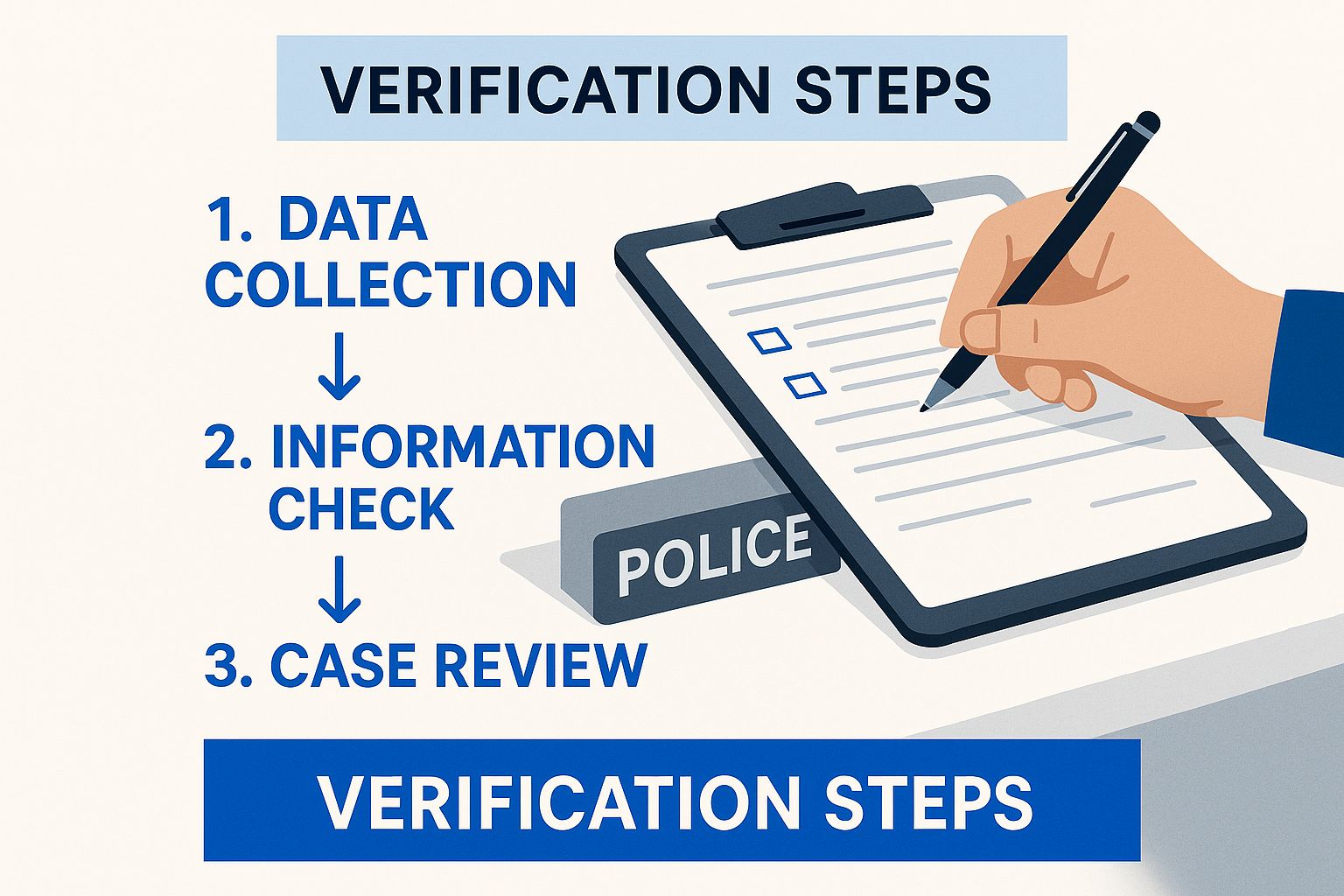
This structured approach is designed to ensure every detail is double-checked before the final report is created.
After a successful visit, the officer drafts and sends the Police Verification Report (PVR) back to the passport office. The status of this report—whether it’s marked as “Clear,” “Adverse,” or “Incomplete”—is what decides the fate of your application. A “Clear” PVR is the green light for your passport to be printed and sent out.
The PVR is the official thumbs-up from the police, confirming that your identity, address, and background have all checked out. A positive report is the final hurdle you need to clear before your passport is approved.
This whole verification step is a major reason why getting a passport can sometimes take a while. When a police check is required, it can stretch the total processing time to anywhere between 30 and 45 days.
This kind of official confirmation isn’t just for passports, either. Many other situations require a similar background check. For instance, if you’re moving abroad for work, understanding how to get a UAE Police Clearance Certificate involves a very comparable verification process to prove a clean record.
Pre-Verification vs Post-Verification Unpacked
One of the biggest points of confusion for passport applicants is the timing of the police check. Does it happen before you get your passport, or after? The answer depends entirely on your application type and falls into two main categories: Pre-Issuance Verification and Post-Issuance Verification.
Figuring out which one applies to you is key, as it directly impacts when you can expect to hold your passport in your hands.
Pre-Issuance Verification: The Standard Route
For most first-time applicants, the default path is Pre-Issuance Verification. Just like the name suggests, the police must complete their check and submit a “Clear” report before your passport is even approved for printing.
This is the most secure and common method. The passport office essentially waits for the green light from the local police, making sure all your details are confirmed and your record is clean from the get-go. No surprises, no last-minute issues.
Post-Issuance Verification: The Fast Track
In contrast, Post-Issuance Verification is more of an exception than the rule. It’s usually reserved for specific cases, like certain passport renewals or applications submitted under the Tatkal scheme. With this method, the passport is issued to you first, and the police verification happens afterward.
This approach can dramatically speed up the process of getting the passport, but it comes with a serious string attached.
Think of it as getting your passport on trust. The authorities issue it with the understanding that this trust will be validated later. If the police verification comes back with an “Adverse” report, that trust is broken.
The consequences are severe. Your passport can be revoked immediately, and you might face penalties or even be barred from reapplying for a while.
Comparing Pre-Issuance and Post-Issuance Verification
To make it clearer, here’s a breakdown of when your police verification will happen and what it means for your passport delivery.
| Feature | Pre-Issuance Verification (Before Passport) | Post-Issuance Verification (After Passport) |
|---|---|---|
| Who It’s For | Most new applicants and some renewal cases. | Tatkal applicants and specific renewal/re-issue cases. |
| Passport Delivery | Passport is issued only after a “Clear” police report. | Passport is issued first, and verification follows. |
| Risk Factor | Low risk; issues are sorted out before issuance. | High risk; a failed check leads to passport revocation. |
Ultimately, while the post-issuance route is tempting because it’s faster, pre-issuance is the most straightforward and risk-free path for the vast majority of citizens. It ensures everything is in order before the final document is printed.
How the mPassport App Is Modernizing Verification
The days of police verification being a painfully slow, paper-driven process are finally coming to an end. The introduction of modern tools, especially the mPassport Police App, is completely changing how this crucial security step is handled.
This shift from manual paperwork to a digital workflow is making the entire experience faster and more transparent for everyone involved. Think about the old system: a physical file travelling slowly from the passport office to the local police station. Now, the mPassport app lets the Passport Seva Kendra (PSK) send verification requests to the police almost instantly. Your file lands on the correct officer’s digital desk, cutting out the old physical transit delays.
A Digital Workflow from Start to Finish
This new approach puts the entire process right in the hands of police officers via a tablet. They get your details, schedule the visit, and—most importantly—can capture and upload their verification report directly from your location or their station. This small change has a huge impact, as it removes the need to go back to an office just to file paperwork, which used to add significant administrative lag.
This digital overhaul brings a few major improvements:
- Real-Time Updates: The system allows for instant communication between the police and the passport office.
- Paperless Process: It drastically cuts down on manual data entry and the risk of human error that comes with it.
- Increased Transparency: Applicants can often track the status of their verification with far more accuracy than before.
This isn’t just about convenience; it’s a fundamental upgrade to a government process, making it more efficient and accountable. It ensures verifications are done and reported with both speed and precision.
The results are already clear. With the app’s integration, police stations can digitally receive and process requests, often within 24-48 hours of an application’s submission. This has helped slash the waiting period from an average of 30-45 days down to just 5-7 days in many areas. You can read more about how these new passport rules are changing the timelines.
This principle of using technology to confirm details is a cornerstone of modern security checks. In the same way, businesses today rely on robust digital tools for secure identity verification to be certain about who they are hiring.
Your Questions on Passport Verification Answered
Going through the passport application process can bring up a lot of questions, especially when you get to the police verification stage. This section will walk you through the most common queries we see, giving you straight answers to help you navigate this step confidently and sidestep any potential headaches.
What Documents Are Needed for the Police Verification Visit?
When the police officer comes to your home, your main job is to show them your original documents. This isn’t the time for just photocopies; the officer needs to see the genuine articles to confirm the details you provided in your application.
Be ready with your key proofs:
- Proof of Address: This could be your Aadhaar card, a recent utility bill (like electricity or water), a rental agreement, or even a current bank statement that shows your address.
- Proof of Identity and Date of Birth: Your PAN card, voter ID, or original birth certificate are the usual go-to documents for this.
It’s always smart to have a clear set of photocopies ready as well. The officer might need to take them for their official records.
What Should I Do If I Miss the Police Officer’s Visit?
Missing the officer’s visit might feel like a big problem, but it’s usually simple to sort out if you act quickly. In most cases, the officer will try calling you or might leave a note with their contact information. Your best move is to call them or your local police station immediately, explain what happened, and reschedule the visit.
The worst thing you can do is ignore a missed visit. This can lead to an “Adverse” or “Incomplete” report, which will stall your application and could even get it rejected. Proactive communication is everything when it comes to getting things back on track.
How Can I Track My Police Verification Status?
Yes, you can absolutely keep tabs on your verification status online. The official Passport India website has a “Track Application Status” feature. Once the police officer finishes their visit and submits the Police Verification Report (PVR), the status on the portal will change. You’ll usually see a message like “Police Verification Report has been submitted,” confirming that this crucial step is done.
After your passport is sorted and verification is complete, you can start planning those international trips. The next step is always to check the specific entry rules for your destination, like the UK Visa Requirements, to ensure your travel is hassle-free.
Does a Police Verification Report Expire?
A Police Verification Report (PVR) is created for one purpose only: your current passport application. It doesn’t have a separate validity period that you can carry over to future applications. Think of it as a snapshot in time, validating your identity and address at that specific moment. When you renew your passport down the line, a new verification will almost certainly be needed, especially if you’ve moved since your last application.
At SpringVerify, we understand the importance of accurate and timely verification. Our advanced background screening services help companies make informed hiring decisions with confidence, ensuring a secure and efficient process.


