

Police verification is an official process designed to confirm a person’s identity, address, and, most importantly, their criminal history. It serves as a crucial security check for both government agencies and employers, ensuring an individual is who they claim to be and doesn’t have an adverse police record. In India, this process is a mandatory step for many official procedures.
Table of Contents
What Is Police Verification and Why It Matters
Think of police verification as an official stamp of trust that validates someone’s background. It’s much more than a simple formality; it’s a foundational security measure used when issuing a passport, onboarding a new employee, or even approving a tenant for a rental property. Without it, the risk of fraud, identity theft, and other security threats would be significantly higher.
This check is requested by all sorts of organisations, from government passport offices to private-sector HR departments. The shared goal is always the same: to establish trust. In modern India, it has become a fundamental step in many of our most important personal and professional milestones.
The Core Goals of Verification
The entire verification process is built around three primary objectives. Each one helps paint a clear and reliable picture of an individual’s background, making the check both thorough and purposeful.
- Identity Confirmation: The first step is to verify that personal details like your name and date of birth match official government-issued documents, such as your Aadhaar or PAN card.
- Address Validation: This is a crucial part of the process. A police officer will physically visit the address you’ve provided to confirm that you actually live there. This “field visit” is key to preventing the use of false addresses.
- Criminal Record Check: Authorities will search police databases for any criminal cases, FIRs, or other adverse reports associated with your name. This is absolutely vital for assessing risk, especially in an employment context.
To get a clearer sense of what’s involved, let’s break down the key components that make up a typical police verification.
Key Components of Police Verification
| Verification Component | What Is Checked | Why It Matters |
|---|---|---|
| Identity Verification | Cross-references name, date of birth, and other personal details against official IDs (Aadhaar, PAN, etc.). | Confirms the person is who they claim to be, preventing identity fraud. |
| Address Verification | A physical visit by a police officer to the applicant’s stated current and/or permanent address. | Ensures the individual can be located and is not using a fake address to evade scrutiny. |
| Criminal Record Check | Searches local and national police databases for any First Information Reports (FIRs), charges, or convictions. | Identifies potential risks associated with hiring someone with a criminal history. |
Ultimately, this table shows how each piece of the verification process works together to create a reliable and comprehensive background profile.
Police verification is fundamentally a risk mitigation tool. Its purpose is to create a secure environment by confirming that an individual’s identity and character are aligned with the information they have provided, protecting both organisations and the public.
For many official processes, this check is indispensable. When you apply for a passport, for instance, the Ministry of External Affairs works with local police to expedite the verification. This typically takes anywhere from 3 to 21 days, depending on the state and whether your application is normal or Tatkaal. This procedure involves local police confirming an applicant’s credentials through document cross-checks and that all-important field visit. You can discover more insights about the state-wise verification timelines on authbridge.com.
Navigating the Police Verification Process Step-by-Step
Understanding what police verification is is one thing, but knowing how the process actually plays out is what truly matters. The whole journey can feel a bit complex from the outside, but it follows a surprisingly structured and predictable path. Let’s break it down into clear, manageable steps, so you know exactly what to expect from start to finish.
The process kicks off the moment an official request is made. This could be triggered by your passport application, a new job offer, or even a rental agreement. As the applicant, you’ll start by submitting the necessary application form along with your supporting documents.
Once submitted, that request is formally sent to the police department with jurisdiction over your address. This routes the task to the specific local police station responsible for your neighbourhood, ensuring the check is handled by officers who are familiar with the area.
The Field Visit and Document Check
This is where things get real. After receiving the request, the station assigns a dedicated officer to your case. Their main job is to conduct the ‘field visit’—without a doubt, the most crucial phase of the process. The officer will physically visit your provided residential address to confirm that you actually live there.
Don’t worry, this isn’t a surprise raid. You’ll typically be informed about the visit ahead of time. Your job is simple: be prepared. Having all your documents ready is the key to making this go smoothly and quickly.
You should have the following original documents (and a set of photocopies, just in case) on hand:
- Proof of Identity: Your Aadhaar Card, PAN Card, or Voter ID.
- Proof of Address: Recent utility bills (like electricity, water, or gas), a registered rent agreement, or bank passbook statements.
- Passport-Sized Photographs: It’s always a good idea to keep a few recent photos ready.
This simple infographic shows how the request moves from you to the police and back again, making the whole workflow easier to visualise.
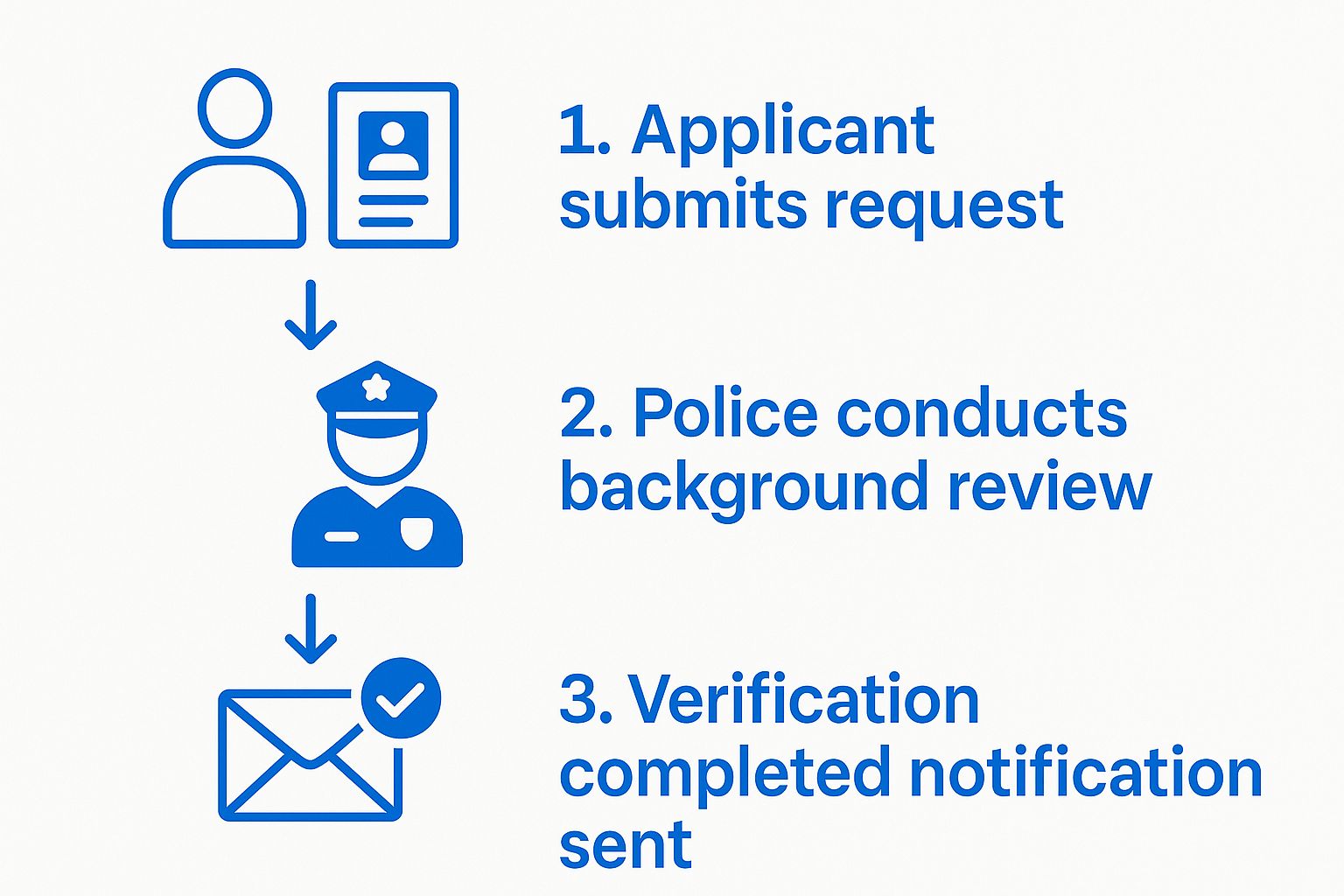
As you can see, the three distinct stages make the entire procedure much less intimidating. For many people, especially those applying for a passport, the journey begins on an official government portal.
Final Report and Tracking Your Status
After the field visit is complete, the officer puts together their findings in a final report. This report will have one of two outcomes:
Clear Report: This is the green light. It means your identity, address, and criminal record check were all successfully verified with no red flags.
Adverse Report: This means a problem was found. It could be a discrepancy like an incorrect address, a mismatch in your documents, or, more seriously, a criminal case discovered in police records.
This final report is then sent back to the authority that requested it, whether that’s the Regional Passport Office or an employer’s background screening partner. Thankfully, most modern systems, like the Passport Seva portal, let you track your application’s progress online. This transparency helps you stay in the loop, know which stage your verification is in, and see the final outcome. For a closer look at what’s involved in specific checks, you can learn more about passport verification and its unique requirements.
Comparing Passport and Employment Verifications
When you hear the term “police verification,” you might think of one single process. The reality is that it’s not a one-size-fits-all check. The two most common times you’ll run into it are when applying for a passport and during a pre-employment background check. While they share a name, they serve very different purposes.
Knowing the distinction is crucial for setting the right expectations, whether you’re a job candidate or an HR manager.
The Core Difference: Government Mandate vs. Corporate Policy
Getting a passport involves a police verification that is a mandatory government requirement. It’s handled directly by local police through the Passport Seva system. Think of it as a fundamental step in national security—the government needs to confirm your identity and where you live before handing you an official travel document.
On the other hand, a police verification for a job is an employer-led initiative. It’s not required by law for most roles but is a vital part of a company’s internal risk management. Organisations use these checks to make sure they’re hiring trustworthy people and to protect the workplace from potential fraud or other issues.
Passport verification is a public safety protocol tied to a government service. Employment verification is a corporate security measure for due diligence. One protects the nation, the other protects the business.
The scale of government verifications is massive. Just look at the Passport Seva Project’s recent data: in a single week, it processed 264,998 police clearance certificate (PCC) applications and issued 216,251 passports. This sheer volume highlights its role as a core government function.
These verifications even have their own timelines and types:
- Pre-verification: The standard check done before a passport is issued.
- Post-verification: Often used for Tatkaal (expedited) applications, where the check happens after you’ve received the passport.
Passport Verification vs Employment Verification
So, what are the key differences you need to know? This table breaks it down clearly.
| Aspect | Passport Verification | Employment Verification |
|---|---|---|
| Purpose | To confirm identity and address for a national travel document. | To assess a candidate’s suitability for a role and mitigate risk. |
| Authority | Government-mandated; carried out by state police. | Employer-initiated; often handled by specialised third-party agencies. |
| Urgency | Varies; can be fast-tracked with Tatkaal applications. | Depends entirely on the company’s hiring timeline and need. |
| Scope | Strictly focuses on address confirmation and checking for criminal records. | Can be much broader, often including past employment verification and education checks. |
At the end of the day, both processes are about building trust through confirmation. For businesses, a solid screening process is an non-negotiable part of modern hiring.
And remember, verification is just one piece of the puzzle. The hiring journey also involves legal paperwork, where automation is becoming more common, like when creating employment contracts with AI. This shows how background checks fit into a much larger, more sophisticated HR workflow.
Understanding Your Rights During Verification
Let’s be honest, having a police officer show up for a verification check can feel a bit invasive. It’s completely natural to feel that way. That’s why it’s so important to know your rights. When you understand what an officer can and cannot ask, you can navigate the process with confidence, ensuring everything stays professional and above board.
Your rights are primarily centred on privacy and data protection. A verification officer has a very specific job: confirm your identity, verify your address, and check for a criminal record. That’s it. They are well within their rights to ask for official documents like your Aadhaar card, proof of residence, or other papers directly related to the check.
But their authority has clear limits. You are under no obligation to share personal information that has nothing to do with their objective. This includes things like your social media passwords, bank account details, or your personal beliefs. It is perfectly acceptable and within your rights to politely decline such requests.
When an Adverse Report Is Wrong
Getting an ‘adverse’ or ‘negative’ report is stressful, especially when you know it’s a mistake. It could be something as simple as a clerical error, an old address still on file, or a case of mistaken identity. The good news is, you absolutely have the right to challenge it.
If this happens, the key is to act fast. Don’t just let it sit.
- Contact the Issuing Authority: Get in touch with whoever requested the verification—be it the Regional Passport Office (RPO) or your employer’s HR team. They can tell you the official steps for filing a dispute.
- Gather Your Evidence: Pull together all the documents that prove the report is wrong. This could be an updated address proof, court papers showing a case was dismissed, or ID proof to clear up a name mix-up.
- Submit a Formal Appeal: Follow the official procedure to submit your appeal along with all your supporting evidence. Make sure your communication is clear, to the point, and professional.
An adverse report isn’t the end of the story. Think of it as an initial finding that you can appeal with the right paperwork. Being proactive is the best way to get any inaccuracies corrected.
The fairness of what is police verification is directly tied to the broader issue of police accountability. For instance, reports showed that between 2018 and 2022, over 96% of deaths in police custody in Gujarat happened within 24 hours of arrest. Statistics like these underscore why transparency in all police interactions is so vital. You can learn more by exploring the full report on policing in India.
For businesses, making sure the verification process is fair means staying on top of all the legal rules. To get a better handle on the legal side of things, check out our detailed guide on HR compliance in India, which covers the framework for background checks and employee onboarding.
Why Police Verification Is a Smart Business Move
For any business, hiring is about more than just filling a seat; it’s about building a team you can trust. This is where police verification stops being a simple procedural step and becomes a sharp business decision. Think of it as a proactive measure, a crucial line of defence for your company’s most valuable assets.
By weaving police verification into your hiring process, you’re not just ticking a box. You’re actively shielding your business from a whole host of internal risks. It helps you spot candidates whose history might pose a threat to your company’s financial stability, data security, or even the general workplace atmosphere. It’s an essential filter in your risk management strategy.
Protecting Your Company and Reputation
A thorough verification does much more than just confirm a clean record; it actively safeguards your entire organisation. The damage a single bad hire can cause is staggering, affecting everything from team morale to your public image.
Making this check a standard part of your process sends a powerful message. It signals to every applicant that your company takes security and integrity seriously. This alone can deter individuals who are trying to hide a fraudulent past or have malicious intentions. This simple step can help you prevent serious issues like:
- Insider Threats: Employees with access to sensitive company data who might be tempted to exploit it for personal gain.
- Corporate Espionage: Individuals hired under false pretences specifically to steal your intellectual property or trade secrets.
- Financial Loss: Fraudulent activities that can drain your company’s resources and lead to significant monetary damage.
At its core, investing in proper background checks is an investment in your company’s long-term health and stability.
A single problematic hire can cause irreparable harm to a company’s reputation. Police verification is not an expense; it’s an insurance policy against preventable financial and reputational disasters.
Safeguarding Sensitive Information
In nearly every business, employees handle sensitive data—from customer details to internal financial records. A key part of responsible hiring, especially for businesses today, involves mastering the security of documents to protect this sensitive personal data. Ensuring the people you bring on board have a trustworthy background is absolutely critical to preventing data breaches that originate from within.
This verification confirms that a candidate has been vetted by an official authority, which gives you an extra layer of confidence. It provides assurance that the person joining your team has no recorded history that would make them a liability. This helps you maintain a secure environment and, just as importantly, protects the trust your customers place in you. That makes it a truly smart business move.
Got Questions About Police Verification? We’ve Got Answers
Even when you think you understand the police verification process, specific real-world questions always pop up. The details can feel a bit overwhelming, so let’s cut through the confusion and tackle the most common queries head-on.
Getting a handle on these points can be the difference between a smooth, fast process and one filled with stress and delays.
How Long Does Police Verification Usually Take?
This is the big one, the question on everyone’s mind. And the honest answer is: it depends. There’s no single, fixed timeline for police verification across India. The time it takes can swing wildly based on a few key factors, making it tough to pin down an exact date.
For passport applications, the Ministry of External Affairs sets a guideline of 21 days for a normal application, but think of it as a goal, not a guarantee. Some cities and states are known for being quicker, while others might take longer because of heavy caseloads or administrative backlogs. Tatkaal applications often flip the script with post-verification (after the passport is issued) just to speed things up. For job-related checks, the timeline is really up to the company and its background screening partner.
What Happens If I Miss the Police Verification Visit?
It happens. You step out for a few minutes, and that’s exactly when the officer arrives. Missing the field visit can definitely complicate things, but it’s not a disaster if you act fast. When an officer can’t find you at home, they’ll file a report saying you weren’t available at the given address.
This usually flags your application with an ‘incomplete’ or ‘adverse’ status.
A missed visit isn’t an automatic failure, but it does mean the ball is now in your court. You have to be proactive and follow up to get things back on track.
Here’s what you should do to fix it:
- Contact Your Local Police Station: Don’t wait around. Call the police station that covers your address, explain what happened, and ask how to reschedule the visit.
- Visit the Station in Person: More often than not, you’ll need to go to the station with all your documents. This shows you’re taking it seriously and are eager to cooperate.
Ignoring a missed visit is the worst thing you can do—it will almost certainly lead to your application being rejected. Prompt communication is everything.
Can a Minor Offence Cause a Negative Report?
This is a huge source of anxiety for many people. The good news is that not every brush with the law automatically leads to a negative report. The impact really depends on the seriousness of the offence.
The police officer’s job is to report any criminal cases they find in their records. The final call, however, usually lies with the authority that requested the check (like the Regional Passport Office).
- Serious Offences: Things like major crimes, active court cases, or any conviction that raises red flags about your character will almost certainly result in an adverse report.
- Minor Offences: A small traffic violation or a petty offence that was settled without a conviction might not be seen as a big deal, especially if it was a long time ago.
The key here is honesty. If you have a minor incident in your past, it’s far better to be ready to explain it than to cross your fingers and hope it goes unnoticed.
What Documents Do I Need for Police Verification?
Being prepared is the single best way to ensure a hassle-free verification. When you have everything organised and ready to go, it shows the officer you’re cooperative and helps them do their job quickly and efficiently.
Here’s a simple checklist of documents you should have ready (keep both the originals and a set of clear photocopies):
- Proof of Identity: An Aadhaar Card is the top choice, but a Voter ID or PAN Card will also work.
- Proof of Current Address: This is critical. Use recent utility bills (like electricity, water, or phone), a valid rent agreement, or your bank passbook showing your current address.
- Proof of Date of Birth: Your birth certificate or your Class 10 mark sheet are the standard go-to documents.
- Passport-Sized Photographs: Always have a few recent, clear photos on hand.
Having these items ready makes the officer’s visit quick and painless, seriously boosting your chances of getting a ‘clear’ report without any headaches.
Navigating background checks is a critical step in building a trustworthy team. For companies looking to make this process seamless, accurate, and fast, SpringVerify offers comprehensive solutions that integrate directly into your hiring workflow. From ID checks to employment history, we help you make informed decisions with confidence. Learn more about how we can support your growth at https://in.springverify.com.


