

A job screen test is that first hurdle in the hiring process. It’s an initial evaluation employers use to sort through a massive pile of applications, helping them quickly spot the candidates who have the essential skills for the role.
Think of it as the first audition. It’s designed to make recruitment more efficient before anyone commits to a full, in-depth interview. This crucial first step ensures that only the most promising people move forward.
Table of Contents
What Is a Screen Test and Why Does It Matter?
Imagine a film director casting a lead role. Before calling actors in for a full-blown audition, they’ll ask for short video submissions. This lets them see who has the basic look and feel for the part without spending days in a casting room. A screen test for a job works exactly the same way. It’s a quick, practical method for hiring managers to sift through hundreds of applications and focus their energy on the real contenders.
In today’s competitive job markets, where a single opening can attract an overwhelming flood of CVs, this initial filter has become an absolute necessity. By using these assessments, companies are building a more structured and objective evaluation process right from the get-go.
The Purpose Behind the Process
At its core, a screen test is all about measuring a candidate’s fundamental abilities against what the job actually demands. It goes way beyond what a CV can tell you, offering tangible proof of a person’s skills. And honestly, it benefits everyone involved.
For employers, the advantages are clear:
- Massive Time Saver: Quickly shortlisting the most promising candidates frees up countless hours and resources.
- Fairer Playing Field: Standardised tests help reduce unconscious bias, giving every applicant a fair shot to prove what they can do.
- Higher Quality Hires: When you only interview candidates who have already demonstrated their basic competence, you’re far more likely to make a great final decision. For more on optimising your hiring, check out our guide to modern human resources.
Here in India, screen tests are becoming more and more common, especially in the IT and tech worlds. The push is to automate the initial screening, with around 36% of companies now using AI to analyse CVs to improve both efficiency and diversity. For candidates, these tests offer a straightforward chance to show off their skills, making sure they’re judged on what they can actually do, not just what’s on paper.
The Purpose of Screening From Both Sides of the Table
To really get what a job screen test is all about, you have to look at it from two different perspectives: the company hiring and the person applying. For both, these initial checks serve a massive purpose. They turn the often chaotic hiring process from a guessing game into a more structured, evidence-based exercise.
Think of it as a crucial first step that balances efficiency for the company with a fair opportunity for the candidate.
From the company’s point of view, the biggest driver is simple: efficiency. When a single job ad can pull in hundreds, sometimes thousands, of applications, sifting through every single CV is a monumental task. It’s a huge drain on time and resources.
Screening tests act as a powerful filter, quickly identifying the people who have the core skills needed to actually do the job. This lets hiring managers focus their valuable time on a much smaller, highly qualified pool of candidates.
Beyond just saving time, this standardised approach genuinely improves the quality of people they hire. By setting a consistent benchmark for everyone, companies can make more objective, data-driven decisions. It helps push aside the unconscious bias that can easily creep in when you’re just relying on a CV or a first impression.
A Fair Chance for Candidates
Now, let’s flip the coin. For job seekers, these tests are a huge plus, even if they seem a bit daunting at first. A screen test is your chance to show what you can actually do, showcasing practical skills that a traditional CV can never fully capture.
It allows your abilities to speak for themselves.
Maybe your work experience isn’t from a big-name company, or perhaps your CV formatting isn’t perfect. A strong performance on a skills assessment can launch you ahead of the competition. It’s a direct path to prove you’re the right person for the job, based purely on your talent.
Screen Test Benefits for Employers vs Candidates
So, how do these advantages stack up side-by-side? While the goals are different, both employers and candidates find real value in a well-structured screening process. It creates a more transparent and effective system for everyone involved.
Here’s a quick breakdown of the benefits for each party:
| Benefit | For Employers | For Candidates |
|---|---|---|
| Efficiency | Drastically cuts down the time spent reviewing unsuitable applications, speeding up the hiring cycle. | Provides a quicker path to the interview stage if skills match, avoiding a long wait. |
| Objectivity | Creates a level playing field with standardised evaluations, reducing hiring bias. | Offers a fair shot to demonstrate skills, regardless of CV prestige or background. |
| Quality | Ensures candidates have the proven, essential skills required before the interview stage. | Allows them to showcase practical talents that a resume can’t fully express. |
| Clarity | Gives a clear, data-backed reason to advance certain candidates over others. | Provides a clear understanding of the core skills the employer values most for the role. |
Ultimately, a good screening test aligns the interests of both the company and the applicant. It ensures the business invests its time in the right people, while giving every candidate a fair chance to prove they have what it takes.
Understanding the Common Types of Job Screen Tests
Not all screen tests are the same. Just as a carpenter has a specific tool for every job, employers use different screening methods to measure different skills and qualities. Understanding what a job screen test involves really means knowing which type you’re likely to come up against.
Most companies use a multi-step process, often kicking things off with an automated review before moving on to more specific, hands-on assessments. This approach helps them build a complete picture of what a candidate can really do.
This visual gives you a good idea of the typical journey a candidate goes through during the screening process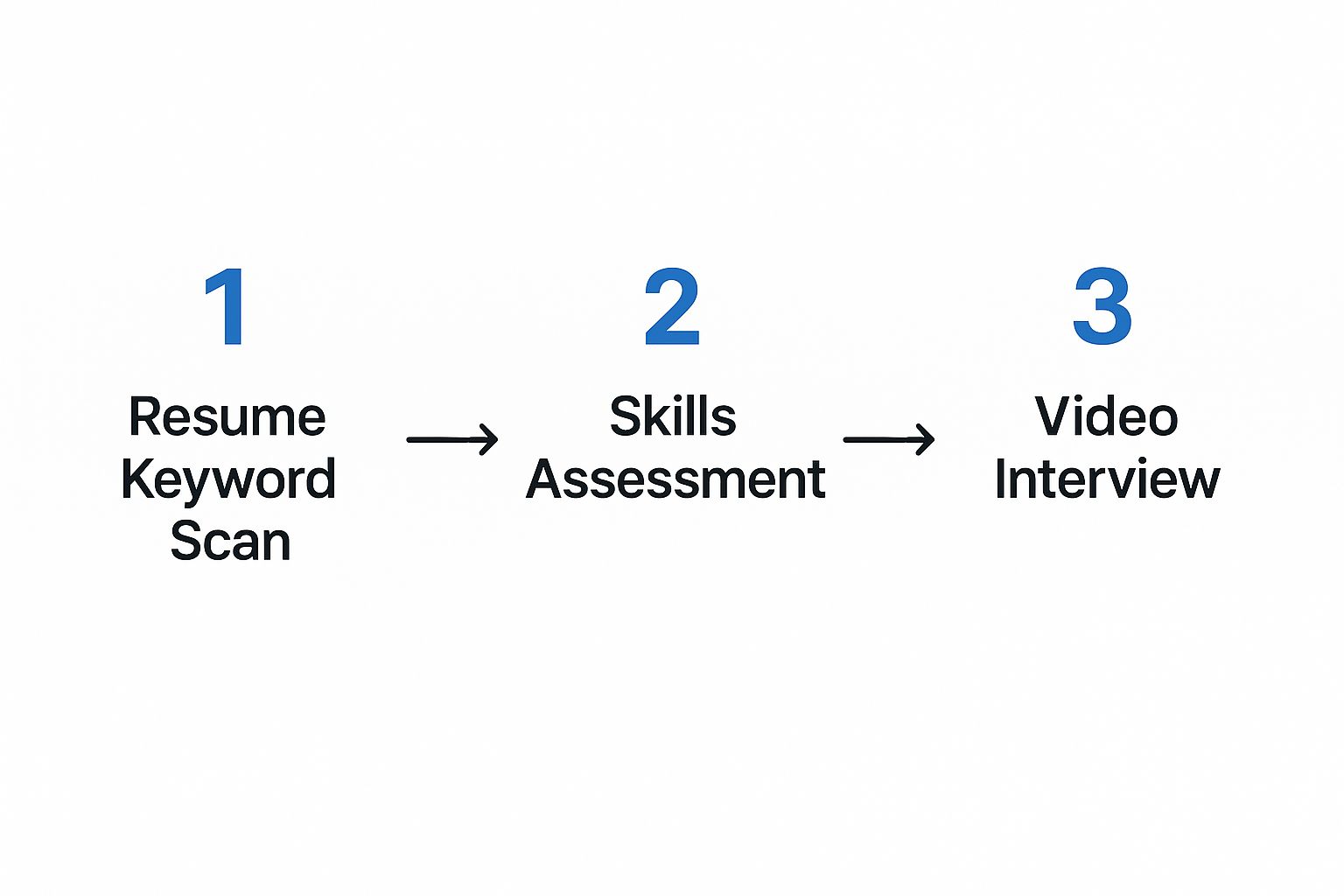
As you can see, the funnel moves from wide, general filtering down to very specific skill checks, making sure only the most suitable people move forward.
Automated Resume and Application Screening
The very first gatekeeper you’ll likely meet isn’t a person at all—it’s an Applicant Tracking System (ATS). This is software that automatically scans your CV for specific keywords, skills, and experiences that match what’s in the job description. It’s a simple efficiency tool for companies drowning in applications.
Think of it like a digital bouncer at a club. If your CV doesn’t have the right “credentials” (in this case, keywords), you’re not getting past the velvet rope to a human reviewer. This is precisely why tailoring your CV to each job ad is so critical.
Skills and Technical Assessments
If you make it past the ATS, you’ll probably face a practical test next. These are designed to directly measure your ability to perform the actual duties of the role.
- For technical roles: This could be anything from a live coding challenge to a data analysis problem or a system design task.
- For creative roles: You might get asked to write a short article, create a small design, or edit a quick video.
- For administrative roles: This might involve a typing speed test or completing a task in a spreadsheet programme.
These tests offer concrete proof of your skills, taking you beyond the claims on your CV. Many organisations also run background checks at this stage to confirm your credentials. Getting familiar with the essentials of employment verification can help you prepare for this part.
Behavioural and Cognitive Tests
Beyond your hard skills, employers want to understand how you think, solve problems, and work with others. This is where behavioural and cognitive tests come into play.
Cognitive ability tests are designed to measure your problem-solving, critical thinking, and learning capabilities. They don’t test your knowledge on a specific topic but rather your raw intellectual horsepower.
Personality assessments, on the other hand, are all about gauging your work style, what motivates you, and how well you might fit into the company culture. While there are no right or wrong answers, these tests help employers predict how you’ll behave on the job. For more on how AI is shaping these tests, you can find great insights from Parakeet AI’s blog.
Hiring data in India shows just how these tests are used. Candidates with 1 to 5 years of experience make up 47% of new hires, while freshers account for about 14%. This tells us that screen tests aren’t just for filtering out people; they’re also a key tool for spotting potential in professionals at the start of their careers.
Navigating the Screening Process Step by Step
So, what does this whole screening process actually look like from your side of the screen? It’s a lot less mysterious when you see the entire journey laid out. Let’s walk through it, from the moment you hit ‘apply’ to the first real conversation with a human. Think of it as a roadmap that shows you exactly where you are in the hiring funnel.
Your adventure kicks off the second you submit your application. But it doesn’t just land in a recruiter’s inbox. The first stop is usually an Applicant Tracking System (ATS). This software is the digital gatekeeper, scanning your CV for specific keywords and qualifications that match the job description. Only the applications that tick these initial boxes get to pass through.
From Automation to Assessment
If your CV impresses the ATS, you’ve made it to the next stage. This typically means you’ll get an email inviting you to an automated test. This email is a great sign—it means you’ve officially moved from the massive longlist to a much more focused group of candidates.
The invitation will give you the lowdown: what kind of assessment it is, roughly how long it’ll take, and the deadline to get it done. This is where you’ll face the core of the screen test, whether it’s a coding challenge, a problem-solving quiz, or a one-way video interview. You complete it on your own time, and the system scores your performance based on pre-set rules.
The whole point of this automated phase is to create an objective, data-driven shortlist. It strips away initial human bias and makes sure every single candidate is measured against the exact same yardstick before a recruiter invests their time.
The Human Review and Final Outcome
Once the automated scores are tallied up, a real person finally enters the picture. A recruiter will review the results of the top performers, looking beyond just the numbers. They’re adding a human layer of context, considering how your performance and profile align with the wider needs of the role and the team.
Based on this combined review, the final shortlist gets decided. From here, you’ll get one of two notifications. The first is a polite rejection letting you know you didn’t quite hit the mark for this role. The second, and the one we’re all hoping for, is an invitation for a proper interview. This marks your successful jump from the screening phase to the next big stage of the hiring process.
How to Prepare for and Pass Your Screen Test
Getting through a job screen test isn’t about crossing your fingers and hoping for the best. It’s about smart, focused preparation. With a solid plan, you can walk into any assessment feeling confident and ready to show them what you’ve got.
Think of yourself as a detective cracking a case. Your first and most important clue is the job description. Read it, then read it again. Highlight every single skill, tool, and responsibility they mention. This document is your treasure map, pointing directly to what the employer values most and will almost certainly test you on.
Dissect and Strategise
Once you’ve got a handle on the job description, it’s time to do some digging into the company’s hiring process. A quick search on employee review sites or professional networks can be incredibly revealing. Do they favour timed coding challenges? Take-home assignments? One-way video interviews?
Knowing what’s coming takes a huge amount of stress out of the equation and lets you channel your energy into practising what matters. This isn’t about boiling the ocean; it’s about targeted, efficient preparation that’s relevant to this specific opportunity.
Your goal isn’t just to finish the test. It’s to demonstrate that you’re proficient and that you truly understand what the role demands. Good preparation turns a nerve-wracking hurdle into a golden opportunity to prove your worth.
Create Your Success Environment
With your research done, the final step is to set the stage for a great performance. For any kind of timed or video-based test, your environment can make or break your chances.
Here’s what to focus on:
- Find a Quiet Space: Make sure you won’t be interrupted. Give your family or flatmates a heads-up that you need some uninterrupted focus time.
- Check Your Tech: Test your internet connection, webcam, and microphone long before the test starts. The last thing you need is a technical glitch adding to the pressure.
- Gather Your Tools: Have any notes, software, or resources you might need open and ready to go before the clock starts ticking.
Time management during the test is also crucial. If you can, scan through all the questions at the beginning to get a feel for what you’re up against and plan how to spend your time. For more general tips on performing well under pressure, it’s always a good idea to improve your test-taking skills.
To bring it all together, here’s a simple checklist to run through before any screen test.
Candidate Preparation Checklist for a Job Screen Test
| Preparation Step | Key Actions | Why It’s Important |
|---|---|---|
| Analyse the Job Description | Identify and list all required skills, tools, and qualifications mentioned. | This tells you exactly what the employer is looking for and what they’re likely to test. |
| Research the Company | Look up the company’s typical interview process on platforms like Glassdoor or LinkedIn. | Knowing the format (e.g., timed test, take-home project) helps you practise effectively. |
| Practise Relevant Skills | Complete practice problems, mock interviews, or small projects related to the role. | Builds confidence and muscle memory, so you’re not figuring things out under pressure. |
| Set Up Your Environment | Find a quiet, well-lit space. Inform others not to disturb you. | Minimises distractions and allows you to focus completely on the task at hand. |
| Test Your Technology | Check your internet, camera, microphone, and any required software beforehand. | Prevents last-minute technical panics that can throw you off your game. |
| Gather Necessary Materials | Have a notepad, pen, water, and any permitted resources within easy reach. | Avoids wasting precious time searching for things once the test has started. |
| Review Test Instructions | Carefully read all instructions, including time limits and submission guidelines. | Misunderstanding the rules is an easy way to lose points and make a poor impression. |
By preparing both your strategy and your physical space, you give yourself the best possible chance to perform at your peak and truly shine.
Designing Effective Screen Tests for Employers
When you’re a hiring manager, putting together a screen test is about more than just weeding out candidates. It’s one of the first real touchpoints someone has with your company, so it needs to be fair, relevant, and leave a positive impression. The best screening processes are built with purpose, making sure every single step reflects what the job is actually about and respects the candidate’s time.
The absolute cornerstone of a great screen test is job relevance. Every question, task, or scenario you create has to directly connect to a core part of the role. Giving a generic logic puzzle to a graphic designer, for example, tells you almost nothing useful. A much smarter approach is a small, practical design task that gives you a genuine glimpse into their skills and how they tackle their work.
Creating a Positive Candidate Experience
Don’t forget, the screening process is a window into your company culture. Clear and concise instructions are completely non-negotiable. If things are confusing, you’ll just cause frustration, and you risk losing great candidates before you even get to speak to them.
A well-designed screen test does two things at once: it effectively checks for the right skills while showing that the employer is organised, fair, and respectful. This first interaction can seriously influence whether a top candidate says “yes” to an offer down the line.
Mixing up your methods will give you a much more rounded view. You could pair a quick skills assessment with a short one-way video interview to get a feel for their communication style. This kind of multi-faceted approach stops you from relying too heavily on one piece of data and helps you build a more complete picture of each candidate. It’s also vital to stay on top of the legal side of things; understanding your responsibilities around hiring compliance is key to building a fair and defensible process.
Refining and Improving Your Process
The hiring world doesn’t stand still, and your screening methods shouldn’t either. In India, for instance, the explosive growth of Global Capability Centres (GCCs) has really dialled up the competition for talent. With over 1,600 GCCs now acting as major innovation hubs, screen tests have become crucial for checking both technical abilities and how well a candidate might fit into these fast-paced environments.
You should be regularly checking how well your tests are actually working. Are they good predictors of on-the-job performance? Are people actually completing them? A simple but powerful step is to ask new hires for feedback on their experience. Their insights are gold, helping you tweak and improve your process for even better results next time.
Got Questions About Job Screen Tests? We’ve Got Answers
If you’re diving into the modern hiring pool, you’ve probably got questions. Whether you’re a candidate facing a screening test or an employer thinking about using one, some queries pop up more often than others. Let’s tackle them head-on.
How Long Does a Typical Screen Test Take?
There’s no single answer here—it really depends on the type of test. An automated CV screen, for instance, is over in a flash.
Practical skills tests are a different story. A short cognitive assessment might only take 20 minutes, but a complex coding challenge could easily run over 90 minutes. Then you have one-way video interviews, which usually land somewhere in the middle, typically taking 15 to 30 minutes to complete.
Any company worth its salt will be upfront about this. They should always clearly state the expected time commitment right in the test invitation email.
Can I Ask for Feedback on My Screen Test Performance?
You can always ask, but honestly, it’s pretty rare to get detailed feedback on automated screening tests. Think about it from the company’s perspective: they’re dealing with a huge volume of applicants at this early stage. Giving individualised feedback just isn’t a scalable or practical option for most.
However, if you make it through to the later interview stages where you’re talking directly with the hiring team, that’s a much better time to ask. At that point, feedback is far more appropriate and often provided.
A well-designed screen test is a strong predictor of on-the-job capability. A test that closely mirrors the actual tasks of the role has high predictive validity, making it a valuable tool for identifying top talent.
Are Screen Tests an Accurate Predictor of Job Performance?
When they’re designed correctly, absolutely. They can be fantastic predictors, especially when it comes to technical or hard skills. A coding test that throws real-world challenges at a developer, for example, is a very reliable indicator of how they’ll perform on the job.
But it’s important to remember that a screen test is just one piece of the hiring puzzle. They work best as part of a wider strategy that includes interviews to assess soft skills and cultural fit, along with solid reference checks to get the complete picture of a candidate.
Making informed hiring decisions is faster and more reliable with the right partner. SpringVerify offers prompt and accurate background verification services, integrating smoothly with your existing systems to ensure you hire with confidence. Discover our solutions at https://in.springverify.com.


