

Table of Contents
Your Career Advocates: Understanding Professional References

Imagine having a team of career advocates, people who have seen your professional skills up close and are ready to speak about your strengths. These aren’t just any contacts; professional references are colleagues, managers, or clients who can vouch for your work because they have experienced it directly. They are the ones who saw you lead a critical project, collaborated with you on a successful campaign, or were impressed by your client service.
Beyond the Resume: The Power of a Human Story
A resume lists your skills, but a professional reference brings those skills to life. They are your professional storytellers, providing real-world examples of your achievements, your approach to challenges, and your dedication. So, what is a professional reference? It is a trusted individual who offers a hiring manager a genuine glimpse into your professional character, one that a CV or interview alone cannot provide. They add a human dimension to your application, confirming that your abilities are not just claims, but proven facts.
This human insight is highly valued in India’s hiring landscape. A 2023 survey revealed that over 85% of employers in major cities like Bangalore, Mumbai, and Delhi rely on professional references, particularly for mid to senior-level positions. This highlights how crucial they are for confirming a candidate’s suitability and skills. You can learn more about the role of reference checking in hiring in this detailed guide on reference checking methods.
Why Smart Employers Rely on Professional References

Here’s a simple truth: anyone can craft an impressive resume or give a polished interview performance. This is exactly why perceptive employers don’t see a professional reference check as a mere formality, but as a crucial step for making smart hiring decisions. References act as powerful risk-reduction tools, helping organisations avoid costly hiring mistakes that can disrupt team productivity for months.
Think of them as a window into a candidate’s actual on-the-job performance. They show how an individual truly behaves under pressure, takes feedback, and works within a team.
Uncovering the Story Behind the Resume
Clever hiring managers use references to get the real story behind the achievements listed on a CV. These conversations can be the deciding factor between a good hire and a great one. References serve as performance predictors, offering valuable clues into how candidates might handle future challenges. They can explain career moves, highlight soft skills that are tough to gauge in an interview, and provide insight into a candidate’s growth potential. Many forward-thinking Human Resources departments now consider this a vital part of their strategy.
Ultimately, the most strategic employers understand that professional references offer a peek into a candidate’s professional DNA. This includes their work habits, leadership style, and their proven ability to deliver results consistently in different work environments.
Choosing References That Actually Make a Difference
Not all professional references carry the same weight, and understanding this hierarchy can be a game-changer for your job search. When thinking about what is a professional reference that truly persuades, your direct supervisors should be at the top of your list. They are the most powerful advocates because they have managed your work, reviewed your performance, and can speak with real authority about your professional growth.
The Inner Circle of Credibility
Senior colleagues who have worked alongside you on important projects are another excellent source. They can vouch for your teamwork, technical skills, and how you handle pressure to contribute to team wins. For roles in customer service or client management, references from clients can provide powerful external validation of your relationship-building abilities and project delivery. Mentors or senior professionals who have guided your career also offer a unique perspective on your potential and development that others cannot.
To better understand who makes the most impactful reference, it helps to see how different types compare. The table below breaks down various reference types and what they are best suited to validate.
| Reference Type | Best For Validating | Typical Relationship Duration | Credibility Level |
|---|---|---|---|
| Direct Supervisor | Performance, work ethic, growth, accountability | 1+ year | Very High |
| Senior Colleague | Collaboration, technical skills, problem-solving | Project-based or 1+ year | High |
| Client | Customer service, project delivery, communication | Project-based or ongoing | High |
| Mentor | Potential, long-term growth, coachability | 6 months to several years | Medium to High |
| Industry Peer | Reputation, industry knowledge, networking | Variable | Medium |
| Mentee/Direct Report | Leadership, management style, development skills | 6+ months | Medium |
As you can see, the closer someone was to your day-to-day work, the more credible their feedback often is to a potential employer.
This simple hierarchy shows the most impactful types of professional references.
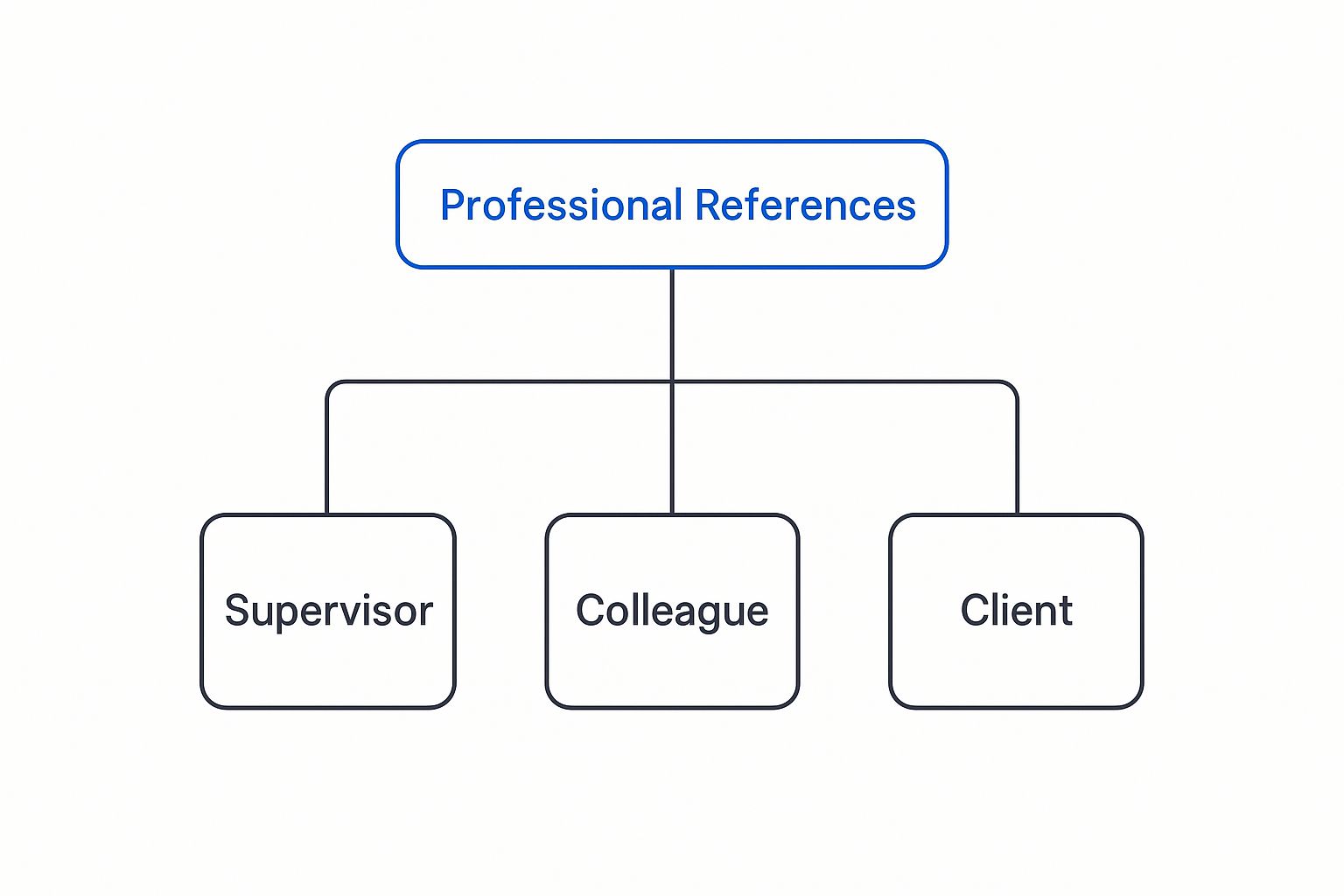
The visualisation highlights that those who have directly managed or collaborated on work with you often carry the most weight.
Expanding Your Network
Beyond this core group, don’t forget other valuable advocates. Industry peers who know your work through professional groups or collaborations can speak to your standing in your field. If you’re applying for leadership roles, even team members you’ve mentored can be powerful references, offering direct insights into your management style and your ability to nurture talent.
The key is to choose references who can collectively paint a complete and compelling picture of your professional abilities. Your aim should be to present a well-rounded, credible, and relevant story of your expertise that aligns perfectly with the job you want. When you choose wisely, your reference list transforms from a simple formality into a strong endorsement of your skills and character.
Building Your Reference Network Before You Need It

The sharpest professionals don’t wait until a job hunt begins to look for a professional reference. Instead, they view building their network as a continuous part of their career. This forward-thinking approach treats professional relationships like the valuable assets they are. It means putting in the effort to maintain genuine connections with colleagues, managers, and industry peers long after a project is finished. To learn how to build connections that genuinely support your career, you can find helpful advice in these best practices for a positive networking experience.
Cultivate Connections Proactively
Begin by spotting potential references in your current role, while your contributions are still fresh in their minds. A quick check-in with former colleagues is more than just polite; it’s a strategic way to keep those professional ties strong. Share your career news, congratulate them on their achievements, and be ready to offer support when you can.
It’s also smart to build a diverse network across different industries and locations. This ensures you have people who can speak to various stages of your career journey. Remember, being a good reference for others is just as important—it’s a professional courtesy that often comes back to you when you need it most.
Equip Your Advocates for Success
Keep a record of your accomplishments and the specific value you brought to projects you shared with potential references. This information is incredibly helpful when they are asked to provide a strong testimonial for you. Also, think beyond traditional jobs—mentors, volunteer supervisors, or leaders in professional groups have all seen your skills in action.
For companies, managing these reference requests is a key part of the talent acquisition process. When an employer asks, “What is a professional reference you can provide?” a well-nurtured network means you’ll have a list of enthusiastic supporters ready to vouch for you.
Mastering the Art of Reference Requests
Asking someone to be your **professional reference** isn’t just a quick email; it’s a strategic move. The key is to ask well in advance. Giving your chosen advocates plenty of time allows them to recall specific examples of your work and prepare thoughtful, compelling stories for the hiring manager.
When you reach out, be direct and clear. Explain the role you’re aiming for and describe the company. This context helps them tailor their endorsement to highlight the skills and experiences most relevant to the job, ensuring their praise is not just positive but also impactful.
Equipping Your References for Success
To get a stellar recommendation, you need to prepare your references to shine. Think of it as giving them a helpful “cheat sheet” so they can confidently speak about your accomplishments. This package should include:
- Your most up-to-date resume.
- A brief reminder of your shared projects or work history.
- A few key achievements or skills you’d like them to mention.
Always ask for permission before listing someone as a reference. If they say no, accept their decision with grace. They might feel they don’t know your recent work well enough or are simply too busy. Once they agree, keep them in the loop. A simple heads-up before an employer contacts them ensures the call isn’t a surprise and they’re ready to go.
Maintaining Your Reference Relationships
The conversation doesn’t end once the reference check is complete. A follow-up thank you is essential, whether you got the job or not. It shows you value their time and support. A great way to strengthen the connection is by offering to return the favour someday.
Nurturing these professional relationships is a smart, long-term career strategy. You never know when you might need their support again. A strong network of advocates who are ready to vouch for you is one of the most powerful assets in your professional toolkit.
Inside the Reference Check: What Employers Really Want
Think of a reference check like a film director interviewing an actor’s past colleagues. The director already has the headshot and resume (your application), but they want to know what it’s really like to work with you on set. Understanding what hiring managers ask your professional references can help you prepare your biggest advocates and ensure they highlight your best qualities.
While employers start with the basics—like confirming your job title and employment dates—the real story unfolds in the questions that follow.
Digging Deeper Than the Facts
Hiring managers want to paint a picture of your professional character. They’re interested in more than just whether you can do the job; they want to know how you do it. They’ll ask about your consistency, your ability to meet deadlines without sacrificing quality, and how you perform when things get stressful.
A huge part of this is understanding how you fit into a team. Questions about your communication style, how you handle disagreements, and your response to constructive feedback are common. They are trying to see if you are a collaborative team player or someone who struggles in a group setting.
Assessing Future Potential
Beyond your past performance, employers are trying to predict your future success. They’ll probe for leadership qualities by asking about times you took the lead on a project or influenced your peers. Your problem-solving skills are also under the microscope, so expect your references to be asked for specific examples of challenges you overcame.
Increasingly, companies look for a growth mindset. They want to know if you’re someone who actively seeks out new challenges and uses feedback to improve. This tells them you’re not just a good hire for today, but an investment for the future.
To help you and your references prepare, here’s a breakdown of common questions employers ask, organised by the skills they’re trying to assess.
Common Reference Check Questions by Category
| Question Category | Example Questions | What Employers Learn | Preparation Tips |
|---|---|---|---|
| Work Ethic & Reliability | “Can you describe their punctuality and attendance?” “How did they handle tight deadlines or high-pressure situations?” | Your consistency, dependability, and performance under stress. | Remind your reference of a high-stakes project you successfully completed on time. |
| Interpersonal & Team Skills | “How did they collaborate with other team members?” “Can you give an example of how they handled a conflict or disagreement?” | Your ability to communicate, work well with others, and resolve conflict constructively. | Choose references who saw you work in a team. Discuss a specific team win with them. |
| Problem-Solving & Initiative | “Describe a time they faced a significant challenge. How did they approach it?” “Did they ever take the lead on a project without being asked?” | Your critical thinking skills, resourcefulness, and proactive nature. | Pick a reference who witnessed you solve a tricky problem or suggest a process improvement. |
| Growth & Adaptability | “How did they respond to constructive feedback?” “Were they open to learning new skills or taking on unfamiliar tasks?” | Your coachability, willingness to learn, and potential for professional development. | Your best reference here is a manager who gave you regular feedback and saw you grow. |
As you can see, these questions go far beyond a simple “yes” or “no.” They require detailed, real-world examples that bring your resume to life.
For organisations, gathering these nuanced details consistently and fairly for every candidate can be a real headache. This is why many partner with specialists. Structured reference verification services ensure that every reference is asked the right questions, giving employers a complete and unbiased view of your potential to succeed in their team.
Professional Reference Verification: The Modern Approach
As the world of hiring moves on from simple phone calls, many organisations are now turning to dedicated verification services to check professional references. This modern approach introduces much-needed structure, consistency, and legal diligence. It transforms reference checking from a scattered, time-consuming chore into a systematic process that delivers trustworthy, standardised insights about candidates.
Professional services like SpringVerify have redefined this space with their technology-first solutions. They make the entire journey—from collecting references to verifying and reporting on them—much smoother, all while ensuring legal compliance and protecting a candidate’s privacy. These services provide employers with a deeper understanding of a candidate’s past performance, reliability, and potential fit within the company culture. This is accomplished through structured interviews conducted by trained professionals who know precisely what to ask and how to interpret the responses.
The dashboard from SpringVerify below illustrates how this organised process is managed.
This structured system gives HR teams a clear, real-time overview of the verification status for multiple candidates at once.
For job seekers, this means a more thorough, fair, and efficient evaluation. The technology speeds up the process, eliminating the frustrating delays often associated with traditional reference checks. Furthermore, professional verification services maintain detailed records and create standardised reports. This helps employers make informed, data-driven hiring decisions while minimising the risk of incomplete or biased information influencing the outcome.
Ready to make your hiring process faster, fairer, and more reliable? Discover how SpringVerify’s background verification services can give you the confidence to build a winning team.


