

Marksheet verification is the formal process of checking that a candidate’s academic marksheet is authentic and was genuinely issued by their university or college. It’s a foundational step that protects organisations from the risks of hiring someone based on fake qualifications. In today’s hiring landscape, it’s simply a non-negotiable part of due diligence.
Table of Contents
Why Marksheet Verification Is Non-Negotiable

In any competitive environment, whether it’s corporate hiring or university admissions, academic credentials are the bedrock of trust. Simply accepting a marksheet at face value is a huge gamble.
With today’s sophisticated forgery techniques, telling a real document from a fake one just by looking at it is nearly impossible. This is where a formal marksheet verification becomes absolutely essential. It’s not just about ticking a box; it’s a fundamental measure to protect your organisation’s integrity.
The process goes far beyond a simple visual check. It involves directly contacting the university, college, or examination board that supposedly issued the document. This confirms not only that the marksheet is real but also that all the key details—like the candidate’s name, scores, and graduation date—perfectly match the official records.
The Rising Tide of Academic Fraud
The stakes have never been higher, thanks to a sharp increase in credential fraud. Some candidates might feel pressured to embellish their academic history to get an edge, but the consequences of getting caught are severe for everyone involved. The problem has become so widespread that it threatens the credibility of our entire educational and professional system.
Take the issue of fake degrees in India, which has become a serious concern. In one shocking case, a university was found to have sold over 36,000 fake degrees, a scandal that completely undermined trust in academic qualifications. This is a stark reminder of why strong verification isn’t just a best practice—it’s a necessary line of defence.
You can get a deeper understanding of this issue from a detailed report on the need for marksheet verification in India for employers.
Who Needs Marksheet Verification and Why
Marksheet verification isn’t just an HR function; several stakeholders rely on it to maintain integrity and make informed decisions. Each has a critical reason for ensuring academic credentials are legitimate.
| Stakeholder | Primary Reason for Verification |
|---|---|
| Employers/HR Teams | To hire qualified, competent individuals and avoid the risks of fraudulent hires. |
| Universities & Colleges | To verify credentials for postgraduate admissions and maintain academic standards. |
| Government Agencies | For verifying eligibility for public sector jobs and issuing visas or work permits. |
| Immigration Authorities | To confirm academic qualifications as part of visa and immigration applications. |
| Professional Licensing Bodies | To ensure candidates meet the educational prerequisites for professional licensure. |
Ultimately, this process forms a chain of trust, ensuring that credentials are valid and recognised across different sectors.
The Real Risks of Skipping Verification
Turning a blind eye to this crucial step can set off a chain reaction of negative consequences for any organisation. The risks go well beyond just making a bad hire.
An unverified hire is a hidden liability. The potential damage to your company’s finances, reputation, and legal standing far outweighs the perceived inconvenience of conducting a thorough background check.
A single hire based on fake credentials can introduce major vulnerabilities:
- Reputational Damage: Imagine an unqualified person in a key, client-facing role. It can quickly erode customer trust and do lasting harm to your brand’s credibility.
- Financial Loss: The costs of recruiting, onboarding, and eventually replacing a fraudulent hire are significant. That doesn’t even factor in their lost productivity or the potential for costly business errors.
- Legal Consequences: In many regulated industries, verifying qualifications is a compliance requirement. Failing to do so can lead to hefty legal penalties, especially if an unqualified employee’s actions cause financial loss or harm.
In the end, having a systematic approach to marksheet verification is an investment in your organisation’s future. It ensures that every new person you bring on board has the genuine skills and value you’re looking for.
How to Verify Academic Documents
Deciding on the right way to verify a marksheet is a bigger deal than it sounds. This choice directly affects how quickly you can hire, how much you spend, and ultimately, how confident you are in the person you’re bringing on board.
You really have two paths to choose from: the old-school, manual way and the newer, digital process. Each one has its own workflow and is a better fit for different kinds of organisations. Getting a handle on these options is your first step toward a screening process you can actually rely on. Your decision will likely hinge on things like your hiring volume, how urgently you need to fill roles, and your company’s tolerance for risk.
The Traditional Manual Approach
The manual process is how things have been done for decades. It’s hands-on, requiring your team to directly contact the registrar or administrative office of the university or board that issued the marksheet. This usually means sending emails, official letters, or even making phone calls, all followed by a formal request for confirmation.
While it can get the job done, this method is riddled with challenges I’ve seen trip up countless HR teams:
- Long Turnaround Times: You’re completely at the mercy of the university’s administrative team. From my experience, getting a response can take anywhere from a few days to several weeks. In a fast-paced hiring market, that’s a massive bottleneck.
- Variable Costs: Many institutions charge a fee for verification, and these fees can be all over the map. When you add up these costs and the administrative time your team is spending, it gets expensive fast, especially if you’re hiring at scale.
- Communication Gaps: Unresponsive universities are a common and deeply frustrating problem. Your team can spend valuable time sending follow-up emails and making calls, only to hit a dead end. This leaves you stuck, unable to move forward with a promising candidate.
Think about it this way: a large, established corporation with a slow and steady hiring cycle might have the resources and patience for this. But for a startup that needs to hire three developers yesterday? Waiting weeks for a university to reply just isn’t an option.
The Modern Digital Alternative
This is where digital verification platforms have completely changed the game, offering a much faster and more reliable alternative. These services often have direct tie-ups with university databases or established verification networks that cut through the red tape. The whole approach is built for speed and accuracy.
Instead of a long, drawn-out paper chase, the digital process is a clean, automated flow.
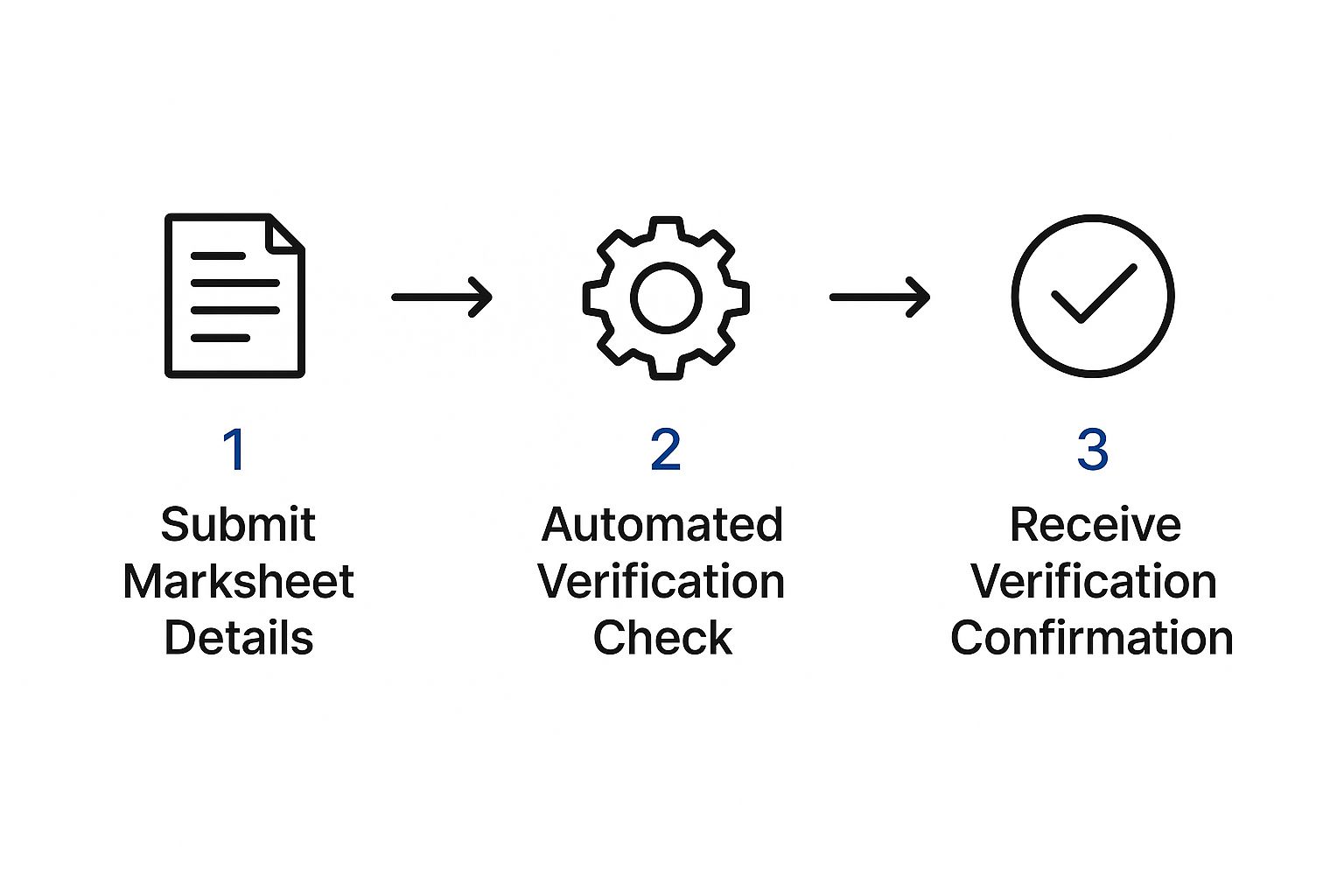
As you can see, technology boils a complex manual task down to a quick, automated check that can often be done in just a few steps.
The real magic of digital verification is its ability to deliver results almost instantly. By plugging directly into official databases, these platforms can confirm a marksheet’s authenticity in minutes, not weeks.
This speed gives you a huge leg up when you’re trying to lock down top talent before your competitors can. A fast-growing tech firm, for instance, can run its background checks, make a confident offer, and get a new hire started while another company is still waiting for a stamped envelope to arrive from a university registrar.
To really get into the weeds of how these modern systems operate, you can explore detailed guides on education verification in India. These solutions don’t just slash the risk of fraud; they create a much smoother, more professional experience for both your candidates and your hiring team.
Manual vs Digital Marksheet Verification
Choosing between these two methods can be tough. To make it easier, let’s break down the key differences in a simple table. This should help you see which approach aligns better with your organisation’s priorities and resources.
| Feature | Manual Verification | Digital Verification |
|---|---|---|
| Speed | Slow; can take days to weeks | Fast; often provides results in minutes or hours |
| Accuracy | Prone to human error and miscommunication | High; pulls data directly from verified sources |
| Cost | Variable and can be high due to fees and labour | Predictable, often lower cost per verification at scale |
| Scalability | Difficult to scale for high-volume hiring | Highly scalable; handles bulk requests easily |
| Process | Labour-intensive; requires manual outreach and follow-up | Automated; minimal manual intervention required |
| Candidate Experience | Can be slow and opaque, causing candidate drop-off | Smooth and transparent, improving the overall experience |
Ultimately, while the manual process has been the standard for a long time, its limitations are becoming more apparent in today’s fast-moving world. Digital verification offers a more efficient, reliable, and scalable solution that meets the demands of modern hiring.
Understanding the Legal Risks of Forged Documents
Skipping marksheet verification is far more than just a small procedural slip-up. In reality, it’s an open invitation for serious legal trouble. When it comes to academic fraud, the Indian legal system doesn’t mess around. If your company accepts or uses forged documents—even by accident—the fallout can extend well beyond just one bad hire.
This isn’t just about a candidate getting into trouble. Imagine your organisation lands a major contract or builds a business case on the back of an employee’s impressive credentials, only to find out their marksheet was a fake. Suddenly, your company could be held liable for misrepresentation. That means facing potential lawsuits, hefty financial penalties, and a hit to your corporate reputation that’s hard to come back from.
The Indian Penal Code on Forgery
The Indian legal system has a very clear and firm stance on document forgery. There are specific laws in place designed to penalise these acts, and as an HR or compliance leader, understanding them is key to grasping the real risk involved.
Two sections of the Indian Penal Code (IPC) are especially important here:
- Section 468 (Forgery for purpose of cheating): This law targets the act of creating a fake document with the clear intention to deceive. It’s directly applicable to any candidate who knowingly hands over a forged marksheet to get a job.
- Section 471 (Using as genuine a forged document): This one is just as critical. It criminalises the act of using a forged document while knowing it’s a fake. So, the moment a candidate presents that fake marksheet, they’re committing a punishable offence.
The consequences are severe. Under the IPC, anyone found guilty of these offences can be looking at imprisonment for up to seven years and a substantial fine.
Real-World Legal Precedents
These laws aren’t just collecting dust in a book; they are actively enforced. We’ve seen numerous court cases across India where individuals have been prosecuted for using fake academic documents. These cases are a loud and clear warning for both job applicants and the employers hiring them.
When an organisation fails to perform due diligence through marksheet verification, it’s not just overlooking a detail—it’s ignoring a significant legal and ethical responsibility. The courts expect employers to take reasonable steps to ensure the authenticity of credentials.
We’ve seen it happen in several high-profile incidents where government jobs were terminated and criminal proceedings were launched against people who got their roles using fake degrees. These actions make it clear that the responsibility doesn’t just stop with the candidate.
Organisations are expected to have solid, reliable processes in place. This is exactly why creating a structured, legally sound verification workflow is so crucial. For more on this, you can check out our guide on https://in.springverify.com/compliance/.
At the end of the day, a diligent verification of marksheet is your first and most effective line of defence. It insulates your organisation from legal headaches and upholds the ethical standards that are the bedrock of any trustworthy and competent workforce.
Integrating Verification into Your Hiring Process

Here’s a common mistake I see all the time: treating verification of marksheet as an isolated task you handle after you’ve already decided to hire someone. When it’s an afterthought, it just creates bottlenecks, frustrates candidates, and is a breeding ground for manual errors.
Instead, verification should be woven directly into the fabric of your hiring workflow, making it a natural, seamless component from the start.
The goal is to shift from a clunky final hurdle to a smooth, automated function. Getting this right creates a much better experience for everyone involved—your candidates and your busy HR team. This proactive approach means you can move forward with confidence, knowing every potential hire is genuinely qualified before an offer is even on the table.
Automating Verification with Your ATS and HRMS
The smartest way to integrate verification is by connecting it directly to your Applicant Tracking System (ATS) or Human Resource Management System (HRMS). Modern verification platforms are built for this, using powerful APIs to make the whole process feel almost invisible.
Imagine this: a candidate moves to a specific stage in your ATS, and that simple action automatically triggers a verification request. The system pulls the necessary information right from the candidate’s profile. Your team doesn’t have to lift a finger to re-enter data, which saves a ton of time and nearly eliminates the risk of typos or mix-ups. This kind of automation is a foundational idea in many modern human resources guides.
This integration pays off in several big ways:
- Centralised Data: All verification reports and updates live directly within the candidate’s profile in your ATS. No more hunting for information; you have a single source of truth.
- Real-Time Updates: Your hiring team can see the live status of a verification check without ever having to switch between different software.
- Improved Efficiency: By automating these triggers, your team is freed up to focus on what they do best—interviewing, engaging with top talent, and other strategic tasks.
Obtaining Candidate Consent Professionally
While automation is a game-changer, you have to handle it with complete transparency to maintain trust and stay compliant. Getting clear, explicit consent from a candidate before starting any background check isn’t just a nice-to-have; it’s an absolute legal and ethical must.
A smooth verification process respects the candidate’s privacy. Clearly explain what you’re verifying and why, and make the consent process simple and straightforward. A positive candidate experience begins with trust.
The consent form itself should be easy to digest, not packed with dense legal jargon. State clearly that you’ll be conducting a verification of marksheet and other relevant checks as part of the application.
Pro-Tip: Embed the consent form directly into your application portal. When a candidate applies, they can electronically sign it as part of their initial submission. This simple step gets the administrative work out of the way upfront, preventing delays later and ensuring you have the necessary permissions on file from day one.
Tackling the Tricky Bits: Solving Common Verification Challenges
Even with the best-laid plans, marksheet verification in the real world can get messy. You’re bound to hit a few roadblocks. Knowing how to handle them is what turns a good verification process into a great one. Think of this as your field guide for troubleshooting the common issues that can throw your hiring timeline off course.
Getting ahead of these problems means your team can manage the exceptions with confidence. This keeps your background screening process solid and dependable, no matter what curveballs come your way. From universities that go silent to confusing paperwork, let’s dive into how to solve these challenges.
When Universities Go Radio Silent
One of the most common headaches in manual verification is the unresponsive university. You’ve sent the request, followed up, and… crickets. This leaves you in a tough spot, especially when a fantastic candidate is eagerly waiting for that offer.
If weeks go by with no response, it’s time to change your approach.
- Go Beyond the General Inbox: Don’t just keep emailing the registrar’s office. Do a little digging. Look for contact details for the head of the specific department, the controller of examinations, or even the alumni relations office. A different contact might be more helpful or at least point you in the right direction.
- Bring in the Pros: This is exactly where a professional verification partner like SpringVerify is worth its weight in gold. We have existing relationships and dedicated contacts within thousands of institutions. We can often cut through the red tape and get a response much faster than a single company trying on its own.
- Keep the Candidate in the Loop: Be transparent. Let the candidate know you’re facing delays from their university. Ask them if they have a personal contact they could share. Sometimes, a nudge from a former student is all it takes to get the ball rolling.
Navigating Name Discrepancies and Minor Errors
It’s surprisingly common to find small differences between a candidate’s marksheet and their other official documents. Maybe a name is spelled slightly differently, a middle name is missing, or a date of birth is off by a day. These might seem small, but you can’t just ignore them.
The trick is not to jump to conclusions or assume fraud. More often than not, these are just old-school clerical errors made years ago.
A small mismatch on a document isn’t an automatic red flag. The goal is to verify the person, not just the piece of paper. The smart approach is to seek extra proof that connects the dots.
When you spot a discrepancy, ask the candidate for an affidavit. This is a simple, legally sworn statement where they explain the difference and confirm that all the documents belong to them. It provides a formal, documented fix that clears up the issue for your records and keeps everything compliant.
Checking Documents from Foreign or Unfamiliar Institutions
What do you do when a candidate hands you a marksheet from a university abroad or an Indian institution you’ve never heard of? Verifying these credentials demands an extra level of care. For foreign documents, you absolutely must confirm the institution’s accreditation in its home country.
For lesser-known domestic boards, the first step is checking if they’re approved by key governing bodies like the University Grants Commission (UGC) or the Association of Indian Universities (AIU). If an institution isn’t on these lists, its qualifications might not be considered valid for employment in India. This is a crucial check to protect your company from hiring someone whose credentials don’t meet national standards.
These complex checks are another area where leaning on specialised verification services can save you a world of trouble.
Your Questions About Marksheet Verification Answered
Even with a clear game plan, it’s natural for HR teams and hiring managers to have questions about the nitty-gritty of marksheet verification. Let’s walk through some of the most common queries I hear. Getting these answers right can demystify the process, making your hiring workflow feel a lot smoother and more predictable.
How Long Does Verification Actually Take?
This is the million-dollar question, isn’t it? The honest answer is: it completely depends on how you do it.
If you’re going the manual route, you’re really at the mercy of a university’s administrative team. It can be a bit of a black box. A realistic timeline can be anywhere from 7 to 21 business days, and I’ve seen it drag on even longer when an institution is particularly swamped or just slow to respond.
Digital verification, on the other hand, is built for speed. By plugging into established databases and verification networks, a digital check can often turn around results within 24 to 48 hours. For some universities with direct API integrations, the confirmation can be almost instant.
The key takeaway here is simple: while manual checks get the job done, digital platforms offer a massive speed advantage. In a competitive hiring market, waiting weeks for a confirmation can mean losing your top candidate to a company that moves faster.
Can Very Old Marksheets Still Be Verified?
Yes, absolutely. Legacy marksheets from decades ago can usually be verified, but this is where you’ll need a bit more patience. Many older universities and boards simply haven’t digitised their archival records. This almost always means the check will have to be done manually.
Here’s how to handle these cases effectively:
- Gather More Details: Don’t just ask for the marksheet. Get as much context from the candidate as possible—their enrolment number, the exact years they studied, and the specific college name if it was affiliated with a larger university. Every little bit helps.
- Be Prepared for Delays: You have to remember, someone might need to physically pull old paper ledgers from a dusty file room. It’s best to set realistic expectations for everyone involved and anticipate a longer turnaround time.
What Information Do We Need From a Candidate to Begin?
To get the ball rolling without any hitches, collecting the right information upfront is critical. Incomplete data is the number one reason I see verifications get delayed.
Here’s your essential checklist:
- A clear, legible, colour scan of the front and back of the marksheet.
- The candidate’s full name exactly as it appears on the document.
- Their student roll number or registration number.
- The name of the university or board, plus the affiliated college.
- The year of admission and the year of passing.
What Should We Do If a Marksheet Is Fake?
Discovering a forged document is a serious red flag, and it’s a situation that requires a calm, methodical approach. The first rule is not to make any rash decisions. Your immediate priority is to ensure your verification result is 100% conclusive.
Once you have that confirmation, follow a clear internal protocol. Loop in your legal and senior management teams right away. The next step is to schedule a discreet conversation with the candidate, present the findings calmly, and give them an opportunity to explain. Based on their response and your company policy, you can then formally withdraw the employment offer and make sure the incident is documented thoroughly for your records.
Navigating the complexities of background checks, from document verification to legal compliance, can be demanding. SpringVerify offers a fast, reliable, and seamless solution, integrating directly with your existing HR systems to automate the entire process. Make confident hiring decisions faster by visiting https://in.springverify.com.


