

In the high-stakes world of mergers, acquisitions, and significant investments, what you don’t know can absolutely hurt you. A surface-level review simply doesn’t cut it when capital and reputation are on the line. The process of due diligence is the critical investigation that separates a landmark deal from a costly mistake, systematically uncovering the financial, legal, and operational realities of a target entity. It is the disciplined effort to examine and verify all the facts and figures before committing to a major transaction.
This comprehensive guide breaks down the eight essential types of due diligence every investor, executive, and HR professional must understand. Moving beyond a simple checklist, we will explore what each type entails, why it matters, and how to execute it effectively. Before delving into these specific categories, it’s essential to grasp the core principle. For a deeper understanding of the fundamental concept of due diligence, you can refer to this guide.
From scrutinising financial statements and legal compliance to assessing operational efficiency and technological infrastructure, this article provides a structured roadmap. We will delve into Financial, Legal, Commercial, Operational, Technology, Environmental, Human Resources, and Tax due diligence. Each section is designed to offer actionable insights and real-world context, ensuring you have the complete picture to mitigate risk, confirm value, and pave the way for a successful and fully informed business decision.
Table of Contents
1. Financial Due Diligence
Financial due diligence is the cornerstone of any major business transaction, acting as a rigorous audit of a target company’s financial health and stability. This deep-dive analysis goes far beyond surface-level numbers, scrutinising historical financial data to verify accuracy and uncover potential liabilities. The primary goal is to validate the seller’s claims, understand the company’s true earning power, and identify any financial risks that could jeopardise the deal or its future success.
This process involves a meticulous review of financial statements, cash flow records, debt schedules, revenue streams, and accounting policies. By examining these elements, an acquirer can assess the quality of earnings, the sustainability of cash flows, and the overall financial position of the target. It’s one of the most critical types of due diligence because it directly impacts valuation and deal structuring.
The Process and Key Focus Areas
The financial due diligence process typically involves several key steps:
- Analysis of Earnings Quality: Investigators focus on determining the sustainability and accuracy of reported earnings. This involves adjusting for non-recurring or unusual items to calculate a normalised EBITDA (Earnings Before Interest, Taxes, Depreciation, and Amortisation), which provides a clearer picture of ongoing profitability.
- Working Capital Assessment: Analysts examine trends in current assets and liabilities. This helps identify seasonality, assess liquidity needs, and ensure that the business will have sufficient capital to operate post-acquisition without immediate cash infusions.
- Debt and Liabilities Review: A thorough review of all debt agreements, contingent liabilities, and off-balance-sheet commitments is conducted. This prevents the acquirer from inheriting unforeseen financial obligations.
- Forecast Validation: The team scrutinises management’s financial projections, validating the key assumptions underpinning their revenue and growth forecasts against historical performance and market trends.
The following infographic provides a quick reference to three critical metrics often analysed during this process: EBITDA trends, free cash flow conversion, and debt levels.
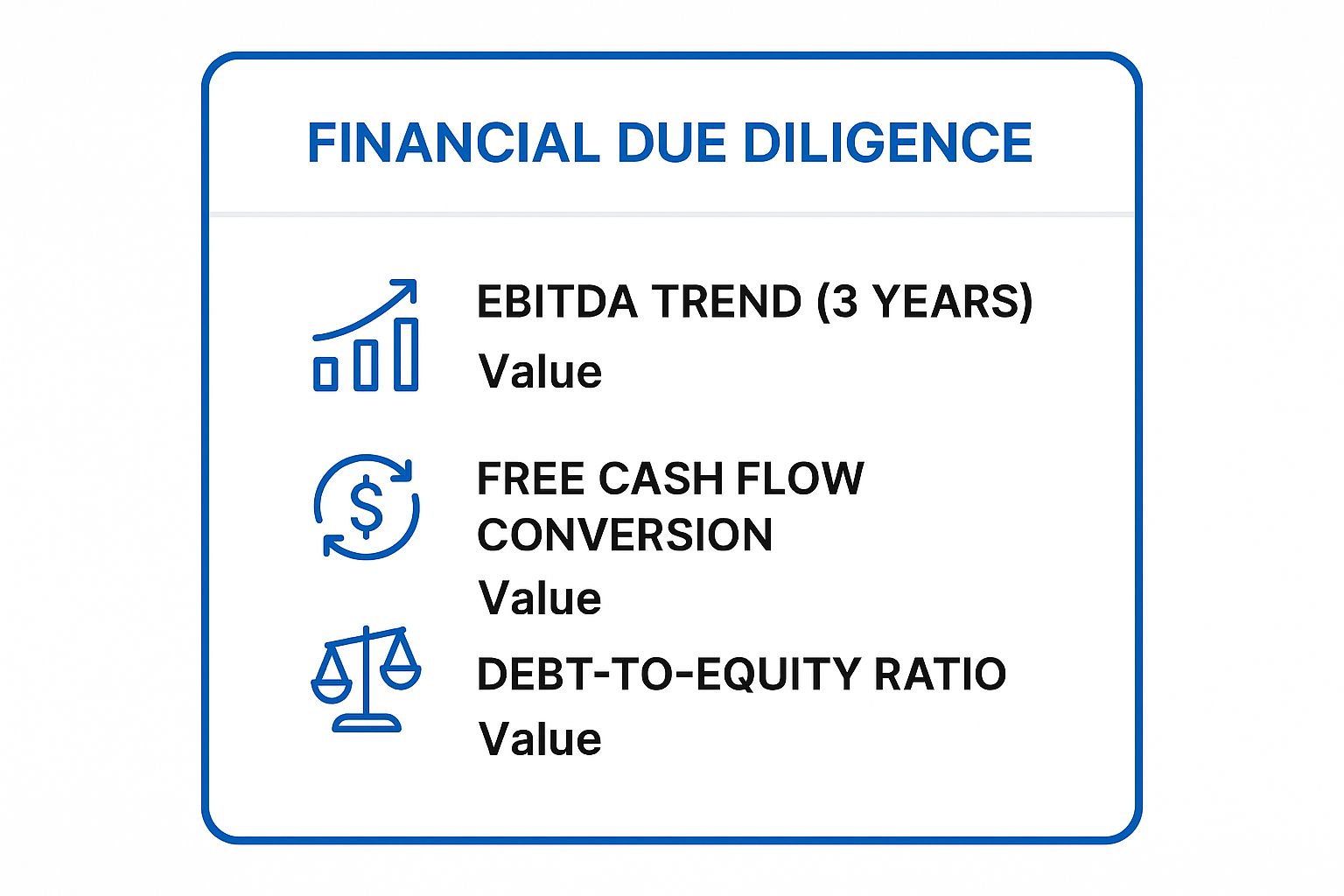
These metrics provide a snapshot of profitability, cash generation efficiency, and financial leverage, which are vital for assessing the target’s overall financial stability and investment risk.
Real-World Application and Best Practices
A prime example is Disney’s $71.3 billion acquisition of 21st Century Fox. The extensive financial due diligence confirmed the value of Fox’s assets and identified synergies, but also uncovered complexities in its international operations, which informed the final integration strategy.
To execute this process effectively, consider these best practices:
- Focus on Cash Flow: Prioritise the quality of cash flow over reported earnings. Cash is less susceptible to accounting manipulations and provides a true measure of operational health.
- Scrutinise Revenue Policies: Analyse the company’s revenue recognition policies for any signs of aggressive accounting that might inflate performance.
- Benchmark Against Peers: Compare key financial metrics, such as profit margins and growth rates, with industry benchmarks to contextualise the target’s performance.
2. Legal Due Diligence
Legal due diligence involves a systematic investigation into the legal affairs of a target company to assess potential risks and liabilities. This exhaustive review examines everything from corporate structure and contracts to intellectual property rights and ongoing litigation. Its primary purpose is to ensure the acquiring company understands the full scope of its legal obligations and exposures before finalising a transaction, preventing costly post-deal surprises.
This process requires a comprehensive analysis of corporate records, material contracts, employment agreements, regulatory filings, and any pending or threatened legal disputes. By scrutinising these documents, a buyer can verify the target’s ownership, confirm its compliance with applicable laws, and identify any legal impediments to the transaction. It stands as one of the most vital types of due diligence because it protects the acquirer from inheriting unforeseen legal battles and regulatory penalties.
The Process and Key Focus Areas
The legal due diligence process typically involves several critical steps:
- Corporate Structure and Governance Review: Investigators verify the company’s legal status, check its articles of incorporation, and review shareholder agreements and board minutes. This confirms the company is in good standing and that the transaction is properly authorised.
- Contractual Obligations Analysis: A thorough review of all material contracts, including customer agreements, supplier contracts, leases, and loan agreements, is conducted. This helps identify any change-of-control clauses, non-compete restrictions, or other provisions that could impact the business post-acquisition.
- Litigation and Regulatory Assessment: Analysts examine all current, pending, and threatened litigation, as well as the company’s history of regulatory compliance. This uncovers potential liabilities and assesses the company’s overall risk profile. More information on legal compliance frameworks can be found at SpringVerify IN.
- Intellectual Property (IP) Verification: The team verifies ownership and status of all key patents, trademarks, and copyrights. This ensures the target company rightfully owns the IP assets crucial to its operations and that they are not subject to infringement claims.
Real-World Application and Best Practices
A classic example is Microsoft’s acquisition of LinkedIn. The deal required an extensive legal review of LinkedIn’s vast portfolio of user data agreements, IP assets, and employment contracts to ensure compliance with global privacy laws and to mitigate potential legal risks associated with integrating the two tech giants.
To execute this process effectively, consider these best practices:
- Prioritise Key Contracts: Focus the initial review on the top 20% of contracts by value or strategic importance to quickly identify the most significant risks and obligations.
- Conduct Early IP Searches: Perform early clearance searches for key trademarks and patents to identify potential infringement issues or ownership conflicts that could devalue the asset.
- Verify Licence Transferability: Scrutinise all essential regulatory licences and permits to confirm they can be transferred to the new owner without interruption to business operations.
3. Commercial Due Diligence
Commercial due diligence evaluates the external market environment and the target company’s position within it. This forward-looking analysis assesses the attractiveness of the market, the strength of the competitive landscape, and the sustainability of the company’s business model. Its primary goal is to validate the strategic rationale behind an acquisition by answering a crucial question: is this a good business in a promising market?
This process examines factors like market size and growth rates, customer relationships, competitive positioning, and the overall commercial viability of the company’s products or services. It scrutinises revenue forecasts and the assumptions they are built upon. As one of the most strategic types of due diligence, it provides critical context to financial data, explaining why the numbers are what they are and what they are likely to be in the future.

The Process and Key Focus Areas
The commercial due diligence process is investigative and often involves external market research and interviews:
- Market Analysis: Investigators assess the size, historical growth, and future projections of the target’s market. This includes identifying key market drivers, trends, and potential disruptions.
- Competitive Landscape Review: This involves identifying key competitors and analysing their strengths, weaknesses, and market share. The goal is to understand the target’s unique selling proposition and its ability to defend its position.
- Customer Analysis: Analysts often conduct interviews with key customers to gauge satisfaction, loyalty, and the likelihood of future business. This uncovers risks related to customer concentration and validates the company’s value proposition.
- Business Plan Validation: The team pressure-tests the management’s business plan and revenue projections against the realities of the market, customer feedback, and competitive pressures.
Real-World Application and Best Practices
A powerful example is Salesforce’s acquisition of Tableau. The commercial due diligence was vital to understand the burgeoning business intelligence and data visualisation market. It confirmed Tableau’s strong brand, loyal customer base, and the significant cross-selling opportunities within Salesforce’s existing ecosystem, justifying the premium valuation.
To execute this process effectively, consider these best practices:
- Conduct Customer Interviews: Speak directly to a sample of top customers to validate retention rates, satisfaction levels, and the perceived value of the product or service.
- Analyse Win/Loss Data: Review the company’s sales pipeline data to understand why deals are won or lost. This provides direct insight into competitive positioning and product gaps.
- Assess the Sales Pipeline: Scrutinise the quality and realism of the sales forecast. A weak or overly optimistic pipeline is a major red flag for future revenue.
4. Operational Due diligence
Operational due diligence examines the inner workings of a target company, evaluating how its people, processes, and systems work together to deliver products or services. This analysis moves beyond financial statements to assess the efficiency, scalability, and overall effectiveness of the business’s day-to-day functions. The primary goal is to identify operational strengths, weaknesses, and potential risks that could impact post-acquisition performance and integration.
This process involves a comprehensive review of production processes, supply chain management, IT infrastructure, quality control systems, and management capabilities. By understanding these core functions, an acquirer can validate the business model’s viability, identify opportunities for cost savings or performance improvements, and ensure the company can support future growth. It is one of the most practical types of due diligence as it directly uncovers the “how” behind the company’s financial results.
The Process and Key Focus Areas
The operational due diligence process typically involves several key steps:
- Assessment of Core Processes: Investigators analyse key operational workflows, from manufacturing and service delivery to logistics and customer support. The aim is to identify bottlenecks, inefficiencies, and dependencies that could pose a risk.
- Supply Chain and Vendor Review: This involves evaluating the stability and reliability of key suppliers, reviewing contracts, and assessing risks related to single-sourcing or geographic concentration. A resilient supply chain is critical for sustained operations.
- IT Systems and Technology Evaluation: Analysts assess whether the current IT infrastructure is scalable, secure, and capable of supporting the business’s strategic goals. This includes reviewing proprietary software, IT support, and cybersecurity protocols.
- Management and Workforce Analysis: This step focuses on the capabilities of the management team and the skills of the workforce. It involves interviews with key personnel to understand the organisational culture and operational expertise.
Understanding these areas is crucial for confirming that the operational reality aligns with the strategic vision presented by the seller.
Real-World Application and Best Practices
A classic example is Amazon’s acquisition of Kiva Systems (now Amazon Robotics). The operational due diligence was paramount, focusing on the efficiency and scalability of Kiva’s robotic warehouse automation technology. Amazon’s deep dive confirmed that Kiva’s systems could revolutionise its fulfilment centres, directly leading to the acquisition and a massive competitive advantage.
To execute this process effectively, consider these best practices:
- Conduct On-Site Visits: There is no substitute for seeing the operations firsthand. Tour key facilities, observe processes, and speak directly with employees on the ground.
- Benchmark Key Metrics: Compare operational KPIs like production cycle times, defect rates, and inventory turnover against industry standards to gauge the target’s competitive performance.
- Interview Across Levels: Speak with senior executives, mid-level managers, and frontline staff to get a holistic view of how the business truly functions and identify cultural or process-related issues. For a deeper understanding of this area, you can learn more about how to enhance your operational reviews on in.springverify.com.
5. Technology Due Diligence
Technology due diligence is a specialised assessment of a company’s complete technology stack, including its assets, infrastructure, capabilities, and associated risks. This deep dive evaluates everything from software systems and proprietary code to cybersecurity posture and the intellectual property (IP) portfolio. The primary goal is to understand the technological opportunities, scalability, and hidden liabilities that could impact the target company’s value and future performance.
This process involves a comprehensive review of software architecture, hardware infrastructure, IT team capabilities, development processes, and the company’s technology roadmap. For acquirers, particularly in the tech sector, it helps determine if the technology is a strategic asset or a potential liability requiring significant future investment. This is one of the most vital types of due diligence for any deal involving software, e-commerce, or data-driven businesses.

The Process and Key Focus Areas
The technology due diligence process typically involves several key steps:
- Code and Architecture Review: Experts analyse the quality, scalability, and maintainability of the company’s proprietary source code. This includes identifying technical debt, which represents the implied cost of rework caused by choosing an easy solution now instead of using a better approach that would take longer.
- Infrastructure and Security Assessment: This step evaluates the robustness and security of the company’s IT infrastructure, including servers, networks, and cloud services. It involves scrutinising cybersecurity policies, incident response plans, and compliance with data protection regulations.
- IP and Licensing Audit: Investigators verify ownership of all critical intellectual property, such as patents, trademarks, and copyrights. They also review open-source and third-party software licences to ensure compliance and avoid legal entanglements.
- Team and Process Evaluation: The assessment extends to the technology team itself, evaluating their skills, structure, and development methodologies (e.g., Agile, DevOps). This helps gauge the team’s ability to execute the future technology roadmap.
Real-World Application and Best Practices
A classic example is IBM’s acquisition of Red Hat. The extensive technology due diligence was crucial to validate the power and scalability of Red Hat’s open-source, cloud-native technologies, confirming its strategic value for IBM’s hybrid cloud ambitions.
To execute this process effectively, consider these best practices:
- Assess Technical Debt: Quantify the level of technical debt within the software. High technical debt can significantly slow down future product development and increase maintenance costs.
- Engage Independent Experts: Utilise third-party technology consultants for an unbiased and objective assessment, especially if the acquiring company lacks deep in-house expertise in the target’s specific tech stack.
- Review Cybersecurity Posture: Go beyond a simple checklist. Conduct vulnerability scans and penetration tests to understand the real-world resilience of the company against cyber threats.
6. Environmental Due Diligence
Environmental due diligence is an increasingly critical investigation into a target company’s environmental risks, liabilities, and compliance status. This process assesses the potential for land or water contamination, non-compliance with environmental regulations, and exposure to climate-related risks that could result in significant financial penalties, clean-up costs, or reputational damage. The primary goal is to identify and quantify these liabilities so an acquirer can make an informed decision and negotiate appropriate protections.
This comprehensive review examines a company’s operations, properties, and supply chain for environmental red flags. It involves analysing historical site usage, current waste disposal practices, and adherence to local and international environmental laws. As regulations tighten and climate concerns grow, this is one of the essential types of due diligence for safeguarding long-term asset value and ensuring corporate responsibility.
The Process and Key Focus Areas
The environmental due diligence process is typically phased and involves several key steps:
- Phase I Environmental Site Assessment (ESA): This is a preliminary investigation to identify potential or existing environmental contamination liabilities. It includes a review of records, a site inspection, and interviews with owners, occupants, and local government officials.
- Compliance Audit: Investigators review permits, licences, and operational records to determine if the company is in compliance with all relevant environmental regulations, such as those governing air emissions, water discharge, and hazardous waste management.
- Climate Risk and Sustainability Assessment: This step evaluates the target’s vulnerability to climate change, including physical risks (like flooding) and transition risks (like carbon taxes). For instance, a thorough process should involve understanding the business impact of climate change on the company’s future operations and profitability.
- Liability Quantification: If potential issues are found, specialists may conduct further testing (a Phase II ESA) to quantify the scope and cost of remediation, which directly impacts deal valuation and negotiations.
Real-World Application and Best Practices
A classic application is any real estate transaction involving former industrial sites. Before redevelopment, a buyer must conduct extensive environmental due diligence to avoid inheriting massive clean-up costs for historical contamination, a liability that can often exceed the property’s value. Similarly, DuPont’s various spin-off transactions required comprehensive environmental assessments to properly allocate historical liabilities between the parent company and the new entities.
To execute this process effectively, consider these best practices:
- Conduct a Phase I ESA for All Properties: Never skip this step, especially for properties with a history of industrial or commercial use. It is a cost-effective way to identify major risks early.
- Assess Environmental Management Systems: Review the target’s internal policies, procedures, and systems for managing environmental compliance. A robust system indicates lower operational risk.
- Factor Findings into Deal Structure: Use the findings to negotiate specific indemnities, purchase price adjustments, or require the seller to place funds in escrow to cover potential remediation costs.
7. Human Resources Due Diligence
Human resources (HR) due diligence is a comprehensive evaluation of a company’s workforce, employment practices, and organisational culture. This analysis moves beyond financial statements to assess the value and risks associated with a company’s most important asset: its people. The primary goal is to understand the human capital landscape, identify potential liabilities like compliance issues or employee disputes, and gauge the cultural fit between the merging entities.
This process involves a detailed review of employment contracts, compensation and benefits structures, HR policies, labour law compliance, and employee relations. By scrutinising these elements, an acquirer can assess key person dependencies, uncover hidden labour costs, and anticipate challenges in post-merger integration. It’s one of the most vital types of due diligence because a deal’s success often hinges on retaining key talent and successfully blending company cultures.
The Process and Key Focus Areas
The HR due diligence process typically involves several key steps:
- Workforce and Talent Analysis: Investigators assess the skills, experience, and performance of the workforce. This includes identifying key employees, evaluating management bench strength, and understanding succession plans to ensure leadership continuity.
- Compensation and Benefits Review: A thorough analysis of all salary structures, bonus schemes, pension obligations, and employee benefits is conducted. This helps to identify any underfunded liabilities and benchmark compensation against industry standards to assess competitiveness.
- Compliance and Legal Audit: This step involves reviewing HR policies, employment agreements, and past employee litigation to ensure compliance with labour laws. When operating globally, it’s crucial to vet candidates thoroughly, often leveraging international background check services to ensure compliance across different jurisdictions.
- Cultural Assessment: Analysts evaluate the target company’s organisational culture, employee morale, and engagement levels. This helps predict potential integration challenges and develop strategies to harmonise different working styles and values. Learn more about the critical aspects of human resources to deepen your understanding.
Real-World Application and Best Practices
A notable example is Facebook’s acquisition of WhatsApp. A significant part of the due diligence focused on preserving WhatsApp’s lean, engineering-driven culture and retaining its highly skilled team, which was critical to the platform’s continued innovation and success post-acquisition.
To execute this process effectively, consider these best practices:
- Review Key Employee Contracts: Scrutinise employment agreements for key personnel, paying close attention to change-of-control clauses, non-compete agreements, and retention incentives.
- Assess Cultural Integration Risks: Conduct anonymous employee surveys or focus groups to gain honest feedback on morale, leadership, and company culture to identify potential clashes early on.
- Benchmark Compensation: Compare salary, bonus, and benefits packages against market data to ensure they are competitive enough to retain top talent after the transaction is complete.
8. Tax Due Diligence
Tax due diligence is a highly specialised investigation into a target company’s tax-related affairs to uncover potential liabilities, assess compliance, and identify planning opportunities. This rigorous review examines all aspects of a company’s tax history and current positions across every jurisdiction it operates in. The goal is to ensure the acquirer is not inheriting unexpected tax debts or compliance failures and to understand the tax implications of the transaction itself.
The process involves a deep analysis of historical tax filings, correspondence with tax authorities, and the company’s internal tax policies. By scrutinising income taxes, indirect taxes (like GST), transfer pricing, and employee-related taxes, an acquirer can gain a clear picture of the target’s tax risk profile. This is one of the most crucial types of due diligence for cross-border transactions, as it directly influences deal valuation, structuring, and post-acquisition integration.
The Process and Key Focus Areas
The tax due diligence process is methodical and detail-oriented, focusing on several key areas:
- Review of Tax Compliance: Investigators verify that the target has filed all required tax returns accurately and on time in all relevant jurisdictions. This includes reviewing federal, state, and local income tax returns, as well as filings for indirect taxes.
- Analysis of Uncertain Tax Positions: The team assesses any aggressive or ambiguous tax positions the company has taken. This helps quantify potential liabilities that could arise from future tax audits or challenges by authorities.
- Transfer Pricing Assessment: For companies with international operations, this involves analysing intercompany transactions to ensure they comply with “arm’s length” principles. Non-compliance can lead to significant penalties and tax adjustments.
- Evaluation of Tax Attributes: The process identifies and quantifies valuable tax attributes, such as net operating losses or tax credits, and determines if they can be utilised by the acquirer post-transaction.
Real-World Application and Best Practices
A high-profile example is the failed $160 billion merger between Pfizer and Allergan. The deal was structured as a “tax inversion” to lower Pfizer’s corporate tax rate. Extensive tax due diligence was critical to validate the structure, but the deal was ultimately abandoned after the U.S. Treasury introduced new rules specifically targeting such transactions, highlighting the risk of legislative changes.
To conduct effective tax due diligence, consider these best practices:
- Analyse All Tax Types: Do not limit the review to corporate income tax. Scrutinise indirect taxes (GST, VAT), payroll taxes, and property taxes, as these can hide significant liabilities.
- Assess Transfer Pricing Policies: For businesses with cross-border transactions, thoroughly review transfer pricing documentation to ensure compliance and avoid future disputes with tax authorities.
- Evaluate Deal Structure Alternatives: Use the findings to model different deal structures (e.g., asset vs. share purchase) to determine the most tax-efficient approach for the buyer.
Types of Due Diligence Comparison Matrix
| Due Diligence Type | Implementation Complexity | Resource Requirements | Expected Outcomes | Ideal Use Cases | Key Advantages |
|---|---|---|---|---|---|
| Financial Due Diligence | Moderate to High Due to detailed financial analysis and data validation | High Requires financial experts and data access | Clear financial health picture Risk identification Valuation accuracy | M&A valuation Investment decisions | Reveals earnings quality Early red flag detection Supports financing decisions |
| Legal Due Diligence | High Requires specialized legal expertise across jurisdictions | Very High Involves legal teams and document review | Identification of legal risks and liabilities Regulatory compliance confirmation | Complex transactions with legal risk concerns | Detects material contract issues Ensures compliance Supports deal structuring |
| Commercial Due Diligence | Moderate Market and competitive analysis with some assumptions | Moderate Requires market research and customer interviews | Validation of market assumptions and growth potential | Strategic investment Market entry assessment | Reveals competitive advantages Highlights customer risks Supports strategic planning |
| Operational Due Diligence | High In-depth operational and management assessment | High Requires on-site reviews and management interviews | Identification of operational risks and efficiencies Management capability validation | Operations-heavy businesses Post-acquisition integration | Improves operational insight Assesses management strength Supports integration plans |
| Technology Due Diligence | High Specialized technical and cybersecurity evaluation | Very High Requires IT experts and technical assessments | Identification of technology risks Scalability and innovation validation | Tech company acquisitions IT integration planning | Uncovers tech risks Assesses IP and technology value Supports tech roadmap alignment |
| Environmental Due Diligence | Moderate to High Specialized environmental assessments needed | High Requires environmental experts and testing | Identification of environmental liabilities and compliance | Industries with environmental impact Real estate deals | Detects contamination risks Validates regulatory compliance Supports ESG criteria |
| Human Resources Due Diligence | Moderate Assessment of workforce, culture, and compliance | Moderate Needs HR specialists and employee access | Identification of talent risks and cultural fit Labor law compliance | Workforce-intensive companies Post-merger integration | Reveals retention risks Evaluates cultural compatibility Supports talent management |
| Tax Due Diligence | High Complex tax law review and multi-jurisdictional analysis | Very High Requires tax experts and detailed documentation | Identification of tax liabilities and optimization opportunities | Cross-border transactions Complex tax environments | Reveals tax risks Optimizes deal structuring Ensures compliance across jurisdictions |
Integrating Your Findings for a Smarter Investment
Having journeyed through the distinct disciplines of due diligence, from the hard numbers of financial and tax analysis to the human element of HR and the forward-looking insights of commercial diligence, it’s clear that this process is far more than a simple checklist. The true mastery of due diligence lies not in executing each type in isolation, but in synthesising their findings into a single, cohesive narrative about the target company. Each investigation is a piece of a larger puzzle; only by assembling them can you see the complete picture.
The various types of due diligence we have explored are deeply interconnected. A financial anomaly uncovered during a review of the balance sheet might find its root cause in an inefficient operational workflow. Similarly, a legal risk identified in a key supplier contract could have significant ripple effects on the company’s commercial projections and market standing. The real value is unlocked when you start connecting these dots.
From Siloed Data to Strategic Insight
The most common mistake organisations make is treating each due diligence stream as a separate workstream that only converges at the final report. A more powerful approach is to foster continuous communication between the different diligence teams throughout the process. An integrated strategy allows for a more dynamic and responsive investigation, where insights from one area can inform and guide the questions asked in another.
For example, if the technology diligence team flags an over-reliance on a single, outdated software platform, this finding should immediately be shared with:
- The Financial Team: To quantify the future capital expenditure required for system upgrades and factor it into the valuation model.
- The Operational Team: To assess the potential for business disruption during a system migration and the impact on productivity.
- The HR Team: To determine if the current workforce has the necessary skills to adapt to new technology or if retraining and new hires will be necessary.
This cross-pollination of information transforms a series of independent audits into a holistic risk assessment, revealing a multi-layered view of the potential investment that would otherwise remain hidden. It’s the difference between identifying individual trees and understanding the health of the entire forest.
Actionable Integration: Building Your Post-Acquisition Blueprint
Ultimately, the goal of comprehensive due diligence is not just to decide whether to proceed with a deal but to understand how to make it successful if you do. A well-integrated diligence report becomes the foundational blueprint for your post-acquisition or post-investment strategy. It provides a clear, evidence-based roadmap for value creation.
Key takeaways to remember:
- Prioritise Ruthlessly: Not all findings are equal. An integrated view helps you distinguish between minor, manageable issues and fundamental deal-breakers that threaten the core investment thesis.
- Negotiate with Precision: When you can clearly articulate how a legal liability will impact future operational costs, or how an environmental concern translates into a specific financial provision, your negotiating position becomes infinitely stronger.
- Plan for Day One and Beyond: The insights gathered from operational, HR, and technology diligence are invaluable for creating a 100-day plan that addresses critical risks and captures immediate synergies.
Embracing the full spectrum of due diligence is your best defence against unforeseen liabilities and post-deal regret. It is a rigorous, resource-intensive process, but the clarity and confidence it provides are indispensable. By viewing the various types of due diligence not as separate tasks but as interconnected lenses, you empower your organisation to make smarter, more strategic decisions that lay the groundwork for sustainable, long-term success.
While you focus on the broad scope of your investment’s due diligence, don’t overlook the critical details of your human capital. SpringVerify offers comprehensive, fast, and compliant employee background verification services, ensuring the talent you acquire or hire aligns with the integrity and quality your business demands. Secure your most valuable asset by visiting SpringVerify to streamline your HR due diligence process.


