


Table of Contents
Why Third Party Verification Matters More Than Ever
Hiring based on trust alone is like building a house without checking the foundation. It might look stable at first, but a collapse is not just possible—it’s disastrous and far more expensive than an initial inspection. The idea behind third party verification is to reinforce that foundation of trust, much like how peer reviews are vital in academic research. Just as a scientist’s work is examined by impartial experts, a candidate’s claims on a CV deserve independent validation.
This need for a neutral second opinion is more critical now than ever. Falsifying information on résumés isn’t a rare occurrence; it’s a widespread issue. Studies reveal that a large number of job applicants admit to stretching the truth on their CVs. These are not minor tweaks but can include everything from invented job titles to completely fake degrees. For any business, this introduces a serious risk that goes far beyond simply making a poor hiring choice.
The Rising Tide of Deception
Ignoring third party verification can lead to severe consequences that damage a company’s finances, reputation, and security. Think about these potential outcomes:
- Financial Loss: An unqualified person in a key technical role can cause project failures, drain resources, and lead to lost business.
- Reputational Damage: The fraudulent behaviour of an employee can stain a company’s public image, chipping away at customer trust.
- Legal and Compliance Issues: In regulated industries, inadequate employee vetting can result in non-compliance and steep fines.
- Security Breaches: An employee with a hidden criminal background or bad intentions could steal sensitive company data.
These risks become even greater in regions where fraud is a known challenge. In India, for example, identity theft is a major concern, making robust verification essential. A 2021 report showed that nearly 27 million Indian adults were victims of identity theft, which resulted in about 1.3 billion hours spent trying to resolve the issues. The same survey found that 36% of adults had their accounts accessed without permission. This environment shows why accepting information without checking it is a risky bet for any organisation.
Creating a Culture of Accountability
Ultimately, bringing in a strong third party verification process helps build a culture where honesty and integrity are valued. It sends a powerful message that your organisation takes facts seriously. This unbiased check protects the business from risk and ensures that genuinely qualified candidates get the recognition they deserve. It transforms hiring from a guessing game into a structured, evidence-based decision.
How Smart Hiring Transforms Your Business

Every hiring decision is a major investment in your company’s future. Think of third party verification as your most reliable insurance policy for that investment. It’s the step that takes you beyond a candidate’s well-crafted CV and allows you to make decisions based on proven facts, not just claims. The true cost of a bad hire isn’t just about spotting a fake degree; it’s about the hidden expenses that surface months down the line. These come from cultural mismatches, exaggerated skills, or experience gaps that weren’t obvious in interviews, quietly harming team morale, stalling projects, and hurting your profits.
Imagine a fast-growing tech startup that was about to hire a senior developer with an impressive resume. During the third party verification process, they discovered the candidate had significantly inflated their role at a previous company. While they did work there, their actual position was far more junior. By uncovering this, the startup avoided putting a critical project into the hands of someone who wasn’t ready for that level of responsibility. In another case, a financial firm skipped this check for a “fast-track” hire, only to face serious regulatory fines when it was revealed the new employee didn’t have a mandatory industry certification.
The Full Spectrum of Modern Verification
Good verification isn’t just about dodging bullets; it’s about building a foundation of trust that gives you a real advantage. It provides a complete, honest picture of a candidate, ensuring the person you bring on board is exactly who they say they are. A proper third party verification service covers several key areas.
- Employment History: Confirms job titles, dates of employment, and why they left previous roles.
- Educational Credentials: Validates degrees, diplomas, and certificates from genuine institutions.
- Professional Licences: Checks that a candidate holds the necessary licences for their profession, like for doctors, engineers, or financial advisors.
- Reference Authenticity: Makes sure that the references provided are real people who can give meaningful feedback on a candidate’s work ethic and character.
By using these checks, leading companies aren’t just managing risk—they’re actively building teams founded on integrity. When everyone knows they’ve been held to the same high standard of honesty, it creates a stronger, more connected work culture. This trust leads directly to better teamwork, increased productivity, and a more resilient organisation. For a closer look at building these kinds of teams, you can find out more about modern talent acquisition strategies.
Balancing Thoroughness with Candidate Experience
Of course, these checks need a careful approach. The aim is to be thorough without making the process uncomfortable or invasive for the candidate. Transparency is the most important part of this balancing act. Letting candidates know upfront that a third party verification check is a standard part of the process sets clear expectations from the start. Working with a professional verification provider ensures the process is handled with respect, speed, and in full compliance with privacy laws. This protects your business while showing potential hires that you are a serious, professional organisation that values both security and fairness.
The Verification Market Boom: What It Means for You

The growing dependence on third party verification isn’t just a passing phase; it’s a major change in how businesses operate and build trust. Think of it as a response to an environment where risks are getting more complex. The market for these services is expanding because organisations see a clear benefit: independent verification pays for itself by preventing costly mistakes. This growth is driven by everything from sophisticated cyber threats to new regulations that make thorough checks a legal must-have, not just a nice-to-have. For your business, this boom means that powerful and affordable verification tools are more accessible than ever before.
This expansion is especially strong in India, where the rapid move to a digital economy has introduced new challenges. The Indian identity verification market was valued at about USD 451.1 million in 2024 and is on a steep upward path. Forecasts suggest it could climb to nearly USD 1,719.7 million by 2033, growing at an impressive compound annual growth rate of around 16%. This growth directly reflects increasing worries about fraud in our connected world. You can explore these identity verification market trends to grasp the full picture.
Why Different Industries Are Investing
The push for verification isn’t uniform across the board. Different sectors are adopting these services for their own specific reasons.
- Financial Services: For banks and fintech firms, solid verification is the bedrock of their operations. They invest heavily in technology to stop fraud, meet strict Anti-Money Laundering (AML) and Know-Your-Customer (KYC) rules, and secure every transaction.
- Healthcare: Hospitals and clinics need to confirm the credentials and licences of their medical staff. This is vital for patient safety and to steer clear of serious legal trouble.
- Gig Economy: Platforms connecting freelancers with customers depend on verification to create a safe and trustworthy environment. This trust is the foundation of their business model.
- Small and Medium Businesses (SMBs): In the past, high-quality verification was out of reach for smaller companies. Now, the market boom has led to affordable, scalable options, letting SMBs protect themselves from hiring risks without needing a huge budget. A comprehensive guide to BeenVerified pricing can offer insights into how these services are priced for different needs.
Technological Leaps Making Verification Better
This market growth is also fuelled by major advances in technology. Today’s third party verification is quicker, more precise, and simpler to use. Artificial intelligence (AI) can scan massive amounts of data in moments to spot red flags that a human might miss. Plus, secure mobile technology allows candidates to submit their documents easily using their phones, which speeds up the entire hiring journey.
What used to be a manual process taking weeks can now be finished in just a few hours or days. This gives you the verified information you need to make confident and quick hiring decisions.
Inside the Verification Process: How It Really Works
The world of third party verification can seem like a black box: you submit a candidate’s details, and sometime later, a report appears. But what really happens in that time? Think of it less like a magic trick and more like a highly organised detective agency, combining powerful technology with human expertise to deliver a clear verdict. The process is a journey from a simple request to a detailed, actionable report, all designed to give you confidence in your hiring decisions. To understand how modern systems operate, it’s helpful to know the steps involved in handling a verify request.
This infographic provides a simple overview of the journey from submission to certification.
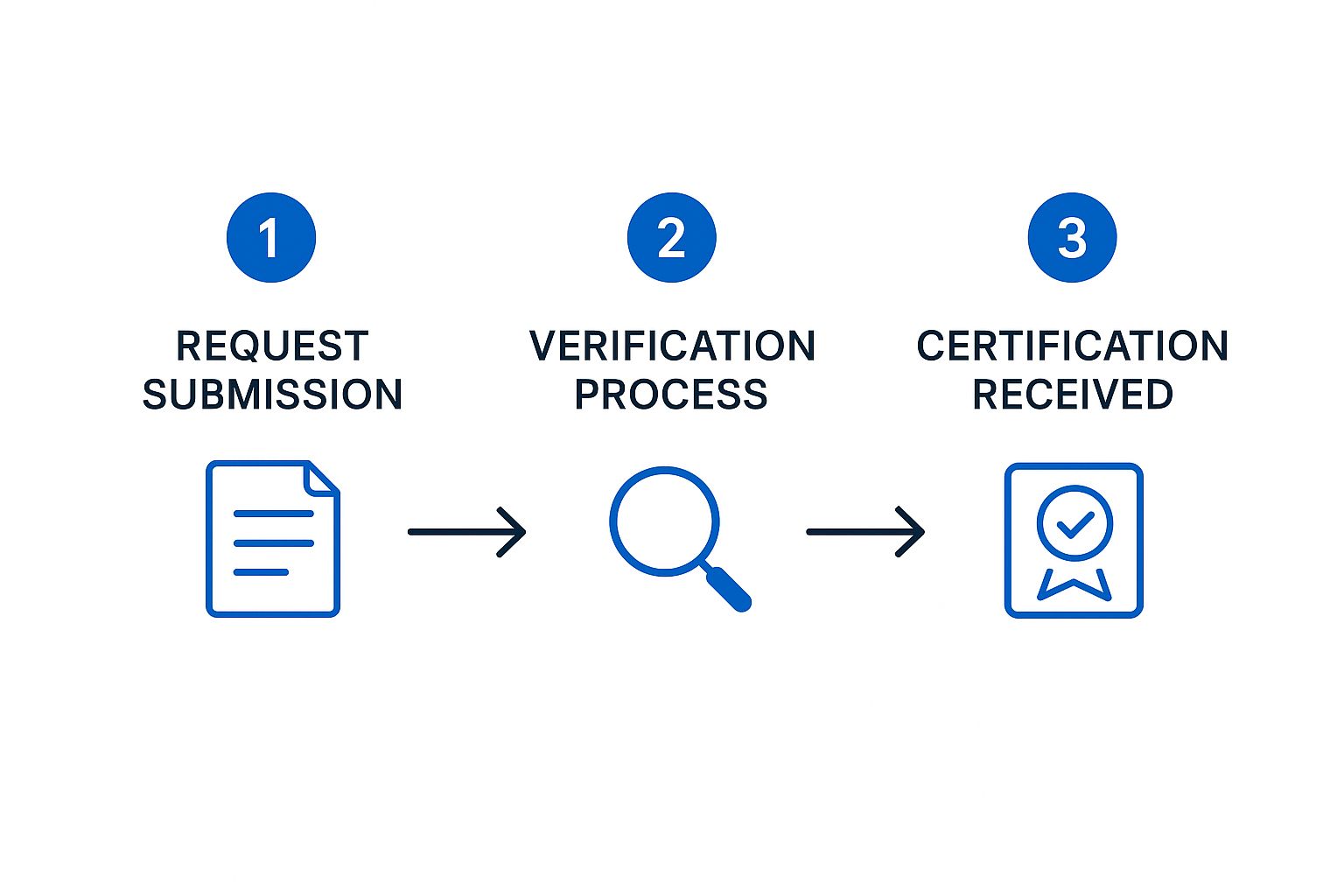
As the visual shows, the entire operation is a structured flow designed for efficiency and clarity.
Stage 1: The Request and Data Collection
Everything begins when you start a verification request through your provider’s platform. This usually involves entering the candidate’s information, like their name, date of birth, and the specific claims you want to check—such as their educational history or previous employment. Once submitted, the system gets to work.
Modern verification services use Application Programming Interfaces (APIs) to build a network of connections. Think of these as secure digital tunnels that let the system instantly ask for information from various official databases.
- Government Databases: For checking national identity documents like Aadhaar or PAN cards.
- Educational Institutions: To confirm degrees and graduation dates directly with universities.
- Credit Bureaus: For financial checks, when relevant and with the candidate’s consent.
- Global Watchlists: To screen for any history of criminal activity or international sanctions.
Stage 2: Automated Analysis and Human Oversight
Once the information starts arriving, smart algorithms analyse it for any mismatches. Does the name on the degree match the government ID? Do the employment dates align with the candidate’s CV? The system is designed to automatically flag these differences.
However, technology isn’t perfect. A small name variation (like “Raj Kumar” versus “Rajkumar”) or a recent address change could create a false alert. This is where human experts are essential. Trained analysts review the flagged items, look into complicated cases, and contact institutions directly if needed. This mix of automation and human review is the key to ensuring accuracy.
To give you a clearer picture, here’s a breakdown of what happens during each stage of the verification process.
Verification Process Breakdown
Complete timeline showing each verification stage, typical duration, data sources, and expected accuracy rates
| Verification Stage | Typical Duration | Data Sources | Accuracy Rate |
|---|---|---|---|
| Identity Verification | 1-4 hours | Government IDs (Aadhaar, PAN), Passport records | 99.9% |
| Education Verification | 1-5 days | University/College databases, Registrar offices | 98% |
| Employment Verification | 2-7 days | HR departments, Company records, Payroll data | 95% |
| Criminal Record Check | 2-10 days | Court records, Police databases, Global watchlists | 99% |
| Address Verification | 1-3 days | Utility bills, Rental agreements, Site visits | 97% |
This table shows that while some checks are very quick, others require more time to connect with the right sources. The goal is always to balance speed with thoroughness to deliver reliable results.
Stage 3: Reporting and Compliance
The final step is to put all the findings into a clear, easy-to-read report. A good report doesn’t just give you a “pass” or “fail.” It will break down each verified item, show the source of the information, and explain any discrepancies found. This helps you make an informed decision rather than just relying on a simple checkmark.
Throughout this process, trustworthy providers strictly follow data protection laws and industry standards. You can learn more about the importance of verification compliance and how it protects both your company and your candidates. A reliable third party verification service always prioritises both accuracy and ethical conduct.
Financial Services: Where Verification Saves Millions
In the high-stakes world of financial services, a single miscalculation or fraudulent act can have ripple effects, costing companies millions. This is why leading financial institutions see third party verification as more than just a compliance task—it’s a powerful tool for staying ahead. Think of it as a financial firm’s most essential risk management instrument, protecting its assets and reputation with every transaction and loan approval. Here, advanced systems do more than just check a name; they analyse employment stability, spending habits, and other data points to build a detailed risk profile.
This rigorous approach is vital for both established banks and modern fintech companies. Digital lending platforms, for instance, depend heavily on strong verification to offer credit to underserved groups while protecting themselves from fraud. Their success rests on finding the right balance between speed and accuracy—approving legitimate borrowers in minutes while instantly flagging suspicious applications. This is especially true for India’s non-bank financial institutions (NBFIs), where business models and credit health are directly linked to the quality of their due diligence. Recent analyses from June 2025 show that the credit profiles of these institutions are heavily influenced by their operational scale and the thoroughness of their third party verification processes. You can read more about how NBFIs are shaped by their verification practices.
Balancing Speed, Security, and Customer Experience
The challenge for any financial service provider is to put these checks in place without creating a frustrating experience for the customer. A slow or complicated verification process can lead to abandoned applications and lost business. The most successful firms have solved this by weaving verification seamlessly into their digital onboarding.
Here’s how they manage this balance:
- Layered Security: They use a multi-faceted approach. An initial automated check might instantly verify a customer’s identity, while more detailed checks run quietly in the background.
- Risk-Based Verification: The intensity of the verification often changes based on the product or transaction size. A small personal loan might need fewer checks than a large business mortgage.
- User-Friendly Tech: They employ technology that lets customers complete verification steps easily on their phones, such as by taking a photo of their ID or a selfie.
Regulatory Pressures as a Driving Force
Beyond just preventing fraud, regulatory rules are a huge motivation for third party verification in finance. Mandates like Know Your Customer (KYC) and Anti-Money Laundering (AML) are not optional; they are legal duties with serious penalties for not following them. These regulations require institutions to confirm their customers are who they say they are and are not involved in illegal activities. For companies in this sector, understanding the intersection of fintech and compliance is crucial. In the end, verification in financial services is the foundation of trust, security, and sustainable growth.
Avoiding Costly Verification Mistakes
Getting third party verification right is about more than just choosing a provider; it’s about smart implementation. A badly managed verification system can cause more issues than it resolves, leading to compliance breaches, poor candidate relations, and wasted money. To sidestep these problems, it helps to learn from common mistakes other organisations have made. Think of it like assembling flat-pack furniture: having all the right components is pointless if you don’t follow the instructions. One wrong move can jeopardise the whole structure.
A frequent error is seeing verification as a simple, one-size-fits-all task. Companies that don’t match their verification checks to specific job roles often end up with partial or irrelevant information. For instance, doing a basic identity check for a senior finance role but skipping a detailed credit and criminal history check exposes the business to huge risks. This oversight can result in disastrous hiring choices, placing untrustworthy individuals in critical positions.
Crafting a Robust Implementation Plan
To prevent these expensive mistakes, a clear strategy is vital. This begins with picking the right verification partner but goes much deeper into your internal processes. Your plan should be proactive, not reactive, aimed at creating a system that is both effective and respectful to candidates.
Key elements to consider include:
- Defining Clear Policies: Establish a written policy that specifies which checks are needed for different roles. This creates consistency and fairness in all hiring decisions.
- Candidate Communication: Be upfront with applicants from the start. Inform them that a background check is a standard part of your hiring journey. This helps manage expectations and reduces potential friction.
- Team Training: Your HR team needs proper training on how to read verification reports, manage discrepancies with professionalism, and adhere to data privacy laws.
- System Integration: A seamless process often depends on technology. Integrating your third party verification provider with your Applicant Tracking System (ATS) can automate requests and cut down on manual data entry, which minimises errors.
Choosing the Right Partner for Your Needs
Picking a verification provider is a crucial choice that should be based on more than just the cost. Different providers have varied service levels, areas of specialisation, and technological abilities. A mismatch between your requirements and a provider’s strengths can cause frustration and poor results. For example, a startup that needs quick, basic checks has very different needs from a large financial institution requiring thorough, ongoing compliance monitoring.
To make the best choice, it’s useful to compare the different types of providers available. The table below breaks down their key features to help you find the right fit for your organisation.
Verification Provider Comparison Guide
Detailed comparison of provider types, strengths, costs, and ideal use cases to guide your selection decision
| Provider Type | Key Strengths | Typical Cost | Best Use Cases | Integration Options |
|---|---|---|---|---|
| Boutique Specialists | Deep industry expertise (e.g., healthcare, finance). | High | Regulated industries that need specific compliance checks. | Often limited, may need custom development. |
| Large-Scale Platforms | A wide variety of checks, global reach, and scalability. | Moderate | Large enterprises with diverse hiring needs across many roles. | Extensive, with pre-built integrations for major ATS/HRIS. |
| Tech-First Providers | Fast turnaround times, strong API, and a user-friendly interface. | Variable | Startups and tech companies that prioritise speed and efficiency. | Strongest feature, designed for smooth integration. |
| Database Resellers | Low cost and instant results for basic checks. | Low | Pre-screening or for roles that are not considered critical. | Minimal, often just a standalone web portal. |
Ultimately, avoiding mistakes in third party verification calls for a comprehensive strategy. It involves building a solid process, training your team, and selecting a partner like SpringVerify that matches your specific objectives, ensuring your hiring process is secure, efficient, and fair for everyone.
Building Your Future-Proof Verification Strategy
The world of identity and claims verification is changing fast, and a strategy that worked yesterday might leave you exposed tomorrow. To stay protected, your approach to third party verification must be built not just for today’s challenges, but also for future threats and opportunities. Think of it like constructing a building in an area known for its unpredictable weather. You wouldn’t just build for sunny days; you’d reinforce the structure to withstand storms, heatwaves, and whatever else might come. A future-proof verification strategy does the same for your organisation’s security and integrity.
This shift is fuelled by two main forces: advancing technology and evolving regulations. On the technology side, new tools are appearing that make verification more secure and efficient. For instance, some systems are exploring blockchain to create identity records that are almost impossible to alter. Imagine a digital ledger where a person’s qualifications, once checked, are sealed permanently. This creates a single, reliable source of truth that is both secure and easy to access, cutting down on repetitive checks.
Simultaneously, artificial intelligence (AI) is becoming a key partner in combating fraud. AI algorithms can analyse thousands of data points in real time to spot subtle patterns that might signal a clever fraud attempt. This is more than simple data matching; it’s about understanding context and behaviour to flag issues that a manual review would likely miss.
The Next Wave of Verification Technologies
As technology moves forward, the ways we confirm identity are becoming more personal and harder to fake. Biometric verification is a major area of growth, moving well beyond simple fingerprints. These new methods provide stronger security because they are based on unique individual traits.
- Voice Recognition: AI can analyse the unique pitch, tone, and rhythm of a person’s voice to confirm their identity, a practical tool for remote verification.
- Facial Analysis: Modern systems can compare a live video feed of a person’s face against their official ID photo with impressive accuracy, stopping impersonation in its tracks.
- Behavioural Patterns: Some sophisticated systems can even analyse how a person interacts with a device—like their typing speed or mouse movements—to create a unique behavioural fingerprint.
This diagram from Wikipedia shows how services pull information from multiple sources, including government records and biometric data, to build a complete picture of an individual’s identity.
Building a Flexible and Adaptable System
Technology is just one part of the equation. Your verification strategy must also be flexible enough to adjust to changing regulations and your company’s growth. What works for a small startup is very different from what a large enterprise requires. The secret is to build a system that can grow with you.
A practical approach involves a few key steps:
- Evaluate New Technologies: Stay informed about new trends in third party verification. When a promising technology appears, run a small-scale pilot programme to test its effectiveness and see how it integrates with your existing workflow.
- Balance Automation and Human Oversight: Automation is fantastic for speed and efficiency, but human expertise is essential for handling complex cases and making careful judgements. The best strategies combine the strengths of both, using technology for routine checks and experts for exceptions.
- Prioritise the Candidate Experience: A thorough verification process shouldn’t feel like an interrogation. Choose partners and tools that make the process smooth and respectful for candidates, which helps protect your employer brand.
Putting It All Together: An Actionable Framework
Creating a future-proof strategy demands a forward-thinking mindset. It involves shifting from a reactive “check-the-box” approach to a proactive stance on risk management. For small businesses, this might mean starting with a reliable partner for essential checks and adding more advanced services as the business expands. For larger companies, it could involve creating a dedicated team to continually evaluate and improve verification capabilities.
The objective is to create a living strategy that evolves. By regularly reviewing your processes, staying informed about new technologies, and choosing adaptable partners, you can ensure your third party verification methods effectively protect your organisation, both today and in the years ahead.
Take the first step towards building a more secure and efficient hiring process. Discover how SpringVerify can provide the reliable, future-ready verification solutions your business needs to grow with confidence.


