

Table of Contents
Navigating the Third Party Due Diligence Landscape in India

Third-party due diligence is essential for risk management in India. It’s no longer a simple formality; it’s a core business practice. What used to be basic background checks has become a comprehensive strategy for building resilience and gaining a competitive advantage. This shift comes from increased outsourcing, complex supply chains, and awareness of potential risks like financial instability, reputational damage, and regulatory penalties.
Understanding the Importance of Due Diligence
Imagine a company partnering with a logistics provider. Without proper due diligence, they might choose one with a history of non-compliance. This could lead to disruptions, fines, and damage to the company’s reputation. A thorough vetting process is key to minimizing these risks.
The regulatory environment in India also demands closer scrutiny of third parties. Due diligence has become critically important as businesses increase their reliance on external partners amidst stringent regulations. A 2022 Deloitte India survey found that 74% of Indian companies conducted comprehensive third-party due diligence assessments before onboarding suppliers or partners. This is a significant increase from the 58% reported in 2018. This emphasizes the rising importance of compliance in Indian business.
Key Aspects of Third-Party Due Diligence in India
Effective due diligence in India covers several crucial areas. These checks help shield businesses from a range of potential problems. For instance, financial due diligence assesses a partner’s financial stability, reducing disruption risks due to insolvency.
- Financial Health: This involves evaluating financial statements, credit history, and debt levels.
- Legal Compliance: This includes reviewing adherence to laws and regulations, such as anti-corruption and data privacy measures.
- Reputational Checks: This involves investigating public perception, media coverage, and any history of controversies.
- Operational Capabilities: This means assessing infrastructure, processes, and resources to ensure the partner can deliver.
Balancing Thoroughness and Efficiency
Thorough due diligence is crucial, but it can’t hinder operational efficiency. Indian businesses face the challenge of balancing comprehensive checks with market agility. This necessitates a strategic approach. It’s not about checking every single box, but about focusing on the most pertinent risks.
A risk-based approach helps achieve this balance. It prioritizes partners based on the risk level they present. High-risk partnerships require in-depth scrutiny, while lower-risk engagements can use a more streamlined approach. This allows businesses to effectively allocate resources. This framework ensures thorough vetting without unnecessarily delaying operations. Ultimately, robust third-party due diligence safeguards Indian businesses and builds trust within their partnerships.
Mastering India’s Regulatory Maze for Third Party Management
Conducting third party due diligence is essential for businesses operating in India. It’s more than just a checklist; it requires a deep understanding of the intricate legal landscape and its impact on how Indian businesses manage third-party relationships.
Key Regulations Impacting Third Party Due Diligence
Several key regulations shape third party due diligence in India.
- The Companies Act 2013, which emphasizes corporate governance and accountability.
- The Prevention of Money Laundering Act (PMLA), crucial for combating financial crimes.
- For subsidiaries of US companies, the Foreign Corrupt Practices Act (FCPA) also plays a significant role.
Additionally, the Reserve Bank of India (RBI) issues guidelines influencing vendor management, especially for financial institutions. These regulations have strengthened compliance and risk management within the financial sector.
This increased focus on due diligence stems from stricter compliance under laws like the Companies Act 2013 and amendments to Corporate Social Responsibility and anti-corruption measures. 64% of Indian firms now prioritize checks on their third parties’ financial health, legal standing, and regulatory compliance, with a strong focus on anti-bribery and corruption checks. Learn more about compliance and anti-corruption measures.
Sector-Specific Regulations and Enforcement Trends
Beyond these broad regulations, sector-specific rules add complexity.
- Telecom companies face unique requirements for data security and licensing.
- Pharmaceutical businesses must adhere to stringent quality control and ethical standards for suppliers.
Recent enforcement trends emphasize holding companies accountable for their third parties’ actions, highlighting the need for proactive due diligence and ongoing monitoring. For a comparison of the Indian regulatory landscape with other regions, see this article on U.S. Regulators Issue New Guidance For Third Party Risk Management.
Practical Approaches for Harmonizing Compliance
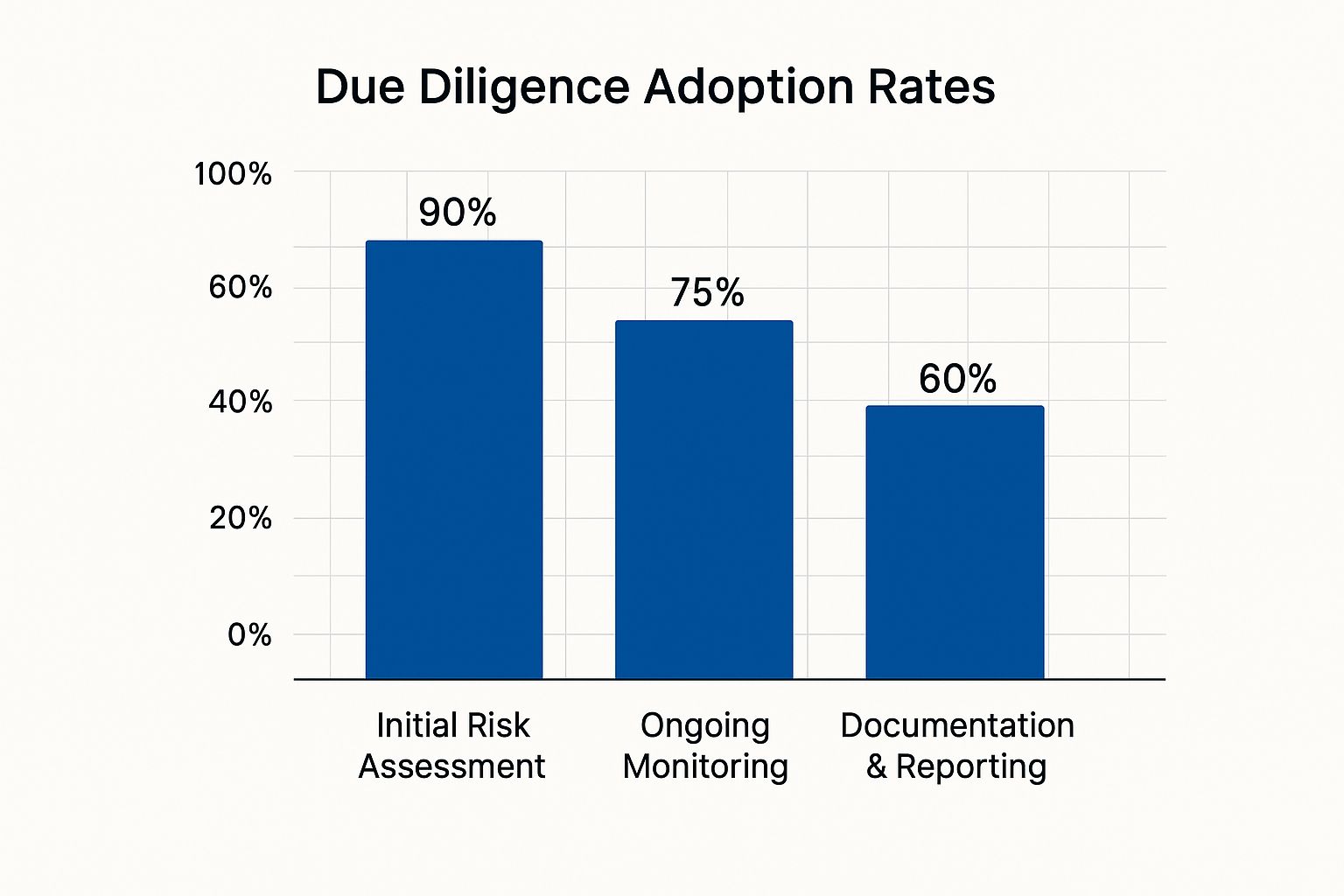
This infographic illustrates adoption rates for Initial Risk Assessment, Ongoing Monitoring, and Documentation & Reporting. While most businesses conduct initial risk assessments, fewer engage in ongoing monitoring and documentation, highlighting an area needing improvement in many programs. Also read: How to master compliance.
Indian businesses with international partnerships face the challenge of harmonizing compliance across jurisdictions. A centralized due diligence framework incorporating global best practices while addressing local regulations can be effective. This requires clear communication, collaboration, and suitable technology solutions. This approach not only strengthens compliance but also improves operational efficiency by streamlining processes.
To help summarize key Indian regulations, the following table provides further detail:
Key Indian Regulatory Requirements for Third Party Due Diligence
This table outlines major Indian regulations affecting third party due diligence processes, the specific requirements each regulation imposes, and which industries are most impacted.
| Regulation | Key Requirements | Affected Industries | Penalty for Non-Compliance |
|---|---|---|---|
| Companies Act 2013 | Emphasizes corporate governance, requiring companies to demonstrate adequate oversight of third-party relationships. | All companies registered in India | Fines, penalties, and potential legal action. |
| Prevention of Money Laundering Act (PMLA) | Mandates robust due diligence measures to prevent money laundering activities through third parties. | Financial institutions, designated non-financial businesses and professions (DNFBPs) | Severe penalties, including imprisonment. |
| Foreign Corrupt Practices Act (FCPA) (for US subsidiaries) | Prohibits bribery of foreign officials and requires companies to maintain accurate books and records, impacting third-party interactions. | Subsidiaries of US companies operating in India | Substantial fines and potential criminal charges. |
| Reserve Bank of India (RBI) guidelines | Provides specific instructions for vendor management and outsourcing, particularly relevant for financial institutions. | Banks, financial institutions, and other regulated entities. | Reprimands, penalties, and restrictions on business operations. |
This table underscores the importance of understanding and complying with these regulations when conducting third-party due diligence in India. Failing to do so can lead to significant penalties and damage a company’s reputation.
Creating Your Third Party Due Diligence Framework That Works

Building a robust third party due diligence framework is essential for businesses in India. It’s not just about checking off requirements; it’s about building a system that truly protects your business while remaining practical and efficient. This section explores creating a framework that balances both comprehensive coverage and operational effectiveness.
Implementing a Risk-Based System
A risk-based approach is crucial for an effective framework. This means focusing resources where they matter most: high-risk third parties. Imagine prioritizing security checks based on the sensitivity of the data being accessed.
A data storage provider handling sensitive financial data requires more scrutiny than a stationery supplier. This targeted approach helps streamline the process and ensures in-depth checks where needed.
You might be interested in: How to master Fintech due diligence.
This focused strategy improves efficiency, avoiding unnecessary delays when onboarding new vendors. It allows your team to allocate time and resources effectively.
Designing Effective Screening Protocols
Screening protocols should be tailored to the Indian business context. Understanding local regulations and business practices is key. For instance, verifying addresses in India can be complex, sometimes needing on-the-ground verification.
Targeted questionnaires: Create questionnaires that address specific risks related to each third party’s role. This uncovers potential issues generic questionnaires might miss.
Verification of Information: Use robust verification methods tailored to India. This might include independent background checks or using technology for digital document verification. SpringVerify is one such platform that facilitates this process.
Clear escalation procedures: Define clear steps for escalating issues if red flags arise during screening. This ensures prompt action and minimizes potential damage.
Building a Framework for Different Needs
Your due diligence framework should be adaptable to your specific business needs. A startup might prioritize speed and cost-effectiveness, while a large enterprise needs scalability and integration with existing systems like their HRMS.
Practical Templates and Examples
To get started, consider practical templates and real-world examples. A financial institution might focus heavily on anti-money laundering checks, while a healthcare provider prioritizes data privacy compliance.
These examples offer a starting point. By adapting these templates to your specific circumstances, you can create a program that genuinely protects your business.
Leveraging Technology to Transform Third Party Due Diligence
Technology is reshaping how Indian businesses conduct third-party due diligence. Instead of relying solely on basic checklists, companies are adopting new solutions to bolster their risk management strategies. This change is driven by increasingly complex supply chains and mounting regulatory scrutiny.
The Reserve Bank of India’s (RBI) guidelines for banks and Non-Banking Financial Companies (NBFCs) highlight the need for rigorous due diligence of vendors and outsourcing partners. This focus aims to reduce operational and reputational risks. Learn more about RBI guidelines here. As a result, companies must adopt more effective and thorough methods to ensure they comply with these regulations.
Specialized Platforms vs. All-in-One Solutions
Selecting the right technology is paramount. Specialized platforms concentrate on particular areas of due diligence, like Know Your Customer (KYC)/Anti-Money Laundering (AML) or cybersecurity, providing in-depth expertise. All-in-one solutions offer a wider array of functions but may lack the same level of specialization.
The ideal choice depends on the specific requirements of each business. For instance, a fintech startup might prioritize KYC/AML compliance, whereas a large manufacturer may require a more comprehensive solution encompassing supply chain risks.
Balancing Automation with Human Expertise
While automation improves efficiency, human oversight remains essential. Technology can automate routine tasks like document verification and data gathering, allowing human resources to concentrate on intricate risk assessments. Think of technology as a high-powered tool: it requires a skilled operator to wield it effectively.
This balance ensures meticulous due diligence and maximizes efficiency. It empowers compliance teams to address subtle risks that automated systems could overlook.
Continuous Monitoring and Emerging Risks
Technology also facilitates continuous monitoring of third parties. Rather than performing one-time checks, businesses can track ongoing shifts in risk profiles. This proactive strategy helps identify and address emerging risks before they escalate into significant problems.
This is particularly vital in India’s dynamic business environment, where regulations and market conditions can change quickly. Early detection enables prompt intervention and mitigation.
Data Privacy and India’s Digital Landscape
Implementing new technologies also requires careful consideration of data privacy. India’s evolving digital regulations mandate strict adherence to data protection laws. Businesses must ensure their chosen solutions comply with these regulations, protecting sensitive information while conducting successful due diligence.
This safeguards both the business and its partners. Prioritizing data privacy fosters trust and showcases a commitment to ethical business practices.
Turning Risk Assessment into Strategic Third Party Management

Moving beyond simple checklists, third party due diligence becomes a powerful tool. It helps you understand the risks linked to your business partners and turn that knowledge into a competitive edge. This means identifying, measuring, and reducing potential problems that could affect your business.
Frameworks for Assessing Third Party Risk
Several frameworks help assess the different aspects of third-party risk. These frameworks provide a structured way to evaluate partners across various risk categories. It’s like having a blueprint when building a house – it ensures a solid foundation. Similarly, a framework creates a strong structure for due diligence.
Financial Stability: Analyze financial reports, credit history, and debt levels. This helps determine a partner’s long-term viability and the chances of future disruptions.
Operational Resilience: Examine a partner’s infrastructure, processes, and disaster recovery plans. This helps understand their ability to handle disruptions and keep services running smoothly.
Compliance Posture: Evaluate adherence to relevant laws, such as data privacy and anti-bribery rules. This helps minimize legal problems and damage to your reputation.
Reputational Factors: Assess public opinion, media coverage, and any past controversies. This gives insights into the potential reputational impact of partnering with specific entities.
Developing Meaningful Risk Profiles
Using these frameworks lets you create detailed risk profiles for each third party. This goes beyond basic pass/fail checks. It’s more like a credit score, offering a nuanced view of a partner’s risk, which allows for better decisions. This information becomes valuable in negotiations, contract terms, and ongoing relationship management.
For instance, a partner with strong finances but weak cybersecurity may need specific contract clauses about data protection. Explore how a strategic technology approach can improve your processes, just like a well-defined digital transformation roadmap helps successful third-party risk management. This method tailors risk management to each partnership.
Practical Approaches for the Indian Context
Verifying information in the Indian market can be difficult. Limited transparency and complex regulations require specific strategies. This often means looking beyond easily accessible data and using techniques designed for the local business environment.
On-the-Ground Verification: Sometimes, physically checking addresses or business operations is necessary. This confirms accuracy and builds trust in the gathered information.
Local Expertise: Working with local experts provides insights into market dynamics and regulatory details. They can help navigate complexities and find trustworthy information. You might be interested in: How to master global database verification.
Quantifying Risk: Putting risk into financial terms helps decision-makers understand the potential impact of different situations. For example, estimating potential losses from a partner’s financial instability can inform investment and contingency plans.
Implementing appropriate controls is also essential. This means setting up safeguards that protect your business without making operations inefficient. Finding the right balance is key. Strict controls can slow things down, while weak controls increase risk. Increased enforcement actions are driving better due diligence. Since 2019, Indian regulators have fined firms over INR 250 crore for poor third-party risk management. This shows that third-party due diligence is not just a compliance box to check, but a vital risk management tool in India. Discover more insights about this trend here. Achieving this balance is crucial for success in the Indian market.
Before we delve further, let’s look at a practical tool to aid in your risk assessment process.
The following table provides a framework for assessing third-party risk, tailored for organizations operating within the Indian business landscape.
Third Party Risk Assessment Matrix for Indian Organizations
| Risk Category | Assessment Criteria | Risk Level | Mitigation Strategies | Monitoring Frequency |
|---|---|---|---|---|
| Financial Stability | Credit history, financial statements, debt levels | Low, Medium, High | Negotiate favorable payment terms, require financial guarantees | Annual/Bi-Annual |
| Operational Resilience | Disaster recovery plans, business continuity measures, IT infrastructure | Low, Medium, High | Implement service level agreements (SLAs), conduct regular audits | Quarterly/Bi-Annual |
| Compliance Posture | Adherence to data privacy laws, anti-bribery policies, industry regulations | Low, Medium, High | Mandatory training, contractual obligations, independent audits | Annual/ Ongoing |
| Reputational Factors | Public perception, media coverage, history of controversies | Low, Medium, High | Due diligence reviews, background checks, public relations strategies | Ongoing/ As Needed |
This table helps visualize the different risk categories and their corresponding assessment criteria. It also suggests mitigation strategies and monitoring frequencies based on the identified risk level. This framework allows organizations to prioritize their efforts and allocate resources effectively based on the potential impact of each risk category. By regularly monitoring and updating this matrix, businesses can proactively manage third-party risks and maintain a strong risk management posture.
Building Sustainable Third Party Relationships That Last
Third-party due diligence isn’t a one-time event. It’s an ongoing process that needs consistent attention and adaptation throughout the relationship lifecycle. Maintaining effective oversight after the initial screening is the real challenge for businesses in India. This section focuses on building robust, long-lasting relationships with third parties.
Continuous Monitoring Without Bureaucracy
Leading Indian organizations have found ways to maintain continuous monitoring without generating mountains of paperwork. This is essential in India’s dynamic business environment. For example, automated alerts can immediately flag changes in a vendor’s financial status or compliance standing, enabling swift action instead of relying on periodic reviews.
Performance Indicators: Develop specific, measurable, achievable, relevant, and time-bound (SMART) performance indicators for each third party. These metrics provide objective data on how well the partner is performing against expectations.
Risk-Based Reassessments: Regularly reassess third parties based on their risk profiles. Higher-risk relationships require more frequent reviews. This targeted approach focuses resources where they are most needed.
Effective Audit Protocols: Implement audit protocols that genuinely identify issues. Instead of relying solely on self-reported information, incorporate independent verification methods, especially for high-risk vendors.
Remediation and Exit Strategies
When problems inevitably arise, having clear remediation strategies is critical. This includes:
Defined Processes: Clearly outline the steps for addressing non-compliance or performance issues. This ensures a consistent approach and promotes timely resolution.
Communication Channels: Establish clear communication protocols for notifying the third party of the problem and collaborating to find a solution. Open communication is key.
Exit Planning: For high-risk relationships, develop a comprehensive exit plan in case the partnership becomes unsustainable. This protects your business from unforeseen disruptions.
Fostering Compliance Through Communication
Maintaining open communication with third parties is essential for fostering a culture of compliance. This requires a delicate balance: enforcing standards without damaging the business relationship.
Regular Updates: Keep partners informed about regulatory changes and internal policy updates that affect them. This proactive approach promotes compliance.
Training and Support: Provide the necessary training and resources to help third parties understand and meet your compliance requirements. This can include workshops, online tutorials, or dedicated support channels.
Collaborative Approach: Frame compliance as a shared responsibility. This fosters a sense of partnership and encourages third parties to take ownership of their compliance obligations.
Building a Culture of Compliance
Extending a culture of compliance beyond your organization to your entire third-party network is fundamental for long-term success.
Code of Conduct: Share your code of conduct with third parties and ensure they understand your ethical expectations. This sets the foundation for a strong and ethical relationship.
Due Diligence Expectations: Clearly communicate your due diligence requirements to potential partners upfront. This attracts vendors committed to compliance from the outset.
Ongoing Feedback: Regularly solicit feedback from third parties about your due diligence processes. This facilitates continuous improvement and strengthens the partnership.
By implementing these strategies, businesses in India can build strong, enduring relationships with third parties built on trust, transparency, and a shared commitment to compliance. This approach not only mitigates risk but also creates a more resilient and ethical supply chain.
Ready to optimize your third-party due diligence process and build stronger, more sustainable relationships? SpringVerify offers comprehensive background verification services tailored to the Indian business landscape, helping you navigate the complexities of compliance and build trust with your partners. Visit SpringVerify today to learn more.


