

If you’ve ever heard the term TAT in a business meeting and wondered what it stands for, especially in HR, you’re not alone. The simple answer is Turnaround Time. But that simple phrase carries a lot of weight, representing the total time it takes for any HR process to go from start to finish.
Think of it as the ultimate measure of your HR team’s efficiency.
What Does Turnaround Time Really Mean?

Let’s use a simple analogy: hiring is like a relay race. The starting gun fires the moment a manager gets approval for a new role. The race isn’t over until that new employee is officially onboarded and ready to go. Every step in between—sourcing candidates, screening résumés, conducting interviews, and making an offer—is one leg of that race. Turnaround Time is the final time on the stopwatch.
In India’s incredibly competitive job market, a fast race time means you snap up the best talent before your competitors have even tied their laces. A slow TAT, on the other hand, means watching great candidates walk away because they simply won’t wait around.
This isn’t just another piece of corporate jargon; it’s a vital sign of your company’s operational health. TAT in the human resources world gives you a clear picture of your entire recruitment cycle, from the first job post to the final onboarding. In a market where every day counts, shortening this cycle brings some serious advantages:
- A Better Candidate Experience: No one likes being left in the dark. A shorter process keeps your top candidates engaged and excited about the opportunity.
- Lower Recruitment Costs: Filling a role quickly means less money spent on advertising and less productivity lost from an empty seat. It’s a direct impact on the bottom line.
- Quicker Business Growth: When you can hire efficiently, you can scale your teams and respond to market demands much faster.
For any modern HR team, getting a handle on TAT is a top priority. By actively measuring and working to improve it, you’re not just speeding things up—you’re building a real competitive edge in the war for talent.
Table of Contents
Why Turnaround Time Is a Strategic Business Advantage

In a market where talent is everything, getting your hiring Turnaround Time right isn’t just an HR metric to track—it’s a core business strategy that directly hits your bottom line. Speed in recruitment has shifted from a nice-to-have to an absolute necessity, especially in hyper-competitive Indian sectors like technology and finance.
Think of it this way: your top candidates are almost always entertaining multiple job offers at once. A slow, cumbersome hiring process is one of the surest ways to lose their interest and push them straight into the arms of a competitor who moves faster.
The Real Cost of a Slow Process
A long Turnaround Time creates serious risks that go far beyond the HR department. The knock-on effects can be felt across the entire organisation, causing very real, tangible setbacks.
Here’s what you’re up against:
- Losing Top Talent: The best candidates simply don’t stay on the market for long. A delayed process gives your competitors the perfect opening to snap up your ideal hire.
- Project Delays and Lost Revenue: Every single day a key role sits empty, important projects can grind to a halt. This impacts team morale, kills productivity, and can directly stall revenue-generating work.
- Damaged Employer Brand: Word gets around. A clunky, drawn-out hiring experience leaves a lasting bad impression, which can put off other great professionals from even applying to your company down the line.
In today’s market, speed is a clear signal of an organisation’s efficiency and decisiveness. A swift hiring process tells candidates you are organised, respect their time, and are serious about bringing them on board.
On the flip side, a fast and efficient process does so much more than just fill a vacancy. It actively builds your reputation as an employer of choice. It creates a positive candidate experience, turning applicants into brand advocates—even if they don’t get the job.
What’s more, slashing your hiring time has a direct impact on your cost-per-hire. Recent data shows that organisations with a high TAT saw their candidate acceptance rates drop by as much as 25%, a trend that has only intensified with the rise of remote work. Streamlining your process can lead to cost-per-hire savings of 10–20% by cutting down the time a role stays open and making your HR operations more efficient. You can find more insights on the new speed standard in tech hiring on Crescendo Global.
This is why understanding the TAT full form in HR and applying it strategically is a genuine competitive advantage.
How to Measure Your Hiring Turnaround Time
It’s an old saying, but it’s true: you can’t improve what you don’t measure. To really get a grip on your hiring cycle and shorten it, you first need to figure out where the time is actually going. The trick is to break down the total Turnaround Time into smaller, more specific chunks. This helps you pinpoint exactly which stages are creating frustrating delays.
Instead of just looking at one big number for the entire recruitment process, think of it as a series of distinct steps. Each step has its own TAT, and each one tells a story about your team’s efficiency. Calculating these individual times means you can stop guessing where the problems are and start knowing for sure.
Key Metrics for Calculation
To get started, let’s focus on two of the most important metrics in any hiring funnel: Time to Fill and Time to Hire. These calculations give you a clear, data-driven view of your process from slightly different angles, making it much easier to spot bottlenecks.
Let’s break down the most common TAT metrics in the hiring process. This table provides a simple formula for each and explains what the metric reveals about your recruitment efficiency.
Key TAT Metrics and Their Calculation
| TAT Metric | Calculation Formula | What It Measures |
|---|---|---|
| Time to Fill | Date of Candidate Acceptance – Date of Job Requisition Approval | The total time a job position stays open. This reflects the overall efficiency of your hiring process and its impact on the business. |
| Time to Hire | Date of Candidate Acceptance – Date Candidate Entered the Pipeline | The speed at which a candidate moves through your hiring funnel. This highlights how efficient your screening and interview stages are. |
Measuring these two metrics separately is vital. A high Time to Fill might tell you there are issues with sourcing candidates, while a high Time to Hire could point to slow interview feedback or scheduling problems.
By tracking these numbers, you can get a much clearer picture of what’s working and what isn’t. For a deeper dive into managing your candidate pipeline effectively, it’s worth exploring proven strategies for talent acquisition.
The image below lays out a simple, three-step cycle for improving your overall HR Turnaround Time.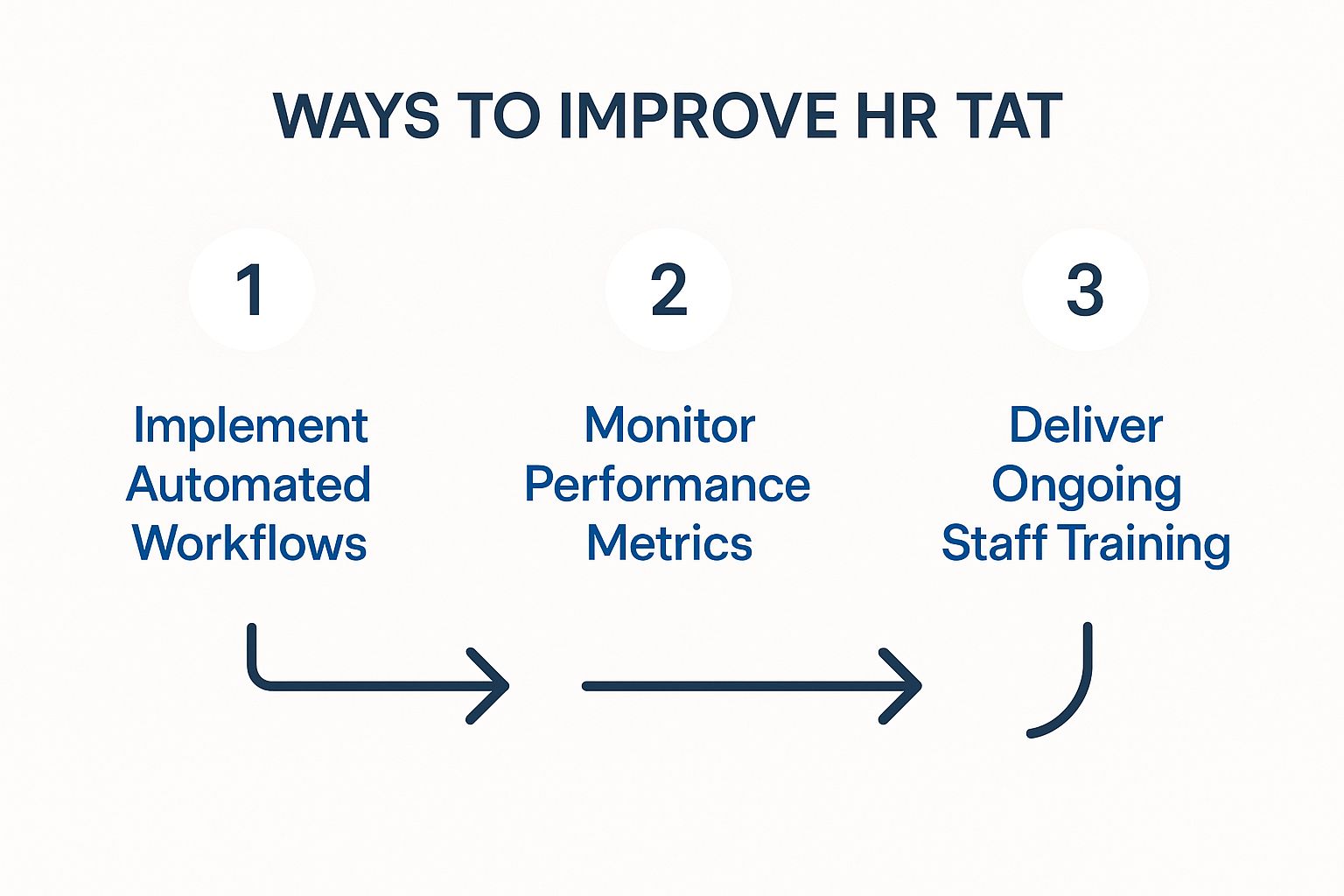
As you can see, improving TAT isn’t a one-time fix. It’s a continuous loop of implementing smart automation, keeping a close eye on performance metrics like the ones we just covered, and investing in ongoing training for your team.
Right, once you have the numbers in front of you, it’s time to play detective. A high Turnaround Time isn’t usually down to one big, obvious problem. It’s almost always a case of death by a thousand cuts—lots of small delays and friction points that stack up. The first real step to building a faster, more efficient hiring process is to hunt down these hidden bottlenecks.
Most organisations find they’re wrestling with the same handful of issues that push their TAT up. These problems often hide in plain sight, buried in the daily grind, slowly gumming up the works. But there’s good news: for every common problem, there’s a practical fix.
Uncovering Common Recruitment Bottlenecks
Let’s pull back the curtain on the usual suspects that drag out a hiring cycle. From messy screening to painfully slow feedback, these are the areas that trip up most HR teams and leave both recruiters and candidates feeling frustrated.
- A Disorganised Screening Process: Manually ploughing through hundreds of CVs for a popular role is a huge time-drain. This can easily become the first major logjam in your hiring funnel.
- Poor Communication with Hiring Managers: Things get chaotic when recruiters and hiring managers aren’t on the same page. Vague job descriptions, sporadic updates, and fuzzy expectations can stall the process for days, sometimes even weeks.
- Sluggish Feedback Loops: The time immediately after an interview is make-or-break. If hiring managers sit on their feedback for too long, your best candidates will lose interest and likely take another offer. Then you’re back to square one.
- Interview Scheduling Chaos: Trying to align the calendars of multiple interviewers with a candidate can feel like an impossible puzzle. The endless back-and-forth emails to find a time that works for everyone is a classic—and completely avoidable—delay.
A slow hiring process is more than just an internal headache; it’s a direct threat to landing top talent. In a competitive market, the company that can move decisively and shows it respects a candidate’s time will almost always come out on top.
Implementing Targeted Solutions
Fixing these snags doesn’t mean you need to tear everything down and start over. It’s about a targeted approach. Focus on a specific solution for each bottleneck you’ve identified. For instance, if screening is your main culprit, think about bringing in an Applicant Tracking System (ATS) to automatically filter CVs based on keywords. This alone can save your team countless hours.
If the real issue is slow feedback from hiring managers, the fix needs to be more structural. You could introduce clear Service Level Agreements (SLAs) that set firm expectations for feedback—say, a 24-hour window after every interview. This builds accountability and makes the standard clear for everyone. By tackling each weak link one by one, you can turn your recruitment process from a slow-moving liability into a genuine strategic advantage.
Proven Strategies to Reduce Your Hiring TAT

Fixing bottlenecks is just playing defence. If you really want to achieve and maintain a low hiring Turnaround Time without letting quality slip, you need to go on the offence. This isn’t about simply patching holes; it’s about building a hiring system that’s designed for speed and fairness right from the start.
The biggest time-sink in hiring? Starting from zero every single time a new role opens up. The solution is to build a proactive talent pipeline. This means connecting with talented people in your industry long before you need them, creating a ready-to-go pool of candidates who are already familiar with your brand.
When a position opens up, your team isn’t frantically searching for needles in a haystack. They’re dipping into a warm pool of pre-vetted talent. This simple shift can turn a chaotic search into a strategic matching exercise, shaving days or even weeks off your initial sourcing time.
Automate and Structure for Speed
Manual tasks are the natural enemy of an efficient hiring process. One of the best investments you can make is in a good Applicant Tracking System (ATS). It can automate the grunt work—like screening CVs, scheduling interviews, and sending updates—freeing up your recruiters to focus on the human side of hiring.
At the same time, it’s crucial to bring consistency to your interviews. Structured interviews, where every candidate for a role answers the same questions, are a game-changer. By scoring their responses against a clear rubric, you eliminate guesswork and gut feelings, which makes the final decision much faster and fairer.
Setting ambitious yet realistic TAT goals is key to driving improvement. A target of reducing your Time to Hire by 15% in the next quarter, for instance, gives your team a clear, measurable objective to work towards.
Finally, don’t let the final stages slow you down. Background checks can become a last-minute bottleneck if you’re not prepared. Using a reliable service for quick employment verification helps keep the momentum going, so you don’t risk losing a great candidate because of unnecessary delays.
By weaving these strategies together—a strong pipeline, smart automation, and consistent processes—you build a hiring engine that is not just fast, but consistently effective.
Frequently Asked Questions About HR Turnaround Time
Once you start looking at HR metrics, the practical questions quickly follow. Knowing the TAT full form in HR is one thing, but actually putting it to work is another. Let’s tackle some of the most common questions that pop up when optimising hiring speed in India.
What Is a Good Hiring TAT in India?
There’s no magic number here. A “good” Turnaround Time really depends on the industry you’re in and how complex the role is.
That said, some clear benchmarks are starting to take shape. For in-demand tech roles in hubs like Bengaluru or Hyderabad, a TAT of 3-7 days from application to offer is fast becoming the standard if you want to stay competitive. For non-tech roles or senior leadership positions, a timeline of 15-25 days is generally considered pretty efficient.
The real goal isn’t just to chase a specific number, but to be faster than the companies you’re competing with for the same talent.
The key is to measure your TAT against your specific industry and continuously seek improvement. A faster process gives you a distinct advantage in securing top candidates who often have multiple offers on the table.
Does Reducing TAT Mean Lowering Quality?
Not at all. In fact, it’s often the other way around. The point of cutting down TAT isn’t to rush important decisions; it’s about getting rid of the dead time and clumsy steps in your process.
A well-oiled hiring process can actually boost the quality of your hires. Here’s how:
- You engage top talent quickly, getting to them before they lose interest or take another job.
- You create a positive candidate experience, which naturally attracts better professionals to your company.
- You rely on structured interviews and clear criteria, which leads to fairer and more consistent decisions.
Think of it this way: a faster process means you’re fishing from a deeper, more qualified talent pool because the best candidates haven’t already been snapped up by someone else.
How Does Technology Help Reduce TAT?
This is where tools like an Applicant Tracking System (ATS) really shine. An ATS is designed to attack the bottlenecks in your hiring process by automating all the repetitive, manual work.
An ATS can screen résumés for keywords in seconds, send out automatic updates to keep candidates in the loop, and make scheduling interviews a breeze. All this automation frees up your recruiters to do what they do best: build relationships and make smart, strategic decisions. That alone can drastically speed up the entire hiring cycle.
Making informed hiring decisions quickly is crucial. SpringVerify provides prompt, accurate, and seamless background verification to ensure you can move forward with confidence without slowing down your hiring process. Learn more about our verification services at SpringVerify.


