

Table of Contents
Navigating India’s Evolving Talent Landscape
The Indian talent market is a whirlwind of activity. Traditional hiring methods are struggling, especially in fast-paced sectors like IT, manufacturing, and services. Companies need to rethink their strategies to snag the best candidates. Holding onto old-fashioned practices might mean losing out on top talent to competitors with more efficient processes.
Understanding the Shift in Hiring Preferences
Skilled professionals are in high demand in India, and what companies look for is changing. Streamlining the hiring process is key because of the competitive market. The India Hiring Intent Survey 2025 reveals some interesting trends. 47% of new hires have 1 to 5 years of experience. This shows a growing preference for early-career professionals who can be quickly trained. Only 14% of hires are fresh graduates, indicating a desire for professionals with some experience who can adapt quickly. Find more detailed statistics here. This calls for a faster, more efficient hiring process. For more insights, check out this resource on talent acquisition.
Measuring the Impact of Streamlining
A streamlined hiring process isn’t just about saving time and money; it’s also about creating a positive experience for candidates. The infographic below illustrates how streamlining affects key hiring metrics.
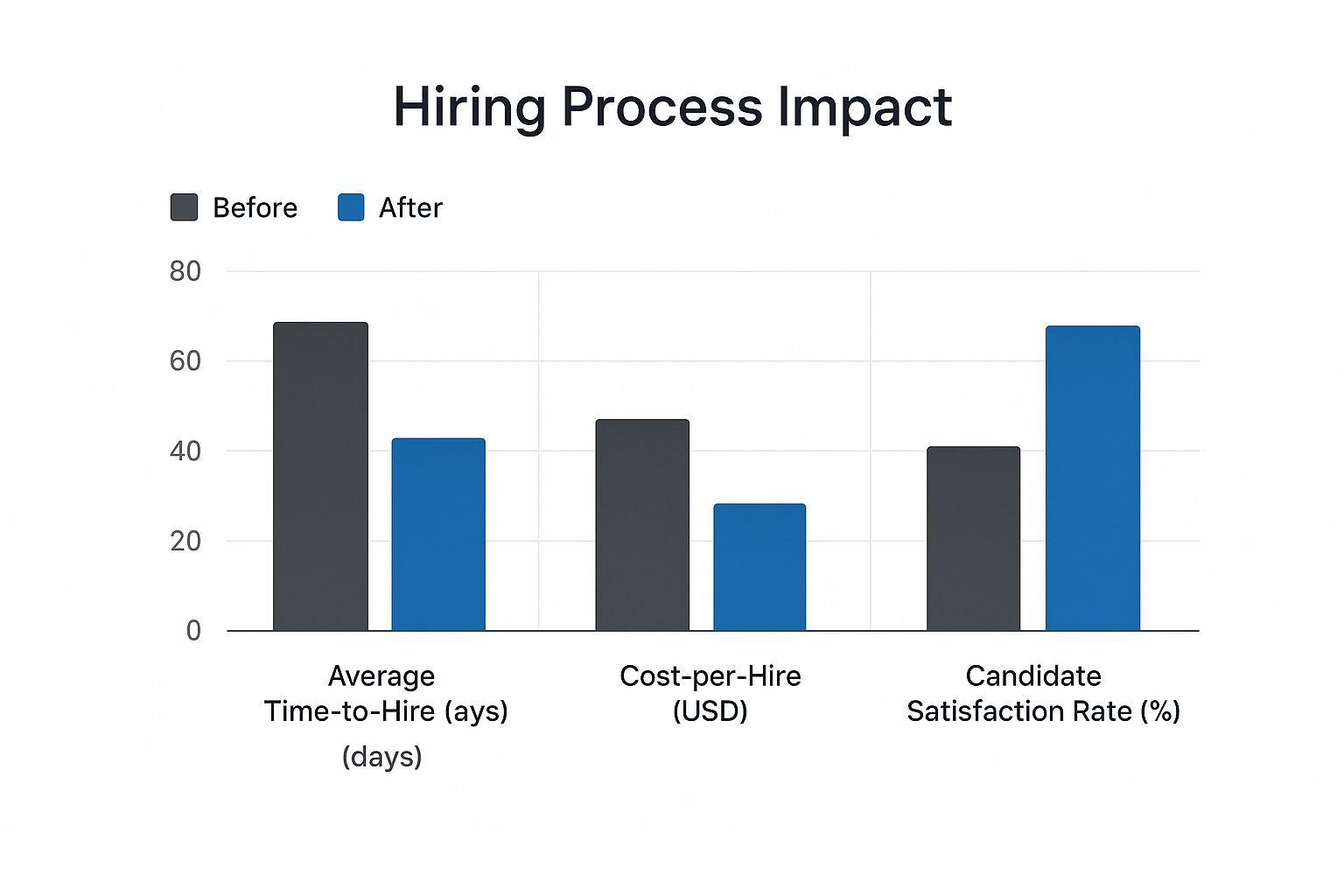
Streamlining greatly reduces time-to-hire and cost-per-hire, while boosting candidate satisfaction. These results highlight the need for efficient hiring in today’s market. Managing talent effectively also involves understanding how to overcome staffing challenges.
The following table provides a snapshot of the hiring distribution across experience levels, giving further insight into the current Indian job market.
Hiring Distribution by Experience Level in India
A breakdown of hiring patterns across different experience levels in the Indian job market
| Experience Level | Percentage of New Hires | Primary Industries |
|---|---|---|
| 0-1 year (Fresher) | 14% | IT, BPO, Sales |
| 1-5 years | 47% | IT, Manufacturing, Services |
| 5-10 years | 25% | Management, Specialized Roles |
| 10+ years | 14% | Leadership, Executive Roles |
This table summarizes the distribution of hiring across different experience levels, further emphasizing the current focus on professionals with 1-5 years of experience.
Embracing Technology and Automation
The demand for talent has pushed companies to adopt tech-driven recruitment strategies. AI-powered screening tools and data analytics help reduce time-to-hire and improve candidate selection. With over 650,000 new graduates entering the workforce every year, companies are automating resume screening and skill assessments. This creates a more streamlined, candidate-focused process. The goal is to minimize delays, reduce unnecessary interviews, and speed up onboarding—essential for competing in India’s rapidly growing industries. Automation lets HR teams focus on strategic initiatives. These advances are vital for navigating the Indian job market and making hiring smoother and more efficient.
Harnessing AI to Transform Candidate Screening

Artificial intelligence (AI) is rapidly changing how Indian companies recruit. It’s no longer a futuristic dream but a practical tool used to find and select the best candidates. This shift is driven by the need for more efficient processes and better hires. Let’s explore the tangible ways AI is impacting recruitment.
AI-Powered Resume Parsing: Deciphering the Data Deluge
Recruiters often spend countless hours sifting through mountains of resumes. AI-powered resume parsing offers a solution. This technology automatically extracts important details like skills, experience, and education, creating a searchable database.
This eliminates manual data entry, saving recruiters significant time. They can quickly identify candidates who meet the job requirements. For example, if a company needs a software engineer proficient in Python, the AI can instantly pinpoint candidates who list this skill. This allows recruiters to focus on strategic tasks rather than tedious administrative work.
Behavioral Assessment Algorithms: Predicting On-the-Job Success
Technical skills and experience are only part of the equation. A candidate’s personality and behavior also play a crucial role in their success. AI-powered behavioral assessment tools analyze candidate responses to predict their on-the-job performance.
These tools assess crucial soft skills like teamwork and communication, helping companies find candidates who are not only qualified but also a good cultural fit. This adds an important layer of objectivity to the screening process. Looking to expand your talent pool? Consider the advantages of remote talent acquisition in India’s dynamic job market.
India-Specific AI Implementations: Addressing Local Challenges
The Indian job market has unique characteristics, including diverse applicant backgrounds and multilingual requirements. AI solutions are evolving to address these nuances. New tools are being developed to process resumes in multiple Indian languages and assess candidates from various educational and professional backgrounds. This promotes fair and equitable evaluation for everyone.
India’s job market is booming. Technological advancements and sectoral growth are expected to generate a 15-20% increase in job opportunities by 2025. The recruitment industry anticipates roughly 500,000 new openings this year alone. Read more about India’s recruitment outlook. This surge in demand makes efficient screening essential.
AI isn’t just for large corporations. Mid-sized companies are also adopting these technologies to improve their hiring processes without breaking the bank. By implementing AI-powered screening, businesses can drastically reduce hiring timelines, secure top talent, and gain a competitive edge.
Building an Interview Process That Actually Works
Many interview processes are inefficient and frustrating. This section explains how to build a structured, yet flexible, interview framework that works within the Indian context. You’ll discover how to sequence assessments effectively, develop culturally relevant evaluation criteria, and reduce the number of interview rounds without sacrificing thoroughness, ultimately leading to better hiring results.
Structuring Your Interview Framework
A well-structured interview process is essential for efficient hiring. Think of it as a well-designed machine, with each component operating seamlessly with the others. Start by defining clear objectives for each interview stage.
For instance, your initial screening could concentrate on basic qualifications and experience. Subsequent rounds can then dive deeper into specific technical skills, personality traits, and cultural fit. This focused approach not only saves time but also provides a consistent experience for every candidate. For further insights into effective human resource practices, consider this resource: How to master human resources.
Sequencing Assessment Formats for Maximum Impact
The sequence of your assessments significantly impacts your hiring efficiency. Start with less demanding assessments, like resume screenings and initial shortlisting. Then, move towards more comprehensive evaluations, such as technical tests or behavioral interviews.
This progressive approach efficiently filters candidates at each step. Imagine conducting a technical skills assessment before a cultural fit interview. This sequence allows you to quickly identify and remove candidates lacking the necessary technical skills, ensuring that only the most qualified individuals progress to later interview rounds.
Developing Culturally Sensitive Evaluation Criteria
India’s rich cultural diversity requires careful consideration during the interview process. Your evaluation criteria should acknowledge and respect these cultural nuances. Factors like communication style and preferred teamwork approaches can vary significantly across regions and backgrounds.
It’s essential to develop evaluation criteria that are both relevant to the job requirements and sensitive to these cultural differences. This approach ensures a fair and objective assessment of every candidate, minimizing unconscious bias and promoting diversity within your organization.
Training Your Interviewers for Better Outcomes
Even with a streamlined process, interviewer bias can inadvertently influence decisions. Investing in interviewer training is paramount. This training should cover a wide range of topics, from conducting structured interviews to recognizing and mitigating unconscious biases.
Well-trained interviewers can effectively identify high-potential candidates while providing a positive candidate experience. This not only improves the quality of hires but also strengthens your employer brand, giving you an edge in a competitive talent market.
Standardizing Scorecards for Objective Evaluations
Standardized scorecards are key to promoting objectivity. These scorecards should outline specific criteria and establish consistent rating scales for every stage of the interview process. This structured approach helps eliminate subjective opinions and ensures fairness in assessing all applicants.
Furthermore, standardized scorecards can reveal insightful patterns in your hiring decisions, providing valuable data for continuous improvement and refinement of your interview process. By implementing these strategies, you can create an interview process that is both effective and efficient, enabling you to attract and secure top talent in India’s dynamic job market.
Turning Recruitment Data Into Strategic Advantage
Data is the lifeblood of successful recruitment. Forward-thinking Indian companies are moving beyond simply tracking applicants. They’re using data to transform their entire hiring process, making smarter decisions that save time and resources.
Identifying Key Metrics and Building Actionable Dashboards
Understanding key metrics is the first step. Time-to-hire, cost-per-hire, and quality-of-hire are essential. But don’t overlook source-of-hire or candidate drop-off rates. These metrics can reveal hidden bottlenecks.
For example, a long time-to-hire might be due to a lengthy interview process or slow background checks. Analyzing each stage pinpoints delays. A dashboard visualizing these metrics allows quick identification of areas for improvement. Tools like Tableau can help create insightful and actionable dashboards.
Predictive Analytics: Forecasting Hiring Needs and Optimizing Job Descriptions
Data can predict future hiring needs. By analyzing historical hiring data, you can anticipate staffing requirements and proactively begin recruitment. This foresight helps fill open positions quickly, avoiding costly delays.
Data also optimizes job descriptions. Tracking which keywords and phrases attract qualified candidates allows you to tailor postings for maximum impact, attracting better-fit applicants and streamlining your screening process. India’s job market is projected for significant growth, making data-driven strategies even more crucial. A recent survey indicated 96% of employers plan to increase hiring in early 2025. Find more detailed statistics here
Navigating Data Compliance in India: Implementing Practical Approaches
When handling candidate data, compliance with Indian regulations is paramount. This includes adhering to data privacy laws and ensuring secure data storage. Failing to comply can lead to penalties and damage your reputation. Addressing these requirements from the outset is crucial.
Implementing data-driven recruitment doesn’t require massive resources. Start small, focusing on a few key metrics and gradually building your analytics capabilities. Even simple spreadsheets can offer valuable insights. As your organization grows, explore more advanced tools like Power BI. This measured approach unlocks the power of data, transforming your hiring process into a strategic advantage.
The following table highlights essential recruitment metrics and improvement strategies.
Essential Recruitment Metrics for Process Optimization: Key performance indicators that help identify bottlenecks and opportunities in the hiring process.
| Metric | Description | Target Benchmark | Improvement Strategy |
|---|---|---|---|
| Time-to-Hire | Time taken to fill a position | Industry average or company best | Automate screening, streamline interviews |
| Cost-per-Hire | Total cost of hiring a new employee | Industry average or company best | Optimize sourcing channels, leverage internal referrals |
| Quality-of-Hire | Performance of new hires | Performance reviews, manager feedback | Improve candidate assessment, refine job descriptions |
| Source-of-Hire | Where successful candidates originate | Track applications by source | Focus on high-performing channels |
| Candidate Drop-off Rate | Percentage of candidates who leave the hiring process | Track drop-off points at each stage | Improve communication, enhance candidate experience |
This table provides a starting point for optimizing your recruitment process. By tracking these metrics and implementing targeted strategies, you can significantly improve your hiring outcomes. This data-driven approach ensures you’re not just filling positions, but strategically building a high-performing team.
Mastering Candidate Communication That Converts

Poor communication is a significant challenge for job seekers in India. This can negatively impact the candidate experience and potentially damage your employer brand. However, many companies are discovering effective strategies to enhance communication while simultaneously reducing the workload on their HR teams. Let’s explore how to optimize your hiring process by improving the effectiveness of your candidate communication.
Automating Communication While Maintaining a Personal Touch
Automation is essential for streamlining the hiring process. However, it’s vital to maintain a personal touch, which is highly valued by candidates in India. AI-powered chatbots, for example, can handle routine inquiries, freeing up your HR team for more strategic tasks.
This ensures candidates receive prompt responses without requiring constant human intervention. This balance of efficiency and personalized interaction is crucial for a positive candidate experience.
Additionally, automated email sequences can keep candidates informed throughout the hiring journey. These sequences can be tailored to reflect cultural nuances and provide personalized updates. This demonstrates to candidates that they are valued.
This personalized approach can significantly improve the candidate experience and reduce drop-off rates. By showing genuine interest in each candidate, you build a stronger connection and encourage them to stay engaged.
Designing Communication Workflows That Eliminate the “Black Hole”
Many applicants experience the frustration of the “application black hole,” where they never receive a response after submitting their resume. This is not only disappointing for candidates but also reflects poorly on your company’s image. Designing clear communication workflows eliminates this problem.
Every stage of the process, from application acknowledgment to interview scheduling and final decision, should trigger an automated communication to the candidate. This transparency keeps them informed and engaged, improving their experience and bolstering your employer brand.
This consistent communication builds trust and fosters a positive relationship with potential hires. By keeping candidates in the loop, you demonstrate respect for their time and interest in the opportunity.
Ready-to-Use Templates and Implementation Strategies
Creating effective communication doesn’t have to be a drain on resources. Utilizing ready-to-use templates for emails and chatbot responses can save your HR team valuable time and effort. These templates can be easily customized to align with your company’s specific needs and branding.
Implementing these strategies doesn’t require a complete system overhaul. Start by identifying the key communication touchpoints in your existing hiring process. Then, gradually introduce automation and templates, ensuring they complement your overall hiring strategy.
For seamless integration with your current systems, consider SpringVerify’s powerful API. This can help streamline your background verification process and further enhance your hiring workflow. By mastering candidate communication, you can transform your hiring process into a positive and efficient experience for both your candidates and your HR team.
Reimagining Skill Assessment for the Modern Workforce
Traditional skill verification methods often disappoint both companies and candidates. This gap highlights the need for more effective evaluation strategies. Let’s explore how Indian organizations are modernizing skill assessment to improve their hiring processes.
Task-Based Assessments: Predicting On-The-Job Performance
Instead of relying solely on resumes and interviews, task-based assessments provide a more practical approach. These assessments require candidates to perform tasks mirroring real-world job responsibilities.
For example, a software developer might debug a piece of code, while a content writer might draft a short blog post. This hands-on approach offers valuable insights into a candidate’s abilities, predicting their potential on-the-job performance more accurately than traditional methods.
Engaging Skill Challenges: Attracting Top Candidates
The best candidates seek engaging and challenging experiences. Traditional assessments can sometimes feel tedious and outdated. Skill challenges, designed to be both stimulating and job-relevant, offer a compelling alternative.
These challenges allow candidates to demonstrate their creativity and problem-solving skills in a dynamic setting. This positive experience not only assesses skills but also attracts top-tier candidates who value innovative evaluation methods. In a competitive talent market, skill challenges can be a crucial differentiator.
Leveraging Digital Credentials For Streamlined Verification
Verifying credentials can be a lengthy process. Digital credentials provide a faster, more secure solution. These verifiable digital certificates streamline verification, reducing administrative work and boosting efficiency.
This allows HR teams to quickly validate qualifications, speeding up hiring. This automation eliminates manual verification, minimizing delays and improving the candidate experience. Digital credentials are transforming today’s fast-paced hiring environment.
Unifying Technical and Cultural Fit Assessments
Forward-thinking companies are moving beyond separate assessments. They’re combining technical evaluations with cultural fit assessments into unified frameworks, respecting candidates’ time while gathering more insightful information than traditional interviews.
This integrated approach allows companies to efficiently evaluate both skills and cultural fit. This leads to better hiring decisions, increased job satisfaction, and lower turnover. This streamlined method allows for informed hiring decisions while respecting everyone’s time. For dependable and efficient background verification solutions tailored to the Indian market, explore the services offered by SpringVerify. They provide comprehensive solutions for businesses of all sizes, helping you build a successful team.
Building a Recruitment Tech Stack That Actually Works
The right technology can completely overhaul a clunky hiring process, turning it into a smooth, efficient operation. Instead of getting caught up in flashy vendor promises, let’s focus on solutions that deliver tangible results for Indian companies. This involves understanding how to create an integrated system that minimizes tedious manual tasks and breaks down information silos.
This streamlined approach significantly boosts efficiency, allowing your team to concentrate on strategic activities.
Selecting the Right Applicant Tracking System (ATS)
An Applicant Tracking System (ATS) is the heart of your recruitment tech stack. Choosing the correct one is paramount. Whether you’re a small startup or a large corporation, look for an ATS that aligns with your company’s specific requirements. For more information on how different HR systems connect, check out our guide on API integrations.
A good ATS should effectively manage job postings, track applicants, and automate communication. Important features to consider include mobile compatibility and seamless integration with other platforms. These features ensure a smooth and efficient process from beginning to end. A well-chosen ATS is the foundation of a successful recruitment tech stack.
Implementing Smart Integrations Between Platforms
A standalone ATS isn’t sufficient. Integrating it with other vital platforms, such as background check providers like SpringVerify and video interviewing tools, is crucial. This seamless information flow eliminates duplicate data entry and accelerates the entire hiring process.
For instance, integrating your ATS with a background check service enables automated verification as soon as a candidate accepts a job offer. This eliminates manual steps and ensures a faster onboarding experience.
Creating Seamless Workflows From Sourcing Through Onboarding
The ultimate objective is to create a frictionless experience for candidates, from initial sourcing to their first day at work. This involves automating tasks whenever possible and establishing clear, consistent workflows. Think of it as building a streamlined assembly line for your hiring process.
This approach minimizes manual errors, saves valuable time, and creates a more positive experience for everyone involved. Automated onboarding workflows, for example, can handle paperwork and introductions, freeing up HR professionals to focus on developing relationships with new hires. This emphasis on automation and efficiency enhances the experience for both the candidate and the hiring team.
Ready to revamp your hiring process? SpringVerify provides comprehensive background verification services specifically designed for Indian companies. Visit SpringVerify to discover how we can assist you in building a successful team.


