

Table of Contents
Understanding When Simplified Due Diligence Actually Works
Let’s cut through the compliance jargon for a moment. When you hear simplified due diligence, don’t think “cutting corners.” Think “smarter, risk-based verification.” It’s about focusing your most intense efforts where they truly matter and making checks more efficient for demonstrably low-risk situations. Many organisations struggle with this idea, fearing that simplifying any process might attract regulatory attention. The reality is often the opposite: a well-defined, risk-based approach is exactly what regulators want to see.
The main idea is to confidently identify customer segments and transaction types where the potential for money laundering or terrorist financing is exceptionally low. This isn’t a gut feeling; it’s a conclusion backed by data. For example, dealing with publicly listed companies on a recognised stock exchange or government bodies often qualifies for simplified procedures. Their ownership and financial activities are already subject to strict public disclosure and regulatory oversight, which significantly reduces their risk profile from the start.
Identifying Low-Risk Scenarios
So, what does a low-risk customer look like in practice? It’s less about one specific trait and more about a combination of factors that, together, paint a picture of minimal threat. To approach this methodically, using a proven due diligence checklist template can be incredibly helpful for a systematic business evaluation.
Consider these common examples of low-risk indicators:
- Customer Type: Public administrations, government agencies, or companies subject to public disclosure requirements.
- Product/Service Risk: Products with low transaction limits or those that don’t allow anonymous fund transfers, like certain types of insurance policies or small-scale e-money products.
- Geographic Location: Customers residing in and operating from jurisdictions with strong and effective Anti-Money Laundering (AML) systems.
- Transaction Nature: Small, regular transactions that fit a predictable pattern, such as monthly utility bill payments.
In India, these measures have become central to compliance frameworks, especially as authorities aim to balance regulatory strictness with operational efficiency. Recent budget changes highlight this trend toward making compliance less of a burden for businesses where risks are low. Exploring these regulatory shifts can help you understand how the landscape is changing for Indian businesses.
Traditional vs. Simplified Due Diligence
The difference in workload and speed between traditional and simplified due diligence is substantial. Companies that correctly apply simplified approaches have reported cutting their compliance workload by up to 60% for low-risk segments, all while keeping perfect audit records. This isn’t just about saving time; it’s about reallocating your most valuable resources—your compliance experts—to focus on high-risk cases that need real investigation.
To see the difference clearly, let’s compare the two approaches side-by-side.
Traditional vs Simplified Due Diligence Comparison
A side-by-side comparison showing the key differences between traditional and simplified due diligence approaches across various parameters
| Parameter | Traditional Due Diligence | Simplified Due Diligence | Time Savings |
|---|---|---|---|
| Identity Verification | In-depth check of multiple documents, UBOs, etc. | Basic identity verification from a reliable source. | High |
| Source of Funds | Detailed investigation and documentation needed. | Generally not required; assumed to be legitimate. | Very High |
| Ongoing Monitoring | Frequent and intensive transaction monitoring. | Standard monitoring for any deviation from the profile. | Moderate |
| Documentation | Extensive record-keeping of all checks performed. | Minimal documentation needed to justify the SDD approach. | High |
As you can see, the time savings are significant, especially in areas like sourcing funds and identity verification.
The ability to programmatically distinguish between these workflows is key to modern compliance. For example, an API can be set up to trigger different verification paths based on initial data points.
This screenshot shows how different API endpoints can be used to start specific checks, allowing for a flexible, risk-based approach right from the integration stage. By calling a lighter verification endpoint for a client you’ve already assessed as low-risk, you can automate the simplified due diligence process efficiently.
Designing Your Compliance Workflow Architecture
Before you even think about writing a single line of code, the real work happens on the drawing board. Successful simplified due diligence is built on a foundation of thoughtful workflow design. This planning phase is what separates an efficient, audit-proof system from an expensive, frustrating mess. It’s where smart organisations invest their time, and it always shows.
The goal is to map out every decision, data point, and potential path a customer verification might take. Think of it like designing a city’s road network. You need main highways for high-volume, low-risk traffic (your simplified workflow), but you also need smaller roads and clear exit ramps for cases that need a closer look (enhanced due diligence). Without this map, you’ll just create compliance traffic jams.
Mapping Your Current Process and Bottlenecks
First, take an honest look at your current setup. Where do things slow down? What tasks consume most of your team’s time? A classic bottleneck is the manual handoff between initial data collection and the actual verification. Your team might be spending hours just chasing down missing documents or re-entering data from one system into another.
For example, a mid-sized fintech firm we worked with found that 40% of their compliance team’s day was spent just preparing cases for review. They were manually pulling together customer-submitted information with data from internal systems before a single check even started. By pinpointing this specific bottleneck, they knew exactly where automation would make the biggest difference.
To get started, it can be helpful to explore various business process automation solutions. These tools can help you visualise and tackle the very bottlenecks you identify, turning manual work into automated steps.
Customer Segmentation and Risk-Based Triggers
The heart of a simplified due diligence workflow is smart segmentation. Not all customers carry the same risk, so they shouldn’t all go through the same process. You need to define clear, data-driven rules that automatically sort customers into different risk tiers from the moment they sign up.
Think about segmenting your customers based on factors like these:
- Entity Type: Is your customer an individual, a sole proprietorship, a private limited company, or a publicly listed corporation? Each carries a different inherent risk.
- Geographic Location: Does the customer or their business operate in a jurisdiction known for strong AML rules, or one that’s on a high-risk list?
- Transaction Profile: What’s the expected volume and value of their transactions? Are they mostly domestic or international?
This upfront categorisation lets you create automated decision triggers. For instance, a rule could state: “If the customer is a registered Indian public limited company and all directors pass a basic ID check, route to the simplified workflow.” Conversely, another rule could be: “If a customer is from a high-risk jurisdiction, immediately flag for enhanced due diligence and human review.” The recent surge in the Indian M&A market really underscores why this efficiency matters. In 2024, M&A activity in India shot up by 18.2%, hitting a total value of US$96.9 billion, which pushed companies to find faster diligence processes. You can find more details in this insightful report on the M&A surge.
With a tool like SpringVerify’s workflow builder, you can visually piece together these decision paths.

This kind of drag-and-drop interface helps non-technical team members see and contribute to the workflow design. It ensures the logic aligns with both business goals and your overall compliance strategy.
Designing Escalation Paths and Human Oversight
Automation is a powerful tool, but it’s not a silver bullet. Your workflow architecture must have clear escalation paths for when the system flags an issue or can’t make a clean decision. Who gets the alert? What information do they need to act? How is their decision logged?
A common mistake is creating an escalation path that just dumps the problem into a general compliance inbox, creating chaos. A much better approach is to use tiered escalation. For example, a low-level flag (like a minor address mismatch) might go to a junior analyst, while a high-level flag (like a potential PEP match) goes straight to a senior compliance officer. Your architecture should define these routes clearly, making sure the right person gets the right information at the right time. This mix of automation and human expertise is the sign of a truly effective compliance system.
Mastering SpringVerify API Integration for Real Results
Now we get to the technical heart of your simplified due diligence strategy. This is where you shift from planning and workflow charts to hands-on, automated verification that frees up your team’s valuable time. Integrating an API like SpringVerify’s is what breathes life into your compliance architecture. It’s the engine that powers the smart, risk-based decisions you’ve designed. Let’s go beyond the basics and look at how real development teams build solid, dependable integrations.
The journey kicks off with authentication and setup, but it quickly gets into the real-world complexities your team deals with daily. Think about managing rate limits during high-volume onboarding, handling errors smoothly without disrupting the user experience, and making sure data syncs perfectly between your systems and SpringVerify. The aim is to build a system that not only functions but grows with you effortlessly.
Getting Started: Authentication and Basic Calls
The first handshake with any API is authentication. This is your secure pass to access the verification tools. Once you have your API key from your SpringVerify dashboard, your first task is to make a basic verification call. This isn’t just a technical check; it confirms that your development environment can talk securely with SpringVerify’s servers.
For example, a simple API call to verify a PAN card can be your initial proof-of-concept. You send the PAN number and get a structured response back, confirming its validity and other details. That first successful call is a huge milestone. It shows the connection is solid and you’re ready to build more complex logic on top. To see what’s possible, you can learn more about our API integrations and see how they can fit into your current tech stack.
Advanced Features for Scalable Operations
Once you’re comfortable making basic calls, the real efficiency comes from using more advanced features. Checking verifications one by one is fine for a handful of cases, but it’s not practical when you need to process hundreds or thousands daily. This is where features like bulk processing are a game-changer. Instead of sending individual requests, you can submit a single file with data for multiple people or entities. The API processes them all at once and returns a consolidated report. This one change can drastically cut down the operational load for both your developers and your compliance team.
Another powerful feature is the webhook. Instead of constantly pinging the API to ask, “Is it done yet?”, you can set up webhooks. This means SpringVerify will automatically send a notification to a URL you provide as soon as a verification is complete. This event-driven method is much more efficient. It cuts out needless API traffic and lets your systems react in real-time. For instance, once a webhook confirms a successful background check, your system can automatically start the next step in the onboarding flow, like sending a welcome email, without anyone needing to lift a finger.
Here’s a glimpse of the SpringVerify API console, where you can manage your keys, check usage, and look through the endpoints.
This central dashboard is vital for developers. It gives a clear picture of API activity and makes it easy to troubleshoot issues or find the right credentials for different environments.
Customising Responses and Handling Edge Cases
A one-size-fits-all approach is rare in compliance. Your internal systems—whether it’s a CRM, HRIS, or a custom-built platform—have their own data structures. A good API integration allows for customisation. You should be able to configure API responses to send only the data fields you need, in the format you want. This makes processing the data on your end much simpler and means you have to write less code.
Handling errors and edge cases is what makes an integration robust instead of fragile. What happens if a submitted document is blurry? Or if a check comes back with an ambiguous result? Your code needs to be ready for these scenarios. A well-designed API will give you clear error codes that your system can understand. For example, an error code for “Invalid Document” should trigger an automatic request for the user to re-upload their ID, while a “Potential Name Mismatch” might flag the case for a human agent to review. Building this kind of logic directly into your integration ensures your automated simplified due diligence process is not just fast, but also resilient and trustworthy.
Building an Intelligent Risk Assessment That Actually Works
The true strength of a simplified due diligence system isn’t just about making checks faster; it’s about making them smarter. The aim is to create an intelligent risk assessment engine that automatically routes cases, freeing up your team from repetitive, low-level decisions. This is how you draw a clear line between genuinely low-risk clients and those who warrant a closer look. It’s about building a decision engine that works for you, not one that creates analysis paralysis.
A good place to start is by designing automated decision trees. These aren’t as daunting as they sound. You’re essentially programming a series of “if-then” rules for your system to follow. For instance, “if a transaction is below ₹50,000 AND the client is from a low-risk domestic location, THEN route to simplified due diligence.” This straightforward logic is the foundation of an automated system.
This infographic shows a basic decision tree for routing due diligence tasks based on a transaction amount.
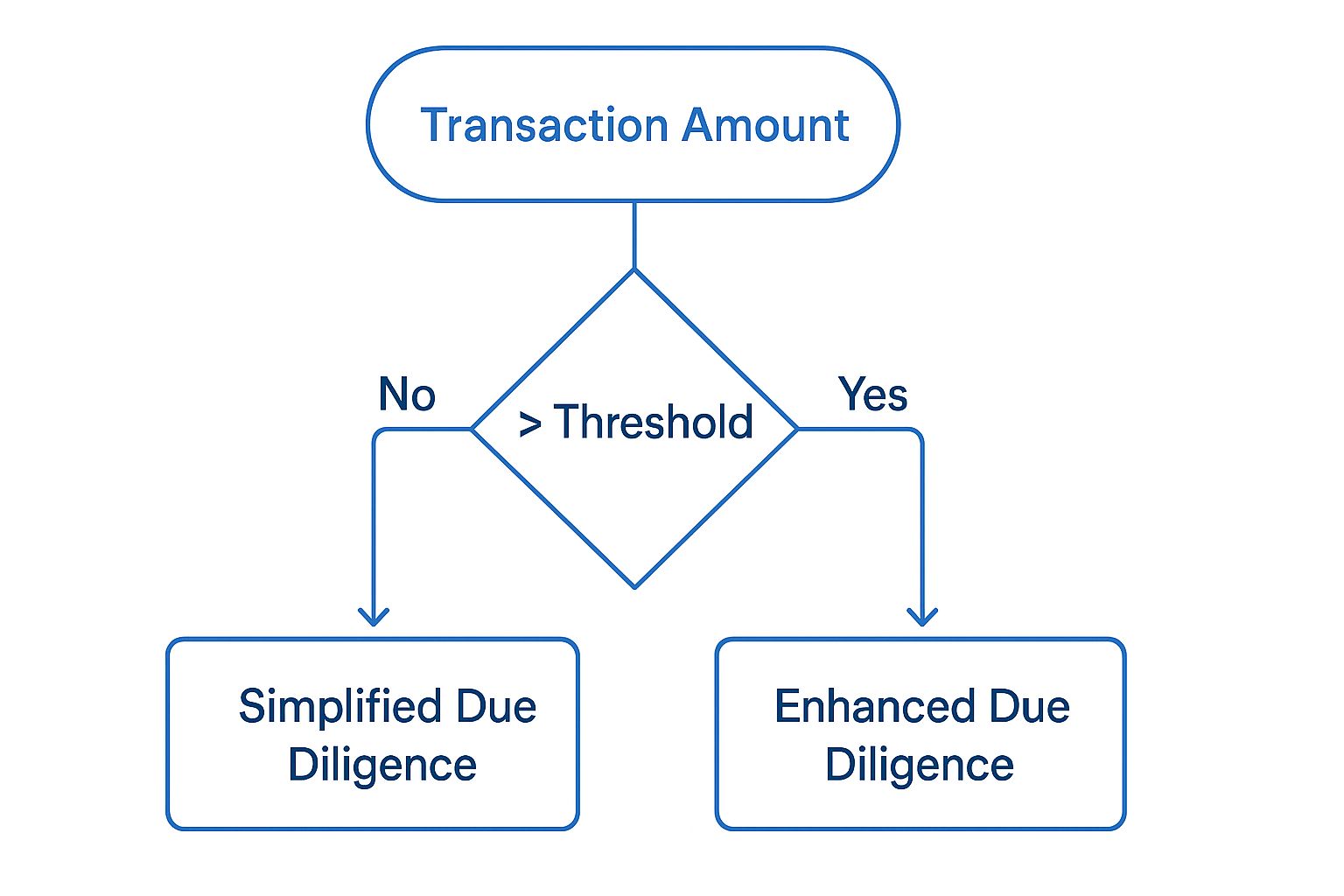
The visual clearly illustrates how a single data point can direct a case down one of two very different paths, forming the core of an automated risk assessment process.
Calibrating Risk Thresholds
Setting the right risk thresholds is a delicate balancing act. If they’re too loose, you risk a high-risk case slipping through the cracks. If they’re too tight, you’ll flood your compliance team with false positives—cases flagged as high-risk that are actually perfectly fine. We’ve seen successful compliance teams reduce manual reviews by as much as 70% by carefully tuning these thresholds, all while improving their threat detection accuracy.
Begin with clear, quantifiable factors. A few examples include:
- Transaction Value: The most obvious one, with clear monetary cut-offs.
- Geographic Risk: Assigning scores to different countries based on established AML indices.
- Customer History: A new customer might carry a slightly higher initial risk score than one with a two-year clean history.
A practical example of predefined thresholds simplifying complex processes comes from recent regulatory changes in India. The transfer pricing Safe Harbour Rules for 2025 establish specific profit margins for sectors like IT/ITES. This move drastically reduces the need for exhaustive, case-by-case transfer pricing audits in cross-border transactions, acting as a form of simplified due diligence at a macro level. You can learn more about how these rules are shaping cross-border M&A deals.
To put this into practice, a risk scoring matrix can be incredibly helpful. It translates different factors into actionable risk levels, guiding your team on what to do next.
Risk Factor Assessment Matrix
Comprehensive risk scoring matrix showing different risk factors and their corresponding weights in the simplified due diligence decision process
| Risk Factor | Low Risk Score | Medium Risk Score | High Risk Score | Action Required |
|---|---|---|---|---|
| Transaction Amount | Below ₹1,00,000 | ₹1,00,001 – ₹5,00,000 | Above ₹5,00,000 | Manual review for high-risk |
| Geographic Location | Domestic (IN) | Low-risk int’l | High-risk int’l | Enhanced Due Diligence (EDD) |
| Customer History | > 2 years, no flags | 6 months – 2 years | < 6 months or flags | Monitor/Manual Review |
| Industry Type | Retail, IT services | Real Estate, Gems | Casinos, MSBs | EDD & continuous monitoring |
This matrix provides a clear framework, helping standardise how your team approaches different scenarios and ensures consistency in your decision-making process.
Using Dynamic Risk Scoring
A static risk score is a good start, but a dynamic one is far more effective. Customer behaviour changes, and their risk score should reflect that. A dynamic system continuously adjusts a customer’s risk profile based on their activity. For example, if a customer who usually makes small domestic payments suddenly starts initiating frequent, high-value international transfers, their risk score should increase automatically, triggering a manual review.
This is where a dedicated risk assessment dashboard becomes invaluable. It offers a live, visual overview of your entire risk landscape.
A dashboard like this allows your team to see at-a-glance which cases are high-risk and why, letting them focus their energy where it’s needed most. The most effective systems even integrate machine learning models that analyse patterns across thousands of customers to identify new, emerging risk factors. This ensures your risk assessment engine constantly improves and adapts over time.
Creating Audit-Proof Documentation Systems
Getting your verification process running smoothly with simplified due diligence is a big win, but that’s only part of the job. The other, equally crucial part is creating documentation that proves your system is solid, compliant, and makes sense. Smart companies know that good documentation isn’t about creating more paperwork; it’s about creating the right paperwork. Your aim is to build an audit trail that keeps regulators happy without drowning your team in administrative work.
When auditors show up, they aren’t just looking for completed checks. They want to understand the why behind your choices. Your documentation needs to clearly show the logic that led you to use simplified measures for a specific customer or transaction. This means your records must do more than just show a timestamp; they need to tell the full story of your risk assessment and decision-making.
Structuring a Defensible Audit Trail
A strong audit trail is your best line of defence during a regulatory review. It should be well-organised, easy to get through, and complete. Think of it as a detailed logbook for every single compliance decision. For every customer onboarded through your simplified due diligence workflow, your system should automatically record and connect several key pieces of information.
What should this trail actually include?
- Initial Risk Assessment: The exact data points (like customer type, location, or product used) that made the customer eligible for a simplified process.
- Verification Results: The outcome of every check performed, even the basic ones. This covers ID verification, watchlist screening results, and any other automated checks.
- Decision Rationale: A system-generated note or flag that clearly states something like, “Case routed to simplified due diligence based on pre-defined low-risk criteria.”
- Timestamps: Every action, from the moment data is entered to the final decision, must be time-stamped to show a clear, chronological order of events.
This level of detail shows that your simplified process isn’t just random but a structured, rules-based system. It’s about proving that every shortcut you took was justified by a matching low-risk profile.
Automating Reports and Exception Alerts
Putting together compliance reports by hand is a slow process that’s wide open to human error. Thankfully, modern systems can generate this documentation for you. By integrating with tools like SpringVerify, you can set up your system to produce real-time compliance reports that are always audit-ready. This gets rid of the last-minute panic to find documents and ensures everything is consistent.
This is where having a central platform becomes so important, letting you see and manage all your compliance data without any hassle.

The screenshot here shows how automated reporting tools can bring all compliance documentation together, making it simple to respond to regulatory questions. It shows the real value of a system that not only runs checks but also organises the proof of those checks into formats that are ready for an audit.
On top of that, your system needs to have automated alerts. If any part of a simplified check flags something unexpected—say, a partial name match on a sanctions list—it should immediately set off an alert and escalate the case. This proactive approach ensures potential issues are dealt with right away, instead of being found months down the line during an audit. At the end of the day, an audit-proof system isn’t just about keeping records; it’s about showing you have active control over your entire compliance setup.
Optimising Performance Through Data-Driven Insights
Getting your simplified due diligence system up and running is a huge achievement, but the work doesn’t stop there. Think of it like a high-performance engine; it needs regular tuning to stay efficient and compliant with regulations. Real optimisation isn’t just about glancing at basic metrics like how fast a check gets done. It’s about digging into the data to understand the story behind the numbers, finding hidden bottlenecks, and constantly improving your process without causing chaos in your daily operations.
Leading companies treat their compliance systems as dynamic tools that require ongoing attention. They avoid the “set it and forget it” mentality. Instead, they use performance data to ask critical questions: Are our risk models losing their edge? Is a certain type of verification causing unexpected delays? Are we getting a spike in false positives that’s turning away good customers? Finding the answers is what keeps a business competitive and secure.
Adopting Advanced Analytics and Testing
To get these answers, you need to go deeper than surface-level data. This is where advanced analytics and specific testing become incredibly useful. Instead of just guessing what might make your process better, you can use data to make informed decisions. Consider setting up A/B tests just for your compliance workflows. For instance, you could test two different risk-scoring models on a small group of new customers to see which one flags fewer false positives without taking on more actual risk.
Another powerful method is pattern recognition. Your system churns out a massive amount of data daily. Advanced analytics tools can sift through this information to spot subtle trends a person might easily miss. You might discover a link between a particular geographic region and a higher failure rate for ID verifications. Finding this allows you to tweak your workflow proactively, maybe by asking for an alternative ID from applicants in that area. An analytics dashboard is perfect for visualising these kinds of trends.
Here’s a glimpse of an analytics dashboard from SpringVerify, which helps track key performance indicators over time.
This visual format makes it simple to see trends, like a sudden increase in incomplete checks, which lets your team jump in and fix the root cause quickly.
Establishing Meaningful KPIs and Feedback Loops
Your key performance indicators (KPIs) should function like an early warning system. While processing time is a good starting point, it doesn’t paint the full picture. Think about tracking more insightful KPIs:
- False Positive Rate: What percentage of cases flagged for more thorough checks turn out to be low-risk after all? A high rate here could mean your risk rules are too tight and need adjustment.
- Customer Drop-off Rate: Where in the verification journey are customers most likely to give up? This can highlight friction points in your user experience that need smoothing out.
- Manual Intervention Rate: How often does a human have to step in to complete an “automated” check? Tracking this helps you see where your automation isn’t as effective as you thought.
Finally, close the loop. The insights you gather from your data analysis should directly lead to changes in your workflow. This continuous cycle of monitoring, analysing, and improving is what elevates a compliance programme from average to exceptional. It makes sure your simplified due diligence process stays efficient and adapts to new threats and rules, keeping your business both safe and agile.
Solving Implementation Challenges Before They Break You
Starting a new simplified due diligence workflow is a great step, but let’s be honest—every new project has its share of speed bumps. The good news is that most of these problems are predictable. If you can see them coming, you can create a plan to deal with them head-on instead of being caught off guard. From technical glitches to tricky regulatory questions, a solid troubleshooting plan is your best defence.
A common issue that trips up many teams is a gap between their technical setup and what compliance actually requires. Your compliance officers might draw up the perfect risk model on paper, but if your developers discover the data they need isn’t available through a simple API call, the whole workflow can screech to a halt. This is why clear communication between departments before and during the project isn’t just a nice-to-have; it’s essential. We’ve seen projects get stuck for weeks just because the development and compliance teams weren’t on the same page.
Getting the Most Out of Vendor Support and Documentation
Another frequent point of friction is not knowing who to ask when a technical problem pops up. This is where your relationship with your verification provider really matters. A provider with strong support and clear, easy-to-understand documentation can turn a full-blown crisis into a minor hiccup. Instead of your team wasting hours trying to figure out a vague error code, they can check a knowledge base or talk to a support team that knows the product inside and out.
For example, detailed support documentation should always be your team’s first port of call for any troubleshooting.

A well-organised support hub like this gives you direct, usable answers to common questions. It empowers your team to solve issues on their own, turning potential roadblocks into simple self-service fixes and keeping your project moving forward.
To keep everything on track, it helps to set up a clear escalation process from day one.
- Define Tiers: Create a straightforward internal path for issues. A minor API problem might go to your lead developer first, but a question about regulatory rules should go straight to your compliance head.
- Set Timelines: Agree on internal response times for different kinds of problems. This ensures issues don’t just sit in someone’s inbox.
- Communicate Clearly: Keep an open line of communication between your technical and non-technical teams. Regular, quick check-ins can stop small misunderstandings from turning into major project blockers.
By getting ready for these common challenges, you can turn potential crises into manageable tasks. This keeps your project on schedule and your team feeling confident.
Ready to implement a simplified due diligence process without the usual headaches? Discover how SpringVerify’s powerful API and dedicated support can make your implementation a success.


