

For a long time, hiring has felt more like an art than a science, hasn’t it? We’ve often relied on gut feelings and intuition to make decisions. But what if you could add a powerful layer of science to that art? This is the real promise of recruitment analytics—making a strategic shift from guesswork to decisions backed by hard evidence.
Table of Contents
Why Recruitment Analytics Is No Longer Optional

Think of it like a seasoned sports scout. Years ago, they might have relied on instinct alone. Today, the best scouts blend their deep experience with detailed performance stats to build a championship-winning team. Recruitment analytics applies this same logic to finding talent, helping you finally understand the ‘why’ and ‘how’ behind your hiring wins and misses.
Moving Beyond Simple Metrics
When you truly embrace recruitment analytics, you stop just filling open roles and start asking the critical, data-informed questions that actually drive improvement. It’s all about building a smarter, more efficient hiring engine. To really get a handle on its importance, it helps to understand the bigger picture of how to master data-driven decision making across your entire business.
With the right data, you can finally get definitive answers to questions like:
- Which job boards actually deliver quality candidates? Instead of spreading your budget thin, you can channel your investment where it generates the best returns.
- How can we shorten our time-to-hire without sacrificing quality? You can pinpoint the exact bottlenecks, whether it’s a slow-to-respond hiring manager or a clunky application form.
- Are we meeting our diversity and inclusion goals? Data can shine a light on unconscious bias in the hiring funnel, giving you the power to build a more equitable process.
This data-first mindset is no longer a luxury reserved for giant tech companies. It’s quickly becoming the essential playbook for any organisation that’s serious about winning the war for talent. In fact, solid data analysis is now a cornerstone of modern talent acquisition strategies, empowering teams to be more proactive and strategic.
To get started, it helps to break down the key ideas.
Core Concepts in Recruitment Analytics
Here’s a quick-glance table breaking down the foundational pillars of recruitment analytics to build understanding.
| Concept Pillar | What It Measures | The Business Question It Answers |
|---|---|---|
| Sourcing Effectiveness | Candidate quality and volume from different channels (job boards, referrals, etc.) | “Where are our best hires coming from, and where should we invest our budget?” |
| Hiring Funnel Velocity | Time spent at each stage of the recruitment process (application to offer) | “Where are the bottlenecks slowing us down, and how can we speed up our hiring?” |
| Candidate Quality | Performance ratings, retention rates, and hiring manager satisfaction for new hires | “Are our hiring methods actually bringing in top performers who stick around?” |
| Cost Per Hire | Total recruitment costs (advertising, agency fees, staff time) divided by new hires | “How much does it really cost us to hire someone, and can we make it more efficient?” |
| Diversity & Inclusion | Demographic data of applicant pools and hires across different stages | “Is our process fair and equitable, and are we building a diverse team?” |
Grasping these pillars is the first step toward transforming your recruitment function from a cost centre into a true strategic partner.
Responding to a Dynamic Job Market
The modern hiring landscape is constantly in motion, which makes data more valuable than ever. Take India’s job market, for example. It shows significant growth, with a projected overall hiring intent increase of 19% in 2025. This rebound is being led by key sectors like manufacturing (25% intent) and automotive (20% intent).
Even more, a major shift is happening in how we work, with 60% of roles expected to be hybrid. These are not just interesting statistics; they are critical insights. They tell us that recruitment analytics must track not only who gets hired but also the evolving work preferences that attract top candidates in the first place.
By embracing recruitment analytics, you move from simply reacting to the hiring market to actively shaping your own outcomes within it. It provides the clarity you need to build a resilient, high-performing workforce that’s ready for whatever comes next.
Ultimately, this data-centric approach turns your recruitment function from a cost centre into a strategic business partner, one that directly contributes to your organisation’s growth and stability.
The Critical Hiring Metrics You Should Be Tracking

You can’t fix what you don’t measure. It’s a simple truth, but it’s amazing how many hiring processes run on guesswork. To truly improve how you recruit, you need to get your hands dirty with the data—the vital metrics that are the lifeblood of any smart recruitment strategy. These numbers tell a story, turning abstract data into a clear picture of your recruitment health.
Think about it: a high application completion rate probably means your process is smooth and user-friendly. But what if it’s low? That’s a massive red flag. It could be screaming that your application form is too long, confusing, or just doesn’t work on mobile. Picking the right key performance indicators (KPIs) is the first step to pinpointing exactly where you need to focus your efforts.
To get you started, we can group the most essential metrics into a few key categories.
Key Metric Categories at a Glance
This table breaks down the different types of metrics you should be tracking. Think of it as a dashboard for your recruitment engine, helping you see what’s working, what’s not, and where your money is going.
| Metric Category | Example Metric | What It Reveals About Your Process |
|---|---|---|
| Speed & Efficiency | Time-to-Fill | How quickly you can get a role from “open” to “filled.” It’s your overall hiring velocity. |
| Sourcing Effectiveness | Source-of-Hire | Where your best candidates are coming from, helping you focus your budget on what works. |
| Cost & Financial Impact | Cost-per-Hire | The total investment required to make a single hire, showing the financial health of your recruiting. |
| Candidate & Hire Quality | Quality-of-Hire | The long-term value a new hire brings, measuring the ultimate success of your process. |
Let’s dive deeper into each of these areas.
Speed and Efficiency Metrics
Time is money, and nowhere is that truer than in recruiting. A slow process frustrates candidates and can cost you top talent. These metrics tell you how fast your hiring engine is running and where the brakes are being applied.
The most famous metric here is Time-to-Fill. This is the big-picture view, measuring the total number of days from when a job is first approved to the moment a candidate signs on the dotted line. It’s a fantastic indicator of your entire recruitment cycle’s duration.
Another crucial, yet distinct, metric is Time-to-Hire. This one zooms in on the candidate’s journey. It measures the time from when a person first applies to when they accept the job offer. A long Time-to-Hire is a classic sign of a poor candidate experience.
Time-to-Fill diagnoses your internal process efficiency, while Time-to-Hire reveals the speed and quality of your candidate’s journey. Optimising both is essential for staying competitive.
Sourcing Effectiveness Metrics
Where do your best hires really come from? If you’re spreading your budget across every job board and social platform without knowing the answer, you’re just navigating without a map. Sourcing metrics give you that direction.
Source-of-Hire is the absolute foundation here. It simply tracks the origin of every successful hire. Was it:
- An employee referral?
- A specific job board like Naukri or LinkedIn?
- A campus career fair?
- Your company’s own careers page?
- A social media campaign?
When you start analysing this data, the insights are powerful. You might find that one job board sends you tons of applicants, but employee referrals consistently produce candidates who actually get hired. That’s the kind of information that lets you double down on what works and cut wasteful spending.
Financial Impact and Cost Metrics
Recruitment isn’t just an HR function; it’s a business investment. And like any investment, you need to understand the costs involved and the return you’re getting. Financial metrics are what make the business case for your team’s hard work.
Cost-per-Hire is the quintessential metric here. To calculate it, you add up all your internal and external recruiting costs over a set period and divide that total by the number of people you hired in that same timeframe.
This number helps you budget more effectively and clearly demonstrates the financial efficiency of your recruitment team. If you want to get even more granular, break it down by department, seniority level, or hiring source. It is a critical data point for any team looking to improve its human resources functions.
The Ultimate Metric: Quality of Hire
Speed and cost are important, but they mean very little if you aren’t hiring the right people. Quality-of-Hire is arguably the most important, yet most challenging, recruitment metric to measure. At its core, it tries to quantify the value a new employee brings to the organisation.
Because it isn’t a single data point, it’s usually a composite score pulled from several sources:
- New hire performance reviews (e.g., ratings after 6 or 12 months)
- Hiring manager satisfaction surveys
- Employee retention rates (how long does the new hire actually stay?)
- Time-to-productivity (how quickly do they become a fully contributing team member?)
Indian recruitment trends also point towards an emphasis on quality. Data shows that 47% of new hires are professionals with 1 to 5 years of experience, while freshers make up only about 14%. This suggests employers are optimising for quality by targeting candidates who can hit the ground running, which reduces ramp-up time and boosts productivity.
By tracking these kinds of metrics, you shift the conversation. It’s no longer just about filling seats; it’s about strategically building a high-performing workforce that drives the business forward.
Building Your Recruitment Analytics Roadmap
Shifting to a data-driven approach in recruitment can feel like a mountain to climb, but it doesn’t have to be. The secret is breaking it down into a clear, step-by-step roadmap. This way, you can implement recruitment analytics thoughtfully and avoid that feeling of being completely overwhelmed. This guide will walk you through the entire process, from figuring out your goals to making confident, insight-backed decisions.
At its core, the whole process is about turning raw data into actionable wisdom. This simple, three-stage flow shows how it’s done.
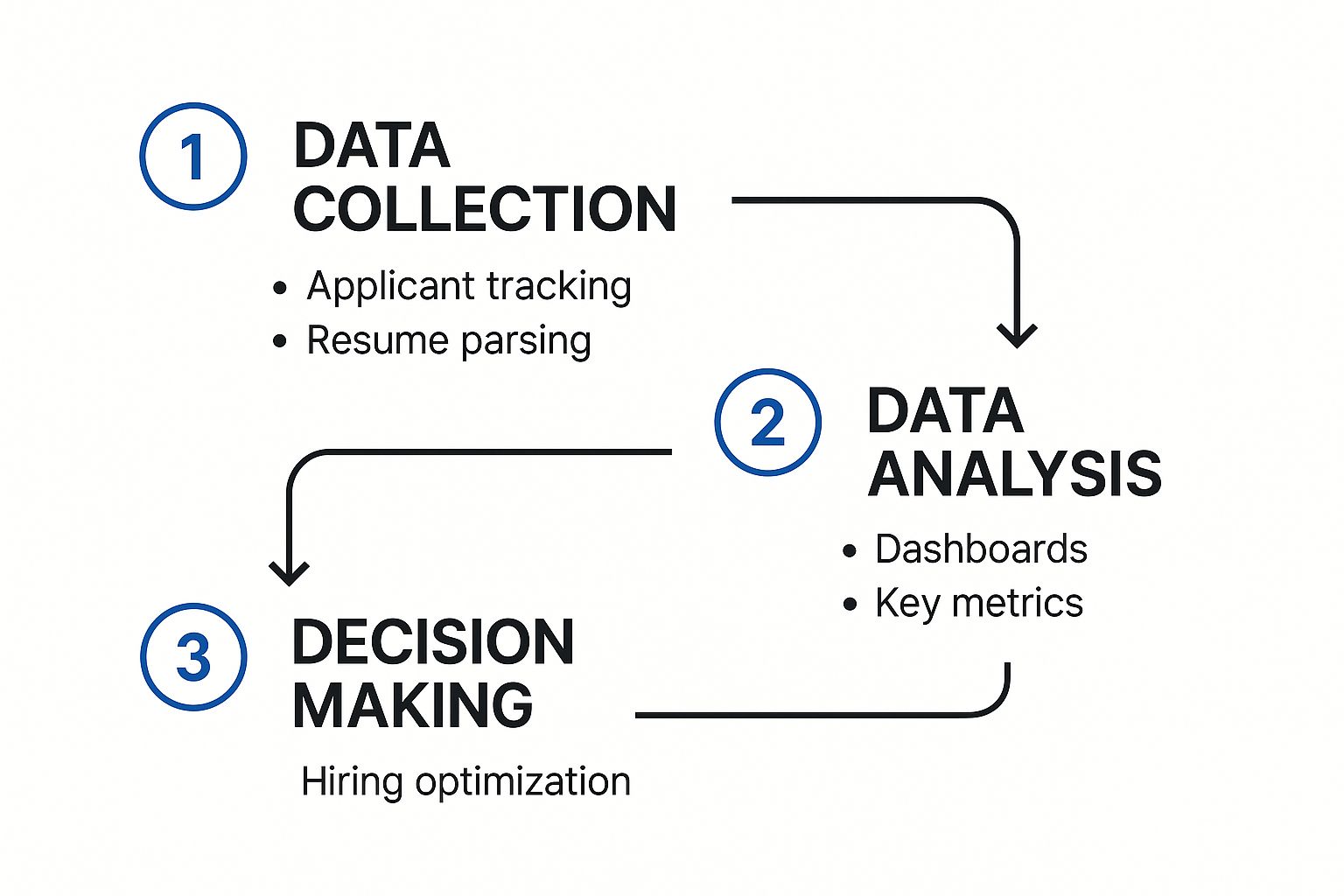
As you can see, effective recruitment analytics isn’t a one-and-done task. It’s a continuous cycle of gathering information, analysing it for patterns, and then using those insights to make smarter hiring decisions.
Step 1: Define Your Core Objectives
Before you even think about touching a spreadsheet, you need to answer the most important question: “What are we actually trying to achieve?” Without clear goals, your data is just noise. Your objective has to be specific, measurable, and tied directly to a real business outcome.
Don’t just say, “We want to hire faster.” That’s too vague. Instead, aim for something concrete like, “Reduce our average time-to-fill for engineering roles by 15% in the next quarter.” This kind of clarity gives your analytics work a clear purpose and a finish line.
Common goals we see teams set include:
- Reducing cost-per-hire by a specific percentage.
- Improving quality-of-hire by increasing the 90-day retention rate.
- Boosting the offer acceptance rate for senior-level positions.
- Pinpointing the top 3 sourcing channels that deliver the best candidates.
By setting these targets right at the start, you make sure your entire process is focused on solving a genuine business problem.
Step 2: Identify and Centralise Your Data
Once you know what you want to measure, the next job is to find the data. For most organisations, this information is scattered across a bunch of different systems. Your goal here is to identify these sources and pull them all together.
Your Applicant Tracking System (ATS) is the primary goldmine. It’s packed with a wealth of information on everything from where candidates came from to how long each applicant spends in a particular stage of your hiring funnel. Other valuable sources include:
- HRIS (Human Resources Information System) for post-hire data like performance reviews and retention rates.
- Candidate and hiring manager satisfaction surveys.
- Financial records for calculating recruitment costs.
Having data in different silos is a common challenge. Pulling it all into a unified system or a central dashboard is absolutely essential for getting a complete, honest picture of your recruitment health.
A common mistake is to analyse data in isolation. Your ATS might show a fast time-to-hire, which looks great. But your HRIS could reveal that those same hires are leaving within six months. Combining data sources is the only way to connect the dots and uncover the real story.
Step 3: Choose the Right Tools for Analysis
With your data identified, you now need the right tools to make sense of it. The good news is you can start small and scale up as your needs and budget grow. The key is to pick tools that simplify the process, not make it more complicated.
- For Beginners: Never underestimate the power of a well-organised spreadsheet. Tools like Microsoft Excel or Google Sheets are fantastic for basic analysis, like tracking your source-of-hire or calculating cost-per-hire. They’re accessible and require minimal investment.
- For Growing Teams: Many modern ATS platforms come with built-in analytics dashboards. These tools offer real-time insights and visual reports that are perfect for tracking key metrics without needing to be a data scientist.
- For Advanced Needs: For those ready to go deeper, dedicated business intelligence (BI) platforms like Tableau or Microsoft Power BI are the way to go. They let you connect multiple data sources and create powerful, interactive dashboards, ideal for diving into predictive analytics.
Ultimately, the right tool is the one your team will actually use. Start with what’s manageable and build from there.
Step 4: Visualise and Share Your Findings
Raw numbers are hard for anyone to interpret. This final, critical step is all about turning your analysis into simple, visual dashboards that tell a clear story. Your stakeholders—whether they’re hiring managers or company executives—need to understand the insights at a glance.
Focus on creating clean charts and graphs that highlight key trends. For instance, a pie chart can instantly show which sourcing channels are bringing in the best candidates, while a line graph can track your time-to-fill over the last few months.
Finally, remember that this is a continuous cycle. Regularly review your dashboards, discuss the findings with your team, and use those insights to refine your strategies. This ongoing process of measuring, analysing, and adjusting is what truly transforms your recruitment function into a strategic, data-powered engine for growth.
The Real-World Business Impact of Smart Hiring

While metrics and dashboards are useful, the true value of recruitment analytics shines when it steps out of the HR department and proves its worth to the entire business. This is where your data connects directly to the bottom line, drawing a clear line between hiring activities and the financial goals that grab an executive’s attention. It’s about building a rock-solid business case for a smarter, data-first hiring culture.
Recruitment analytics gives organisations the power to adopt genuinely smart hiring strategies that lead to measurable business gains. Instead of relying on gut feelings, data offers concrete proof of how better hiring directly lifts company performance. For example, by using modern strategies for smart hiring, teams can make huge improvements in interview efficiency and candidate evaluation.
Dramatically Reduce Hiring Costs
One of the quickest and most convincing wins from recruitment analytics is its power to cut down on unnecessary spending. Without data, recruitment budgets are often spent based on habit or guesswork, which is a recipe for wasted money. Analytics acts like a spotlight, showing you exactly which channels are delivering real value and which are just draining your resources.
You might discover you’re spending thousands on a premium job board that sends a flood of applicants, but almost none of them make it past the first screening. By shifting that budget to your employee referral programme—which your data shows delivers a much higher quality-of-hire—you cut costs and improve your results at the same time. This isn’t just about saving a few rupees; it’s about optimising your investment for the best possible return.
Boost Productivity and Slash Turnover
A great hire acts as a force multiplier for productivity. On the flip side, a bad hire can crush team morale and drain resources. The quality-of-hire metric is your direct link to organisational performance. When you use analytics to pinpoint the traits, skills, and sources of your top-performing employees, you create a blueprint for success that you can use again and again.
By focusing on data that predicts on-the-job success, you build teams that are more productive, more engaged, and more likely to stay. This directly reduces the enormous hidden costs associated with employee turnover, from lost productivity to the expense of recruiting and training a replacement.
A data-driven approach ensures you aren’t just filling seats but are strategically adding value to every team. This is particularly vital for specialised roles where the impact of a single top performer can be massive. Many organisations, from growing startups to large corporations, find that a data-backed hiring focus is a key competitive advantage. This approach is especially valuable for modern staffing agencies aiming to supply superior candidates to their clients.
Elevate Your Employer Brand
In a competitive talent market, your reputation is everything. A clunky, slow, or impersonal hiring process can be a major black mark against your employer brand. Recruitment analytics gives you the tools to see your process through the candidate’s eyes and make smart, targeted improvements.
Here are a few ways data can refine the candidate journey:
- Pinpointing Bottlenecks: Is your application abandonment rate sky-high? Data can show you exactly where candidates are getting stuck and dropping off, so you can simplify the process.
- Improving Communication: By tracking feedback from candidate satisfaction surveys, you can make sure your team is responsive, respectful, and professional at every single touchpoint.
- Personalising the Experience: Analytics can help you understand what different types of candidates value, allowing for a more tailored and engaging approach that resonates.
When you create a superior, data-refined candidate experience, you build a powerful reputation. This transforms your employer brand from being just another company to being a true magnet for A-list talent, making your recruitment efforts far more effective and less reliant on expensive advertising.
The Future of Hiring with AI and Predictive Analytics
Looking at past performance data is useful, but the real game-changer in recruitment analytics is the ability to predict the future. This is where Artificial Intelligence (AI) and predictive modelling stop being buzzwords and become your most powerful hiring tools. Think of it as the difference between driving by looking in the rearview mirror versus using a GPS that maps out the best route ahead.
Forward-thinking companies are already using these tools to forecast their hiring needs with uncanny accuracy. Imagine knowing you’ll need to hire five data scientists in six months, based on your project pipeline and historical attrition rates. This insight allows you to start building a talent pool before you need it, instead of scrambling to fill an unexpected vacancy.
Harnessing AI for Smarter Predictions
AI pushes this even further. It crunches massive datasets to spot subtle patterns that a human recruiter might miss. By comparing potential candidates against the profiles of your current top performers, AI can identify who has the highest probability of succeeding in a specific role. It can even flag employees who are at risk of leaving, giving you a crucial window to step in and retain them.
The applications are woven throughout the entire hiring process:
- Inclusive Job Descriptions: AI tools can scan your job descriptions for biased language, ensuring you attract a more diverse and qualified pool of applicants from day one.
- Intelligent Resume Screening: Moving beyond simple keyword matching, AI understands the context behind skills and experience. This leads to fairer, more effective, and unbiased resume screening.
- Personalised Candidate Journeys: AI helps you craft a unique and engaging experience for every applicant, keeping them informed and interested from their first click to their first day.
This isn’t just theory; it’s about using data to build the workforce of tomorrow, today. To truly understand how this works in practice, you can dive deeper into how to power up your hiring with predictive analytics in recruitment and turn data into a real competitive edge.
AI’s Impact on the Indian Job Market
The AI boom isn’t just changing how we hire—it’s reshaping the job market itself, creating an explosion in demand for new skills. The AI job market in India is on fire, with over 450,000 active AI-related job listings as of mid-2025.
This surge is heavily concentrated in tech hubs like Bengaluru and Hyderabad, with high demand for roles in Generative AI, MLOps, and AI ethics. Recruiters are also becoming more specific about work models; 35% of these listings now insist on a hybrid or full-time office presence, marking a clear shift away from purely remote roles. This kind of data is gold for any strategic workforce planning.
Predictive analytics answers the ultimate strategic questions: Who should we hire? When will we need them? And what skills will they need to succeed? It transforms recruitment from a reactive function into a proactive, strategic powerhouse.
When you embrace these advanced analytics, you’re no longer just filling open positions. You are strategically sculpting a workforce that is perfectly aligned with your future business goals. You’re ensuring you have the right people, in the right roles, at precisely the right time. That is the true power of looking forward.
Common Questions About Recruitment Analytics
Diving into recruitment analytics can feel like stepping into a new world, and it’s completely natural to have questions. Let’s walk through some of the most common curiosities and hurdles that teams face. Think of this as your practical guide to getting started with confidence.
Is This Only for Large Companies?
Absolutely not. While big corporations might be running complex predictive models, the real magic of recruitment analytics lies in its core principles, which are universal. You don’t need a massive budget or a dedicated data science team to get started.
Small and medium-sized businesses can see huge benefits just by tracking fundamental metrics in a simple spreadsheet. For instance, even a basic log of your source-of-hire can tell you which job boards are actually worth your money. The goal here isn’t complexity for its own sake; it’s about making smarter decisions, no matter the size of your company.
How Do We Handle Messy or Incomplete Data?
Welcome to the club! This is probably the single most common roadblock teams hit. The old saying “garbage in, garbage out” is especially true in HR, where research shows 42% of professionals see bad data as a major hurdle. The secret is to not boil the ocean.
Start small and get obsessed with consistency. Pick just a handful of critical metrics you want to track—like applicant sources and key funnel stages—and create a crystal-clear process for how that data gets entered. Clean up your most important data first, then you can expand.
The goal isn’t perfect data overnight; it’s about establishing a foundation of reliable information for a few key metrics and then building from there. This progressive approach makes data quality manageable.
How Can We Get Our Team to Adopt This?
Change is hard, and it’s normal to meet some resistance. The key to getting your team on board isn’t to force dashboards on them; it’s to show them how this new data makes their jobs easier and more successful.
- Showcase Quick Wins: Did you figure out a way to cut down the time-to-fill for a tough role? Did you uncover a new, high-quality source for candidates? Shout it from the rooftops!
- Provide Practical Training: Run simple, hands-on workshops. Show your recruiters how to read the charts and, more importantly, what those numbers actually mean for their day-to-day work.
- Connect to Their Goals: Make it clear how using analytics helps them hit their individual and team targets. Frame it as a powerful tool for success, not just another chore.
When data becomes an ally instead of an obstacle, you’ll naturally build a culture that gets excited about making informed decisions.
Ready to build a more confident hiring process? With SpringVerify, you can streamline your background checks, integrate with your existing systems, and make secure, data-backed hiring decisions faster. Learn more and get started today.


