

Think of your proof of identity in India as the key to almost everything in modern life. These official documents are what let you open a bank account, land a job, or access essential government services. Without a valid Proof of Identity (PoI), even simple administrative and financial tasks can feel like hitting a brick wall.
Table of Contents
Understanding Your Identity Documents
Establishing who you are is a fundamental step in nearly every formal interaction. In India, this is usually done with a few key documents that serve distinct, though sometimes overlapping, purposes. While a PoI confirms your identity, it’s almost always requested alongside a Proof of Address (PoA) and a Proof of Date of Birth (PoDB).
Imagine these three proofs as a three-legged stool—each one supports the others to create a stable, verifiable identity. For example, when you apply for a loan, the bank needs to know who you are (PoI), where you live (PoA), and your age (PoDB) to properly assess your application.
The Foundation of Indian Identity Verification
The idea of a formal identity document isn’t new. The system we have today has deep historical roots, shaped heavily by both colonial and post-colonial experiences. It all started back in the 1940s during World War II when India introduced ration cards to manage food supplies. This document quickly became a common proof of identity, especially for people who didn’t have other forms of ID. You can learn more about this fascinating paper infrastructure in Indian history.
Today, that early system has evolved into a much more structured framework. The main goal is to give every resident a reliable way to prove who they are, making sure they can access their rights, services, and economic opportunities.
This context is crucial because not all documents are created equal. Some are fantastic for proving who you are but say nothing about where you currently live. Others might confirm your date of birth but aren’t accepted everywhere as a primary PoI.
Knowing what each document is for helps you pick the right one for any situation, whether you’re onboarding at a new job or filling out government paperwork. This guide will demystify the entire system, starting with the core documents that keep the nation running.
The Core Documents for Proving Your Identity
When you need to furnish a proof of identity in India, a handful of core documents immediately spring to mind. Think of them as the MVPs of the identity world—each with its own specific strengths, purpose, and the official body that issues it. Getting a handle on their unique roles is the key to navigating everything from opening a bank account to government services without any headaches.
This visual guide neatly lays out the most common identity documents, showing the hierarchy and relationship between them.
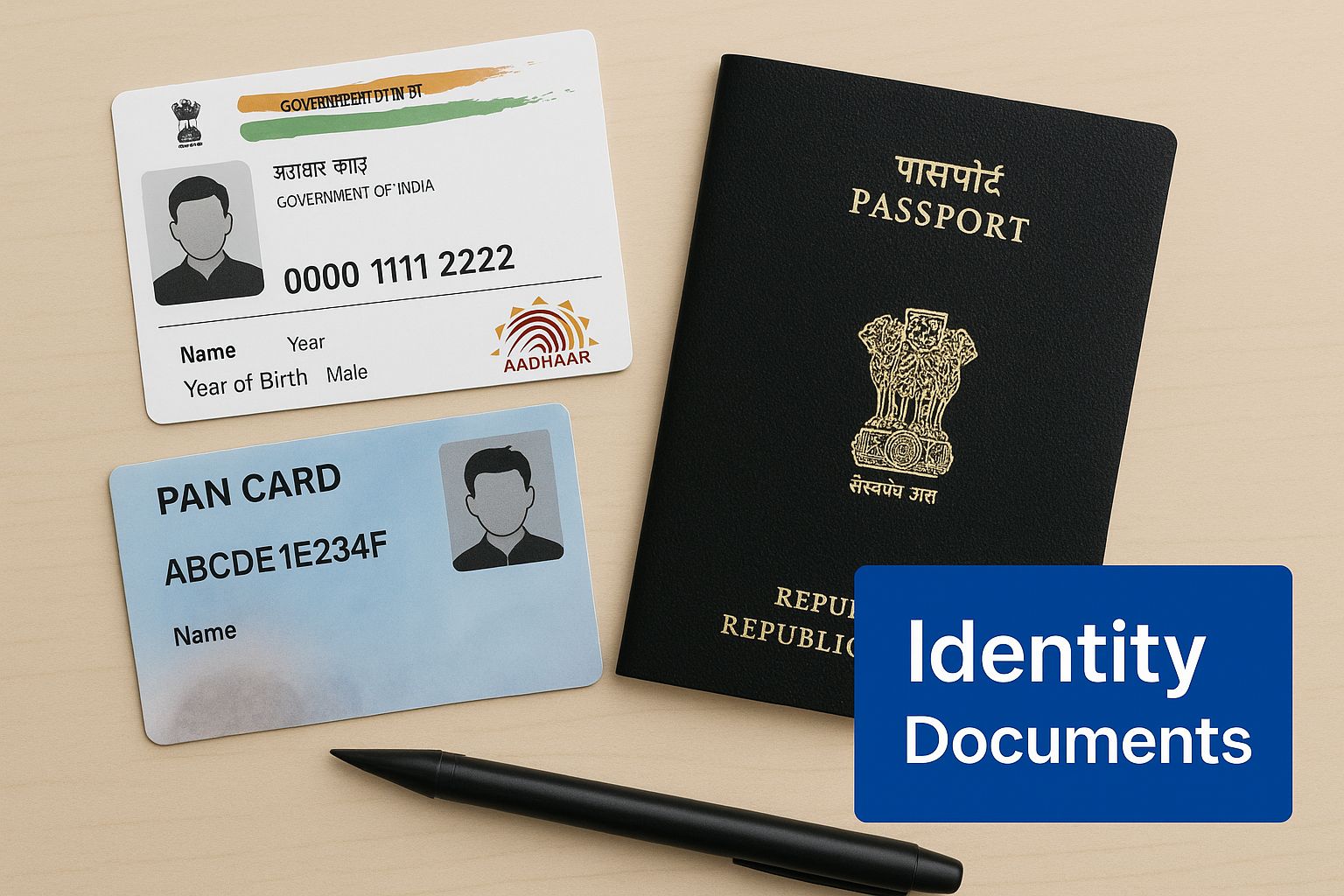
As you can see, documents like the Aadhaar and Passport often act as foundational proofs, while others like the PAN card are built for more specialised jobs. Let’s break down the most essential ones.
Aadhaar Card: The Universal Identifier
Issued by the Unique Identification Authority of India (UIDAI), the Aadhaar card is probably the most widespread proof of identity today. Its core mission was to give every single resident a unique, verifiable identity, backed by biometrics like fingerprints and iris scans. This makes it an incredibly solid tool for authentication.
Before Aadhaar came along, a huge chunk of the population struggled to prove who they were. In the early 2010s, over a third of Indians didn’t have birth certificates and a staggering 60% were without bank accounts. Launched back in 2009, the Aadhaar system was designed to fix this, enrolling 600 million people by 2015 and now covering over 1.2 billion residents. You can get more insights into India’s landmark ID system and its rapid adoption and how it transformed the landscape.
Its real power lies in e-KYC (Electronic Know Your Customer), which enables instant verification. This has made it the go-to document for banks, telecom companies, and government welfare schemes.
PAN Card: The Financial Fingerprint
The Permanent Account Number (PAN) card is your golden ticket to the financial world. Issued by the Income Tax Department, its main job is to track financial transactions to clamp down on tax evasion. It’s a 10-character alphanumeric identifier, and it’s mandatory for a whole host of activities.
You absolutely need a PAN card for things like:
- Filing your income tax returns.
- Opening a bank account or a Demat account for stock market investments.
- Making financial transactions above a certain threshold, like large cash deposits or property sales.
It’s crucial to remember, though, that a PAN card mainly proves your financial identity, not where you live. While it’s an essential document, it’s often not accepted as a standalone Proof of Address (PoA).
Key Takeaway: Think of your PAN card as your financial passport. It validates your identity for any activity involving money and taxes, but for proving where you live, you’ll need a different document.
Voter ID Card: The Democratic Right
Also known as the Elector’s Photo Identity Card (EPIC), this document comes from the Election Commission of India. Its primary role is simple: to allow eligible citizens to cast their vote in elections. Over the years, it has also become a widely accepted proof of identity and address across the country.
Because it contains both your photograph and your address, it’s a reliable document for general identity verification, whether you’re getting a new SIM card or filling out various government applications.
Passport and Driving Licence: The Versatile Proofs
The Indian Passport, issued by the Ministry of External Affairs, is the ultimate proof of identity, address, and citizenship all rolled into one powerful booklet. It’s recognised globally and is, of course, the main document you need for any international travel.
A Driving Licence, issued by regional transport authorities, serves a dual purpose. It’s official permission to drive a vehicle, but it’s also commonly used as a valid proof of both identity and address for many day-to-day needs.
To help you keep these straight, here’s a quick side-by-side look at the most common identity documents.
Quick Comparison of Indian Identity Documents
This table gives you a snapshot of the key documents, highlighting who issues them, what they’re primarily used for, and how long they’re valid.
| Document Name | Issuing Authority | Primary Use Case | Validity |
|---|---|---|---|
| Aadhaar Card | Unique Identification Authority of India (UIDAI) | Universal identity, government schemes, e-KYC | Lifetime |
| PAN Card | Income Tax Department | Financial transactions, tax filing | Lifetime |
| Voter ID Card (EPIC) | Election Commission of India | Voting, general identity and address proof | Lifetime |
| Indian Passport | Ministry of External Affairs | International travel, comprehensive identity proof | Typically 10 years |
| Driving Licence | Regional Transport Office (RTO) | Driving vehicles, identity and address proof | Varies by state and age |
Each of these documents has a clear and distinct role. While some, like the Passport, are all-rounders, others like the PAN card are specialists. Understanding which one to use in which situation is the first step towards a smooth verification process.
How Aadhaar Revolutionised Identity Verification
Before Aadhaar came along, proving your identity in India was a slow, paper-heavy affair. Think of it like sending a letter by post versus firing off an instant message. Both get the job done, but one is dramatically faster and more efficient. Aadhaar became the instant message of identity verification, and it completely changed the game.
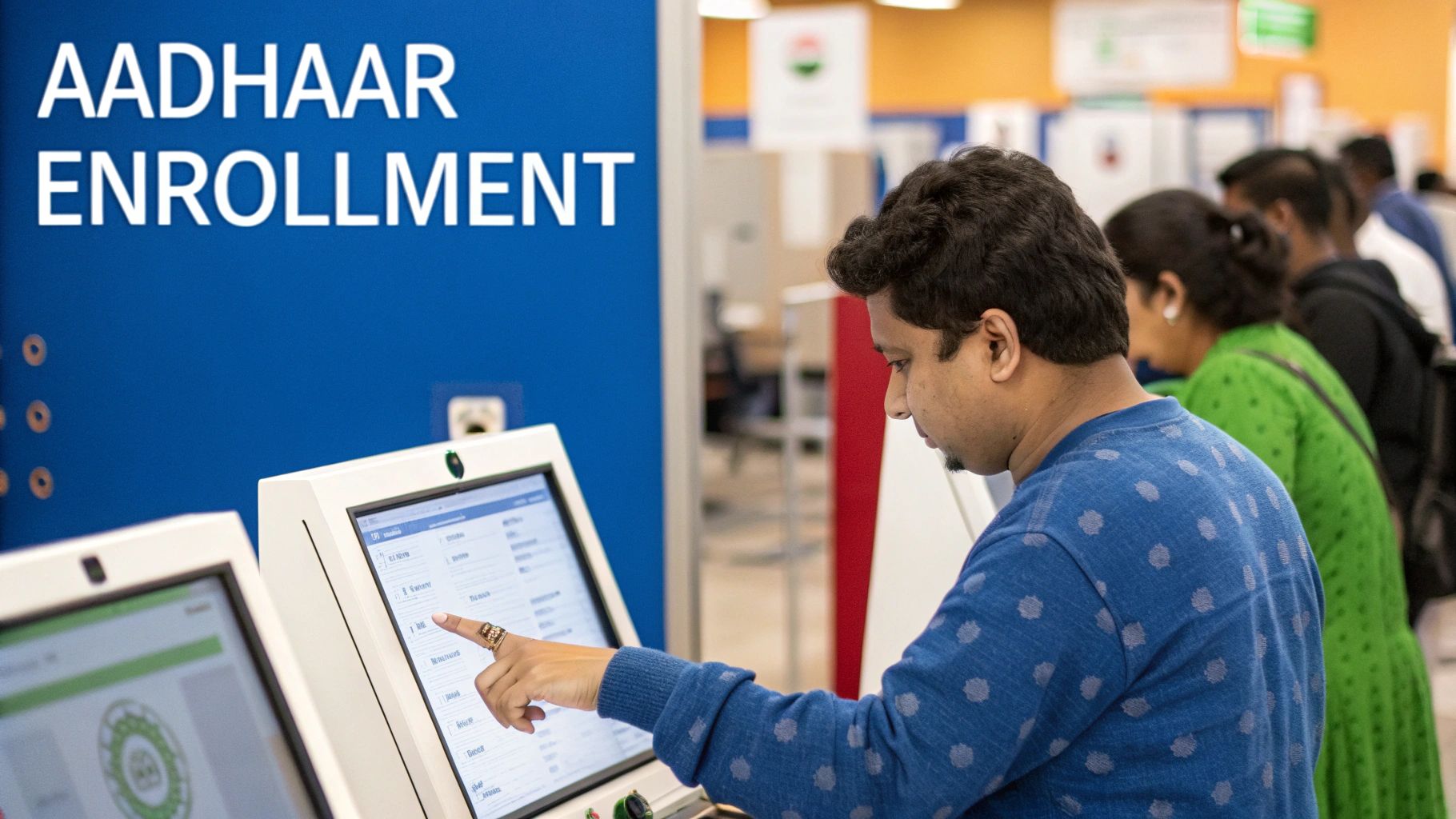
Its real magic lies in its digital-first, biometric-backed foundation. By linking a unique 12-digit number to an individual’s fingerprints and iris scans, the Unique Identification Authority of India (UIDAI) created a system that could prove who you are with near-certainty in seconds.
This capability unlocked the power of e-KYC, or Electronic Know Your Customer. Instead of photocopying documents and waiting days for someone to check them manually, businesses could authenticate a customer instantly with just their Aadhaar number and a quick biometric scan or a one-time password (OTP).
The Real-World Impact of Instant Verification
The ripple effects of this change have been enormous. Suddenly, processes that took days could be wrapped up in minutes, often from the comfort of your own home.
Just think about these common scenarios:
- Opening a Bank Account: What once demanded a trip to the bank with a stack of papers can now be done on a mobile app in minutes.
- Getting a New SIM Card: Telecom companies can activate new connections almost instantly using Aadhaar-based e-KYC.
- Receiving Government Benefits: Direct Benefit Transfer (DBT) schemes use Aadhaar to send subsidies and payments straight to beneficiaries’ bank accounts, cutting out frustrating delays and corruption.
This shift hasn’t just made life more convenient; it has driven massive financial inclusion, allowing millions to access formal financial services for the very first time. The speed and reliability of this system have made it a cornerstone for businesses looking to scale their operations quickly. For a deeper look at how modern tools leverage these documents, you can explore our detailed guide on identity verification and its role in secure onboarding.
This digital authentication system acts like a universal key. It unlocks services swiftly and securely, removing the friction that once defined Indian bureaucracy and commerce.
A Privacy-Conscious Approach to Identity
A common question that always comes up with Aadhaar is data privacy. How can a system holding so much information be secure? The answer lies in its “minimal data” design philosophy. The system was intentionally built to be a pure identity authenticator, not a warehouse for your sensitive personal details.
While Aadhaar does collect demographic data like your name and address alongside your biometrics, it deliberately avoids storing information about religion, caste, or ethnicity. This design choice was made to keep the platform neutral and focused on one thing: proving you are who you say you are.
When an organisation uses Aadhaar for verification, it sends a request to UIDAI’s servers. The servers don’t hand over your data; they simply send back a “yes” or “no” response to confirm if the details match. This way, your identity gets confirmed without oversharing your personal information, striking a crucial balance between verification and privacy.
A Business Guide to Verifying Identity in Hiring
For any organisation, checking a candidate’s identity isn’t just a box to tick; it’s the very foundation of building a trustworthy and compliant workforce. Get this step wrong, and you could be opening the doors to fraud, legal headaches, and major security breaches. A solid verification process is your first line of defence during employee onboarding.
The whole thing kicks off with collecting documents securely. It doesn’t matter if you’re asking for physical copies or digital uploads—handling this sensitive data with care is non-negotiable. Once you have the documents, you can go one of two ways: the traditional, manual route or the modern, digital one.
Physical verification means someone is manually inspecting documents, looking for tell-tale signs of a fake. This can be slow and is definitely prone to human error. On the other hand, digital methods like Aadhaar e-KYC are much faster and more reliable, checking information directly against official government databases in real-time.
Building a Fraud-Resistant Onboarding Process
The best way to spot fraudulent documents is to be proactive. Train your hiring team to recognise the common red flags that give away a forgery.
Key warning signs include:
- Inconsistent Formatting: Be on the lookout for strange fonts, text that doesn’t line up properly, or blurry logos that just don’t match what official government-issued documents look like.
- Physical Irregularities: Check for obvious signs of tampering. This could be anything from altered dates and mismatched photos to damage around important information fields.
- Failed Digital Checks: If a document fails an automated check or a QR code scan, that’s an immediate reason to dig deeper.
It’s absolutely crucial to have a clear game plan for these situations. For example, what if a candidate’s name is spelled differently on their Aadhaar and PAN cards? Your team needs a standard procedure, like requesting a clarifying affidavit, to handle it. This keeps your hiring decisions consistent and fair for everyone.
Think of identity verification as the quality control check for your most valuable asset—your people. A meticulous process not only protects the business but also ensures you are building a team on a foundation of trust and integrity.
The whole concept of identity is also getting broader. As verification technology moves forward, many businesses are starting to look at what’s next in the digital identity space. For anyone curious about the future of online security, learning about hiring digital identity experts in Crypto & Web3 provides a fascinating peek into where the field is headed.
Creating Clear Protocols for Discrepancies
Small issues like mismatched addresses or minor name variations pop up all the time, but they need to be handled systematically. Your internal policy should spell out exactly what to do when something doesn’t add up.
- Document the Issue: Make a clear note of the specific discrepancy you found between the documents.
- Communicate Clearly: Let the candidate know what the problem is and be specific about what extra documentation you need, like a legal affidavit for a name change.
- Set a Deadline: Give the candidate a reasonable amount of time to provide the necessary clarification.
- Final Verification: Once you receive the new documents, run the verification checks again to make sure everything aligns perfectly.
By putting a structured workflow in place, you give your team the confidence to manage these hiccups consistently, reinforcing your commitment to compliant and thorough hiring. For more tips on sharpening your onboarding strategy, feel free to explore our resources for human resources professionals to help you hire with greater confidence.
Tackling Common Identity Document Headaches
We’ve all been there. You’re trying to get through a verification process, and it grinds to a halt because one document lists your name as “S. Kumar,” while another spells it out as “Suresh Kumar.” It feels like a bureaucratic nightmare, causing frustrating and unnecessary delays. This section is your practical guide to fixing these common identity proof headaches.
These little discrepancies aren’t just minor annoyances. They can completely derail important life events like landing a new job, securing a bank loan, or registering a property. The trick is to get ahead of these issues proactively, rather than waiting for a verifier to flag a problem.
Start by Updating Your Core Documents
The very first step is to fix the information at its source. For India’s most crucial identity documents, the process is thankfully quite straightforward, even if it requires a bit of patience.
- Aadhaar Card Updates: The Unique Identification Authority of India (UIDAI) makes it easy to update your name, address, date of birth, and mobile number online through the myAadhaar portal. For bigger changes like a name correction, you’ll just need to upload a scanned copy of a valid supporting document, like your passport or a marriage certificate.
- PAN Card Corrections: The Income Tax Department allows you to request changes or corrections to your PAN data via the TIN-NSDL or UTIITSL portals. You’ll have to fill out the “Request for New PAN Card or/and Changes or Correction in PAN Data” form and submit your supporting documents.
Getting these two foundational documents corrected first creates a positive ripple effect, making it much simpler to update all your other linked accounts and services.
Think of your Aadhaar and PAN as your “master” identity files. When they’re accurate, you ensure consistency across the entire financial and administrative system. This simple step can prevent most verification failures before they even happen.
Handling Name Changes and Affidavits
Sometimes, a quick online update isn’t enough, especially after a marriage or a legal name change. When this happens, an affidavit becomes your most powerful tool. A deed poll affidavit, also known as an affidavit for a change of name, is a legal document you swear before a notary or magistrate.
This document serves as your official declaration of your new name and is legally binding. It’s the primary proof you’ll need to get your name updated on all other forms of proof of identity in India, from your passport down to your bank accounts, effectively bridging the gap between your old and new identity.
For smaller issues, like minor spelling differences or variations in initials, a “one and the same person” affidavit can often clear things up without the hassle of changing all your documents. This affidavit simply clarifies that “S. Kumar” and “Suresh Kumar” are, in fact, the same individual.
Keeping your documents aligned isn’t just about personal convenience; it’s a critical part of being in good standing, especially for employers who need to follow strict hiring rules. Staying on top of the latest verification standards is essential, and you can learn more about navigating regulatory compliance in India to ensure your hiring workflows are always current. Taking these proactive steps helps cut through red tape and keeps your professional and personal life running without a hitch.
Got Questions? We’ve Got Answers
Navigating the rules around identity proof in India can feel a bit tricky. Let’s clear up some of the most common questions people have, so you can handle your documents with total confidence.
Which Document Is the Strongest Proof of Identity?
While you’ve got a few options, the Indian Passport is pretty much the heavyweight champion of identity documents. Issued by the Ministry of External Affairs, it hits all the right notes: it confirms your identity, address, date of birth, and most importantly, your citizenship. Thanks to its high-security features and global acceptance, it’s considered the gold standard.
Right behind it is the Aadhaar Card. Its biometric link makes it incredibly tough to fake, giving it a very high level of trust for authentication. For almost everything you need to do within India, Aadhaar is the go-to and most commonly requested ID.
Can I Use a Digital ID From DigiLocker for Verification?
Yes, you absolutely can! The Information Technology Act of 2000 gives documents stored in DigiLocker the same legal weight as their physical copies. This means you can flash your digital Aadhaar, Driving Licence, or vehicle registration from your DigiLocker app, and it’s perfectly valid.
In fact, many government bodies and private companies, like the traffic police and railway authorities, are required to accept these digital proofs. It’s a super convenient and secure way to manage your IDs without the fear of losing the physical cards.
What Should I Do if My Name Is Spelled Differently Across My IDs?
Mismatched names are a surprisingly common headache, but they are definitely fixable. Your best bet is to start by correcting your core documents, focusing on your Aadhaar and PAN cards first. You can usually kick off this process online by uploading a supporting document with the correct spelling, like your passport or birth certificate.
If you’re dealing with a bigger change, like taking on a new surname after marriage, you’ll probably need a notarised affidavit. This is a legal document that officially states your name change. It acts as a bridge, connecting your old identity to your new one and making it much smoother to update all your other records.
Is an Aadhaar Card Mandatory for All Services in India?
Nope, it’s not mandatory for every single thing. The Supreme Court of India has made it clear: while you do need it for things like government welfare schemes and filing income tax returns (by linking it to your PAN), it can’t be forced on you for opening a bank account or getting a new SIM card.
Service providers have to give you other ways to verify your identity. That said, because of how quick and easy e-KYC is, Aadhaar is still the most popular and efficient proof of identity in India for both companies and individuals.
Ready to make your hiring process faster, safer, and more reliable? SpringVerify offers comprehensive background verification services, from instant ID checks to employment history, all designed to help you build a team you can trust. Discover how SpringVerify can secure your hiring workflow today.


