

Getting a passport in India used to be a long, paper-heavy slog. Thankfully, those days are mostly behind us. The modern system is a much slicker operation, built around security and speed, primarily because the Passport Seva Programme (PSP) has brought the entire workflow online. This has made the whole experience significantly faster and more transparent for everyone involved.
At its heart, the entire process rests on two core stages that work in tandem to protect the integrity of every passport issued. First, you have the in-person check at the Passport Seva Kendra (PSK), where officials meticulously review your documents for authenticity. This is where your proof of identity, address, and birth date get a thorough look-over.
Next comes the second, equally critical stage: police verification. This is the on-the-ground check to confirm you actually live at the address you’ve provided. It’s a fundamental security measure designed to stop fraudulent applications in their tracks.
Table of Contents
The Two Pillars of Verification
Think of the PSK appointment and the police check not as separate hurdles, but as interconnected parts of a single, secure chain of events.
- Document Scrutiny at the PSK: This is the foundation. An officer physically inspects your original documents, comparing them against the details you entered in your online application. Any discrepancy, no matter how small, can cause a delay, so getting this right is key.
- Physical Address Confirmation: Once your paperwork gets the green light at the PSK, your file is sent electronically to the local police station that covers your address. An officer is then assigned to visit your home and confirm you live there.
This simple flow shows how an application moves from submission to approval.
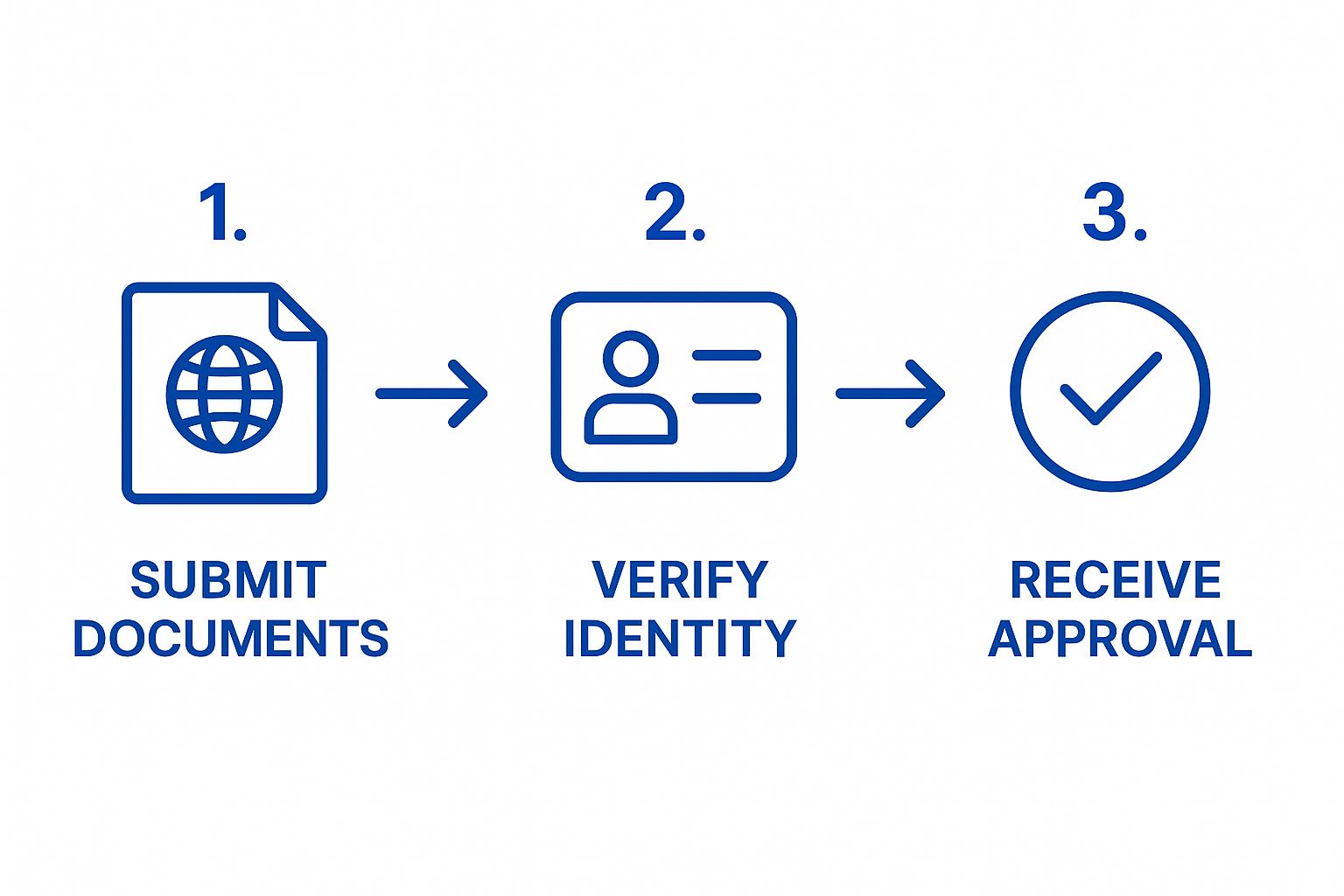
As you can see, after the initial document submission, the identity verification stage is the absolute linchpin of the process before any approval is given.
Technology Has Been a Game-Changer
India’s passport verification system has received some major upgrades, especially with the rollout of PSP Version 2.0 and e-passports. The police verification stage, once a notorious bottleneck, has been completely transformed by the mPassport Police App.
This one tool has slashed turnaround times from weeks (or even months) down to just 5 to 7 days in 25 states and Union Territories. It’s a massive improvement.
This digital-first approach doesn’t just speed things up for genuine applicants; it also beefs up security, making it much tougher for anyone to fake an identity. It’s a smart system built on checks and balances, blending digital efficiency with vital human oversight.
Understanding these mechanics is the first step to a smooth application. It’s also worth remembering that these local checks are part of a much bigger security picture. For some applicants, this can include a comprehensive review against global databases to screen for any international red flags.
Preparing Your Documents for a Flawless Application
Let’s be honest, gathering your documents is the most make-or-break step in the entire passport application journey. A single mistake here isn’t just a minor hiccup; it can lead to frustrating delays. I always tell people to think of this stage as laying the foundation—if it’s not solid, everything that follows will be shaky.
It’s not just about having the documents. It’s about ensuring every single one is valid, recent, and perfectly consistent with the next.
I’ve seen applications get held up for the smallest things. A minor name spelling difference between an Aadhaar and a PAN card, for instance, is a classic red flag. The officials at the Passport Seva Kendra (PSK) have a sharp eye for these kinds of discrepancies, and they can halt your application right in its tracks.
Essential Documents for Passport Application Verification
Getting your documents in order is crucial. The table below breaks down exactly what you’ll need, with some key pointers I’ve picked up over the years to help you avoid common mistakes.
| Document Category | Accepted Documents | Key Points to Remember |
|---|---|---|
| Proof of Identity | Aadhaar Card/e-Aadhaar, PAN Card, Voter ID Card (EPIC), Valid Driving Licence | Your name must be spelled identically across all documents. Ensure licences are not expired. |
| Proof of Date of Birth | Birth Certificate issued by a Municipal Authority, School Leaving Certificate (SSLC) | The Birth Certificate is the gold standard. The SSLC is a common and accepted alternative if the certificate isn’t available. |
| Proof of Address | Utility bills (water, electricity, telephone), recent bank passbook/statement, Aadhaar card, valid rental agreement | Address proofs like utility bills must be recent, typically not more than 3 months old. The address must exactly match your application form. |
| Special Cases | Identity Certificate (Annexure A), No Objection Certificate (NOC – Annexure G) | Primarily for government employees. Minors have their own set of requirements, often needing parents’ passports. Always check the specific annexures for your situation. |
Having these documents organised and ready will make your appointment at the PSK a much smoother experience. The goal is to leave no room for questions or discrepancies.
Proving Your Current Address
This is where so many people stumble. The address proof you submit absolutely must be recent and a perfect match for the address on your application form. An old electricity bill or a bank statement with a previous address is an almost guaranteed rejection.
Here are your most reliable options:
- Utility Bills: Water, electricity, or telephone bills are great, but they can’t be more than 3 months old.
- Bank Documents: A recent passbook or a bank statement works well, as long as your current address is clearly printed.
- Aadhaar Card: This is often the easiest, provided the address is up-to-date.
- Rental Agreement: Make sure it’s valid and registered.
Here’s a pro tip from years of experience: always bring more than one proof of address to your PSK appointment. Having a backup, like a recent electricity bill and your bank passbook, can be a lifesaver if one document is unexpectedly deemed insufficient.
The integrity of these documents is the backbone of the process of passport verification. While we’re focused on the physical documents for the PSK, it’s interesting to see how identity verification is evolving. Companies face similar challenges and rely on modern identity verification solutions to securely confirm who their users are.
Navigating Special Scenarios
Not every application fits the standard mould. Some situations call for different, or additional, paperwork.
For example, government employees usually need to provide an Identity Certificate in the format of Annexure A or a No Objection Certificate (NOC) as per Annexure G.
Likewise, applications for minors have their own specific requirements, like including the parents’ passports. Taking a few extra minutes to double-check the annexures and supporting documents needed for your unique situation is crucial. It’s a small investment of time that prevents major headaches down the road.
What to Expect During Police Verification
The police verification stage is probably the most nerve-wracking part of the whole passport process. It feels a bit mysterious, mainly because it’s the one step that happens away from the controlled environment of a Passport Seva Kendra (PSK). But once you understand how it works, it becomes a lot less intimidating.
After your application gets the green light at the PSK, your file is sent electronically to the police station in charge of the address you provided. This is where technology has really changed the game.
The Role of the mPassport Police App
Gone are the days of paper files moving at a snail’s pace between government offices. Now, the mPassport Police App is the digital backbone of this entire operation.
The app lets the assigned police officer get your details, schedule the visit, capture all the necessary information, and submit their final report—all from a smartphone. This has slashed verification times. What used to take weeks, or even months, can now be wrapped up in just a few days. The officer has a simple, direct job: confirm that you actually live at the address you listed on your application.
This digital approach to a physical check is what keeps the process both quick and accurate.
Below is an example of the modern Indian passport. The security of this document is directly supported by this thorough verification process.
This image shows the current biometric e-passport, which has an electronic chip inside. This makes it far more secure and much harder to fake than the older, non-chip versions.
Preparing for the Officer’s Visit
Being ready for the visit is the easiest way to make sure everything goes off without a hitch. The officer will usually give you a call to set up a convenient time.
Here’s what you should have ready to go:
- Original Documents: Keep all the original documents you submitted at the PSK somewhere you can grab them easily. The officer will need to see them to cross-check everything.
- Photocopies: It’s always a smart move to have a set of photocopies on hand, just in case they’re needed.
- Your Presence: This is a big one. You have to be physically present at the address for the visit. The verification can’t be completed with just a family member.
The officer isn’t there to interrogate you; they’re just completing a standard procedural check. They are simply confirming who you are and where you live. Keeping your documents in order and following these steps is a key part of making sure your application meets national security protocols. To get a better sense of how these checks fit into a wider compliance framework, you can read up on the essentials of background check compliance in India.
Handling Common Verification Issues
Even if you’re perfectly prepared, things can sometimes go sideways. Knowing how to handle common hiccups can save you a ton of stress and keep your passport application from getting delayed.
What if you miss the officer’s visit? Don’t panic. They will usually try to get in touch with you again. If you don’t hear back, you can always go to the local police station yourself with your application file number to get things rescheduled.
A tiny difference between your application address and what’s on your door can also cause a snag. For example, if your application says “Flat 4B” but your door is marked “Apartment 402,” it might raise a question. Just be ready to explain any small discrepancies, and have something like your rental agreement handy to back it up.
At the end of the day, the police verification is a straightforward confirmation of facts. By understanding the process, being prepared, and knowing how to handle common issues, you can navigate this critical stage with confidence and keep your passport application moving forward smoothly.
Why a Strong Verification Process Matters Globally
It’s easy to think of a passport application as just another personal chore—a box to tick off before a trip. But the meticulous process of passport verification you go through has a much bigger impact than you might realise. It directly influences the power and respect of the Indian passport on the world stage.
Think about it this way: every single verified application reinforces the integrity of our national travel documents. When other countries trust that an Indian passport is secure and issued through a rigorous, fraud-proof system, it opens up a world of benefits for all of us. This isn’t just about national pride; it translates into very real, tangible advantages.
This trust is built on a foundation of modern security features and efficient checks. The introduction of e-passports with embedded microchips, for example, makes forgery incredibly difficult. Combine that with a fast, reliable verification system, and it sends a clear signal to the world that India is serious about its security and identity management.
The Connection to Global Mobility
At its core, a robust verification system is the foundation for stronger diplomatic ties. Countries are far more willing to offer visa-free travel or visa-on-arrival facilities when they have complete confidence in the authenticity of another nation’s travel documents. Why? Because a secure passport minimises the risk of illegal immigration and other potential security threats.
The improvements in India’s system have already shown some remarkable results. According to the Henley Passport Index, India’s passport rank jumped significantly to 77th in mid-2025—the largest leap recorded during that period. This upward trend is directly tied to technological upgrades and more streamlined police verifications, all of which enhance our passport’s global standing. You can explore more about India’s passport evolution to see how these changes have boosted its power over the years.
Enhancing National Credibility
Every time you hand over your passport at an international border, you aren’t just presenting your own identity. You’re representing the credibility of the entire Indian system. That smooth entry process you experience at a foreign airport is a direct result of the trust that has been built over years of consistent, secure verification.
Ultimately, your personal application journey is a small but vital part of a much larger national effort. By ensuring every detail is correct and undergoing the thorough verification process, you contribute to making the Indian passport one of the most respected travel documents in the world.
The Common Mistakes That Slow Down Passport Verification
Getting a passport should be a fairly straightforward process, but it’s often the small, seemingly harmless mistakes that bring everything to a grinding halt. From my experience seeing countless applications, there are a few common tripwires that applicants hit time and again, causing a lot of frustration and stalling the whole process.
Knowing what these pitfalls are is the best way to make sure your application sails through without a snag.
Many of these issues are surprisingly simple to avoid once you know what to look for. For example, a tiny variation in your name—think “Rohan K Sharma” on your PAN card versus “Rohan Kumar Sharma” on your Aadhaar—can be a major red flag for officials. When it comes to official documents, consistency is everything.
Another classic mistake is providing an incomplete or temporary address for the police verification. The system is designed to confirm where you actually live long-term. Using a short-term rental address or a relative’s house where you don’t permanently reside is almost guaranteed to result in a negative report.
When Documentation Details Don’t Match Up
One of the most frequent reasons for a delay is inconsistent personal information across your documents. The name, date of birth, and address you put on your application form must be an exact match to what’s printed on your supporting IDs.
Let’s look at a common scenario involving address proofs. Imagine your electricity bill lists your address as “Flat No. 4, Block A,” but your rental agreement just says “A-4.” Even though it’s clearly the same place, this tiny difference is enough to trigger a query from the verification officer and put your application on hold.
What Not To Do: Assuming small variations in your name or address won’t be noticed. They will be.
What To Do Instead: Before you even think about submitting your application, lay out all your documents—Aadhaar, PAN, utility bills, everything. Cross-check them line by line. If you find a mismatch, get it corrected before you go to your PSK appointment. It’s a bit of work upfront, but it saves you weeks of hassle later.
India’s network of several hundred Passport Seva Kendras (PSKs) and Post Office Passport Seva Kendras (POPSKs) has massively improved how quickly applications are processed. However, data from these centres consistently shows that while they handle huge volumes, most delays are still caused by applicant-side errors, either in the paperwork or during the police check. For a deeper dive, you can review passport data insights on indiastat.com.
Fumbling the Police Verification Stage
The police verification is a make-or-break step, and if you don’t handle it right, it can stop your application dead in its tracks. A very common error is simply not being available when the officer visits or missing their phone calls.
Here’s a real situation an applicant shared with me: the police officer called while they were stuck in a meeting. They missed the call and forgot to call back. The officer, unable to make contact, had no choice but to file an “incomplete” report. This forced the applicant to go all the way to the Regional Passport Office just to get the process started again.
To avoid this headache, just follow these simple rules:
- Stay Reachable: Keep your phone on you and answer calls from unknown numbers for a week or two after your PSK appointment. It’s probably them.
- Be Proactive: If you miss a visit, don’t just wait and hope. Call your local police station with your application reference number and ask to reschedule.
- Have Your Originals Ready: Make sure you have all your original documents handy for the officer to inspect. They need to see them to close out the verification successfully.
At the end of the day, dodging these common mistakes really boils down to being meticulous with your paperwork and proactive in your communication. If you treat each step with the care it deserves, you can make your passport verification process as smooth and fast as possible.
Frequently Asked Questions

Even with the clearest instructions, it’s natural to have a few questions pop up when you’re dealing with something as important as a passport. Let’s tackle some of the most common queries we see, so you can move forward with confidence.
How Long Does Police Verification for a Passport Usually Take in India?
This is probably the most asked question, and for good reason. Thanks to the rollout of the mPassport Police App, the process has become much quicker than it used to be. For most applicants across the country, you can expect the police verification to be wrapped up in just 5 to 7 days.
Of course, this isn’t a hard and fast rule. The actual timeline can shift depending on your location, how busy your local police station is, and most importantly, the accuracy of the address and documents you’ve provided. My advice? Keep an eye on your application status through the official Passport Seva portal to stay in the loop.
What Happens If I Receive an Adverse or Incomplete Police Verification Report?
Seeing an “adverse” or “incomplete” status can be stressful, but don’t panic. It simply means the police couldn’t confirm your details for some reason. Often, it’s because you weren’t home when they visited, or there was a small mismatch in your paperwork.
In this situation, the Regional Passport Office (RPO) will get in touch. They might ask you for more documents, request a clarification, or, in some cases, you’ll need to go through the police verification step again.
The absolute key here is to act fast. Respond to any communication from the RPO immediately. Quick action is your best bet for clearing up the issue and preventing your application file from being closed.
Is Police Verification Required for Passport Renewal?
It depends. Whether you’ll need to go through police verification for a renewal hinges on a few key factors. Here’s a quick breakdown of what to expect:
- Probably No Verification: If you’re renewing your passport before it expires (or very soon after) and none of your personal details have changed—especially your address—the verification step might be skipped.
- Verification is Likely: If you’ve moved, there’s been a long gap since your last passport expired, or if there were any issues with your old passport, you should prepare for a full police verification.
Can I Travel While My Passport Application Is Undergoing Police Verification?
This is a great question with a slightly different answer depending on your situation.
If you’re applying for your very first passport, the answer is no. You simply don’t have the legal document required for international travel yet.
But if you’re renewing your passport, you can typically hold onto your old one while the new application is being processed. This means you can continue to travel internationally. Just be sure to watch that expiry date on your old passport! Once your new passport arrives, the old one is automatically cancelled, and you’ll need to use the new one for all future trips.
Making informed hiring decisions requires a verification process as thorough as the one for passports. SpringVerify offers fast, accurate, and compliant background checks to help you build a trusted team. Streamline your hiring workflow by visiting https://in.springverify.com.


