

Table of Contents
Why Pre-Employment Screening Changes Everything
This screenshot shows the Wikipedia page for background checks, giving you a bird’s-eye view of the topic. It really highlights how much is involved, from legal details to the different kinds of checks out there. It underscores how important a structured, well-informed approach to pre-employment screening truly is.
Think of pre-employment screening as a compass for your hiring process. It points you toward the best candidates and helps you steer clear of potential problems.
The Competitive Edge of Smart Screening
Savvy companies don’t see screening as a roadblock, but as a secret weapon. Imagine two companies hiring for the same position. Company A relies only on resumes and interviews. Company B, on the other hand, uses a thorough screening process.
Company B gains a real edge by getting a fuller picture of each candidate. They learn about not just skills and experience, but also about things like personality and how well someone might fit into the team. This helps them make smarter hiring choices and build a stronger workforce.
Debunking the Myths of Pre-Employment Screening
Some companies shy away from thorough screening because they worry about the cost and the time involved. But these worries are often based on misunderstandings. Automated background check services like SpringVerify can actually speed up the process significantly.
Also, the benefits in the long run far outweigh the initial investment. Think about the cost of a bad hire: lost productivity, team disruptions, and maybe even legal trouble. Pre-employment screening helps prevent these issues. It’s a small price to pay for the peace of mind and long-term gains.
The Transformative Power of Verification
Plenty of organizations have dramatically improved their hiring results with pre-employment screening. Take a fast-growing tech startup in Bengaluru, for example. They were struggling with high turnover and inconsistent performance.
After putting a comprehensive screening program in place, their turnover went down by 25% within the first year. This happened because they were able to make better hiring decisions, choosing candidates who were both skilled and a good fit for the company culture. This really shows how pre-employment screening can help build stronger teams and fuel overall company growth.
Finding the Right Balance
Effective pre-employment screening is about getting the right information without making the process too complicated for candidates. The best leaders understand this balance. Using tools like SpringVerify lets you tailor your screening approach for different roles.
This helps you get the information you need while creating a good experience for your candidates. Pre-employment screening isn’t just another hiring step; it’s a fundamental change in how you build your team. It helps you make informed decisions, hire the best talent, and build a positive and productive work environment. It’s the difference between a team of all-stars and one that’s just okay.
The Hidden Costs of Skipping Pre-Employment Screening
This screenshot from the EY homepage, a global leader in assurance and advisory services, speaks volumes. Their very existence highlights the seriousness of employment fraud. Think of it: a whole industry built around helping companies avoid risks. The image itself projects trust and security, exactly what comprehensive pre-employment screening offers.
Imagine a building with hidden cracks in its foundation. You might not see them at first, but over time, those small flaws can cause major structural damage. Bad hires are just like those cracks. That’s why pre-employment screening is so crucial.
Beyond the Obvious: The Ripple Effect of Negligence
Think about the real-world impact of poor screening. It’s more than just the cost of replacing someone. Imagine hiring a delivery driver without checking their driving record. A simple oversight could lead to accidents, lawsuits, and a tarnished reputation.
Or consider the security risks. What if an employee with access to sensitive data has a history of dishonesty? This isn’t just a hypothetical problem. In India, employment fraud is a major issue. An EY study revealed that a staggering 96% of fraudulent healthcare professionals, 88% in financial services, and 79% in IT had significant work experience. This shows how even seasoned applicants can misrepresent themselves. Thorough screening is essential to protect your company.
The Competitive Advantage of Thorough Screening
Pre-employment screening isn’t just about avoiding problems; it’s about building a stronger business. When you truly know your employees, you can build trust, foster teamwork, and create a more positive work environment.
This translates to smoother onboarding, fewer management headaches, and a more productive team. It’s like assembling a winning sports team. You want to make sure each player is a good fit for their position and the team dynamic. This foundation allows your company to focus on growth and innovation.
Building Trust and Sustainable Growth
Effective screening sends a powerful message to your current employees, too. It shows that you value integrity, take security seriously, and are committed to building a safe and respectful workplace. This fosters trust and shared responsibility.
Furthermore, thorough screening sets the stage for sustainable growth. By hiring the right people from the outset, you avoid the disruption and expense of bad hires. This frees up resources for long-term planning and strategic initiatives. Pre-employment screening isn’t an expense; it’s an investment in your company’s future.
Building Your Pre-Employment Screening System Step by Step
Creating a robust pre-employment screening system isn’t about making things more complicated. Think of it as designing a smooth, efficient process to find the best candidates while also respecting their time. It’s like laying the foundation for a house – the stronger the base, the better the structure will stand.
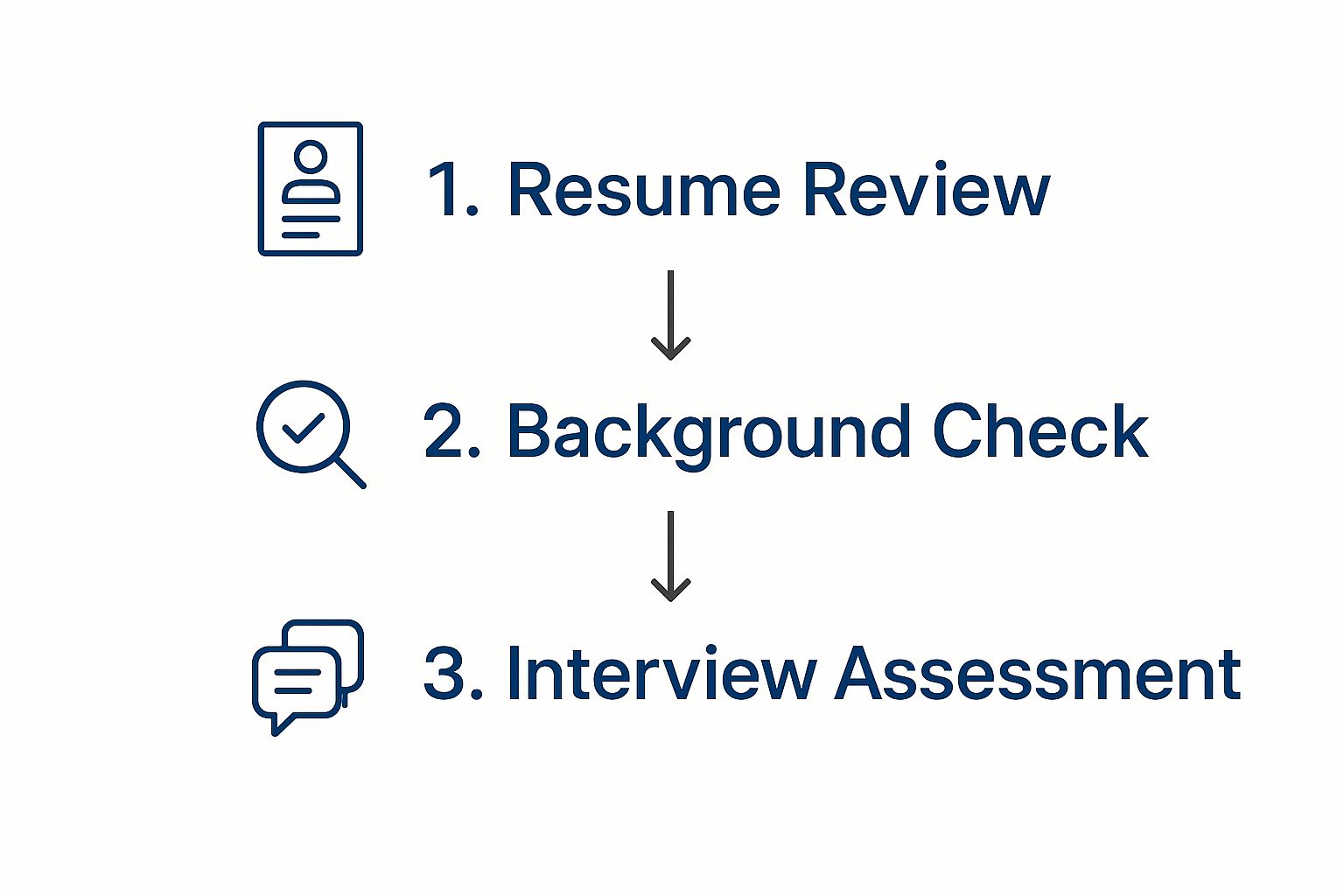
The infographic above shows the basic flow: resume review, background checks, and interviews. Each step builds on the last to paint a complete picture of the candidate. From initial qualifications to personality and experience, every stage is vital.
Defining Your Screening Needs
Before diving in, figure out exactly what you need. Think about the must-have skills and qualities for each role. Are there legal requirements specific to your industry? This clarity helps you select the right screening tools. For example, a cybersecurity role might demand deeper background checks than an entry-level marketing position. Need more guidance on building your team? Explore our guide on talent acquisition.
Choosing the Right Tools
Having the right tools is like having the right equipment for a job. It makes everything easier. A dedicated pre-employment screening software can simplify the entire process. Companies like SpringVerify offer solutions designed for businesses of all sizes, automating tasks and freeing up your HR team for more strategic work.
Structuring Your Process
This screenshot from Wikipedia’s Human Resource Management page shows just how much HR handles. Pre-employment screening is a vital piece of this puzzle. A well-structured process helps create a more strategic and effective HR department.
Once you’ve got your tools, build a clear, step-by-step process. This includes setting timelines for each stage, establishing how you’ll communicate with candidates, and putting reporting systems in place to track progress. This keeps things consistent and reduces the chance of mistakes or delays.
To help you visualize a typical process and timeline, take a look at the table below:
Pre Employment Screening Process Timeline: A step-by-step breakdown showing typical timeframes and responsibilities for each screening stage
| Screening Stage | Timeline | Responsible Party | Key Activities |
|---|---|---|---|
| Application Review | 1-3 days | HR/Recruiter | Review resumes and applications, screen for basic qualifications |
| Initial Screening Call | 15-30 minutes | HR/Recruiter | Phone interview to assess basic skills and cultural fit |
| Background Check | 3-7 days | Third-Party Vendor/HR | Conduct background checks (criminal, employment, education) |
| Interviews | 1-2 weeks | Hiring Manager/Team | In-person or video interviews to evaluate technical skills, experience, and cultural fit |
| Assessment Tests (if applicable) | 1-2 days | HR/Hiring Manager | Administer skills assessments or personality tests |
| Reference Checks | 2-3 days | HR/Hiring Manager | Contact references provided by the candidate |
| Decision & Offer | 1-3 days | Hiring Manager/HR | Make final hiring decision and extend offer |
This table provides a general overview. The specific timeline and responsible parties can vary based on company size, industry, and the complexity of the role being filled. However, it highlights the importance of a structured approach for efficiency.
Candidate Communication
Throughout the process, keep candidates in the loop. Regular communication, even quick updates, shows respect for their time and keeps them from feeling anxious. This creates a positive candidate experience, strengthening your employer brand and attracting top talent. Remember, pre-employment screening is the candidate’s first real look at your company culture.
By following these steps, you can build a pre-employment screening system that makes your hiring stronger, protects your company, and helps you build winning teams. It moves screening from a simple checkbox to a real strategic advantage.
Essential Pre-Employment Screening Components That Matter

This screenshot from HireRight‘s website highlights their focus on helping businesses make informed hiring decisions. It visually emphasizes their dedication to data-driven insights and mitigating risk – two vital pieces of effective pre-employment screening. The clean design reflects how technology simplifies this often complex process.
Not every pre-employment screening check is created equal. Some offer crucial information, while others may not be worth the time or money. Knowing the difference can significantly impact your hiring success. Think of it like building a house: you wouldn’t use the same materials for the foundation as you would for the roof. Different roles and industries need different screening components.
Core Verification Elements
Several key checks make up the foundation of any strong screening program. Identity verification, for example, confirms that candidates are who they say they are. This may seem basic, but it’s the first step in protecting your company from identity theft and fraud.
Then there’s employment history verification. This goes deeper than just confirming dates of employment. It digs into the candidate’s actual responsibilities, performance, and reasons for leaving previous roles. This gives you valuable context you won’t find on a resume. It’s like peeking behind the curtain of a candidate’s work history.
The importance of background checks in India is further highlighted by how often discrepancies appear in candidates’ employment histories. A 2021 Global Benchmark Report by HireRight found that 70% of hirers discovered discrepancies in Indian candidates’ employment histories. This high rate of resume fraud and discrepancies makes thorough background screening crucial for a trustworthy hiring process. Discover more insights.
Prioritizing Based on Role and Risk
How you prioritize these checks depends entirely on the specific job. A credit check might be essential for a senior finance role, while a motor vehicle record check is a must-have for a driver. It’s all about assessing the specific risks tied to each position and tailoring your screening approach accordingly. You might find this helpful: employment verification.
When building your pre-employment screening system, consider the latest strategies for efficient talent acquisition. Resources on remote hiring best practices can be a great starting point.
Emerging Verification Methods and Specialized Needs
New verification methods are constantly appearing, from social media screening to skills-based assessments. It’s important to evaluate these new tools to see if they fit your needs and budget.
Plus, different industries have unique requirements. Healthcare, for instance, often involves detailed licensing and credential verification. Understanding these nuances is vital for developing a truly effective and compliant screening program.
Balancing Protection and Practicality
Ultimately, pre-employment screening is about finding the right balance. You need comprehensive protection without making the process too long or intrusive. This means carefully choosing which elements are most valuable for your organization and its hiring challenges. It’s like crafting a recipe: you want the ideal mix of flavors without making it overly complicated. By concentrating on the key components and adjusting them to your specific needs, you can build a pre-employment screening program that delivers real results.
Mastering Pre-Employment Screening Compliance Without Stress
Think of compliance as your roadmap for pre-employment screening. It helps you navigate the process smoothly, avoiding legal potholes that could damage your company, even if you had the best intentions.
Understanding the Regulatory Landscape
Navigating pre-employment screening regulations can feel overwhelming. However, a practical approach can simplify things. Focus on consent, data privacy, and documentation. These are the cornerstones of a legally sound screening process.
For example, imagine asking a friend to borrow their car. You wouldn’t just take it without asking, right? Similarly, getting a candidate’s informed consent before a background check is crucial. Clearly explain what information you’ll collect and how you’ll use it. Transparency builds trust and protects your company.
Learning From Experience
Many HR professionals have successfully built compliant and efficient screening programs. Their experiences offer valuable lessons. One common mistake is treating compliance as a separate, cumbersome task. Instead, weave it into your existing workflow from the start. This proactive approach simplifies the process and reduces errors.
Need to verify employment eligibility? Use a tool like Form I-9 Employment Eligibility to simplify the process and ensure accuracy.
Building Safeguards That Don’t Slow You Down
Effective compliance doesn’t mean sacrificing speed. You can build safeguards that protect your company without creating unnecessary delays. Focus on clear candidate communication, professional adverse action procedures, and meticulous record-keeping.
For instance, when communicating with candidates, use clear language, avoiding confusing legal terms. Explain the process clearly to build trust and set expectations. Want to learn more about navigating compliance? Check out our guide on compliance for pre-employment screening.
Practical Strategies for Success
Here are some practical tips for mastering pre-employment screening compliance:
- Collaborate with your legal team: They can offer guidance on specific regulations and help create compliant policies.
- Stay informed about regulatory changes: Laws change, so staying updated is vital.
- Build compliance checkpoints into your workflow: This ensures consistency.
- Document everything: Keep detailed records of each step in the screening process.
To help illustrate the varying compliance requirements across different regions, take a look at the table below:
To help you understand the diverse landscape of global compliance, we’ve compiled a table summarizing key requirements by region. This will give you a quick overview of the essential regulations you need to be aware of.
| Region | Key Regulations | Consent Requirements | Data Retention |
|---|---|---|---|
| United States | Fair Credit Reporting Act (FCRA), Equal Employment Opportunity Commission (EEOC) guidelines | Explicit, written consent generally required before conducting background checks | Varies by state and type of information; generally, no longer than necessary for the purpose collected |
| European Union | General Data Protection Regulation (GDPR) | Consent must be freely given, specific, informed, and unambiguous | Data should be kept only as long as necessary for the purposes for which it was collected |
| India | Information Technology Act, 2000 | Consent is generally required, but the specific requirements can vary | No specific legislation dictates data retention periods, but adherence to global best practices is recommended |
| Canada | Personal Information Protection and Electronic Documents Act (PIPEDA) | Consent must be meaningful and informed | Retention periods should be proportionate to the purpose of collection and followed by secure disposal |
This table provides a simplified overview. It’s essential to consult with legal counsel for specific guidance based on your location and hiring practices. Remember, staying informed and proactive is key to maintaining a compliant and efficient screening process.
By following these strategies, you can develop a pre-employment screening program that’s both compliant and efficient. This approach attracts top talent while minimizing legal risks, turning compliance from a potential burden into a source of confidence. It’s about building a system that works for you, not against you.
How Technology Is Transforming Pre-Employment Screening
The world of pre-employment screening is changing rapidly, thanks to technology. For companies eager to hire the best, understanding these changes isn’t just helpful – it’s essential. It’s less about chasing the latest shiny tools and more about strategically applying technology to improve your entire screening process.
AI and Automation: A Powerful Partnership
Imagine Artificial Intelligence (AI) and automation as a team working behind the scenes. AI quickly analyzes huge amounts of data, spotting patterns and potential issues a human might overlook. This dramatically speeds up screening, a real bonus for fast-growing companies sifting through many applications. Automation handles repetitive tasks, like reviewing resumes and checking references, freeing up your HR team for more important work.
For instance, AI-powered tools can scan resumes for certain keywords and skills. This helps filter out unqualified applicants, saving recruiters time. It’s not about replacing human judgment; it’s about giving recruiters a more focused group of candidates to consider.
Emerging Technologies: Verification Gets an Upgrade
New technologies are constantly changing how we verify information. Blockchain, for example, offers a secure way to check credentials, making it simpler to confirm education and professional certifications. Automated background check platforms are also becoming more powerful, using multiple data sources to paint a complete picture of a candidate’s background.
The global employment screening market is growing steadily, with big changes happening in the Indian market due to rising technology use. AI and automation are leading the charge, making background checks faster and more accurate. This looks set to continue, with AI-powered systems expected to be the norm by 2025, further improving background check speed and accuracy in India. Learn more about market growth.
Smooth Integration Is Key
Getting technology to work with your current HR systems is crucial. Choose tools that easily connect with your Applicant Tracking System (ATS) and other HR software. This prevents information from getting stuck in different places and gives you a single, unified view of each candidate’s progress.
The Human Element Remains Important
While technology offers amazing efficiency, human oversight is still vital. AI and automation are powerful, but they’re not perfect. Human judgment is necessary to interpret the results, consider the context, and make smart hiring choices. It’s a collaboration: technology does the hard work, while humans add critical thinking and ethical considerations.
The Future of Screening
The future of pre-employment screening is linked to technology. Staying aware of new trends and checking out new solutions will keep your company ahead of the game. It’s not about keeping up; it’s about strategically using technology to find, screen, and hire the best talent, helping your company succeed.
Scaling Pre-Employment Screening As Your Company Grows
Your pre-employment screening program should fuel your company’s growth, not hinder it. Think of it like building a house: a simple foundation works for a small cottage, but a skyscraper needs something far more robust to support its height and weight. Similarly, as your company expands, so too must your screening process.
From Startup to Enterprise: Adapting Your Approach
Startups, much like a small band playing local gigs, often prioritize speed and flexibility. A quick chat and a listen to their demo tape might be all it takes to bring on a new guitarist. Similarly, early-stage pre-employment screening could involve basic checks and informal reference calls. This lightweight approach makes sense when resources are tight and every hire is mission-critical.
But as your company grows and takes on bigger stages, a more structured approach to hiring is essential. Imagine coordinating a symphony orchestra with the same casual approach you used for the band – chaos would ensue! Consistent, formalized screening becomes necessary as teams expand and roles become more specialized.
Building a Scalable Screening Program
How do you build a screening program that can grow with your company? Here are a few key strategies:
- Invest in the Right Technology: Imagine trying to bake thousands of cookies with a single oven. It’s just not efficient. Similarly, as your hiring volume increases, manual processes become a bottleneck. Automating tasks like background checks and resume screening frees up your HR team to focus on more strategic work. SpringVerify offers solutions designed to scale, making automation accessible for businesses of all sizes.
- Develop Internal Expertise: While technology is a powerful tool, human judgment remains invaluable. Developing a skilled HR team who understand the nuances of pre-employment screening is like having a master conductor who can guide the orchestra to a flawless performance. This expertise ensures that the technology is used effectively and ethically.
- Evolve Your Screening Standards: A one-size-fits-all approach to screening is rarely effective. Just as a conductor demands different skills from a violinist than a percussionist, your criteria should adapt as your company grows and roles evolve. Regularly reviewing and updating your screening practices keeps your program aligned with your business needs.
Measuring and Improving Your Program
Like a gardener tending to their crops, pre-employment screening requires ongoing care and attention. Tracking key metrics such as time-to-hire, cost-per-hire, and candidate experience is like checking the soil health and adjusting your watering schedule. This data-driven approach allows you to identify areas for improvement and optimize your process.
Regular feedback from hiring managers is also crucial. Think of it as getting feedback from the audience after a concert. This direct input helps you fine-tune your program and ensure it’s hitting the right notes.
Maximizing Value at Every Stage
Pre-employment screening is not a set-it-and-forget-it task. It’s an evolving process that should adapt to your company’s specific needs and the changing hiring landscape. By taking a strategic, scalable approach, you can ensure your screening program delivers maximum value at every stage of your company’s growth. It’s about building a solid foundation for sustainable hiring success.
Ready to optimize your hiring process? Explore SpringVerify’s comprehensive pre-employment screening solutions today.


