

A pre-employment medical test is a health check-up that a potential new hire undergoes after a job offer has been made. Its main job is to confirm that the candidate is medically and physically up to the task, ensuring they can handle the core duties of the role without putting themselves or others at risk.
Table of Contents
Understanding the Pre-Employment Medical Test

Don’t think of a pre-employment medical test as just another doctor’s visit. It’s more like a pre-flight inspection before a new team member comes on board. This is a specialised assessment, designed to match a person’s physical and mental fitness to the specific demands of their future job. The goal is simple: make sure the candidate can do their work safely and effectively.
This step is a key part of modern workplace safety and risk management. For example, a commercial driver needs sharp vision and quick reflexes. A construction worker, on the other hand, needs a certain level of physical strength and stamina. The medical test is there to confirm these specific, job-related fitness requirements are met.
The Purpose Behind the Process
These assessments do more than just tick a box for fitness. They serve several critical functions for everyone involved—employers and candidates alike. At their core, they are a proactive way to build a healthier, safer, and more productive work environment.
Here are the key goals:
- Enhancing Workplace Safety: Identifying any health issues that could potentially lead to accidents or injuries, which protects the individual, their colleagues, and even the public.
- Reducing Liability: By ensuring employees are fit for their tasks from day one, companies can lower the risk of workplace incidents and any legal or compensation claims that might follow.
- Promoting Employee Well-being: Sometimes, these tests can bring unknown health problems to light, giving candidates a chance to get early treatment and manage their health better.
- Establishing a Health Baseline: This creates a snapshot of an employee’s health when they are hired, which can be incredibly useful for monitoring their occupational health over time.
A pre-employment medical assessment is fundamentally a tool for alignment. It aligns the physical requirements of a job with the physical capabilities of the candidate, creating a foundation for long-term safety and success.
To see where these medical tests fit into the bigger hiring picture, it’s useful to look at a comprehensive guide to the pre-employment screening process. This helps put the medical exam in context with background checks and other verifications.
The Growing Importance in India
In India, these tests have become a non-negotiable part of hiring, pushed by both legal requirements and a growing corporate focus on wellness. The market is definitely reflecting this shift. The wider Asia Pacific market for pre-employment medical exams is expected to grow at a Compound Annual Growth Rate (CAGR) of about 7% between 2025 and 2033.
This growth is being driven by a greater awareness of occupational health risks and an emphasis on preventative healthcare to boost employee productivity. When you frame the test as a strategic tool, its importance becomes crystal clear.
Navigating India’s Legal and Ethical Guidelines
Conducting a pre employment medical test in India isn’t as simple as just sending a candidate to a clinic. It involves a delicate balance of employer needs, candidate rights, and legal obligations. Think of it like navigating a busy street in Mumbai—you need to know the rules of the road to ensure everyone gets where they’re going safely and fairly.
The foundational rule here is job relevance. This principle is completely non-negotiable.
Any medical test you ask for must directly relate to the specific, essential functions of the job. For instance, requiring a pilot to undergo a vision test is perfectly reasonable and legally sound. However, asking an office-based software developer to take a strenuous physical endurance test would almost certainly be seen as discriminatory, as it has no real bearing on their ability to write code.
The whole point is to prevent hiring decisions based on stereotypes or biases about certain health conditions. A medical issue only becomes a valid reason for disqualification if it genuinely stops the candidate from performing the core duties of the role, even with reasonable adjustments.
Key Legislation Shaping Medical Screenings
While India doesn’t have a single, all-encompassing law that governs pre-employment medical tests, several key statutes create a framework that every employer must follow. These laws often apply to specific industries, mandating health checks to protect workers in hazardous environments. To manage this properly, a thorough understanding and commitment to complying with employment laws is essential.
Two of the most significant pieces of legislation are:
- The Factories Act, 1948: This law mandates medical examinations for workers in factories, especially those exposed to dangerous substances or processes. It’s designed to prevent occupational diseases and ensure a safe working environment for everyone.
- The Mines Act, 1952: Much like the Factories Act, this legislation requires initial and periodic medical checks for anyone working in mines. The hazardous nature of mining—with risks like dust inhalation and intense physical strain—makes these health checks a critical safety measure.
These government mandates heavily influence the pre-employment medical examination market in India. Occupational health experts note that companies in these regulated sectors that skip these screenings face a much higher risk of workplace accidents and the insurance claims that follow. This trend points to a broader shift towards formalising health assessments and using digital records for easier compliance, a development detailed in recent market analyses.
The Pillars of Ethical Practice: Consent and Confidentiality
Beyond the specific laws, two ethical pillars support any legally sound medical screening programme: informed consent and strict confidentiality. These aren’t just nice-to-haves; they are fundamental rights that protect every candidate.
Informed Consent: This means a candidate must voluntarily agree to the medical examination after being clearly told what the test involves and why it’s necessary for the job. Any form of coercion or lack of transparency is unacceptable. The candidate always has the right to know what tests are being conducted.
Once you have consent, confidentiality is paramount. A candidate’s medical information is deeply personal and sensitive. The results of a pre employment medical test must be protected and accessible only to those with a legitimate need to know, like the hiring manager or HR personnel directly involved in the decision.
Here are the core principles for handling this sensitive data:
- Secure Storage: All medical records, whether they’re digital or physical, must be stored securely to prevent anyone from accessing them without authorisation.
- Limited Access: Only designated personnel should ever see the results. Sharing this information widely within the organisation is a serious breach of privacy.
- Purpose Limitation: The data you gather should only be used for the reason it was collected—assessing fitness for that specific role. Using it for any other purpose is unethical and potentially illegal.
By building your screening process on these legal and ethical foundations, you create a system that is fair, respectful, and legally defensible. For a deeper dive into maintaining legal soundness in your hiring, check out our guide on staying compliant with Indian regulations.
What to Expect During the Medical Examination

Stepping into a clinic for a pre employment medical test can feel a bit mysterious, but knowing what’s involved makes the whole experience much clearer. It’s not a pass-or-fail exam on your general health. Instead, it’s a focused assessment to make sure your physical capabilities are a good match for the specific demands of the job you’re applying for.
The core question being answered is simple: can this candidate safely and effectively perform the essential duties of the role? Every part of the test is chosen with that question in mind. It’s a practical step toward building a safe and healthy workplace right from the start.
The Foundational Physical Examination
The cornerstone of any medical screening is the general physical examination. Think of it as the first walkthrough of a property before you buy—it gives a broad overview of your current health. A doctor or another qualified medical professional will check several key indicators to get this baseline.
These checks are fairly standard and help establish a snapshot of your health:
- Vital Signs: This is the basic stuff—measuring your blood pressure, heart rate, breathing rate, and temperature to see how your body is functioning at rest.
- Height and Weight: These measurements are used to calculate your Body Mass Index (BMI), which can be one indicator of overall health.
- Medical History Review: You’ll have a chat about your past illnesses, surgeries, allergies, and any medications you’re currently taking. Being open and honest here is key for an accurate assessment.
- Physical Assessment: The doctor will do a hands-on check of your major body systems, like your heart, lungs, and muscles, to look for any obvious issues.
This part of the test simply ensures there are no immediate red flags that might affect your ability to handle the general physical demands of a work environment.
Common Laboratory and Screening Tests
Beyond the physical check-up, most medicals dig a little deeper with lab tests. These screenings give objective data that a physical exam can’t provide, and they’re chosen based on the role and any potential on-the-job exposures.
In Indian organisations, these health checks typically include the physical exam along with lab tests for things like blood glucose and cholesterol, lung function tests, and drug screenings. This is especially important given that non-communicable diseases (NCDs) like diabetes and hypertension affect over 20-25% of the working-age population in India. In fact, data shows that about 15-20% of applicants show up with undiagnosed health conditions that could impact their job performance, making these screenings a vital checkpoint.
The most common tests you’ll encounter are:
- Blood Tests: A small blood sample can reveal a ton of information, from blood sugar levels (to check for diabetes) to cholesterol and liver function.
- Urine Analysis: This simple test can spot signs of kidney problems, dehydration, infections, and is also the standard method for drug screening.
A key part of workplace safety is maintaining a drug-free environment. For any role that is safety-sensitive, a urine test is a standard and effective screening method.
For many companies, drug screening is a non-negotiable step. To understand this component better, you can explore our complete guide on what to expect during a drug test verification.
Job-Specific Specialised Assessments
Not all jobs are created equal, and neither are their medical tests. For roles with very specific physical or environmental demands, specialised assessments are brought in. This is where the idea of “job relevance” really shines.
A pilot, for example, will need extensive vision and hearing tests because their ability to see and hear with precision is critical for safety. In the same way, a firefighter will need a lung function test (spirometry) and a cardiovascular stress test to ensure they can handle extreme physical strain and smoke inhalation.
The following table breaks down some of these common specialised tests and where they’re most relevant.
Standard Components of a Pre-Employment Medical Test
This table outlines the common tests included in a pre-employment medical screening, their purpose, and examples of job roles where they are most relevant.
| Test Component | Purpose of the Test | Relevant Job Roles |
|---|---|---|
| Vision Test | Measures sharpness, colour perception, and peripheral vision. | Pilots, drivers, machine operators, graphic designers. |
| Hearing Test (Audiometry) | Assesses the ability to hear across different frequencies. | Construction workers, airport ground staff, call centre agents. |
| Lung Function Test (Spirometry) | Measures lung capacity and airflow to detect respiratory issues. | Miners, textile mill workers, firefighters, chemical plant workers. |
| Chest X-Ray | Screens for lung conditions like tuberculosis or other abnormalities. | Healthcare workers, teachers, food handlers, frequent travellers. |
| ECG (Electrocardiogram) | Checks the heart’s rhythm and electrical activity for cardiac issues. | Roles requiring heavy physical exertion, pilots, emergency responders. |
By tailoring the pre employment medical test to the specific job, employers can gather the exact information they need to make a fair and well-informed hiring decision.
A Step-by-Step Guide for Employers and Candidates
Figuring out a pre-employment medical test can seem a bit complicated, whether you’re setting one up as an employer or showing up for one as a candidate. But when you break it down, the journey is really just a series of clear, logical steps for both sides. The goal is simple: gather the right information transparently and use it responsibly.
For employers, the process kicks off long before a candidate ever sets foot in a clinic. It starts with a solid understanding of what the job actually demands. For candidates, the journey begins after getting a conditional job offer, marking one of the final hurdles before officially joining the team.
This guide looks at the process from both perspectives, clearing up who does what and what to expect. This way, the entire experience is smooth, fair, and efficient for everyone.
The Employer’s Roadmap to a Compliant Test
As an employer, your job is to create a process that’s both structured and legally sound. This makes sure the medical assessment is truly relevant to the job, fair to the candidate, and respects their rights every step of the way. Cutting corners here can lead to bad hires and legal headaches.
Here’s what the process typically looks like from your side:
- Define Job-Specific Health Requirements: First things first, analyse the essential functions of the role. What are the absolute must-have physical and mental capabilities? For a warehouse worker, it might be lifting a specific weight. For a pilot, it’s flawless vision.
- Select a Certified Medical Partner: Don’t just pick any general clinic; partner with an occupational health provider. These specialists get the connection between health and work, ensuring the tests are appropriate and the results are interpreted in the right context.
- Extend a Conditional Job Offer: This is a non-negotiable step. You can only request a medical test after you’ve made a conditional job offer. This proves that your hiring decision was based on skills and experience first, with the medical check simply confirming the candidate’s fitness for that specific role.
- Handle Results Ethically: When you get the medical report, its purpose is singular: to assess if the candidate can perform the job’s essential duties. All this information is highly confidential and must be stored securely.
This structured approach is just good governance. For more ideas on building effective and compliant workflows, check out our detailed resources on managing human resources.
The infographic below gives you a bird’s-eye view of the core stages in the process.
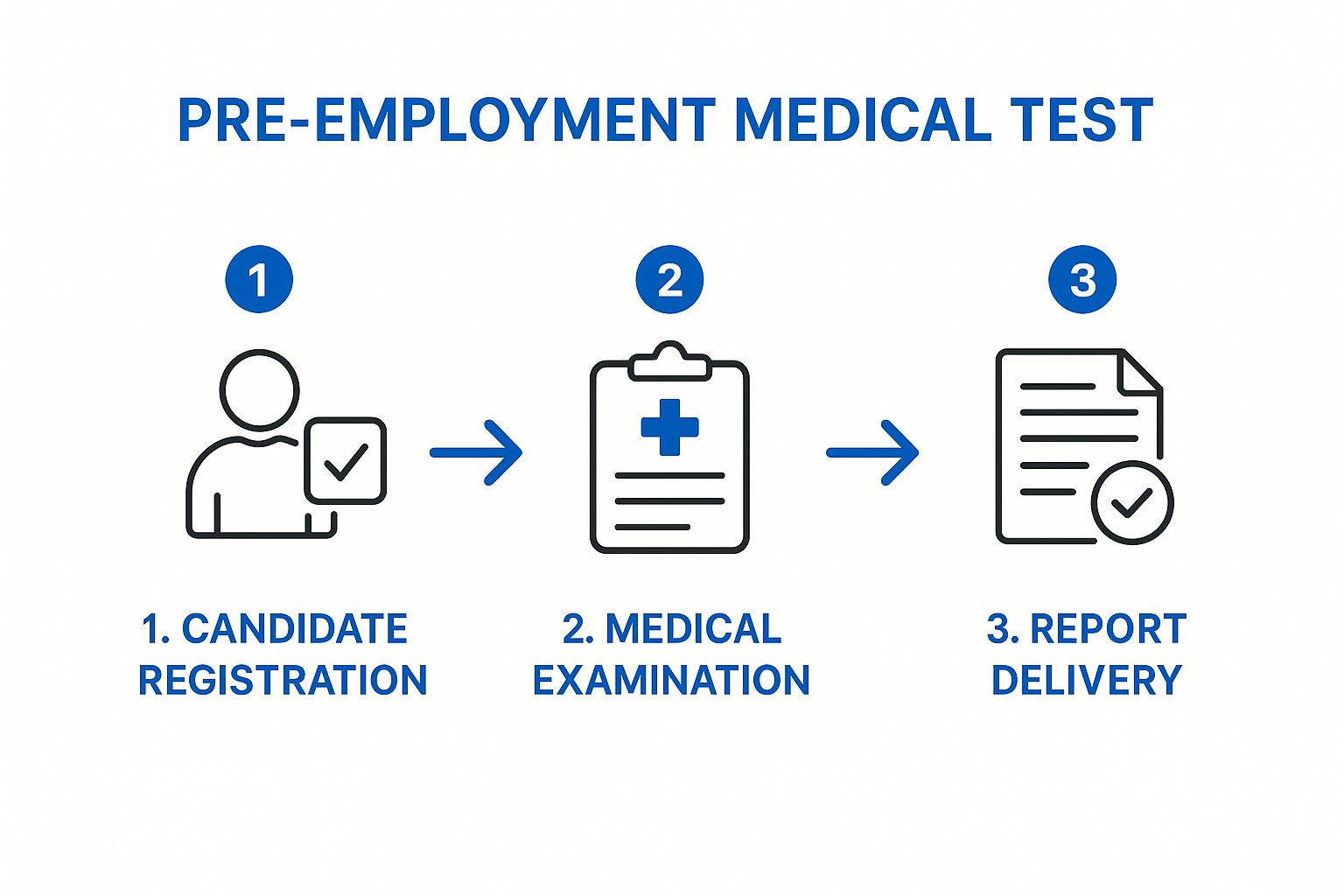
This visual shows the simple flow, from the candidate registering for the test all the way to the confidential report landing with the employer.
The Candidate’s Journey Through the Medical Check
Getting asked to take a medical test is a good thing—it means you’re the top choice for the job! Knowing what to expect can take the stress out of it and help you feel more confident.
Here’s a quick look at what your journey will involve:
- Receiving Instructions: The company will give you all the details you need for the appointment: the time, date, clinic location, and any special instructions you need to follow before you go.
- Preparing for the Appointment: This part is usually easy. You might be asked to fast for a few hours if you’re having a blood test or to bring your glasses for a vision check. Just follow the instructions they give you to make sure the results are accurate.
- Understanding Your Rights: Don’t forget, you have rights in this process. You have to give your informed consent before any test happens, and your medical data must be kept private. You’re also entitled to know what they’re testing for and why it’s relevant to the job.
The point of a pre-employment medical test isn’t to dig through your entire health history. It’s a targeted check to confirm you’re fit for a specific set of job duties, ensuring you have a safe and productive start in your new role.
Making Fair Hiring Decisions with Test Results

When the results from a pre employment medical test land on your desk, it’s a pivotal moment. But it’s a huge mistake to see the report as a simple ‘pass’ or ‘fail’. Instead, you should treat it as one specialised piece of information that needs to be interpreted carefully, ethically, and strictly within the boundaries of Indian law.
The question you need to ask isn’t, “Is this person perfectly healthy?” The real question is much more focused: “Does this candidate have a medical condition that would directly stop them from performing the essential tasks of this specific job, either with or without reasonable adjustments?”
Getting this distinction right is the bedrock of making fair, non-discriminatory, and legally solid hiring decisions. Any decision has to be based on a clear, provable link between a health condition and the job’s core duties. Anything less is just speculation and opens the door to discrimination.
The Role of Reasonable Accommodation
The concept of ‘reasonable accommodation’ is a massive part of this puzzle. It simply means making modifications or adjustments to a job or the work environment that allow a qualified person with a disability to perform the essential functions of that role. For employers in India, this is both a legal and ethical duty.
This doesn’t mean you have to completely change the job. It’s about making practical adjustments that don’t create an “undue hardship” for the business.
So, what does reasonable accommodation look like in the real world?
- Ergonomic Adjustments: For an office role, this could be providing a specialised chair or an adjustable desk for someone with a chronic back issue.
- Modified Work Schedules: It might mean allowing flexible hours for an employee who needs to attend regular medical appointments for a manageable condition.
- Assistive Technology: This could involve supplying screen-reading software for a visually impaired candidate whose job is mostly computer-based.
The goal of reasonable accommodation is not to lower job standards but to remove barriers. It ensures that a talented candidate is not unfairly excluded because of a manageable health condition that doesn’t impact their ability to contribute.
Communicating Outcomes with Sensitivity
How you talk about the outcome of a pre employment medical test is just as crucial as the decision itself. This is a sensitive conversation that demands professionalism, empathy, and complete confidentiality.
If you decide not to move forward with a candidate based on the medical results, your communication has to be crystal clear and directly tied to the job’s specific requirements. Vague reasons can be easily misinterpreted and could even spark legal challenges.
Documenting the Decision-Making Process
In the world of hiring, solid documentation is your best friend. It acts as a clear, objective record showing how and why a hiring decision was made, protecting you from potential claims of discrimination. Your paperwork should tell the story of a logical and fair assessment.
Here’s a quick checklist for what your records should include:
- Job Analysis: A clear breakdown of the essential functions of the role.
- Medical Report: The confidential medical assessment from the healthcare provider.
- Assessment of Impact: Your detailed analysis of how a specific health finding actually impacts the ability to do the essential job duties.
- Accommodation Review: Notes on whether you considered reasonable accommodations and why they were or were not feasible.
- Final Decision: The ultimate hiring decision, with a clear explanation that links back to the job’s requirements.
By following this careful, thoughtful, and well-documented process, you make sure every hiring decision is not only fair to the candidate but also fully compliant and legally sound.
Best Practices for a Compliant Screening Programme
Creating a pre-employment medical testing programme that’s effective, fair, and legally solid isn’t just an administrative task. Think of it as building a key piece of your company’s risk management and wellness infrastructure. Following a few best practices will make sure your screening process is consistent, defensible, and sets the stage for a healthy work environment from day one.
The cornerstone of any good programme is standardisation. Every single candidate applying for the same role must go through the exact same set of tests. This consistency is your best defence against any claims of discrimination, as it clearly shows your health requirements are based on the job’s demands, not the individual.
Train and Empower Your HR Team
Your HR team is on the front lines of this entire process, and they need more than just a checklist to navigate it successfully. They need to genuinely understand the legal nuances that come with medical screenings in India.
Invest in training that really digs into:
- Job Relevance: How to draw a straight line from a specific medical test to the essential duties of a role.
- Candidate Rights: A deep dive into consent, confidentiality, and data privacy laws.
- Sensitive Communication: The best way to discuss results and decisions with candidates professionally and with empathy.
An empowered HR team can manage the screening process with confidence. This not only minimises legal risks but also ensures a positive candidate experience, turning a tricky compliance area into a smooth part of your hiring workflow.
Choose Certified Occupational Health Partners
The quality of your medical screening partner has a massive impact on the reliability and legality of your whole programme. Don’t just pick any clinic down the road. It’s crucial to partner with certified occupational health providers who specialise in workplace health assessments. These are the experts who truly understand the link between specific medical conditions and job performance.
An occupational health specialist does more than just run tests. They interpret the results within the context of the job, giving you a clear, defensible assessment of a candidate’s fitness for that specific role.
This specialisation means the medical advice you get is not only accurate but directly useful for your hiring decision. A qualified partner is an impartial advocate for the integrity of the process.
Safeguard Candidate Data Religiously
When it comes to a pre employment medical test, a candidate’s health information is some of the most sensitive data you’ll ever handle. Protecting it isn’t just a good idea; it’s a legal and ethical duty. Putting strict data privacy and security protocols in place is fundamental to building trust and staying compliant.
Your data protection strategy should include:
- Strict Access Control: Make sure only authorised people, like the hiring manager and specific HR staff, can see medical reports. No one else.
- Secure Storage: Whether it’s a digital file or a physical one, all medical records must be stored securely and confidentially.
- Purpose Limitation: The medical information should be used only for assessing fitness for the role. That’s it.
By weaving these best practices into your screening programme, you create a system that is efficient, legally sound, and treats every candidate with respect.
Frequently Asked Questions
When it comes to pre-employment medical tests, it’s natural for both employers and candidates to have questions. Getting a handle on your rights and what’s expected helps make sure the whole process is clear, fair, and above board for everyone.
Let’s tackle some of the most common queries head-on.
Can a Job Offer Be Withdrawn After a Medical Test?
Yes, but only in very specific situations. A conditional job offer can be rescinded after a medical test if there’s a direct, provable link showing a health condition makes it impossible for the candidate to perform the essential duties of the job, even with reasonable accommodations.
Think about it this way: if a candidate for an electrician role fails a colour vision test, and telling wires apart is a critical part of the job, withdrawing the offer could be justified. On the other hand, pulling an offer because of a condition that has zero impact on job performance is discriminatory and could land a company in serious legal trouble.
What Happens if I Refuse a Medical Test?
If a pre-employment medical test is a required and relevant part of the hiring process for a specific role, refusing to take it will likely mean the withdrawal of your conditional job offer. Employers have a right—and in safety-sensitive industries, a legal duty—to confirm that candidates are physically up to the task.
The key here is consistency. This requirement must be applied to every single candidate for that same role. It can’t be a selective demand.
The rule of thumb is simple: the test must be a necessary step to confirm someone can do the job safely. Backing out of a legitimate screening gives the employer grounds to disqualify you.
Who Pays for the Pre-Employment Medical Test?
The employer. Always. The prospective employer is responsible for covering 100% of the cost for any required pre-employment medical test.
Because the company is the one requiring the screening for its own hiring purposes, it’s considered a business expense. A candidate should never be asked to foot the bill for their own examination. Any request for payment is a major red flag and is completely out of step with professional hiring practices in India.
Making hiring decisions with confidence starts with reliable information. SpringVerify offers prompt, accurate, and seamless candidate screening services, including health and drug test verifications, to help you build a safe and productive workforce. Streamline your background checks at https://in.springverify.com.


