

So, you’ve landed a government job offer. Congratulations! That’s a huge achievement. But before you get your official joining letter, there’s one final, crucial step you need to clear: police verification. It’s easy to think of this as just another piece of administrative red tape, but it’s much more than that. Think of it as the government doing its homework to build a foundation of trust with you, its newest team member.
Table of Contents
What Police Verification for a Government Job Really Means

At its heart, police verification is a detailed background check. Just like any major company would vet a new hire for a sensitive position, the government needs to ensure that the people it employs are trustworthy and reliable. After all, public service is a position of immense responsibility.
This process is designed to answer a few fundamental questions about you:
- Are you really who you say you are?
- Is there anything in your past, like a criminal record, that might get in the way of your duties?
- Does your overall character align with the integrity expected from a government employee?
The Core Purpose Behind the Process
The main goal of police verification isn’t to catch you out or pry into your private life. It’s about protecting the very institution you’re about to join. The authorities will confirm your identity, your current and permanent addresses, and—most importantly—your antecedents. This is just a formal term for your past conduct and history.
The idea is simple: make sure that people appointed to public roles have a clean record and a character that inspires confidence. It’s a standard, non-negotiable part of the hiring process for almost every government job in India, from administrative roles to positions in education, finance, and security.
Why Honesty Is Non-Negotiable
When you fill out your attestation form and go through this process, your best approach is complete and total honesty. The police aren’t looking for saints; they’re looking for honest citizens. In fact, trying to hide a minor issue from your past is often seen as a much bigger problem than the issue itself.
The point of police verification is to build a relationship based on trust, not to disqualify people. Being upfront and transparent on your forms shows integrity—a quality that’s highly valued in public service.
This table breaks down the key aspects of the verification process to give you a clearer picture.
Key Aspects of Police Verification at a Glance
| Verification Aspect | Purpose | What is Checked |
|---|---|---|
| Identity Verification | To confirm you are who you claim to be. | Official IDs like Aadhaar, PAN card, and Passport are cross-referenced with your application. |
| Address Verification | To confirm your place of residence. | A local police officer may visit your provided current and permanent addresses to verify them. |
| Criminal Record Check | To check for any past criminal involvement. | Records are checked against local police station databases and the National Crime Records Bureau (NCRB). |
| Character & Antecedents | To assess your general reputation and past conduct. | Local inquiries might be made with neighbours or community members to gauge your character. |
Understanding these components helps demystify the process and prepares you for what’s to come.
Getting through this step is a standard part of the journey for every successful government job candidate. If you’re looking to understand the broader hiring landscape, this complete guide to landing a public sector role can offer some great insights. By knowing why this verification is so important, you can approach it calmly and confidently, clearing the final hurdle on your way to a rewarding career.
The Legal Framework and Key Court Directives
The police verification process for a government job isn’t just a random hurdle; it’s grounded in a solid legal structure. This framework is built on the service rules of each government department and, crucially, has been shaped and refined over the years by the Indian judiciary. Think of it as a game with a clear rulebook that both you and the authorities have to play by.
At its heart, the need for verification comes from various Central and State Civil Services Rules. These regulations insist on a thorough check of a candidate’s character and past conduct—their “antecedents”—before an appointment is made permanent. The whole point is to make sure that people entering public service have the integrity the job demands.
For a long time, though, this process felt like an endless, unpredictable waiting game. That’s where the courts, especially the Supreme Court of India, stepped in to bring some much-needed order and clarity to the chaos.
The Role of Supreme Court Judgements
Landmark court rulings have been a game-changer, turning police verification from a procedure with no end in sight into a time-bound one. These judgements act as a powerful check on the system, making sure the process is fair, efficient, and doesn’t leave candidates stuck in career limbo.
These judicial interventions are all about balancing an individual’s rights with the security needs of the country. The courts have made it clear that while verification is necessary, it can’t be used as an excuse for endless delays that could unfairly torpedo a candidate’s career.
One of the biggest impacts has been setting clear timelines. The courts have repeatedly stressed that government departments and the police have a duty to wrap up the verification process within a reasonable period.
The Supreme Court’s involvement has shifted the power dynamic. It arms candidates with the knowledge that the system has deadlines. This changes police verification from an unpredictable ordeal into a structured, regulated process.
This legal backing is incredibly important. It means that you, as an applicant, have rights. The verification isn’t just something that happens to you; it’s a formal process governed by rules designed to protect your interests.
Setting a Clear Timeline for Verification
A pivotal moment in defining the police verification rules for govt jobs came when the Supreme Court set a firm deadline. In a significant judgment, the Court mandated that the police verification of a government employee’s credentials must be completed within six months of their appointment. This ruling was a direct response to cases where delays caused extreme hardship—like one instance where an employee’s service was terminated right before retirement because their verification was still pending.
This six-month deadline is a big deal for a few reasons:
- It Provides Certainty: It gives both you and your employer a clear timeframe, putting an end to the uncertainty that comes with provisional appointments.
- It Ensures Accountability: It makes the police and the hiring department accountable for getting their part done on time.
- It Prevents Hardship: It protects you from the fallout of long delays, like a sudden job loss or missed promotions.
This legal precedent fundamentally changes things. It confirms that your provisional appointment should become permanent within a set period, bringing some much-needed predictability to the whole affair.
What This Means for Your Application
Knowing this legal framework empowers you. You’re not just sitting around waiting; you’re part of a process with established rules. While the police are doing their thing, which includes a detailed look into your history, it helps to understand how a court record check actually works and what it covers.
The legal directives also shed light on what happens if an old or minor case pops up. The courts have often ruled that minor slip-ups or cases that ended in an acquittal shouldn’t automatically disqualify someone, especially if the offence didn’t involve “moral turpitude.” The real focus is on whether you were honest and disclosed it upfront.
Ultimately, the legal rules around police verification are there to create a fair and transparent system. They help the government hire people of good character while also protecting the rights of applicants like you, making the path to a confirmed government job clearer than ever before.
Your Step-by-Step Police Verification Journey
Trying to understand the police verification process can feel a bit like putting together furniture without the instructions. It seems overly complicated, with all sorts of moving parts. But once you break it down, it’s actually a pretty logical sequence.
Let’s walk through this journey together, from the moment you hand in your forms to the final report landing on your new employer’s desk.
This infographic gives you a bird’s-eye view of the typical flow for a government job, showing how each step leads to the next.
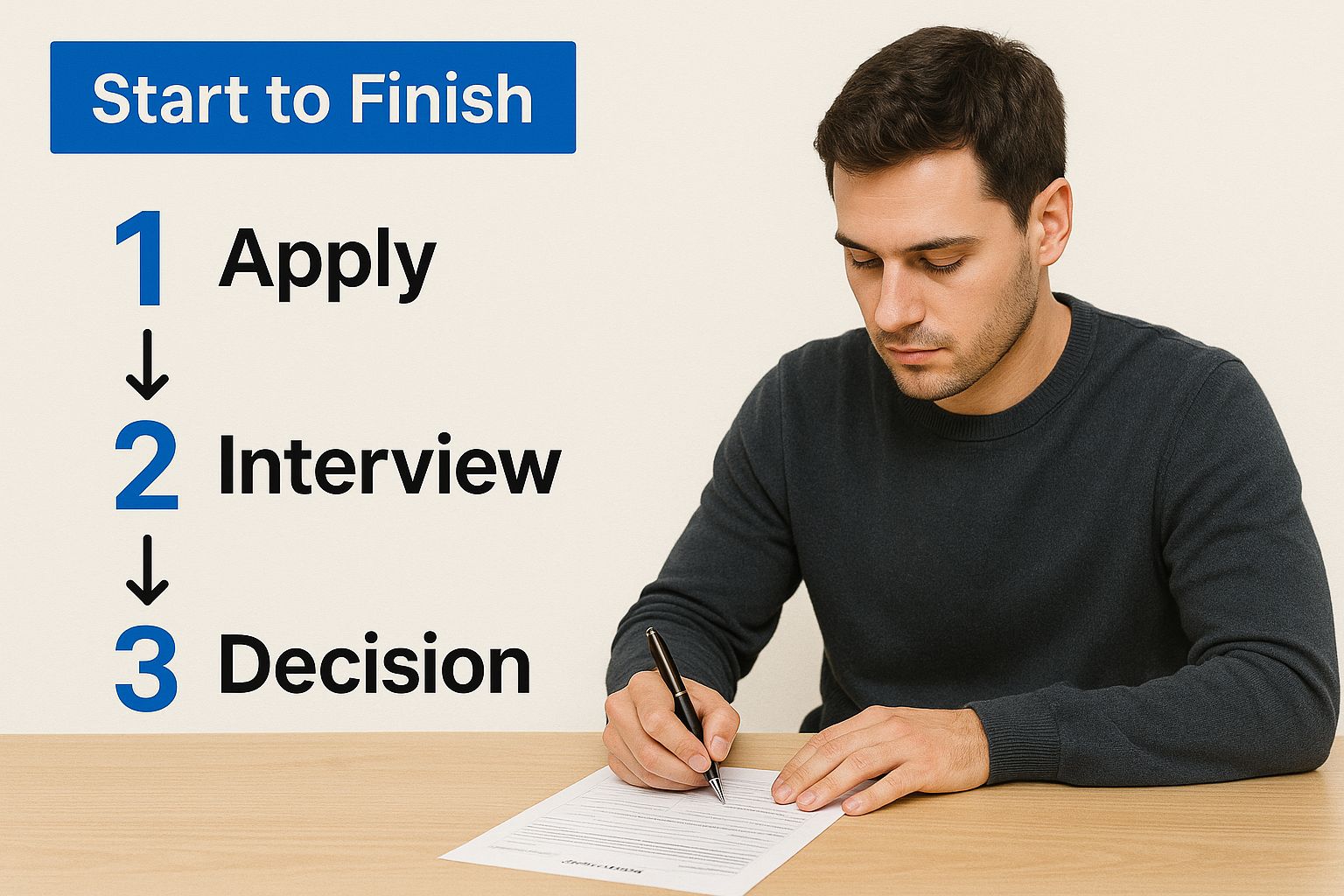
As you can see, the whole thing is a chain of events. Getting everything right at the start makes all the later stages go much, much smoother.
Stage 1: The Attestation Form
Your journey kicks off with the attestation form. This is, without a doubt, the most important document in the entire process. Don’t think of it as just another form; it’s your official statement to the government about who you are, where you’ve lived, what you’ve studied, and your past conduct. Your new department will hand this over to you soon after you get your provisional offer.
Think of this form as the foundation of a house. If the foundation is weak or has cracks—in other words, if it’s full of errors or missing information—the whole structure becomes unstable. The police will use the details you provide here as their primary roadmap. Absolute accuracy is everything.
Stage 2: Departmental Scrutiny and Forwarding
Once you’ve submitted the attestation form, it doesn’t immediately go to the police. First, it lands on the desk of the administrative or HR team in your new department. They’ll do an initial check to make sure you’ve filled everything out and attached all the right documents.
After this internal once-over, your form is officially sent to the District Superintendent of Police (SP) or Commissioner of Police in the area of your permanent and current addresses. If you’ve lived in a few different districts, they’ll send a copy to each police authority. This is the step that officially starts the police-led part of the verification.
Stage 3: The Field Verification
This is the part most people imagine when they hear “police verification.” The district police headquarters passes your case down to the local police station covering your residential area. A specific officer, usually a constable or head constable, gets the task of doing the on-the-ground check.
This field visit usually involves two key things:
- The Home Visit: The officer will show up at the address you provided. Their main goal is to confirm that you actually live there. They might ask a few simple questions to cross-check the details on your form.
- Neighbourhood Inquiry: The officer will also discreetly chat with two or three of your neighbours or other respected people in the locality. They’ll ask about your general character, reputation, and how long you’ve been in the area. This is a standard way to get a sense of your social standing.
Remember, the field verification is less of an interrogation and more of a confirmation exercise. The officer’s job is just to verify the facts you’ve already given them. Being polite, cooperative, and easy to reach will make this step completely painless.
Stage 4: Criminal Record Check
While the field verification is happening, your details are also being run through various police databases. The local police station checks its own records for any First Information Reports (FIRs), criminal cases, or any other negative reports filed against you.
This check isn’t just local, either. Your information is cross-referenced with district and state-level crime record bureaus to make sure the screening is thorough. This is where any undisclosed incidents from your past can come to light, which is why total honesty on your attestation form is so important. To get a better idea of what these checks entail, you can learn more about comprehensive identity verification services and how they work.
Stage 5: Compiling and Submitting the Final Report
Once the field visit and record checks are done, the local police officer puts together a detailed report. This report summarises all their findings, stating whether your information was correct and if any adverse records popped up.
The report then moves up the chain of command, from the local station back to the district police headquarters. A senior officer reviews it for completeness before giving it the final stamp of approval. Finally, this consolidated report is officially sent back to the government department that started the process, closing the loop on your verification journey.
Preparing Your Documents for a Smooth Process

Think of the police verification process as a journey. Your documents are your passport. If they’re in perfect order, you’ll sail through. If not? You’re looking at frustrating, unnecessary delays.
Gathering your paperwork isn’t just a box-ticking exercise. It’s about building a flawless, transparent file that leaves no room for questions. A well-prepared document set is your single best strategy for a quick and positive outcome. The police rely entirely on the information you provide, so clarity and completeness are everything.
Even a single missing document or a small mismatch in details can bring the entire process to a grinding halt.
The Essential Document Checklist
Let’s break down exactly what you need to have ready. Organising your documents is the easiest way to make sure you don’t miss a thing. Each piece of paper serves a specific purpose, from proving who you are to confirming where you live.
Below is a simple checklist of the core documents you will almost certainly need for police verification. Getting these in order upfront is half the battle won.
Document Checklist for Police Verification
A comprehensive checklist of essential documents required for the police verification process, categorized for clarity.
| Document Category | Examples | Key Purpose |
|---|---|---|
| Proof of Identity | Aadhaar Card, PAN Card, Passport, Voter ID Card | Confirms your legal name, date of birth, and personal identity. Consistency is key. |
| Proof of Address | Utility bills (electricity, water), updated Aadhaar Card, valid rental agreement | Verifies your current and/or permanent residence, which is where the physical check happens. |
| Educational Certificates | Class 10th & 12th mark sheets, degree certificates, diplomas | Validates the educational qualifications you declared in your government job application. |
| Photographs | Recent passport-sized colour photographs (usually 4-6 copies) | Required for affixing on the attestation form and other official records. |
Having these documents organised in a single folder, with both the originals and multiple photocopies, will save you a world of last-minute stress. Remember, an accurate address verification check is one of the most critical parts of this process, so ensure that proof is current and correct.
Mastering the Attestation Form
The attestation form is the single most important document in this entire process. It’s not just an application; it’s a sworn statement about your personal history. Any mistake or omission here can be interpreted as an attempt to mislead, which carries serious consequences.
Pay extra-close attention to these common problem areas:
- Residential History: You must list every address where you have lived for more than one year during the preceding five years. Be precise with dates and locations. Forgetting an old rental is a frequent error that gums up the works.
- Disclosure of Legal Cases: This section is non-negotiable. You must disclose any and all police cases, FIRs, or court proceedings, even if you were acquitted or the case was minor and later withdrawn.
The golden rule is absolute honesty. Hiding information is almost always treated more severely than the information itself. An old, minor case that you disclose is manageable; one that you hide and is later discovered can lead to disqualification.
Your goal is to present a complete and honest picture of yourself. By preparing your documents meticulously and filling out the attestation form with total transparency, you take control of the process and pave the way for a smooth verification.
How to Handle Delays and Negative Reports
Waiting for your police verification report can be one of the most nerve-wracking parts of the whole hiring process. As days stretch into weeks with no update, it’s only natural to start thinking the worst. But take a breath—delays are far more common than you might think and rarely signal a major problem.
On the other hand, getting a negative or “adverse” report can feel like a knockout blow. In reality, it’s usually just the start of a conversation, not the end of your job prospects. If you know your rights and what to do next, you can turn that panic into a clear, actionable plan.
Understanding and Tackling Delays
Delays in police verification can pop up for all sorts of reasons, and most of them are purely administrative. Before you get too anxious, it helps to understand what might be causing the holdup.
Some common culprits for a delayed report include:
- High Workload: Local police stations are often swamped with verification requests, not just for government jobs but also for passports, licences, and more.
- Jurisdictional Complexity: If you’ve lived in multiple cities or states, your file has to do a bit of travelling. It gets sent to each location, which naturally adds time to the process.
- Incomplete Information: A simple mistake on your attestation form, like forgetting a previous address, can unfortunately send the whole process back to square one.
- Holiday Periods: Public holidays and festival seasons can slow down any government administrative work to a crawl.
Historically, police verification in India has been plagued by these kinds of delays. The process used to take anywhere from two to six months, leaving candidates in limbo and delaying their appointment letters. To get around this, some departments would issue provisional appointments pending verification.
Thankfully, a recent Supreme Court directive is pushing to streamline all this. The court has set a clear timeframe to get verifications done, aiming to clear the backlog and ensure appointments are regularised on time. It’s a huge step forward, impacting thousands of candidates waiting to start their new roles. You can get more details on the court’s impact on these timelines in this legal analysis.
If you find yourself stuck in a delay, don’t just sit and wait. You can be proactive. Your first port of call should be the administrative or HR department of your potential employer. They’re your main contact and can often check on the status for you through official channels.
Decoding and Contesting an Adverse Report
Getting an “adverse report” sounds scary, but it’s crucial to understand what it actually is. It simply means the police found information that doesn’t quite match what you provided, or they discovered something they think the employer should be aware of. This could be anything from an undisclosed criminal case to a simple mix-up in your address history.
An adverse report is not an automatic disqualification. The principles of natural justice guarantee you the right to be heard. The appointing authority is required to tell you exactly what the negative report says and give you a fair chance to explain your side of the story.
An adverse report is a finding, not a final judgment. Your right to respond is a cornerstone of the process. A clear, honest, and well-documented explanation can often resolve the issue in your favour.
Once you’re notified of an adverse finding, what you do next is critical. Here’s a straightforward action plan:
- Request a Copy: Formally ask the appointing department for a copy of the adverse report. You need to know exactly what the issue is before you can address it.
- Gather Evidence: Pull together all the documents that back up your case. This might include court acquittal orders, proof of residence, or statements that clear up a misunderstanding.
- Submit a Written Representation: Write a clear and respectful letter explaining your position. Stick to the facts and attach copies of all your supporting documents.
If your written explanation is rejected, you may have the option to appeal to a higher authority within the department or even take your case to an administrative tribunal. The most important thing is to act quickly and follow the proper procedures. Hitting a snag is stressful, but the police verification rules for a govt job are designed with pathways for you to seek a fair resolution.
Common Questions About Police Verification Answered
Navigating the police verification rules for a government job can feel like walking through a maze. We’ve laid out the main path, but it’s the specific, personal questions that often cause the most stress. This is where we tackle those common worries head-on.
Think of this section as your troubleshooting guide. We’re diving into the “what if” scenarios that keep applicants up at night—from having a pending police case to worrying about a minor tiff with a neighbour. The goal is to swap that uncertainty for solid, clear answers.
What If I Have a Pending Police Case During Verification?
This is easily one of the biggest anxieties for many candidates. But take a breath—a pending case isn’t an automatic disqualification. What matters most isn’t the case itself, but how you handle it. The appointing authority will look at the nature and seriousness of the charge; a minor traffic violation is worlds away from a charge involving moral turpitude.
The golden rule here is full disclosure. You absolutely must declare any pending FIR or court case on your attestation form. Hiding it is seen as a major breach of trust and is far more likely to get you disqualified than the case itself.
Here’s what you can generally expect:
- Conditional Appointment: You might get a provisional appointment, with your final confirmation hanging on the court’s verdict.
- Departmental Review: The department will dig into the specifics of the case to figure out if it impacts your ability to perform the job.
- Document Submission: Be prepared to submit official papers, like a copy of the FIR and any relevant court documents.
Ultimately, honesty is your best defence. Declaring it upfront allows the department to make a fair decision based on their rules. Finding out later creates a much bigger problem for everyone.
How Long Is a Police Verification Valid for Government Jobs?
This is a really common point of confusion. A police verification report isn’t like a passport or a driving licence with a fixed expiry date. It’s a one-time check done for a specific role in a specific department.
Think of it this way: a police verification is a snapshot, not a permanent certificate. It reflects your record at a specific point in time for a specific purpose.
This means if you switch jobs, even to another government department in the same state, your new employer will kick off a completely new verification process. They need the most current information available right when they hire you. Each verification is a fresh start, designed to maintain the integrity of every new appointment.
Will a Past Neighbourhood Dispute Affect My Job?
Lots of people have been part of minor disagreements that might have even involved the police showing up. Whether this impacts your job application boils down to one simple question: Was a First Information Report (FIR) filed?
If the whole thing was sorted out informally at the police station without an FIR being registered, it’s very unlikely to show up on your official record. But if an FIR was lodged, you are legally required to disclose it. This is true even if the case was later withdrawn or you were acquitted. The verification process is designed to look for all registered FIRs.
The department will then look at the nature of the dispute. A silly argument over parking or loud music is highly unlikely to be a deal-breaker. The real issue, once again, is your transparency. Forgetting to mention a registered FIR is a serious omission.
Can I Start My Job Before Verification Is Complete?
Yes, and this happens all the time in government hiring. Most departments will issue what’s known as a “provisional appointment letter.” This lets you join the department, start your work, and even begin drawing a salary while the police verification is chugging along in the background.
But it’s critical to understand what “provisional” really means. Your offer letter will have a clause making it crystal clear that your job is conditional. If the police verification comes back with a negative report and you can’t successfully challenge it, your service can be terminated.
The good news is that recent Supreme Court directives have been pushing for faster verification timelines. This helps shorten that nerve-wracking period of uncertainty for new hires, letting them get their appointments regularised much faster.
At SpringVerify, we understand the importance of thorough and efficient background checks for making confident hiring decisions. Our advanced screening services help companies ensure they are hiring trustworthy and qualified candidates every time. Learn more about how SpringVerify can streamline your verification needs.


