

Police tenant verification is a mandatory safety check for landlords in India. It involves submitting your tenant’s details to the local police so they can run a background check. Think of it as a crucial step to confirm a tenant’s identity, look for any criminal history, and make sure your property isn’t being used for illegal activities.
This simple process helps create a safer environment for you, your neighbours, and the entire community.
Table of Contents
Why Tenant Verification Is Your First Line of Defence
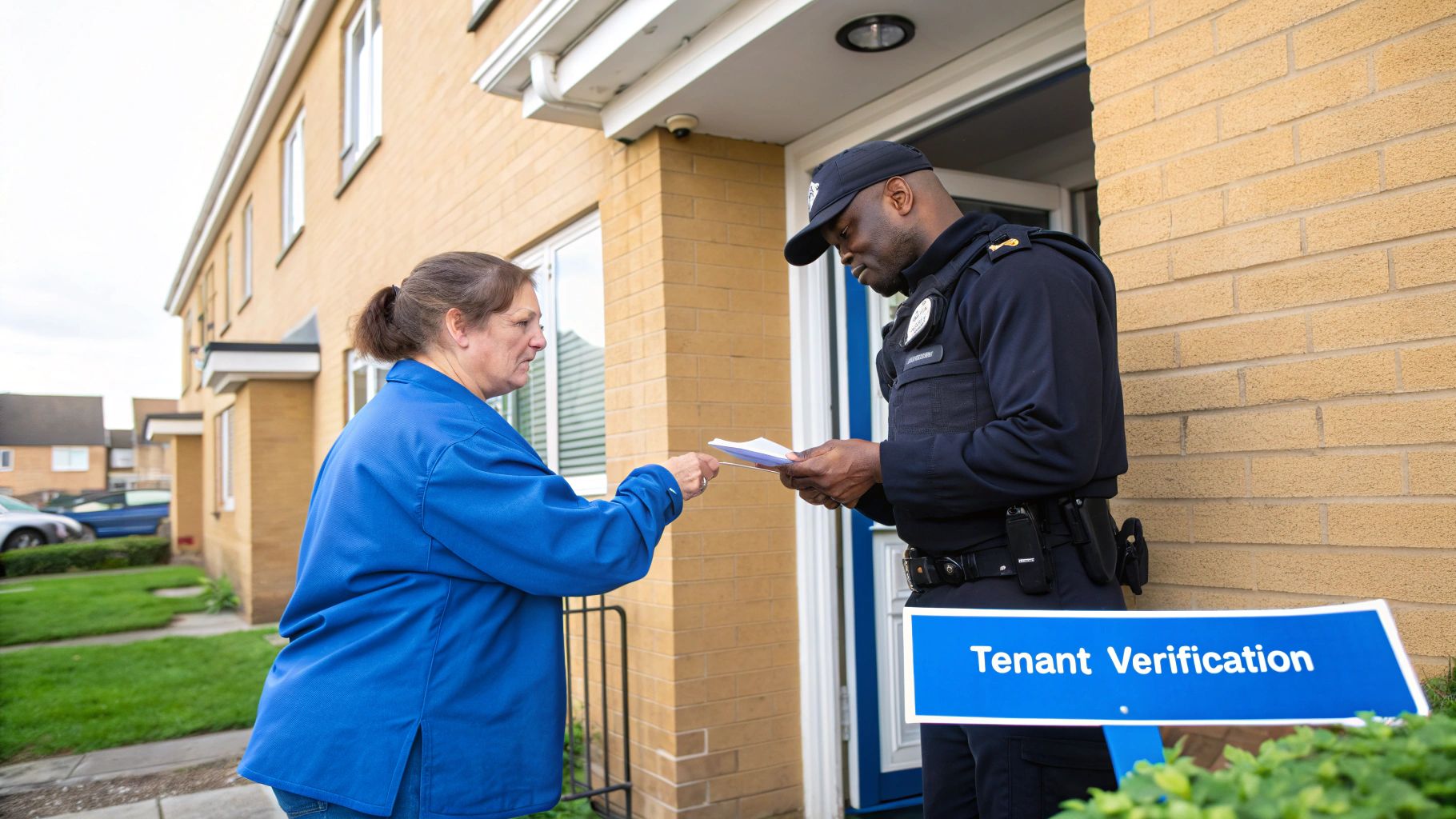
Think of police tenant verification as the rental market’s version of an airport security check. Just as airports screen passengers to keep everyone safe, landlords use this process to vet potential tenants. It isn’t about distrust; it’s about building a secure and transparent tenancy from day one. This small step adds a vital layer of protection for your property and the neighbourhood.
By formalising the tenancy with the authorities, you’re not just ticking a box on a to-do list. You are actively contributing to community safety, making it much harder for someone with criminal intent to find a place for unlawful activities. It’s a proactive approach that safeguards both your investment and your reputation.
More Than Just a Formality
At its heart, this process is about creating an official record of who is living in your property. This documentation becomes invaluable if any issues pop up later, as it provides a clear, official link between the tenant and your property in police records.
To give you a clearer picture, let’s break down the key parts of the police tenant verification process and what they aim to achieve.
Police Tenant Verification At a Glance
| Component | Objective |
|---|---|
| Identity Confirmation | To confirm the tenant is who they claim to be using official documents like an Aadhaar card or passport. |
| Criminal History Check | To scan police databases for any past criminal involvement or outstanding warrants. |
| Address Validation | To build a credible residential history and reduce the risk of renting to someone with a hidden past. |
This structured process transforms a private rental agreement into a secure, legally recognised transaction. Here’s a quick overview of what these checks entail:
- Identity Confirmation: This is about ensuring the person moving in is who they say they are by checking documents like an Aadhaar card or passport. You can dive deeper into authenticating documents in our guide to identity verification services.
- Criminal History Check: The police cross-reference the tenant’s details with their own databases to flag any past criminal involvement or active warrants.
- Address Validation: Confirming previous addresses helps build a credible history for the tenant, lowering the risk of renting to someone who might be hiding something.
A Non-Negotiable Legal Obligation
What might have once been seen as just good practice has now become a legal duty for landlords across India. Authorities are stepping up their enforcement, holding property owners directly accountable for verifying their tenants. Simply put, ignoring this is no longer an option and can lead to serious trouble.
For instance, recent events show a clear trend towards stricter compliance. In June 2024, Bidhannagar Police issued show-cause notices to 94 landlords for failing to conduct mandatory verifications, signalling growing legal pressure. This isn’t just happening in one place; cities like Pune, Chandigarh, and Dehradun are also holding landlords accountable, especially with concerns that unverified tenants could use rented properties for cyber fraud or other crimes.
This shift highlights a fundamental change in the rental world: police tenant verification is no longer a suggestion but a crucial legal requirement. It protects your property, your neighbours, and your community from potential harm.
Ultimately, embracing police tenant verification is just responsible property management. It aligns your practices with the law, protects your financial investment, and helps build safer neighbourhoods for everyone. It’s the first—and most important—step in creating a secure and trustworthy landlord-tenant relationship.
Understanding Your Legal Duties as a Landlord

While checking a tenant’s background is a smart move for any landlord, it’s important to realise that in many parts of India, this isn’t just a recommendation—it’s the law. This responsibility isn’t just about good practice; it’s a legal duty, and the onus is placed squarely on you, the landlord. The authorities see this process as a crucial part of maintaining public safety and national security.
The legal muscle behind this comes mainly from Section 188 of the Indian Penal Code (IPC). This law deals with disobedience to an order issued by a public servant. So, when your local police commissioner mandates tenant verification, ignoring it becomes a direct violation of this section.
The Consequences of Non-Compliance
Choosing to skip your legal duty for police tenant verification comes with some serious risks. The penalties under Section 188 are no slap on the wrist; they’re designed to make sure landlords take this responsibility seriously. The consequences can range from fines to more severe legal trouble.
Landlords who neglect this duty can face:
- Financial Penalties: The authorities can levy hefty fines, which often increase based on the seriousness of the situation. These fines act as a clear deterrent against negligence.
- Imprisonment: In more extreme cases, especially if letting an unverified tenant move in leads to a public safety threat, a landlord could face jail time. The term might be up to one month, or even six months if the oversight endangers human life or safety.
This legal framework shifts tenant screening from a simple background check into a critical civic duty. The law essentially makes you a partner in keeping the community safe by holding you accountable for who lives in your property.
Understanding these penalties helps change the perspective on verification. It’s not a chore; it’s a vital legal obligation. The law is straightforward: the responsibility is yours, and the consequences of ignoring it are real.
How Local Regulations Shape Your Duties
While Section 188 of the IPC is the national backbone, the specific rules for police tenant verification often come from local authorities. Big cities, with their own unique security challenges, tend to have particularly strict regulations that landlords must follow. These city-specific rules are key to preventing crime in dense urban areas.
This localised approach means you have to stay on top of the specific directives from the police in your city. The details might vary, but the core requirement to verify your tenant is always the same.
Here’s a quick look at how some major cities are handling it:
- Delhi: The Delhi Police have consistently issued orders making tenant verification mandatory. They’ve even set up a streamlined online portal to make it easier, leaving no real excuse for not complying.
- Mumbai: As a major financial hub, Mumbai has incredibly strict rules. Landlords are required to submit tenant details at their nearest police station right after the rental agreement is signed.
- Bengaluru: The Bengaluru City Police also enforces this mandate and frequently runs awareness campaigns to remind landlords of their duties and the legal trouble they could face for failing to do so.
These examples highlight a clear trend across India’s major cities. Local police are actively enforcing these rules to stop their cities from becoming safe havens for criminals. For landlords, keeping up with these regulations isn’t just about dodging a fine; it’s about being a responsible property owner who helps create a safer city for everyone. You can learn more about navigating these complexities by exploring an overview of legal and regulatory compliance.
How to Navigate the Tenant Verification Process
Getting through a police tenant verification might seem daunting, but it’s actually a pretty straightforward process once you know the steps. Think of it as a simple roadmap with a few key stops. Whether you’re comfortable doing things online or prefer to handle it in person, the core requirements are the same, so you can meet your legal duties without any unnecessary stress.
The whole thing is designed to be accessible. By getting all your paperwork together beforehand and knowing your submission options, you can sail through the verification smoothly. A little bit of prep work not only saves a ton of time but also helps you sidestep common mistakes that can cause delays or legal headaches.
This visual guide breaks down the simple, three-step journey of police tenant verification, from gathering documents to getting that final confirmation.
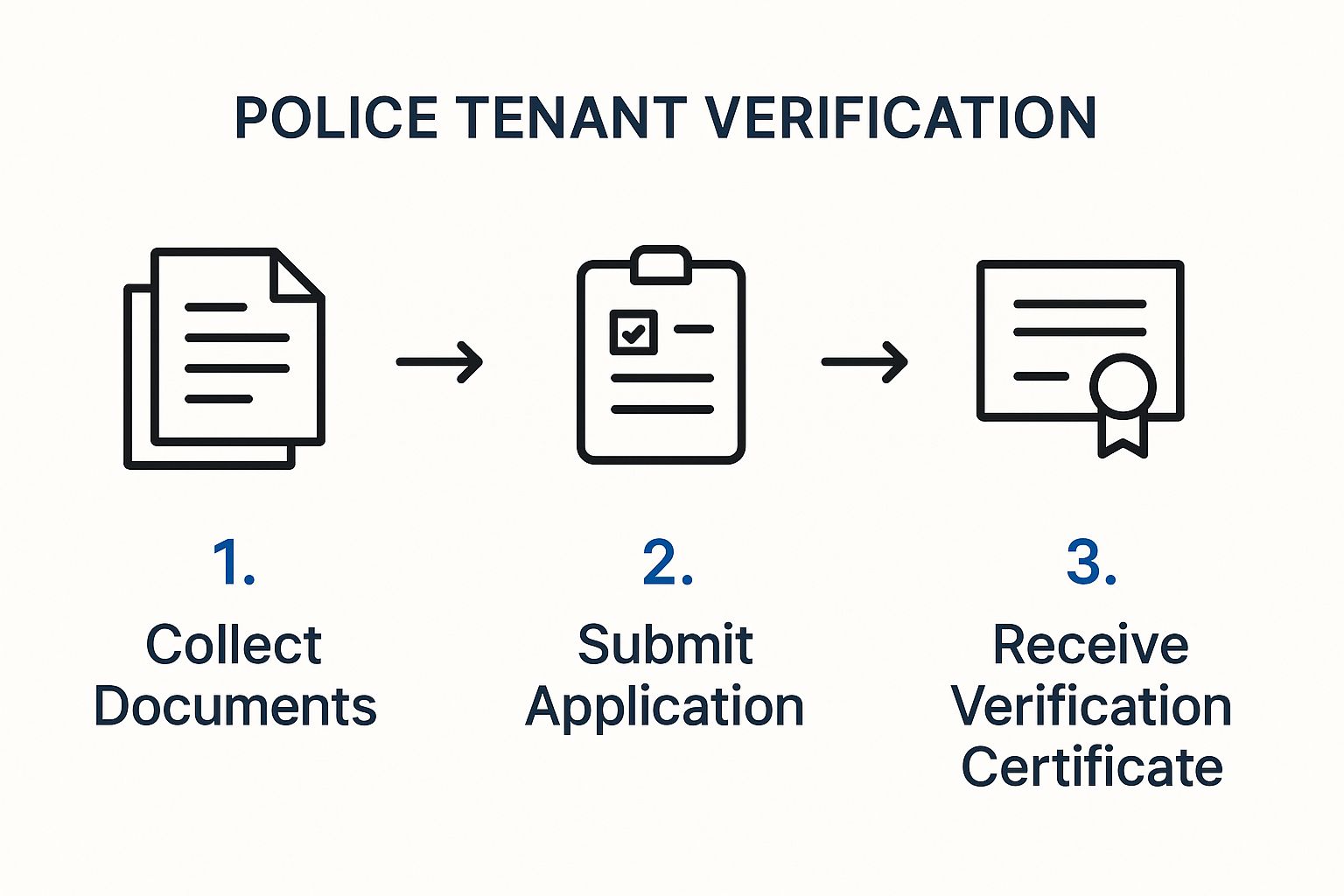
As you can see, the process flows logically from document collection to submission, and finally to getting the official verification certificate that proves you’ve done your part.
Step 1: Assemble the Necessary Documents
Before you can even start, you need to gather a specific set of documents from both yourself (the landlord) and your potential tenant. Seriously, having everything ready to go is the single best thing you can do to make this process painless. Missing paperwork is the number one reason these things get held up.
Here’s what you’ll generally need to collect:
- Tenant’s Documents: This includes a copy of their government-issued photo ID (like an Aadhaar Card or Passport), proof of their permanent address, and often, proof of employment like a company ID card or offer letter.
- Landlord’s Documents: You’ll need a copy of your own photo ID and address proof to confirm you’re the property owner.
- Property Documents: A copy of the registered rent agreement is a must-have, as it’s the legal backbone of the tenancy.
- Photographs: Both you and your tenant will usually need to provide recent passport-sized photos.
Think of this stage as preparing your ingredients before you start cooking. With all your documents organised and ready, the rest of the process is much faster and simpler.
Getting these items together upfront also signals to the tenant that you’re a thorough and professional landlord, which helps set a positive tone right from the start. Plus, it gives you an early chance to spot any potential red flags.
Step 2: Choose Your Submission Method
Once you’ve got all the documents in a neat pile, it’s time to submit the police tenant verification form. Most states now give you two main options: you can do it online through a dedicated police portal, or you can go the old-school route and visit a local police station. Each method has its pros, so you can pick whichever one suits you best.
The Online Method
For sheer speed and convenience, the online method is tough to beat. Many state police departments have launched user-friendly websites that let you handle the entire process from the comfort of your home or office.
- Visit the Official Portal: Find the official website for your city or state police. Look for a section labelled something like “Citizen Services” or “Tenant Verification.”
- Fill the Application Form: You’ll enter details about yourself, your tenant, and the property directly into an online form.
- Upload Scanned Documents: Upload clear, scanned copies of all the documents you collected in the first step.
- Submit and Save: After you submit the form, you’ll usually get an acknowledgement receipt or a reference number. Make sure to save this for your records.
This digital route is not just faster; it also gives you an instant, trackable record of your submission, which is incredibly useful for proving you’re compliant.
The Offline Method
If you’re not a fan of online portals, or if your local area doesn’t have a reliable online system, the traditional offline method is always there for you.
- Obtain the Form: Pop over to your nearest police station to pick up a physical tenant verification form. Some police websites also let you download and print the form at home.
- Complete the Form: Fill out the form carefully with all the required information.
- Attach Photocopies: Make photocopies of all the necessary documents and staple them to the completed form.
- Submit in Person: Take the form and the attached documents to the police station and hand them in. Always ask for an acknowledgement slip or a stamped copy as proof that you’ve submitted it.
This hands-on approach can offer peace of mind, as you’re delivering the documents directly to the authorities. And make no mistake, the authorities are taking this process very seriously. For example, ahead of Independence Day celebrations, Chandigarh Police verified a massive 18,497 tenants and servants in just 15 days to enhance city-wide security. This just goes to show how vital tenant verification has become for public safety. You can read more about how police conduct these large-scale verification drives in this report from The Times of India.
Why Verification Is a Win for Both Landlords and Tenants
It’s easy to dismiss police tenant verification as just another box to tick on a landlord’s endless checklist. But thinking of it that way misses the point entirely. This isn’t a one-sided chore; it’s the very foundation of a secure, transparent rental relationship, with real upsides for both the landlord and the tenant.
When you frame it this way, the process shifts from a legal hurdle to a mutual pact for safety and trust. If landlords take a moment to explain the shared benefits, tenants are far more likely to see it as a smart safety measure for everyone, not an invasive background check. That kind of cooperation sets a positive tone right from the start.
How Landlords Gain Peace of Mind
For any landlord, a rental property is much more than bricks and mortar—it’s a serious financial investment. Police tenant verification is a powerful risk management tool, adding a layer of security that simple credit checks or personal references just can’t provide. It helps you know exactly who you’re trusting with your asset.
The most obvious benefit is heightened security. By confirming a tenant’s identity and checking for any criminal history, you dramatically lower the risk of your property being used for illegal activities. This isn’t just about protecting your building from damage; it’s about protecting the peace and safety of the entire neighbourhood.
On top of that, verification is a solid defence against financial fraud. It helps you weed out applicants using fake identities to sign a lease, only to vanish a few months later without paying rent. Having a tenant’s background officially logged with the police gives you a clear course of action if the relationship sours.
“A verified tenancy is a secure tenancy. For landlords, it’s the ultimate peace of mind, knowing that you’ve done your due diligence to protect your property, your investment, and your neighbours.”
Finally, going through the proper verification process keeps you on the right side of the law, saving you from hefty fines or legal trouble down the road. It’s a simple step that marks you as a professional, responsible landlord who can be trusted.
The Tenant’s Stake in Verification
From the tenant’s side of the table, a request for police verification can feel a bit intrusive at first glance. But it’s actually just as much in their interest. It confirms their credibility as a reliable renter and is a strong signal that they’re moving into a safe, well-managed community.
First off, completing a police verification legitimises the tenancy. It creates an official record of their address, which can be surprisingly handy for all sorts of administrative needs. This formality also builds trust with the landlord, showing that they take their responsibilities seriously—which is exactly the kind of property owner you want.
Beyond that, tenants get to live in a safer environment. When all landlords in a building or area make tenant verification a standard practice, it lifts the security for everyone. This collective effort discourages people with criminal intent from even trying to rent there, helping maintain a peaceful community.
This push for stricter verification is gaining momentum across India. For example, in just the first half of 2024, Goa Police carried out 471 tenant verification drives, a huge jump from the 236 conducted in all of 2023. It’s part of a nationwide trend to ensure rental properties aren’t misused, which ultimately makes neighbourhoods safer for everyone living there. You can get more details on how Goa Police are stepping up tenant checks on Propnewstime.com.
Ultimately, police tenant verification isn’t about suspicion; it’s about creating a stronger, safer rental ecosystem for all.
Modernizing Your Verification with Technology
The old-school way of handling police tenant verification—endless paper forms, long queues at the local police station—still works, but it feels like it belongs in another era. For landlords and property managers who value their time, efficiency is everything. Let’s be honest, manual processes are slow, riddled with potential for human error, and create an administrative headache that can grind your entire rental cycle to a halt.
Think about it like this: you could build a modern apartment complex using only hand tools. It’s possible, sure, but it would be painfully slow and inefficient. In the same way, sticking to manual verification when digital solutions exist puts you at a serious disadvantage. Technology offers a faster, more accurate, and far simpler path forward.
The Shift to Automated Screening
The future of tenant screening is automated. Modern tools are built to strip away the manual effort, swapping paperwork for instant, data-driven checks. This isn’t just a matter of convenience; it’s about upgrading your security and compliance protocol to be faster and more reliable than ever before.
This leap forward is powered by what are known as Application Programming Interfaces, or APIs. You can think of an API as a secure messenger that lets different software systems talk to each other. When it comes to tenant screening, an API can connect your property management software directly to verification databases, fetching the information you need in seconds.
Instead of you having to manually collect forms, submit them, and then wait for a response, the technology does the heavy lifting. This integration completely removes the delays and ensures you get thorough results almost instantly.
How API Integration Works for Landlords
An API-driven solution, like the one from SpringVerify, turns police tenant verification from a task that takes days into a process that’s over in minutes. It works by embedding powerful verification tools directly into the platforms you already use to manage your properties.
Here’s a glimpse of how it streamlines your workflow:
- Instant Identity Checks: The API can immediately cross-reference a potential tenant’s Aadhaar or PAN card details with official government databases. This simple step eliminates the risk of dealing with someone using a fake identity.
- Criminal Record Searches: It automatically scans multiple criminal record databases, offering a much more comprehensive check than a standard manual submission might uncover. You get a clear, reliable picture of a tenant’s background.
- Address Validation: The system can validate addresses against official records, confirming a tenant’s residential history and flagging any red flags or inconsistencies.
This automated approach doesn’t just save an incredible amount of time; it also slashes the risk of human error. A single typo or a misread name on a paper form can invalidate a check, but an API ensures data is transmitted and verified with precision.
Integrating verification technology into your operations is like swapping a paper map for a real-time GPS. You move from a reactive, paper-based system to a proactive, digital-first approach that gives you a clearer view of the road ahead.
The Benefits of a Tech-Driven Approach
Bringing a modern verification solution into your process does more than just speed things up. It gives you a strategic edge, allowing you to manage your rental properties more securely and effectively.
Let’s put the old and new methods side-by-side:
| Feature | Traditional Method | API-Driven Solution |
|---|---|---|
| Speed | Days or even weeks | Minutes |
| Accuracy | Prone to human error | High precision, data-driven |
| Convenience | Manual paperwork, in-person visits | Fully automated and remote |
| Record Keeping | Physical files, easy to misplace | Digital, secure, and organised |
The efficiency gains are undeniable. A faster turnaround lets you fill vacancies quicker, which means less potential income lost between tenants. More importantly, the improved accuracy means you’re making decisions based on solid, comprehensive data, which strengthens both your compliance and your security. If you’re looking to build this kind of efficiency into your own systems, you can learn more about how to get started with SpringVerify’s API integrations.
Ultimately, modernizing your police tenant verification process lets you work smarter, not harder. It cuts down your administrative load, minimises your risk, and gives you the peace of mind that comes from knowing your screening is as thorough as it is efficient.
Common Questions About Police Tenant Verification
Even when you know the rules, the real world throws curveballs. Police tenant verification is a critical legal duty, so getting the details right is non-negotiable. We’ve rounded up the questions we hear most often from landlords and laid out direct, no-nonsense answers to help you handle the process with confidence.
This isn’t just about ticking a box; it’s about navigating real-world situations, like a tenant who pushes back or figuring out confusing timelines. Let’s cut through the noise and get you the clarity you need to protect yourself legally.
Is Police Tenant Verification Mandatory in My State?
This is the big one, and the answer isn’t a simple yes or no. While it’s a smart move for any landlord in India, whether it’s legally mandatory often comes down to local city or district orders.
In major cities, you can bet it’s a legal requirement. Police Commissioners in places like Delhi, Mumbai, Pune, and Bengaluru have issued specific directives under Section 144 of the CrPC, making it obligatory for all landlords. These aren’t just suggestions; they’re in place to beef up urban security.
Ignoring this in these areas isn’t just a slip-up—it’s a punishable offence under Section 188 of the Indian Penal Code.
Local regulations can shift based on security concerns. The smartest and safest approach? Always assume it’s mandatory. A quick check on your local police department’s official website or a visit to the nearest station will give you the final word.
What Should I Do If a Tenant Refuses Verification?
A potential tenant refusing police verification is a massive red flag. Don’t ignore it. The responsibility for getting this done falls squarely on your shoulders as the landlord, and their refusal puts you in a legally tight spot.
If you face hesitation or an outright refusal, the first step is a calm, professional conversation.
- Educate Them: Clearly explain that police verification isn’t a personal choice but a legal requirement in your area. Frame it as a standard safety procedure for the entire community.
- Highlight the Upside: Let them know that it legitimises their tenancy and makes the building safer for everyone, including them.
- Stand Your Ground: If they still refuse after you’ve explained the situation, the best advice is to walk away from the rental agreement.
Renting to someone who hasn’t been verified (where it’s required) opens you up to fines, potential jail time, and serious liability if that tenant gets involved in any illegal activities. It’s far safer and more responsible to decline their application.
How Long Does the Police Verification Process Take?
The timeline can vary quite a bit, depending on how you submit the form and how busy your local police department is. Generally, online is faster than offline.
- Online Submission: This is your speediest option. Once you submit the form on the official police portal, you’ll usually get an instant acknowledgement receipt. The actual background check and final confirmation can take anywhere from a few days to about two weeks.
- Offline Submission: Going the old-school route and dropping off a physical form at the police station will almost always take longer. You could be waiting more than two weeks, depending on the station’s workload.
To keep things moving, kick off the verification process the moment the rental agreement is signed. Always hold onto that acknowledgement receipt—it’s your proof of compliance while you wait for the final report.
Can Tenants Do Their Own Police Verification?
The short answer is no. The legal duty to initiate and complete the police tenant verification process rests entirely with the landlord or property owner. The authorities hold you accountable.
The tenant’s role is simply to cooperate. They need to provide you with their documents and correct personal details. They can’t, however, submit the verification form themselves.
Think of it this way: the police need a fixed point of contact who is responsible for the property. That’s you. You’re the one who fills out the form, attaches the documents, and submits everything to the police for their official records.
Ready to make your verification process faster, more accurate, and completely seamless? SpringVerify offers a powerful, API-driven solution that automates identity checks, criminal record searches, and more, integrating directly into your existing workflow. Cut down on paperwork and get reliable results in minutes, not weeks.
Discover a smarter way to screen tenants by visiting https://in.springverify.com today.


