

A PAN verification API is a digital tool that instantly confirms if an individual’s or company’s Permanent Account Number (PAN) is authentic by checking it against official government databases. Think of it as a secure, automated bouncer for your financial and onboarding processes, making sure every identity you deal with is legitimate.
Table of Contents
What Is a PAN Verification API and Why Is It Essential?

Imagine your business is bringing a new customer on board for a loan. In the past, this was a manual slog: collect a physical copy of their PAN card, have an employee painstakingly check the details, and cross your fingers that it wasn’t a clever fake. This whole process was slow, riddled with human error, and wide open to sophisticated forgeries.
A PAN verification API completely flips the script. It acts as a secure bridge between your application—whether it’s a website or a mobile app—and the official PAN databases managed by government bodies like the NSDL. When a user punches in their PAN, the API sends a secure request and gets a real-time response, confirming the card’s validity and the holder’s details in seconds.
The Shift from Manual to Automated Verification
Moving from manual checks to automated verification isn’t just a nice-to-have anymore; it’s a must for any modern business in India. The old manual way is loaded with problems that hit your bottom line and your reputation hard.
The real issue with manual verification is how inefficient and unreliable it is. It causes delays that frustrate customers, creates operational headaches that drive up costs, and leaves the door wide open for identity fraud that can lead to massive financial losses.
With over 61 crore PAN cards issued in India as of 2023, the sheer scale of verification required is staggering. Businesses that have plugged in a PAN verification API are seeing incredible results. Many report up to a 40% reduction in customer onboarding time and a 30% drop in operational costs. These aren’t just empty numbers; they come from cutting out manual work, boosting accuracy, and directly tackling the risks of financial fraud, which cost businesses over ₹1,600 crore in 2022.
Core Pillars of API-Driven Verification
The crucial role of a PAN verification API boils down to three key pillars:
- Security: By checking an identity against an official source, it serves as your first line of defence against fraud and impersonation.
- Compliance: It automates a vital part of meeting Know Your Customer (KYC) and Anti-Money Laundering (AML) regulations, shielding your business from heavy penalties.
- Efficiency: It provides instant results, which makes for a smooth user experience, reduces customer drop-offs, and seriously speeds up your business processes.
Ultimately, bringing this technology into your workflow is about building trust. It shows your customers that their data is handled securely, while ensuring your business is built on a solid foundation of verified, authentic identities. You can see just how easy it is to add this capability by checking out our guide on API integrations.
The Escalating Need for Robust Digital Verification
India’s digital economy is booming, and while that brings incredible opportunities, it also opens the door to new and serious risks. The very convenience of digital onboarding and transactions has unfortunately become a breeding ground for financial fraud and identity theft. For any business today, operating without a solid verification system is like leaving your front door wide open in a bustling marketplace.
This new reality has spurred regulatory bodies like the Reserve Bank of India (RBI) to tighten the rules. Know Your Customer (KYC) and Anti-Money Laundering (AML) regulations aren’t just suggestions anymore—they’re strict mandates. Sticking to old-school manual checks is not only slow and inefficient but also a huge compliance risk waiting to happen.
The Financial Stakes of Identity Fraud
The numbers don’t lie. In the 2023-24 fiscal year alone, financial fraud in India led to staggering losses of over ₹14,000 crore. The RBI also reported that bank frauds in 2024 soared past ₹139 billion, with a huge chunk of that tied directly to identity theft. This is precisely where a PAN verification API becomes a non-negotiable part of your toolkit. It offers real-time validation against official government databases to shut down fraud before it can even start.
Think of a PAN verification API as your first line of automated defence. It instantly checks a Permanent Account Number against data from trusted sources like the NSDL, confirming the holder’s identity in mere seconds. This isn’t just about beefing up security; it’s about building a foundation of trust from the very first interaction.
In a world where a single fraudulent transaction can tarnish a company’s reputation overnight, being proactive about verification is essential. It’s about protecting your business, your customers, and proving you’re serious about security.
Verification Beyond Financial Transactions
This need for trustworthy digital verification isn’t just limited to banking and fintech. Human resources teams, for example, are wrestling with the same issues. How can you be sure a candidate is who they say they are during the hiring process?
Digital verification is now critical across the board:
- E-commerce: Vetting sellers and buyers in high-value transactions to keep marketplace fraud at bay.
- Lending Platforms: Confirming a borrower’s identity on the spot to minimise credit risk.
- HR and Recruitment: Authenticating candidate identities to build a secure and reliable workforce from day one.
Beyond finance, robust digital verification is vital in HR, where tools like automated candidate screening processes are helping companies hire more efficiently and accurately. By integrating a PAN verification API, businesses in every sector can build a more secure, compliant, and trustworthy reputation in a fiercely competitive market.
How the PAN Verification Process Works
To get your head around how a PAN verification API works, it helps to think of it as a super-secure, incredibly fast messenger. Your business needs to confirm a customer’s identity. The API is the messenger that takes your request straight to the official source and zips back with a verified answer in moments. It’s a simple idea that fuels a highly secure and efficient process.
The whole thing kicks off the moment a user types their PAN number into your platform—be it a mobile app, website, or even an internal tool. This is the package your messenger needs to deliver. Your system then calls the API, sending the PAN number in what’s called a secure “API request.” This is like putting the package into a locked, tamper-proof box addressed to a very specific, secure destination.
The Secure Data Exchange
That secure destination is known as an API endpoint. It’s a unique URL that your API vendor, like SpringVerify, provides. Think of it as the digital doorway to the verification service. Once your request arrives at this endpoint, the API provider’s system takes over. It securely forwards the PAN information to the official government databases—primarily the NSDL (National Securities Depository Limited) or UTIITSL.
At its heart, this process creates a direct line to authoritative data. The API isn’t guessing or relying on old information; it queries the official government source of truth in real-time. This guarantees the highest level of accuracy for every single check.
The government database then runs the PAN against its records. After confirming the details, it shoots a response back to the API provider containing the key data points that validate the PAN.
This diagram breaks down the simple, three-step flow of data from your platform, to the verification source, and back again.
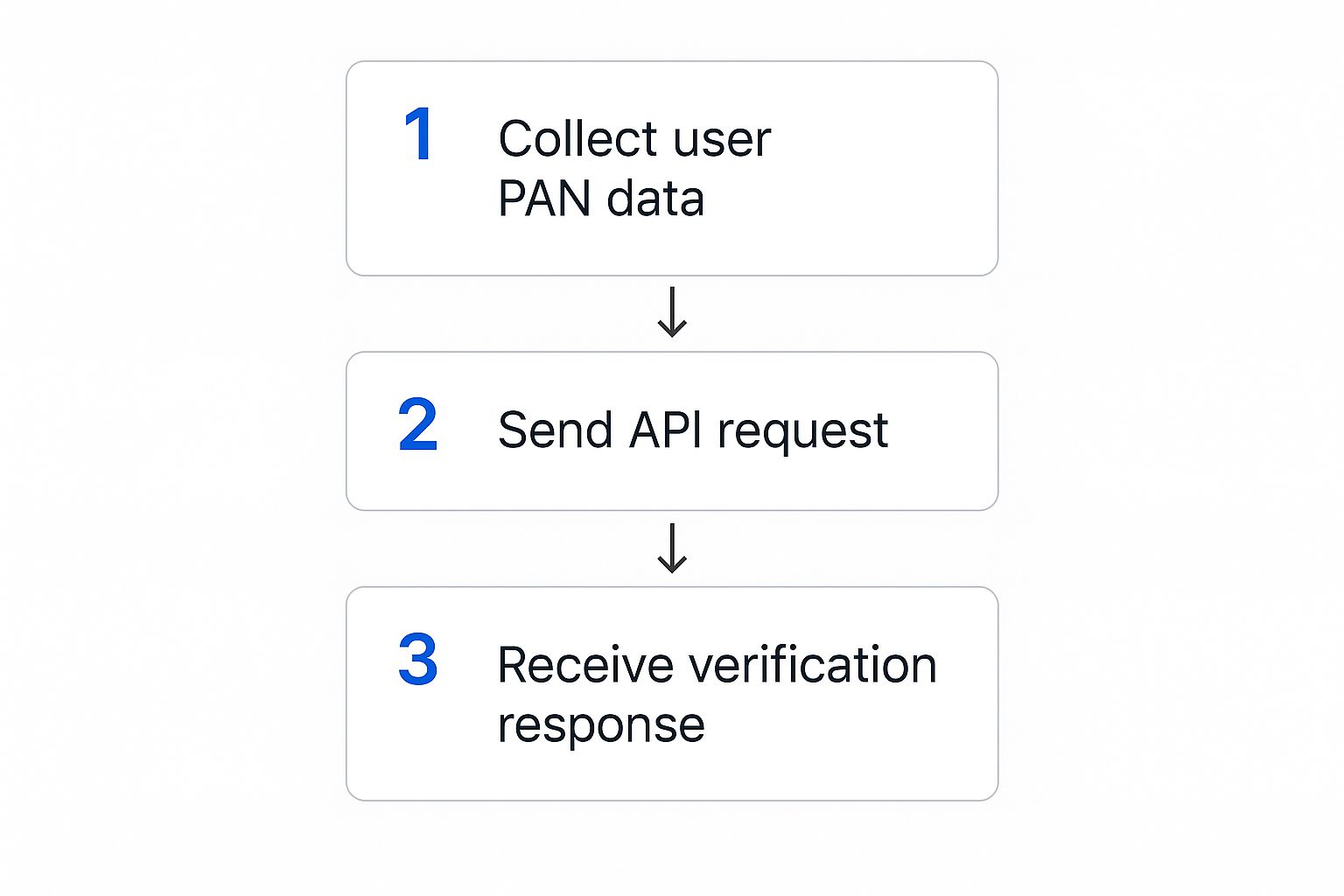
As the visual shows, it’s a straightforward, linear exchange of information, built from the ground up for speed and security.
Understanding the API Response
Finally, the API provider takes the raw data from the government’s response, translates it into a clean, easy-to-digest format, and sends it back to your application. This is the “API response.” This entire round trip—from your platform to the NSDL database and back—is usually over in just a few seconds.
The response you get back typically includes crucial information to validate the user’s identity:
- Verification Status: A clear “Success” or “Failure” message.
- Full Name: The name of the person or company as it’s recorded in the database.
- PAN Status: Confirms if the card is “Active” or has been deactivated.
- Category: Identifies the type of cardholder (e.g., Individual, Company).
This screenshot from our identity verification API shows how a modern platform presents these results in a clear and actionable way.
You can see how the response provides an organised summary, which allows your systems to automatically approve or flag a user based on the verified data. This immediate feedback loop is what makes the PAN verification API such an indispensable tool for instant, reliable, and secure onboarding and compliance.
Powerful Business Benefits of Using a PAN API

Thinking about a PAN verification API as just a technical upgrade is missing the bigger picture. It’s actually a move that delivers solid, measurable wins for your business, hitting everything from your bottom line to how quickly you can operate. When you swap out slow, mistake-prone manual checks for instant, automated verification, you’re not just making one thing better—you’re creating a ripple effect of benefits across the entire organisation.
The first thing you’ll notice is how much faster customer onboarding becomes. A process that used to eat up hours, or even days, of tedious manual work now happens in a matter of seconds. In a competitive market where a long sign-up form is a top reason for customers to walk away, that speed is everything. Faster onboarding means better conversion rates and a fantastic first impression.
Slashing Costs and Boosting Efficiency
Automating your PAN checks directly translates into significant savings. You’re cutting down on the labour hours your team spends on repetitive data entry and cross-checking, which means lower salary costs. More importantly, it frees up your people to work on strategic tasks that actually grow the business, instead of getting bogged down in administrative busywork.
On top of that, automation all but eliminates the risk of human error. A simple typo during a manual check can spiral into compliance headaches or frustrating delays for your new customers. A PAN API, on the other hand, pulls data straight from official NSDL or UTIITSL sources, guaranteeing accuracy and making your operations far more reliable.
By automating a core compliance task, you are not just making a process faster—you are building a more resilient and efficient operational backbone for your entire business.
This shift toward automation is what sets successful modern businesses apart. Integrating a PAN API is a perfect example of using technology for smoother, more efficient operations. If you’re curious about what else can be automated, there are plenty of powerful workflow automation examples that can completely change how your business runs.
To truly grasp the difference, let’s compare the old way with the new.
Manual vs API-Based PAN Verification
The table below lays out just how stark the contrast is between traditional manual checks and using a dedicated API. It highlights the massive gains in speed, accuracy, and security.
| Feature | Manual Verification | API-Based Verification |
|---|---|---|
| Speed | Takes hours to days; highly dependent on manual effort. | Instant; verification happens in real-time (seconds). |
| Accuracy | Prone to human errors like typos and data entry mistakes. | 100% accurate; data is pulled directly from official government sources. |
| Cost | High operational costs due to required labour hours. | Low per-verification cost; significantly reduces labour expenses. |
| Scalability | Difficult to scale; more volume means hiring more people. | Highly scalable; can handle thousands of verifications without extra staff. |
| Security | Lower security, with higher risk of fraud and data mishandling. | High security; instant validation prevents identity fraud. |
| Compliance | Manual and inconsistent; higher risk of non-compliance. | Automated and consistent; ensures adherence to KYC/AML norms. |
| Customer Experience | Slow and frustrating, leading to higher drop-off rates. | Fast and seamless, leading to higher conversion and satisfaction. |
As you can see, the move to an API isn’t just an incremental improvement—it’s a fundamental change in how you operate, making your processes leaner, safer, and more customer-friendly.
Strengthening Security and Ensuring Compliance
In a world where financial fraud is a constant worry, a PAN verification API acts as a powerful line of defence. It instantly checks an individual’s credentials against an authoritative government database, stopping identity fraud in its tracks. This proactive security step protects your business from financial hits and, just as importantly, protects your hard-earned reputation.
Guaranteed regulatory compliance is another huge plus. Sticking to KYC (Know Your Customer) and AML (Anti-Money Laundering) rules isn’t optional. An API automates this crucial step, ensuring every verification is logged and handled according to the latest standards. This protects your business from the steep fines and legal troubles that come with non-compliance, giving you invaluable peace of mind.
How Different Indian Industries Use PAN Verification

A PAN verification API isn’t a one-trick pony built for a single purpose. It’s more like a master key that unlocks security and efficiency across a whole host of Indian industries. Its real power shines through in how different sectors adapt it to solve their unique challenges, from stamping out fraud to speeding up critical business processes.
For fintech firms and digital lenders, the API is the very bedrock of their operations. When a customer applies for an instant loan, the lender needs to verify their identity and financial standing immediately. A PAN verification API makes this possible, confirming the applicant’s details in seconds and drastically minimising the risk of lending to a fraudulent individual. This instant validation is crucial for maintaining the fast, seamless user experience that modern borrowers have come to expect.
Banking and Financial Services
In the highly regulated world of banking and Non-Banking Financial Companies (NBFCs), compliance isn’t just a goal—it’s an absolute mandate. Here, the PAN verification API is an indispensable tool for meeting strict Know Your Customer (KYC) and Anti-Money Laundering (AML) regulations.
Every time a new bank account is opened or a significant transaction occurs, banks must verify the customer’s identity. The API automates this process, ensuring every check is accurate, consistent, and logged for regulatory audits, protecting the institution from hefty fines.
This technology is foundational to India’s economic infrastructure, with its reach extending far beyond traditional finance. It’s used to instantly verify borrowers and guarantors in lending, fulfil KYC norms in banking, and even validate high-value sellers on e-commerce platforms to slash fraud.
E-commerce and Human Resources
The e-commerce sector also reaps huge benefits from this technology. To maintain a trustworthy marketplace, platforms must vet their high-value sellers and, in some cases, even buyers. A quick PAN check helps confirm that a seller is a legitimate business entity, reducing the risk of fraudulent listings and protecting customers. For more on this, you can explore our guide on verification in the e-commerce industry.
Beyond transactions, the API has found a solid home in Human Resources. During employee onboarding, HR teams use it for background checks to confirm a new hire’s identity and financial history. This simple step ensures that the employee’s details are authentic, helping to build a reliable and trustworthy workforce from day one.
From insurance providers speeding up policy issuance to investment platforms ensuring investor compliance, the applications are vast. Each industry takes the same core technology—real-time identity validation—and uses it to build safer, faster, and more reliable operations perfectly tailored to its specific needs.
Picking the right technology partner for your PAN verification API is a big decision. It’s one of those choices that will directly shape your operational efficiency, your platform’s security, and ultimately, your customer’s experience. With so many providers out there, it’s easy to feel a bit lost. But if you focus on a few key areas, you can cut through the noise and find a partner that genuinely fits your business.
First things first: think about reliability and uptime. An API that is constantly down will bring your onboarding or transaction processes to a screeching halt. That’s a deal-breaker. Look for providers who can guarantee high uptime—ideally 99.9% or higher—and have a solid track record of stability. This ensures your verification process is always ready to go when you and your customers need it most.
Just as important is where they get their data. A top-tier provider will have direct, authorised integrations with official government databases like NSDL and UTIITSL. This is non-negotiable. It’s the only way to guarantee the information you get back is accurate, current, and legally sound, forming the very foundation of a trustworthy verification system.
Evaluating Key Technical and Support Features
Beyond the basics of uptime and data sources, the quality of a provider’s developer documentation speaks volumes about their professionalism. Clear, thorough documentation packed with code samples and straightforward guides makes the integration process a breeze for your tech team. It saves them a ton of time and headaches.
Transparent and predictable pricing is another deal-maker. You want to avoid partners with confusing pricing tiers or hidden fees that pop up unexpectedly. A good provider offers clear models, whether it’s a simple per-API call fee or a subscription, allowing you to budget effectively as your business—and your verification volume—grows.
Finally, never, ever compromise on security and compliance. Your chosen provider absolutely must follow strict data protection standards and be fully compliant with all Indian regulatory requirements. This isn’t just about ticking a box; it’s about protecting sensitive customer data and shielding your business from serious legal risks.
To help you make a smart choice, here’s a quick checklist to run through:
- API Uptime: Does the provider offer a service level agreement (SLA) with a high uptime guarantee?
- Data Source: Are they plugged directly into the official NSDL/UTIITSL databases?
- Developer Experience: Is the documentation easy to follow? Is real, human technical support available when you need it?
- Security Protocols: What measures do they have to protect data, both when it’s moving and when it’s stored?
- Compliance: You can learn more about robust compliance standards and ensure your provider measures up.
By weighing potential partners against these standards, you can choose a PAN verification API provider like SpringVerify that doesn’t just give you reliable tech, but acts as a true strategic partner in your company’s growth.
Your Questions About PAN Verification APIs, Answered
Stepping into new technology always brings up a few questions. It’s only natural. We’ve gathered the most common queries we hear about PAN verification APIs and laid out the answers in plain English, helping you get a clear picture of how it all works.
Is It Actually Legal to Use a PAN Verification API in India?
Yes, absolutely. Using a PAN verification API is not just legal—it’s often a required part of doing business responsibly in India.
These APIs are built to help companies meet the strict Know Your Customer (KYC) and Anti-Money Laundering (AML) rules from authorities like the RBI and SEBI. They provide an authorised channel to check information against official government databases like NSDL and UTIITSL, making the whole process secure and compliant.
The main thing to remember is that these APIs aren’t just a legal loophole. They are an essential tool for building a business that’s both compliant and protected from fraud.
What Information Do I Get Back From a Successful PAN Check?
When an API call is successful, you get a clean, straightforward summary of the key details needed to confirm someone’s identity. The typical response includes:
- Full Name: The cardholder’s name exactly as it appears on official records.
- PAN Status: A simple confirmation of whether the PAN is “Active” or “Inactive.”
- Last Updated Date: Shows you when the record was last changed, giving you confidence in its accuracy.
- Category: Tells you if the cardholder is an “Individual,” “Company,” or another entity type.
How Fast Is the Verification Really?
It’s practically instant. A standard API response lands in just a few seconds.
This speed allows for real-time verification at crucial moments, like when a new customer is signing up or a transaction is being processed. It’s a massive leap from manual checks, which could drag on for hours or even days.
Ready to put a stop to fraud and make your onboarding process lightning-fast? SpringVerify offers a reliable and developer-friendly PAN Verification API that fits right into your existing workflows. Get started with secure, instant identity checks today. Learn more at springverify.com.


