

Picture this: your app gets a new sign-up, and you need to know—right now—if that person is real. An online identity verification API is what makes that instant, secure confirmation happen. It’s the digital connection that lets your platform talk to a trusted verification service.
Think of it as a smart, digital bouncer for your online space. It checks IDs at the virtual door, ensuring only legitimate users get access, all in a matter of seconds.
Table of Contents
So, What Exactly Is an Online Identity Verification API?
In simple terms, an API (Application Programming Interface) is a set of rules and tools that lets different software applications communicate with each other. For identity verification, it means you don’t have to build a hugely complex and expensive verification system from the ground up. Instead, you can simply plug in a specialised API that does all the heavy lifting for you.
Here’s a good analogy: ordering food on a delivery app. You don’t need to know the chef’s recipe or the delivery partner’s exact route. You just pick what you want from the menu (the API documentation), place your order (the API request), and the app makes sure your food (the verification result) gets to you. The API is the reliable waiter in this scenario, handling the entire process seamlessly.
How It Works in Practice
The whole process is built for speed and security. When someone signs up, your platform uses the API to send their details—like a PAN card number or Aadhaar information—over a secure channel to the verification provider.
The provider’s system then cross-references this information against official government databases, all happening in the background. In just a few moments, your application gets a clear response back: “verified” or “not verified.” What used to be a sluggish, manual chore becomes a nearly instantaneous event.
Key Takeaway: An API hides all the messy complexity. Your app doesn’t have to touch sensitive data directly or manage connections to government databases. It just sends a request and gets a simple yes-or-no answer, making the entire workflow secure and incredibly straightforward.
The Growing Need in India
This kind of technology isn’t just a “nice-to-have” anymore; it’s becoming essential for running a business online in India. As e-commerce, digital banking, and other online services have exploded, so has the need for reliable ways to confirm who you’re dealing with. The market numbers tell the story.
The identity verification market in India was valued at around USD 451.1 million in 2024. It’s projected to shoot up to USD 1,719.7 million by 2033, growing at an impressive CAGR of 16%. This isn’t just growth; it’s a direct response to the urgent need to secure online transactions and meet strict regulations designed to fight fraud. If you’re interested in the details, you can explore more about this market’s expansion and the driving trends.
Ultimately, using an online identity verification API gives businesses a serious advantage. It helps you:
- Onboard Users Quickly: Forget manual checks that drag on for hours or even days.
- Build Immediate Trust: You show customers from day one that you’re serious about protecting them.
- Prevent Fraud: Bad actors and fake accounts are stopped at the door, before they have a chance to do any damage.
The Business Case for Identity Verification APIs

Thinking about an online identity verification API as just a technical add-on is missing the bigger picture. It’s a strategic business decision. The real payoff isn’t in the lines of code, but in the concrete results you’ll see in your daily operations, customer relationships, and, most importantly, your bottom line. It’s about building a foundation of trust that you can grow on.
At the heart of it, the business case is straightforward. These APIs solve three critical challenges for any modern company in India: cutting down on financial risks, winning over more customers, and staying on the right side of the law. Each of these is a major pillar for long-term stability and success.
Protecting Your Bottom Line from Fraud
Fraud isn’t just a nuisance; it’s a persistent and expensive threat. Whether you’re dealing with fake accounts or fraudulent payments, the damage can hit your finances and your reputation hard. Trying to check every new user by hand is not only impossible at scale, but it’s also like leaving the door wide open for clever fraudsters to walk right in.
An online identity verification API serves as your automated front line of defence. It instantly checks the details a user provides against official government databases, stopping bad actors in their tracks before they can do any damage. This proactive stance slashes fraud-related losses, safeguarding your revenue and your company’s good name.
And it’s not just about catching the obvious fakes. Today’s APIs are smart enough to pick up on subtle red flags that a person might easily overlook, delivering a layer of security that manual checks simply can’t compete with.
Creating a Frictionless Customer Experience
First impressions count, and nowhere is that truer than in user onboarding. A clunky, slow sign-up process is a guaranteed way to lose someone’s interest. If a potential customer has to wait hours—or even days—for a manual approval, they’re almost certainly heading over to your competitor.
This is where an automated API gives you a serious edge. It turns the entire onboarding process into a quick and seamless experience.
By automating identity checks, you let users get verified and start using your service in minutes, not days. This immediate access dramatically boosts conversion rates and sets a positive tone for the entire customer relationship.
A smooth start tells your customers you respect their time and have invested in efficient, modern technology. That first positive feeling is a crucial step in building lasting loyalty.
Navigating India’s Regulatory Landscape
Staying compliant isn’t optional, especially if you’re in fintech, gaming, or e-commerce. Regulations for Know Your Customer (KYC) and Anti-Money Laundering (AML) in India are stringent, and the penalties for getting it wrong can be severe. Having a solid identity verification process is absolutely central to meeting these legal duties.
A dependable API is your best ally in navigating these complex rules. It gives you a clear, auditable trail of every verification, so you can confidently prove your compliance to regulators. This helps you avoid hefty fines and protects your brand’s reputation, which is especially critical as digital services become the norm across the country.
The global identity verification market is expected to surge to USD 42.8 billion by 2035, and India is a massive part of that story. With its huge, digitally savvy population and strong regulatory frameworks like Aadhaar-based e-KYC, the demand is clear. This growth underscores just how vital these APIs are for securing India’s digital economy.
If you want to dig deeper into these trends, you can explore detailed insights on the identity verification market. Picking the right API partner isn’t just a security move; it’s a strategic choice to future-proof your business.
To put it all together, here’s a quick summary of the core benefits you gain.
Core Benefits of an Identity Verification API
| Benefit Category | Business Impact |
|---|---|
| Financial Security | Significantly reduces losses from payment fraud, fake accounts, and chargebacks by automatically blocking malicious users at the source. |
| Operational Efficiency | Eliminates slow, costly manual reviews, freeing up your team to focus on growth instead of administrative tasks. |
| Customer Experience | Provides instant, frictionless onboarding, which boosts conversion rates and increases customer satisfaction and loyalty from day one. |
| Regulatory Compliance | Ensures adherence to KYC/AML mandates in India, providing an audit trail that protects the business from fines and legal action. |
| Brand Reputation | Builds trust with users by creating a secure environment, showing that you take their safety and data protection seriously. |
Ultimately, integrating an identity verification API moves your business from a reactive to a proactive stance. You stop fighting fires and start building a more secure, efficient, and trustworthy platform for the future.
What Makes a Top-Tier Verification API?
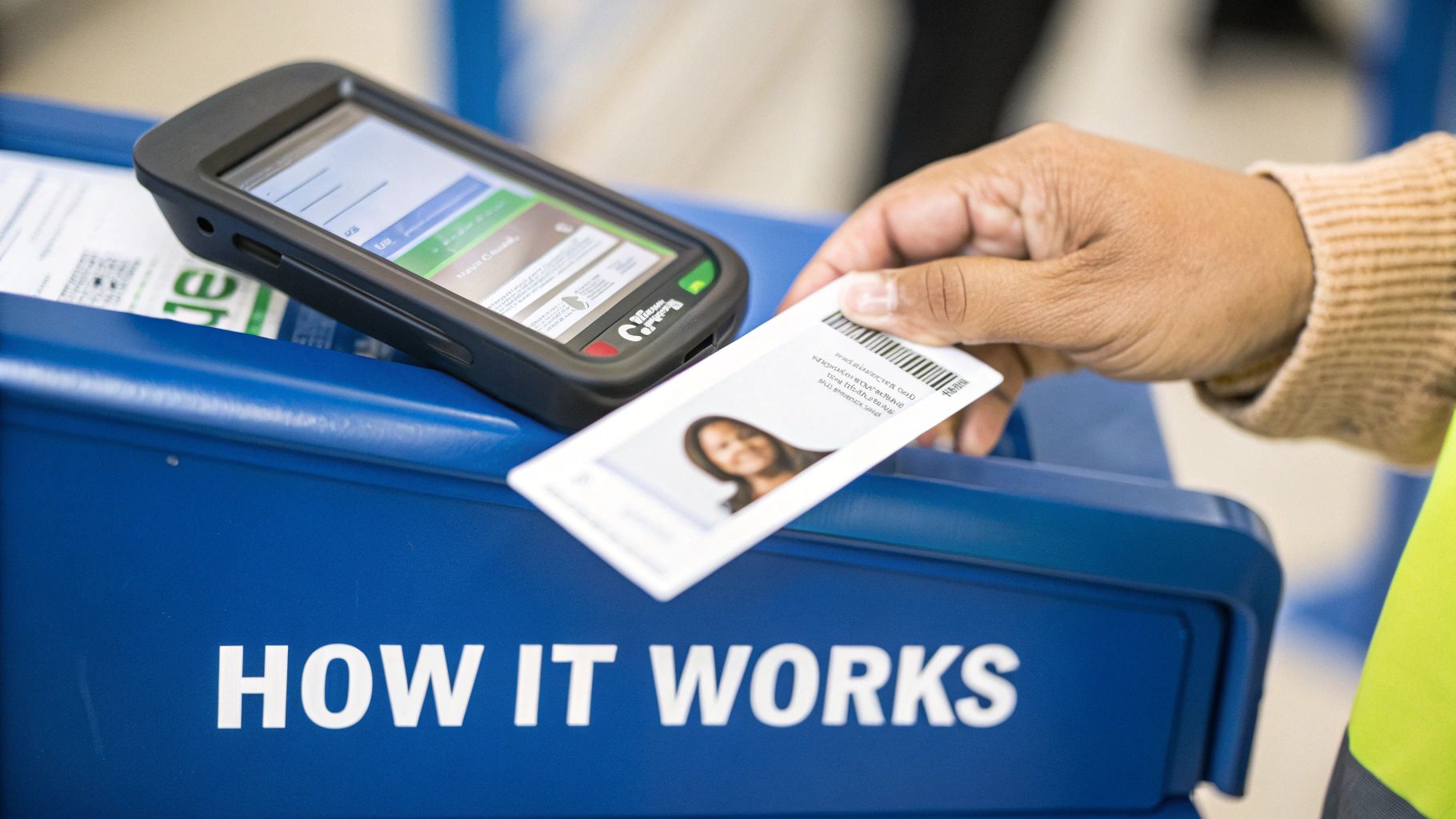
When you’re shopping for an online identity verification API, it’s easy to think they’re all the same. But that’s a dangerous assumption. The real difference between a basic tool and a top-tier solution is in the details—the depth and sophistication of its features.
Think of it like choosing a security system for your home. The cheapest option might tick a box, but a premium system offers layers of protection that actually keep you safe. A great API does more than just check a name against a number; it’s like a digital detective, using multiple methods to confirm an identity with high accuracy. This is what separates a reliable service from one that leaves you exposed. For any business operating in India, a few features are simply non-negotiable.
Essential Document Verification Capabilities
The bedrock of any solid identity check is document verification. A premier API needs to instantly read and analyse a whole host of official Indian documents. This isn’t just about simple Optical Character Recognition (OCR), but intelligent data extraction and fraud detection.
The API should handle these with ease:
- Aadhaar Cards: Verifying the number and pulling key details like name and address.
- PAN Cards: Confirming the PAN’s validity and linking it to the right person.
- Voter ID Cards: Validating the card as a legitimate proof of identity.
- Driving Licences: Extracting information and making sure the document is authentic.
The system’s AI has to do more than just read the text. It needs to be sharp enough to spot signs of tampering—think altered photos, mismatched fonts, or inconsistencies in the document’s layout. This AI-powered analysis is your first line of defence against fakes.
Crucial Insight: The best APIs don’t just validate a number; they analyse the entire document. They check for holographic elements, watermarks, and other security features, just like a trained professional would, but at a scale and speed humans simply can’t match.
Advanced Biometric and Liveness Detection
In an age of deepfakes and digital tricks, matching a photo from an ID to a selfie just doesn’t cut it anymore. This is where biometric verification, powered up with liveness detection, becomes absolutely essential. It answers the most critical question: is the person physically present right now?
A top-tier API gives you this confidence through smart checks. Liveness detection asks the user to do something simple, like smile or turn their head. This proves they are a live person interacting with the camera in real-time, not just holding up a static photo or a pre-recorded video. It’s a simple but powerful roadblock against common identity fraud tactics.
The Power of Developer-Friendly Tools
Even the most powerful API is useless if your tech team has a nightmare integrating it. This is why having comprehensive SDKs (Software Development Kits) and clear, detailed documentation is so important. A good provider makes life easy for your developers.
SDKs for different platforms (like Android, iOS, and Web) come with pre-built components that slash development time. Instead of building a user interface for capturing documents from scratch, your team can use a ready-made module that’s already been tested and optimised. This means you can get your verification flow up and running in days, not months.
The growth in this space is incredible. The global digital identity verification market is projected to jump from USD 13.78 billion in 2025 to USD 39.66 billion by 2032. India is a major force behind this trend, trying to strike that tricky balance between user convenience and tight security. While simple password methods still hold a 68.5% market share because they’re easy to use on mobile, the push for stronger, multi-factor verification is clear as businesses fight back against rising fraud.
You can discover more insights on digital identity market trends to see just how the landscape is shifting. It all points to the growing need for APIs that can handle both simple and advanced verification flows to meet everyone’s needs.
Integrating Your First Identity Verification API
Bringing an online identity verification API into your product might seem like a daunting technical task, but you’d be surprised. Modern APIs are designed to make this process incredibly straightforward. For both product managers and developers, the path from picking a provider to going live can be broken down into a few clear, manageable steps. It’s less about wrestling with complex code and more about smart planning and configuration.
Let’s walk through a real-world scenario. Imagine a new fintech app in India aiming to provide instant, secure account creation. Their big goal is to integrate an API that verifies user identities on the spot, without blowing up their product timeline. This example really helps show how accessible this powerful tech has become. Before we get into the nuts and bolts, it’s worth getting a quick refresher on how API integration works at a high level.
The Initial Setup and Configuration
First things first, our fintech app needs to pick a verification provider and get its API keys. Think of these keys as a unique, secure password that lets their application talk to the verification service. Once they have these keys, the real work on the backend can start.
This is where their developers will write the code that actually calls the API. It involves sending the user’s data (like a PAN card number or Aadhaar details) to the API endpoint and then correctly interpreting the response that comes back. A good API will return clear, structured data—usually in a format called JSON—that plainly states whether the check was a success, a failure, or needs a manual look.
Key Insight: A well-documented API is an absolute lifesaver. Always look for providers that offer crystal-clear instructions, code samples you can actually use, and a support team that gets back to you. This will slash your development time and headaches.
Designing the User-Facing Flow
While the backend is busy with the technical mechanics, the frontend is all about the customer. A clunky, confusing interface will send users running for the hills, no matter how brilliant the technology is. Our fintech app has to design a simple, intuitive journey for uploading documents.
This usually breaks down into a few key parts:
- Clear Instructions: Simply telling the user which document to use and how to take a good, clear photo.
- Real-time Feedback: Instantly letting the user know if their picture is blurry, too dark, or unreadable so they can fix it right away.
- Liveness Checks: Asking the user to do something simple, like smile or turn their head, which is a clever way to stop fraudsters from using a static photo.
The whole point is to make the process feel fast, professional, and friction-free. To see what’s out there, you can explore the different API integrations that help create these smooth user journeys.
This flow breaks down a complex backend process into a simple, three-stage journey from the user’s point of view.
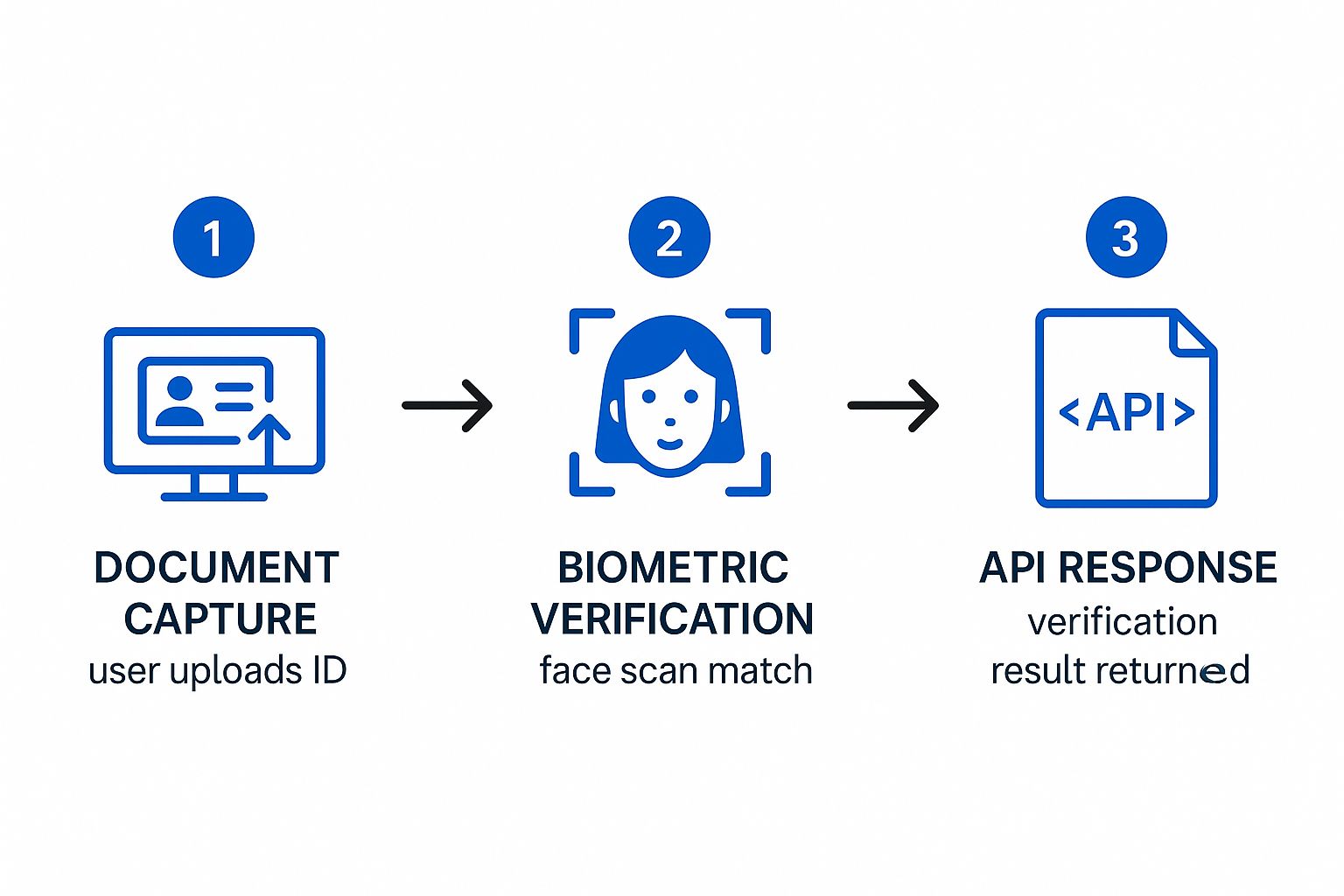
As the visual shows, the entire interaction—from capturing the document to getting the final thumbs up or down—is built for speed and clarity.
Testing and Launching with Confidence
Before you even think about going live, rigorous testing is non-negotiable. This is where a sandbox environment comes in. Reputable API providers offer this safe, isolated testing ground that perfectly mimics the live system. Here, our fintech app’s team can throw everything they can think of at the API without using real data or spending a rupee.
They can simulate all sorts of scenarios:
- Successful Verifications: Running valid documents through the system to make sure the “happy path” works like a charm.
- Failed Verifications: Trying to use fake or invalid data to see exactly how the system handles rejections.
- Edge Cases: Testing with low-quality images or tricky liveness check conditions to find and fix any potential weak spots.
Once all the bugs have been ironed out in the sandbox, it’s just a matter of switching the API keys from the testing set to the production ones. With solid planning and thorough testing, the team can launch with total confidence, knowing their online identity verification API is ready to deliver a secure and seamless start for every new customer.
Navigating Security and Compliance in India

When you’re using an online identity verification API, you’re handling some of the most sensitive personal data that exists. That’s a huge responsibility. This means security and regulatory compliance aren’t just features on a checklist; they are your absolute highest priorities. In India, this involves a deep understanding of the law, demanding powerful technical safeguards, and, most importantly, choosing a partner who takes this duty as seriously as you do.
Think of it this way: you’ve been entrusted with the keys to someone’s digital life. You wouldn’t just leave them lying around. You’d keep them secure, respect their purpose, and ensure only the right people have access. A trustworthy API provider is your expert locksmith in this scenario, bringing the right tools and knowledge to protect that trust.
Understanding India’s Data Protection Laws
The legal landscape in India has been significantly shaped by the Digital Personal Data Protection Act (DPDPA). This act lays down clear, strict rules for how businesses must collect, handle, and secure user data. Getting this wrong isn’t just a minor slip-up; it can lead to massive financial penalties and do lasting damage to your brand’s reputation.
A compliant API provider is much more than a vendor—they are your partner in navigating these legal waters. They build their systems from the ground up with these regulations in mind, making sure their verification processes follow legal mandates for data minimisation, purpose limitation, and explicit user consent. To operate safely in India, you need solid systems, and using the right KYC compliance software is a cornerstone of secure and compliant operations.
Key Takeaway: Your API partner’s compliance with Indian law is non-negotiable. Choosing a provider that deeply understands and adheres to the DPDPA isn’t just a good idea; it’s fundamental to running your business responsibly.
When you team up with a compliant partner, you’re building on their foundation of security and legality, which frees you up to focus on what you do best. This is exactly why it’s so important to scrutinise a provider’s credentials. To see what this looks like in practice, you can explore the specific compliance standards SpringVerify adheres to to keep its partners safe.
Core Security Practices You Must Insist On
Beyond the legal side of things, certain technical security measures are simply non-negotiable. These practices are what create the digital fortress that shields sensitive data from breaches and prying eyes.
When vetting a provider, you need to confirm they have these critical safeguards in place:
- End-to-End Encryption: This is essential. It ensures data is scrambled and unreadable from the moment a user submits it until the final verification result is delivered. No one in between can make sense of it.
- Secure Data Storage: It’s not enough to protect data in transit. All sensitive information must be stored in encrypted databases, shielded by multiple layers of security to prevent unauthorised access.
- Regular Security Audits: The provider must be able to prove their commitment to security. Look for regular, independent security audits and certifications like ISO 27001, which is the gold standard for information security management.
Why Data Residency Matters
Data residency is another crucial piece of the puzzle for businesses operating in India. In simple terms, this principle means that the personal data of Indian citizens should be stored on servers physically located within India’s borders.
Keeping data “in-country” adds another layer of legal and physical security. It ensures your users’ information falls under Indian law and jurisdiction, which can streamline compliance and build significant trust with your customers. So, when you’re evaluating an online identity verification API, always ask: where will my data be stored? A provider that prioritises data storage within India clearly understands the local business landscape and its unique requirements.
Identity Verification Use Cases Across Indian Industries
The real value of an online identity verification API isn’t just in the technology itself, but in how it solves everyday business problems. You can really see its power in action across India, where it’s become a cornerstone for growth and security in everything from busy financial centres to vibrant online marketplaces. The abstract idea of “verification” becomes very concrete when you see it helping a business thrive.
Let’s look at how different industries are using these APIs to tackle their specific challenges and build more reliable platforms. Each example tells a story of a common industry headache and how automated verification offers a clear, effective solution.
Fintech and Secure Onboarding
For financial technology companies, that first interaction with a new customer—the onboarding process—is everything. The trick is to make opening an account fast and paperless while also meeting the strict security demands needed to stop fraud. Doing this manually is just too slow and clunky, often causing frustrated customers to give up halfway through.
This is where an online identity verification API becomes a game-changer. Imagine a new user wants to open a digital bank account. They can simply upload their PAN and Aadhaar details right in the app. The API works in the background, instantly checking these documents against government databases and using liveness detection to make sure the user is who they say they are. The entire KYC process is done in minutes, not days. This kind of instant, secure verification is absolutely fundamental for building trust in fintech services. You can dig deeper into how identity verification powers the fintech industry and fuels this kind of rapid, secure expansion.
A leading digital lending platform saw a 40% drop in application fraud just three months after integrating an API-based verification system. It also slashed its average customer onboarding time from two days to less than five minutes.
E-commerce and Fraud Prevention
E-commerce businesses are in a constant fight against payment fraud. A scammer with stolen credit card details can create huge financial losses and seriously harm a brand’s reputation with both banks and honest customers. On top of that, they need to verify a buyer’s age for certain regulated products.
An identity verification API acts as a smart, automated gatekeeper. If a customer makes a high-value purchase, the system can trigger a quick identity check to confirm they are the actual cardholder. It’s a simple step that dramatically cuts down on chargebacks and creates a safer marketplace for everyone. For age-restricted items, it ensures the business stays compliant by verifying the customer’s age against an official ID, protecting the company from legal trouble.
The Gig Economy and Building Trust
Think about ride-sharing or delivery services. The entire gig economy model is built on a foundation of trust. Customers need to feel safe when a driver or delivery partner shows up at their door, and the platform is the one responsible for guaranteeing that safety.
An API-driven verification process is essential for bringing new partners on board. Before a driver can even think about accepting their first ride, the API automatically checks their:
- Driving Licence for validity and authenticity.
- Identity using their Aadhaar or PAN card.
- Background through automated criminal record checks.
This thorough, automated screening creates a community of trusted individuals, ensuring only verified and reliable people join the network. It’s a critical process that protects customers and proves the platform is serious about safety—a key ingredient for success in the long run.
Answering Your Key Questions
As you look into adding an online identity verification API to your workflow, a few practical questions are bound to pop up. It’s completely normal to wonder about the setup process, security, and all the jargon. Getting straight answers is the first step to making a smart decision for your business in India, so let’s tackle some of the most common queries.
First up, the big one for any development team: time. Just how long does it take to get one of these APIs plugged in and working?
How Long Does API Integration Typically Take?
The good news is, integrating a modern identity verification API is often much quicker than people expect. If you choose a provider that offers solid documentation and a full set of SDKs (Software Development Kits), a developer can often get a basic integration done in just a few days. The provider has already done all the heavy lifting on the backend.
Of course, if you’re building a highly customised user interface or need a more intricate verification process, that will add to the timeline. The real trick is to find a partner whose tools are designed to make your life easier, not one that forces your team to build everything from the ground up.
Is Using an Identity Verification API Secure?
Absolutely, but with a big caveat: it all comes down to the quality of your provider. A truly reputable online identity verification API is built with security at its very core. The best services use end-to-end encryption for all data, both when it’s moving and when it’s stored, making sure sensitive information is always protected.
It’s critical to partner with a provider that is fully compliant with Indian regulations like the Digital Personal Data Protection Act (DPDPA) and global standards such as ISO 27001. Don’t be shy about asking for proof of their security certifications before you sign anything.
What Is the Difference Between Identity Verification and KYC?
This is a really common point of confusion, but it’s simple when you break it down.
Think of it like this:
- Identity Verification is the specific action. It’s the technical step of confirming someone is who they say they are, usually by checking their government ID or biometric data.
- Know Your Customer (KYC) is the broader process. It’s a regulatory requirement, especially for financial companies, designed to stop financial crime. Identity verification is a vital piece of the KYC puzzle, but KYC also involves things like ongoing risk monitoring and due diligence.
In short, identity verification is the tool you use, while KYC is the regulatory reason you often need that tool in the first place.
Ready to build trust with your users through seamless, secure, and compliant verification? SpringVerify offers a powerful API that fits right into your existing systems, helping you onboard genuine users faster and keep fraud out. Explore our API solutions today


