

Table of Contents
Navigating The Reality Of High Volume Hiring
Let’s be honest: the strategies that work for filling a handful of roles a month will break down spectacularly when you’re suddenly faced with hundreds of open positions. The reality of managing high volume recruitment is less about simply doing more of the same and more about re-engineering your entire approach. It’s a shift from a linear, manual process to building a high-throughput machine.
The challenges aren’t just about the sheer numbers; they’re about juggling quality, speed, and a positive candidate experience all at once. When your inbox is flooded with thousands of applications, the pressure to just “get bodies in seats” can be immense. This approach often leads to poor hiring decisions and high turnover, which only perpetuates the hiring cycle. To get the basics right, you might want to look at a comprehensive guide to recruitment before tackling large-scale hiring.
The Real-World Bottlenecks
From my conversations with talent acquisition leaders who have been in the trenches, a few common pain points consistently emerge. Administrative overload is a classic one. Your team gets buried under a mountain of resumes to screen, interviews to schedule, and follow-ups to send. This isn’t just inefficient; it’s a recipe for burnout and costly mistakes.
Another major hurdle is the candidate experience. When you’re dealing with immense volume, it’s easy for communication to slip. Candidates are left in the dark, leading to frustration and a damaged employer brand. A negative experience doesn’t just lose you one candidate; it can deter their entire network from ever applying. The core issue is that processes designed for low-volume, high-touch recruitment just don’t scale. They become bottlenecks that slow everything down.
To understand how these challenges vary, let’s look at a few high-volume sectors.
High Volume Recruitment Challenges by Industry Sector
Comparison of recruitment volume challenges and solutions across different industries
| Industry | Average Monthly Hires | Primary Challenge | Success Rate |
|---|---|---|---|
| Retail | 200-500+ | High seasonal demand, rapid turnover, and need for speed. | 65% – Success hinges on fast, localised recruitment and a simple application process. |
| BPO/Customer Support | 300-1000+ | Extremely high volume, assessing soft skills at scale, high attrition within the first 90 days. | 55% – Often struggles with quality due to the sheer volume, but automation helps. |
| E-commerce & Logistics | 150-600 | Managing sudden hiring surges (e.g., festival season), verifying addresses and past records for delivery staff. | 70% – Success is tied to flexible staffing models and tech-driven background checks. |
| IT Services | 100-400 | Screening for specific technical skills, competing for talent, and managing a multi-stage interview process. | 75% – Higher success due to established processes, but speed is a constant battle. |
As the table shows, while the volume is high across the board, the specific pain points differ significantly. A retail company’s biggest problem might be speed, while an IT firm struggles more with skill-based screening.
Industry Pressures And Market Dynamics
Certain sectors are perpetually in a state of high-volume hiring. Think about the demands in retail, e-commerce, customer support centres, and technology services. In India, this challenge is especially pronounced. Projections show India’s job market is set to grow by about 9% in 2025, with massive demand in IT, retail, and BFSI sectors.
This creates an intense war for talent, where an estimated 80% of Indian employers report difficulties finding properly qualified candidates. You can learn more about the hiring trends shaping India’s job market to grasp the competitive pressures. This market reality means you’re not just hiring at scale; you’re doing it in a fiercely competitive environment.
Successful organisations recognise this and shift their mindset. They move from reactive hiring—posting a job and hoping for the best—to proactive talent pipelining and building scalable systems. They understand that managing high volume recruitment successfully requires a fundamental change in strategy, tooling, and team structure, which we will explore in the following sections.
Creating Systems That Actually Scale
When faced with managing high-volume recruitment, the most common mistake is to just push the pedal harder on your existing manual processes. This is a bit like trying to solve a traffic jam by just honking louder – it doesn’t actually create more capacity. It just leads to chaos, burnout, and costly errors. Building a system that can truly handle a hiring surge requires a completely different mindset. You need to redesign your recruitment infrastructure from the ground up, moving from a disconnected series of tasks to an interconnected, automated workflow.
The aim isn’t simply to survive a hiring boom; it’s to build a machine that thrives on it. This means looking beyond your Applicant Tracking System (ATS) and thinking about the entire ecosystem of tools and processes. When your systems are properly integrated, data flows effortlessly, manual data entry becomes a thing of the past, and your team is free to do what they do best: talk to and evaluate great candidates.
Architecting a Scalable Recruitment Workflow
A scalable workflow is all about eliminating bottlenecks before they even have a chance to form. It’s a proactive approach, not a reactive one. Think about it: instead of a recruiter manually sending out interview confirmation emails, a well-built system can trigger them automatically the moment an interview is booked in your ATS. This one small automation, multiplied by hundreds or thousands of interviews, frees up a massive amount of administrative time and nearly eliminates the risk of human error. To get this done, you can explore powerful automation solutions like Zapier, which let you connect different apps and automate repetitive tasks without needing a developer.
This way of thinking also applies to how you structure your team. Many companies fall into the trap of having a generalist model where every recruiter handles everything from sourcing to closing. At scale, this is a recipe for inefficiency and burnout. A more effective strategy is to specialise roles:
- Sourcing Specialists: These are your talent hunters, proactively finding and engaging passive candidates to build strong pipelines for your most critical roles.
- Recruitment Coordinators: They are the logistical backbone, managing the high volume of scheduling, candidate communication, and keeping everyone moving through the process smoothly.
- Recruiters/Closers: This group focuses their expertise where it has the most impact—interviewing, evaluating candidates, and managing the offer process.
This specialised structure allows each team member to become an expert in their area, leading to better candidate experiences and much faster hiring cycles.
Integrating for Efficiency and Security
The real magic of a scalable system happens with integration. Your ATS should act as the central command centre, but its true power is unlocked when it talks to your other essential tools. For any company that’s serious about hiring quality talent at scale, a crucial integration point is with your background verification partner.
Imagine manually kicking off background checks for hundreds of new hires. It’s an administrative nightmare waiting to happen. An integrated solution, like connecting your ATS with SpringVerify’s API, can automate this entire process. For example, when you move a candidate to the “Offer Accepted” stage in your ATS, it can automatically trigger a background check request in SpringVerify. All the updates and the final report are then pushed directly back into the candidate’s profile in your ATS. You can learn more about how to streamline your recruitment operations with these kinds of smart integrations. This doesn’t just save hundreds of hours; it also creates a secure, compliant, and consistent process for every single hire.
This forward-thinking approach is quickly becoming a necessity. Recent analysis of hiring trends in India shows a major uptick in employer confidence. In early 2025, the hiring intent among Indian companies soared to 29%, a significant jump from 17.7% the previous year. You can read more about India’s hiring surge to grasp the scale of this growing demand. This data confirms that the pressure for high-volume hiring isn’t just a temporary phase. Making the shift to scalable, technology-driven systems is no longer just a competitive advantage—it’s essential for survival and success.
Finding And Evaluating Candidates At Scale
Once your hiring systems are ready for a higher workload, your focus needs to shift to the core challenge of managing high-volume recruitment: finding and assessing a massive number of candidates. When you have hundreds of applications pouring in for every open role, your usual manual methods for sourcing and screening will quickly become your biggest bottleneck. This is where you need to go beyond simply posting a job and hoping for the best.
Think of your recruitment strategy like casting a wide net instead of using a single fishing line. To do this, you need a multi-channel sourcing approach that taps into both active and passive talent pools. This means making the most of job boards, social media platforms like LinkedIn, employee referral programmes, and even virtual career fairs. This wider approach is especially important in the current market. For instance, recent data on white-collar hiring in India shows an 18% year-on-year increase in April 2025. This surge, which you can explore the staffing industry analysis here, highlights just how crucial broad and effective sourcing has become.
Building Proactive Talent Pipelines
A truly effective strategy for high-volume scenarios is to build a talent pipeline before you even have an open position. This involves constantly sourcing and engaging with potential candidates for roles you hire for frequently. When a new job does open up, you aren’t starting from zero; you already have a pre-vetted pool of interested candidates ready to talk. This dramatically cuts down your time-to-fill and reduces the pressure on your hiring team.
For identifying candidates at a large scale, you might look into specialised methods like using LinkedIn profile scraping tools. These can help you gather public contact information to build targeted outreach lists. Just be sure to always stay compliant with the platform’s terms of service and all privacy regulations. The aim is to create a dynamic database of talent that you can nurture over time, turning a reactive hiring process into a proactive one.
Advanced Screening That Doesn’t Burn Out Your Team
With thousands of applicants, it’s simply not possible to review every CV manually. You need to get smarter about how you screen. The goal is to quickly and fairly pinpoint the most promising candidates while treating everyone who applied with respect.
Here are a few methods that work particularly well when dealing with a high volume of applicants:
- Skills-Based Assessments: Instead of just relying on a CV, test for the actual skills required for the job. For a customer service role, this might be a brief assessment on communication and problem-solving. For a developer, it could be a coding challenge. These tests provide objective data, helping you filter candidates based on their real capabilities, not just keywords on a resume.
- Structured Phone Interviews: Ditch the informal “get to know you” calls. Instead, provide your team with a consistent set of questions to ask every candidate during the initial screening. This ensures each applicant is evaluated against the same benchmarks, which helps reduce bias and makes it much easier to compare candidates fairly.
- Asynchronous Video Interviews: This is a powerful tool for high-volume roles. Instead of trying to schedule countless live video calls, you can send candidates a link to record their answers to a few questions on their own time. Your team can then review these short videos whenever it fits their schedule. This allows them to screen more candidates in less time while still getting a sense of their personality and communication style.
By putting these modern sourcing and screening strategies into practice, you create a system that can handle a high volume of candidates without sacrificing quality. This approach is fundamental to a successful talent acquisition strategy in a competitive market. It allows your team to direct their energy toward the best-fit candidates, ensuring your high-volume hiring efforts lead to high-quality hires who will excel in your organisation.
Smart Technology That Actually Delivers Results
Technology can be your strongest partner in managing high-volume recruitment, but it can also become a costly distraction if you don’t choose it carefully. The idea isn’t to adopt every new tool that comes along, but to strategically implement systems that give you measurable results and free up your team for what they do best: building relationships with people. Let’s talk about what actually works.
The following infographic shows key metrics that are vital to track when you bring new recruitment technology on board.
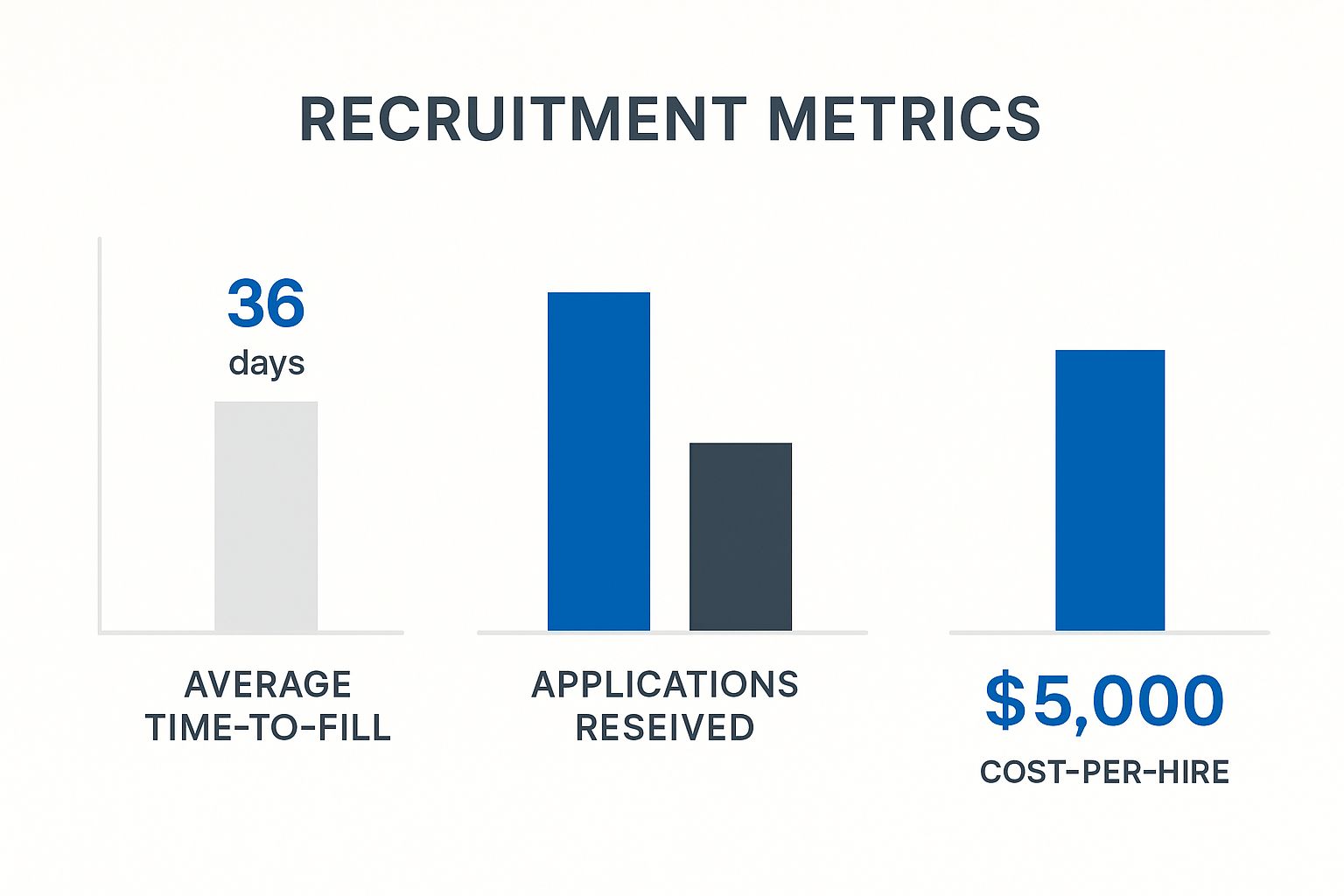
This data clearly shows how you can gain efficiency, which directly impacts your cost-per-hire and time-to-fill—the very metrics that well-chosen technology is meant to improve.
To understand the real-world impact, let’s look at a breakdown of how different recruitment technologies can affect your bottom line. The table below compares the potential return on investment for various tools.
Recruitment Technology ROI Comparison
Analysis of time savings and cost reductions from different recruitment automation tools
| Technology Type | Implementation Cost | Time Saved Per Hire | Annual ROI |
|---|---|---|---|
| Applicant Tracking System (ATS) | Medium (₹50,000 – ₹2,00,000 annually) | 4-6 hours | 150-200% |
| AI Resume Screening | Low-Medium (Add-on to ATS) | 2-3 hours | 200-300% |
| Automated Interview Scheduling | Low (₹5,000 – ₹20,000 annually) | 1-2 hours | 300-400% |
| Integrated Background Checks | Low (Per-check model) | 24-48 hours (turnaround) | 100-150% (risk reduction) |
As you can see, even tools with low implementation costs, like automated scheduling, can deliver an impressive return by saving your team valuable hours on every single hire. This shows that the investment often pays for itself very quickly.
Automation That Enhances, Not Frustrates
One of the biggest wins in high-volume hiring is automating repetitive administrative work. But this is about more than just basic email templates. A modern automation workflow can manage the entire logistical side of the early recruitment stages.
- Intelligent Scheduling: Instead of playing email tennis for weeks, tools can sync with interviewer calendars and let candidates book available slots themselves. This is a small change with a massive impact on both candidate experience and recruiter productivity.
- AI-Powered Resume Screening: A well-set-up Applicant Tracking System (ATS) can use AI to screen and rank thousands of resumes against your job criteria in minutes. The secret is to train it properly to avoid bias and focus on skills, not just matching keywords.
- Candidate Experience Chatbots: A chatbot can be a fantastic front-line helper, answering common questions about the role, company culture, or application status 24/7. This gives candidates instant engagement and filters out basic questions, allowing your team to focus on more meaningful conversations.
When set up right, these tools don’t make the process feel cold or robotic. They make it faster and more responsive, which dramatically improves how candidates see your company.
Integrating Background Checks for Speed and Security
A major bottleneck in the final stages of mass hiring is the background verification process. Manually starting and tracking checks for hundreds of candidates isn’t just slow—it’s also full of potential for human error and security risks. This is where a smooth integration between your ATS and a trusted background check partner like SpringVerify becomes a game-changer.
By connecting SpringVerify to your hiring system, you can automate the entire verification workflow. When a candidate is moved to the “offer” stage in your ATS, the background check process can be triggered automatically. All communication and the final reports are then fed directly back into the candidate’s profile. This creates a secure, trackable, and incredibly efficient system that can shave days, or even weeks, off your time-to-hire. This level of automation is essential for keeping up the momentum when you need to onboard a lot of people quickly and safely.
Using Data to Continuously Optimise
The best technology gives you data you can actually use. Your ATS and other recruitment tools are collecting a goldmine of information every day. Use it to answer important questions like:
- Which sourcing channel gives us the highest quality candidates for our high-volume roles?
- Where are the biggest drop-off points in our application process?
- How long does each stage of our hiring funnel actually take?
Looking at these metrics helps you fine-tune your strategy over time. You might find that a certain job board gives you lots of applications but few qualified candidates, or that your application form is too long and putting off mobile users. Without data, you’re just guessing. With it, you can make smart decisions that improve both your efficiency and the quality of your hires, making sure your investment in technology delivers a real return.
Designing Interview Processes That Move Fast

When you’re hiring at scale, small delays don’t just add up; they multiply. A scheduling snag that’s a tiny issue when hiring one person becomes a huge bottleneck when you’re trying to hire 500. This is why building an interview experience that is both quick and thorough is essential for managing high volume recruitment. The aim is to be decisive without rushing and to make every touchpoint meaningful for your team and the candidates.
The key isn’t to cut corners. It’s about making each stage of the interview process smarter and more consistent. It’s about creating a system that moves with intent, helping you spot top talent quickly while treating every applicant fairly. This approach helps you avoid two common pitfalls: losing great people because your process is too slow, or making inconsistent hiring choices because there’s no clear framework.
The Power of Structured Interviewing
One of the best adjustments you can make is to introduce structured interviews. This simply means asking every person applying for the same role the exact same set of pre-planned questions, in the same sequence. The impact of this change is huge. It moves the conversation away from a hiring manager’s gut feeling or a candidate’s “likeability” and towards their actual skills and abilities.
Why does this matter so much when hiring in large numbers? It establishes a consistent, fair baseline for comparing candidates. When you need to assess dozens of people for one position, having standardised answers makes decision-making much quicker and significantly less biased. You can create a simple scoring rubric for each question, letting interviewers record their thoughts in a measurable way. This data-first approach is a game-changer when you have to compare ten candidates side-by-side.
Group Assessments and Virtual Interviewing
For some roles, especially in fields like customer service or sales where teamwork is vital, group assessments are incredibly efficient. Instead of one-on-one interviews, you can bring a small group of candidates together to work on a problem-solving task. This lets you see their communication skills, teamwork, and critical thinking in action—all in much less time than it would take to interview each person separately.
Leaning into virtual interviews is also a must. This goes beyond basic video calls. Asynchronous video interviews, where candidates record answers to your questions on their own time, are a fantastic tool. Your hiring team can then watch these recordings whenever it suits them, letting them screen more candidates without the logistical headache of scheduling hundreds of live conversations.
Training Your Interview Team
None of these methods will work without a well-prepared interview team. Consistency is the goal. Your interviewers must be on the same page about:
- The interview questions and what a “good” answer looks like.
- The scoring rubric and how to use it fairly.
- How to manage time well and keep the interview moving.
- How to create a positive and welcoming candidate experience.
Running short training workshops before a big hiring drive can make a significant difference. It guarantees every candidate receives the same professional, fair treatment and ensures the information you gather is dependable. Ultimately, a thoughtfully designed interview process is about more than just speed. It’s about creating a fair and effective system that helps you confidently pick the best talent from a massive applicant pool, making your large-scale hiring both efficient and successful.
Maintaining Human Connection During Mass Hiring

When the hiring floodgates open, the biggest trap in managing high volume recruitment is letting candidates become just another entry in a database. This is an easy mistake to make when your team is swamped, but it’s a costly one. A great candidate experience isn’t a luxury you sacrifice for scale; it must be deliberately designed into your process from the very first contact. The aim is to use automation to amplify your team’s ability to connect, not to replace it. This strategy protects your employer brand and makes every interaction count.
It might seem impossible to maintain meaningful connections with a massive pool of applicants, but it’s totally achievable with the right plan. It all starts by remembering that while you’re dealing with volume, each candidate is having a singular, personal experience with your company.
Communication That Builds, Not Overwhelms
Timely and transparent communication is the foundation of a positive candidate experience. When hiring in bulk, applicants often feel like their resume has disappeared into a black hole. This is your chance to use technology to maintain a human touch.
Think beyond the standard “We’ve received your application” email. A well-organised system can send personalised updates at key moments. For example, you could automate a message that says, “Hi [Candidate Name], we’ve just finished our initial review for the [Job Title] role and will be contacting shortlisted candidates for interviews over the next three days.” This small gesture gives clarity and manages expectations without adding any manual work for your team. The goal is to make automation feel like a helpful guide, not a cold, robotic gatekeeper.
Providing Value, Even in Rejection
One of the most difficult parts of mass hiring is delivering bad news to a large number of people. However, how you manage rejections reveals a lot about your company’s character. A generic, impersonal rejection email can leave a sour taste. While you can’t give detailed individual feedback to thousands, you can still offer genuine value.
Consider trying this approach:
- Tiered Feedback: Set up a few different rejection templates based on the stage the candidate reached. Someone who made it to a final interview deserves more than a candidate screened out at the CV stage.
- Offer Resources: For candidates who weren’t a fit, you could include a link to your company’s career blog or a list of other open positions they might be a better match for.
- Invite to Talent Pool: Politely ask promising but unsuccessful candidates if they’d like to join your talent community for future openings. This turns a “no” into a “not right now” and builds a valuable pipeline for later.
These actions demonstrate respect for the time and effort candidates have put in. They are also vital for building and protecting your talent brand, as a positive candidate experience encourages referrals and reapplications. Good practices in this area are a key part of effective human resources management.
Onboarding That Sets People Up for Success
The human connection needs to continue long after the offer letter is signed. A chaotic onboarding process for a large group of new hires can undo all the goodwill you’ve built. Design a structured onboarding experience that is both efficient and welcoming. This could involve grouping new starters into cohorts for training, assigning them a buddy from day one, and using automated workflows to handle paperwork smoothly. This ensures that from their very first day, your new employees feel like valued team members, not just faces in a crowd.
Measuring What Matters and Improving Continuously
When you’re deep in the trenches of managing high-volume recruitment, it’s easy to get fixated on the wrong scoreboard. Many organisations chase metrics like time-to-fill and cost-per-hire, believing that faster and cheaper always equals better. But let’s be honest: a fast hire who leaves within three months isn’t a success; it’s a costly mistake that forces you back to square one. True success comes from measuring what genuinely predicts long-term business impact and using that data to constantly get better.
It’s about shifting your perspective from just filling seats to hiring quality talent that stays and performs. This requires a more nuanced approach to data, one that provides actionable insights rather than just a dump of numbers on a spreadsheet.
Moving Beyond Surface-Level Metrics
The first step is to expand your dashboard beyond the basics. While speed and cost are important, they don’t tell the whole story. To get a real picture of your recruitment health, you need to track metrics that reflect quality and satisfaction.
Here are some essential KPIs that offer a deeper understanding of your high-volume hiring success:
- Quality of Hire: This is the ultimate metric. It can be measured by looking at the performance review scores of new hires after their first 90 days, their ramp-up time to full productivity, or even retention rates after one year. A high score here proves your process identifies people who truly thrive in your organisation.
- Hiring Manager Satisfaction: Are your hiring managers happy with the candidates they’re seeing and the overall process? A simple survey sent after a role is filled can provide invaluable feedback. A low satisfaction score is a major red flag that something is broken in your screening or communication process.
- Source of Hire Effectiveness: Don’t just track where applicants come from; track where your best hires come from. Analysing this helps you double down on the channels that deliver quality candidates, optimising your spending and effort for maximum impact. You might find that employee referrals, for example, have a much higher quality-of-hire score than a specific job board.
Creating Actionable Dashboards and Feedback Loops
Data is only useful if it helps you make better decisions. Your goal should be to create reporting systems that highlight bottlenecks and opportunities for improvement. For instance, if your data shows a significant drop-off rate after the first interview for a specific department, that’s not just a statistic—it’s a signal to investigate. Is the job description misleading? Are the interview questions unclear? This is where you can create a powerful feedback loop.
By sharing these insights with your hiring teams, you empower them to address issues proactively. Organise brief, monthly meetings to review the key metrics. This collaborative approach turns data analysis into a team sport, where everyone is invested in improving the process. It helps you identify small problems before they become major roadblocks in your recruitment engine. This continuous improvement cycle is what separates organisations that merely survive high-volume hiring from those that excel at it.
Ready to bring this level of efficiency and security to your hiring process? SpringVerify integrates seamlessly with your existing systems to automate background checks, ensuring you can hire great talent at scale, quickly and confidently.


