

Trying to pin down a single, fixed cost for ISO 27001 certification in India is a bit like asking, “How much does it cost to build a house?” The answer is always, “It depends.” The final price tag can swing from ₹2 lakhs to over ₹13 lakhs, shaped entirely by your company’s size, its complexity, and what security measures you already have in place.
Think of it this way: the investment scales with the scope of your Information Security Management System (ISMS). Just as a larger house with more rooms and advanced security features costs more to build, a larger organisation with more complex processes will have a higher certification cost.
Table of Contents
What Is the Real Cost of ISO 27001 Certification in India?
The final bill for getting ISO 27001 certified isn’t just one number. It’s a sum of all the parts that go into building a robust security framework tailored to your business. The size of your team, the number of locations, and the technology you use all play a huge role in shaping the total investment.
It’s a common-sense rule: as your organisation grows, the scope of your ISMS expands right along with it. This means you’ll need to budget more for implementation, company-wide training, and the final audits.
Estimated Costs by Organisation Size
Naturally, the financial commitment changes dramatically based on your employee headcount and how intricate your operations are. A small startup can get by on a leaner budget, but a large enterprise will need to invest far more to get everyone and everything up to standard.
Here’s a quick look at what you can generally expect based on your company’s size.
Estimated ISO 27001 Certification Costs in India by Company Size
| Company Size (Employees) | Typical Cost Range (INR) | Key Cost Components |
|---|---|---|
| Small (Under 20) | ₹2 lakhs – ₹9 lakhs | Consultation fees, basic implementation, external audit. |
| Mid-Sized (20-100) | ₹5 lakhs – ₹10 lakhs | More extensive training, detailed risk assessment, audit fees. |
| Large (100+) | Over ₹13 lakhs | Comprehensive implementation, multi-departmental training, extensive auditing across multiple locations. |

As the table shows, small businesses often see total costs land somewhere between ₹2 lakhs and ₹9 lakhs. For mid-sized companies, that figure can climb to between ₹5 lakhs and ₹10 lakhs. Large organisations, on the other hand, frequently go past the ₹13 lakh mark because of their extensive training needs and more complex, multi-stage audits.
For a deeper dive into how these costs fit into the broader picture, you can explore our complete guide on company compliance.
Breaking Down the Key Cost Drivers
Getting a rough idea of the ISO 27001 certification cost in India is one thing, but understanding what actually shapes that final number is another. The total price tag is a blend of several factors, and each one carries a different weight. Think of it like planning a big wedding—the final bill depends on the size of the guest list, the venue you pick, and the vendors you hire.
The single biggest driver is the scope of your Information Security Management System (ISMS). A larger, more complex organisation with multiple departments, various locations, and a wide range of data processing activities will naturally have a much broader scope. This means more assets to protect, more risks to analyse, and more controls to put in place, all of which directly add to the implementation and audit time.
Another critical piece of the puzzle is the current state of your IT infrastructure and security posture. An organisation running on outdated systems with minimal security protocols has a much steeper hill to climb. A huge chunk of the ISO 27001 certification cost comes from implementing the necessary security controls, including essential cybersecurity measures and hardware security. This could mean investing in new software, upgrading hardware, and training employees.
The following infographic gives a clear picture of how these primary drivers build up the overall certification cost.
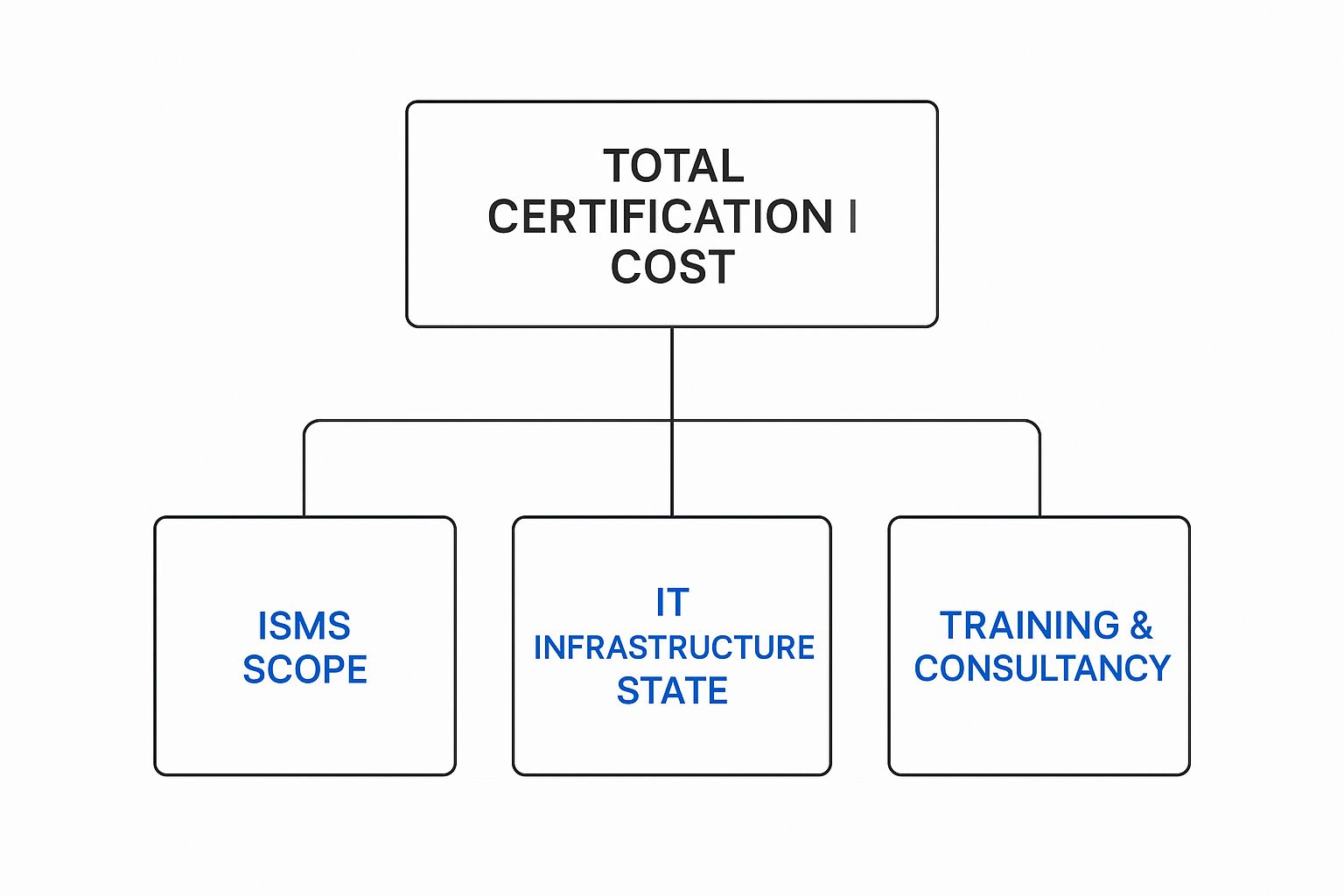
As you can see, your ISMS scope, existing tech, and whether you need outside help are the foundational pillars that will determine your budget.
Consultancy and Employee Training Needs
Your choice between building an in-house team or bringing in external consultants will also have a major impact on the cost. Consultants certainly come with a hefty price tag, but they bring specialised expertise that can get you to the finish line much faster. On the other hand, training your own team might look cheaper up front, but it requires a serious investment of time and internal resources.
The number of employees who need security awareness training acts as a direct multiplier. A larger workforce means higher training costs and more complex logistics to get everyone up to speed and compliant.
Finally, don’t forget the human element. The number of employees handling sensitive data directly affects the scale of your training programmes and the complexity of your access controls. This is especially vital for growing businesses, where securely hiring and managing enterprise teams is crucial for ensuring compliance right from the start. Each of these components—scope, infrastructure, expertise, and people—plays a key role in shaping your final budget.
Uncovering the Hidden and Ongoing Expenses
Getting your ISO 27001 certificate is a fantastic achievement, but it’s really just the starting line, not the finish. The initial certification fee is only the tip of the iceberg when it comes to your total investment. Think of it like buying a car—the sticker price is just the beginning. You still have to budget for fuel, regular maintenance, and insurance. True compliance works the same way; it’s a continuous journey with recurring costs.
This journey involves mandatory annual surveillance audits in the first and second years after your initial certification. These are essentially mini-checkups to make sure your Information Security Management System (ISMS) is still running effectively and you’re keeping up with the standard. They’re less intense than the big audit, but they are a necessary, predictable expense you need to plan for.
Then, every three years, you’re up for a full recertification audit. This one is just as thorough as your very first audit. Its purpose is to ensure your security practices haven’t just been maintained, but have evolved right alongside your business and are still tough enough to handle new threats.

Beyond the Audits
On top of the scheduled audits, several other costs can pop up along the way. These are often the “hidden” expenses that can catch organisations off guard if they haven’t been factored into the budget from the start.
- Specialised Software: You might find you need to invest in dedicated tools for things like risk management, document control, or tracking security incidents.
- Technology Upgrades: Your initial gap analysis could highlight that you need new hardware or software to properly meet specific security controls.
- Internal Audits: Before any external auditor walks through your door, you have to conduct your own internal ones. This requires either training your own staff to do it right or hiring an external expert.
- Continuous Training: Security threats are always changing, and so is your team. Ongoing training and awareness programmes aren’t just a good idea—they’re essential for keeping everyone sharp and maintaining compliance.
A huge part of keeping that certification active is making sure your team stays vigilant. This covers everything from regular security awareness refreshers to making sure new hires have the right credentials. This is exactly where a solid process for employment verification becomes a critical, ongoing operational cost.
By looking ahead and anticipating these recurring and potential expenses, you can build a realistic long-term budget for your ISO 27001 journey. This way, you can avoid any nasty financial surprises and ensure your security posture remains strong and sustainable.
Smart Strategies to Lower Your Certification Costs
Getting ISO 27001 certified doesn’t have to drain your company’s finances. With a bit of smart planning, Indian businesses can seriously cut down the overall investment, making top-tier information security achievable without breaking the bank. Your best tool for saving money is, without a doubt, strategic planning.
One of the most effective ways to manage costs is through a phased implementation. Instead of trying to get the whole organisation certified at once, why not start smaller? Pick a single, critical business unit to begin with. This lets you focus your resources, learn from the process on a manageable scale, and rack up some early wins before you roll it out company-wide.

Empower Your Internal Team
Relying heavily on external consultants is one of the biggest expenses you’ll face. A fantastic way to lower the ISO 27001 certification cost in India is to build that expertise right inside your own team. Investing in training for key staff to become certified ISO 27001 Lead Auditors can give you a massive return on investment.
Having this skill in-house dramatically cuts down on the need to hire pricey consultants for your mandatory internal audits. In India, this kind of training usually costs between ₹15,000 to ₹45,000 for a solid 40-hour programme. Think about it—that one-time investment pays for itself by getting rid of recurring external audit fees. You can get a better sense of what’s involved by exploring insights on ISO 27001 training fees in India.
By empowering your own employees, you not only save money but also build a sustainable, in-house security culture that understands your business operations intimately.
Make Savvy Technology and Vendor Choices
The tools you use and the partners you choose also make a big difference to your bottom line.
A good starting point is to look at your options and see where you can be clever with your budget. The table below outlines a few practical strategies to consider.
Cost Optimization Strategies for ISO 27001
| Strategy | Potential Cost Saving | Considerations |
|---|---|---|
| Use Open-Source Tools | High – Can eliminate software licensing fees entirely. | Requires some in-house technical skill to set up and manage. May lack the polished user experience of paid tools. |
| Negotiate Audit Fees | Medium – Potential for 10-20% reduction on audit costs. | Get quotes from multiple accredited bodies. Be prepared to negotiate and bundle services for better rates. |
| Combine ISO Audits | Medium – Can reduce overall audit time and fees. | Only applicable if you’re pursuing other standards like ISO 9001. Requires coordination with the certification body. |
| Phased Implementation | High – Spreads costs over time and reduces initial outlay. | Certification scope is limited initially. It takes longer to certify the entire organisation. |
These aren’t just abstract ideas; they are actionable steps you can take. Here’s a bit more detail on how to put them into practice:
- Explore Open-Source Tools: Before you splash out on expensive licensed software for things like risk management or document control, check out the open-source alternatives. Many free tools are perfectly capable of meeting the standard’s requirements, especially for smaller organisations.
- Negotiate with Certification Bodies: Never accept the first quote you get for your external audit. It’s a competitive market. Reach out to multiple accredited certification bodies for proposals and don’t be afraid to negotiate for a better deal. Asking to bundle your surveillance and recertification audits can often get you a discounted package.
- Combine Audits: If your organisation is also aiming for other ISO standards, like ISO 9001 for quality management, ask your certification body about combined audits. This approach can streamline the process, saving you both time and money.
Calculating Your Return on Investment
It’s easy to look at the ISO 27001 certification cost in India as just another line item on the expense sheet. But that misses the bigger picture entirely. A better way to think about it is as a strategic business investment—one that pays back in tangible, and sometimes intangible, ways. Shifting your perspective is the first step to seeing its true worth.
The most obvious financial win comes from new business. Many large companies and global clients, especially in the tech and finance worlds, won’t even consider partnering with a vendor that isn’t ISO 27001 certified. It’s become a non-negotiable requirement. Lacking the certificate can get you automatically disqualified from high-value contracts, which means the investment becomes a direct key to unlocking new revenue.
Beyond Winning New Business
The financial upside isn’t just about client acquisition. The real value is in the strength of your security practices. A single data breach can be financially devastating, leading to massive regulatory fines, crippling legal fees, and reputational damage that can haunt a company for years. ISO 27001 gives you a proven framework to drastically lower this risk, acting as a powerful insurance policy against a catastrophic financial blow.
On top of that, some cybersecurity insurance providers in India might even offer you lower premiums once you’re certified. Why? Because they see an organisation with a formal Information Security Management System (ISMS) as a much lower risk. When you’re calculating the ROI, think about how certification reinforces your defences against modern threats, especially with so many teams working remotely. Having solid remote cybersecurity strategies is a critical piece of this puzzle.
But the benefits you can’t put a number on are just as powerful. ISO 27001 certification builds rock-solid trust with your customers, who are more aware of data privacy than ever before. This trust morphs into a serious competitive advantage that your non-certified competitors will find almost impossible to match.
Ultimately, the ROI isn’t just about preventing losses or closing deals. It’s about creating a proactive security culture, making your internal processes more efficient, and building a brand that people know they can rely on. That initial cost quickly turns into a strategic asset that delivers value across the entire business.
Common Questions About ISO 27001 Costs
Even with a clear budget in mind, a few questions always pop up. Let’s tackle some of the most common ones we hear about the ISO 27001 certification cost in India to clear up any lingering doubts.
How Long Does Certification Take?
This really depends on your company’s current state. The timeline can vary quite a bit based on your size, complexity, and how mature your existing security practices are.
For a small, nimble startup, you might be looking at a timeline of three to six months. On the other hand, a larger organisation with intricate processes and multiple departments should probably plan for a six- to twelve-month journey, right from the initial gap analysis to getting that final certificate in hand.
Can We Get Certified Without a Consultant?
Yes, you absolutely can. For a small business, going the DIY route is possible, especially if you have a sharp internal team with solid project management skills and technical know-how. This approach will save you a good chunk of money on consultancy fees, but be prepared for a serious investment of your team’s time and effort.
It’s easy to get confused between the two main players. A certification body is the accredited third party that conducts the final, official audit and grants you the certificate. A consultancy, however, is an optional guide you can hire to get you ready for that big audit.
Unfortunately, finding specific government subsidies for SMEs aiming for ISO 27001 is a bit of a moving target. These schemes are rare and change often. Your best bet is to check directly with local industry associations or look into current MSME programmes to see if any financial support is available.


