

Let’s be honest: for too long, human resource planning has been treated like a necessary evil—a box-ticking exercise to figure out next year’s headcount. But that’s a massive missed opportunity. Real human resource planning is about making sure your business has the right people with the right skills, in the right roles, and at the right time. It’s what shifts HR from being a reactive support team to a strategic partner that actually drives business growth.
This process is all about aligning your workforce strategy with your company’s core objectives, ensuring your talent can meet not just today’s demands, but tomorrow’s too.
Table of Contents
Aligning Your People Strategy with Business Goals
The biggest mistake I see companies make is treating HR planning as an internal HR project. Its real power comes from looking outwards first—translating high-level business goals into a concrete, actionable people strategy. Without this link, even the best hiring and development plans will miss the mark.
So, before you even think about analysing your current workforce, you need to understand the big picture. What are the company’s strategic goals for the next one to three years? Your leadership team isn’t just thinking about the next quarter; they’re planning major moves that have huge implications for your talent needs.
Connecting HR Planning to Business Objectives
To make this practical, you need to start asking the right questions—questions that bridge the gap between boardroom strategy and your on-the-ground people needs. This initial analysis is the foundation for everything that follows.
Think about these common business scenarios:
- Entering a new market? If the plan is to expand into a new region, what does that mean for talent? You’ll probably need people with specific language skills, deep local market knowledge, or experience navigating international regulations.
- Launching a new product? If a tech-heavy product is in the pipeline, that’s your cue. You’ll soon need more software engineers, data scientists, or product managers who understand that specific technology stack.
- Undergoing a digital transformation? If the goal is to automate key processes, you’ll need employees who are skilled in the new tech. At the same time, you’ll have to figure out how to upskill or redeploy people whose jobs are about to change dramatically.
By translating business goals into talent requirements, you transform the human resource planning process from a theoretical exercise into a strategic roadmap. It’s about proactively building the workforce you’ll need tomorrow, not just managing the one you have today.
This strategic alignment is the bedrock of successful workforce planning. It ensures every decision you make—from recruitment priorities to training budgets—directly supports the company’s most important goals. Without this, HR stays stuck in an administrative silo, struggling to prove its value.
Defining Clear and Practical Goals
Once you have a firm grasp of the business direction, it’s time to get specific. Vague goals like “improve talent” are completely useless. You need clear, measurable targets that you can actually track.
For example, instead of a generic objective, your goals should sound more like this:
- “Increase the number of data analysts on the marketing team by 25% within 12 months to support the launch of our new analytics platform.”
- “Develop a leadership pipeline to fill 70% of senior management roles internally over the next two years, reducing our reliance on expensive external search firms.”
- “Implement a cross-training programme to upskill 50 customer service agents in basic technical support by the end of Q3 to handle the expected increase in queries from the new product.”
See the difference? These goals are specific, measurable, and time-bound. They create a clear roadmap for the rest of your planning process and make it much easier to get buy-in from leadership because they can see exactly what you’re trying to achieve. For more insights on modernising your HR function, check out our guide on managing human resources effectively. This is how you turn HR into a strategic powerhouse that builds an agile, skilled, and forward-thinking workforce.
Auditing Your Current Workforce Capabilities

Before you can build a bridge to your future workforce, you need a crystal-clear picture of where you stand right now. A thorough audit of your current capabilities isn’t just a preliminary step; it’s the most critical diagnostic you’ll perform in the entire human resource planning process. This goes far beyond a simple headcount. It’s a deep dive into the skills, potential, and even the hidden vulnerabilities within your organisation.
Think of it like a meticulous stocktake of a warehouse. You wouldn’t just count the number of boxes. You’d open them up to see what’s inside, check expiry dates, and figure out which items are in high demand. The exact same principle applies to your talent.
Building Your Skills Inventory
Your first practical task is to create a skills inventory. This is essentially a comprehensive database that catalogues the real-world abilities, qualifications, competencies, and experiences of your current employees. It’s what moves you from guesswork to hard data.
To start, identify the core competencies your business actually relies on today. This should include:
- Technical Skills: Specific software proficiency, coding languages, machine operation, or data analysis techniques.
- Soft Skills: Communication, leadership, problem-solving, and collaboration abilities.
- Certifications and Qualifications: Professional licenses, industry-specific certifications, or academic degrees.
A word of advice: don’t rely solely on job descriptions. They’re often outdated or too generic. Instead, use a mix of self-assessment surveys, manager evaluations, and performance review data to build a much more accurate picture. This inventory can become an invaluable tool, revealing hidden talents—like a marketing manager who happens to be fluent in a language that’s key to your global expansion plans.
A detailed skills inventory is your internal talent marketplace. It allows you to identify not just who you have, but what they are truly capable of, revealing opportunities for internal mobility and pinpointing critical skill gaps before they become a crisis.
This process can be complex, which is why outsourcing certain human resource functions is a fast-growing trend. In fact, approximately 76% of companies now leverage external providers to boost efficiency, especially as talent management gets more intricate. This is particularly relevant as organisations grapple with challenges like employee burnout, reported by 44% of workers, and a concerning dip in engagement.
By outsourcing administrative burdens, your internal HR team can focus on strategic tasks like this crucial talent audit. You can find more details on these and other HR statistics and trends on Tapwell.in.
Analysing Workforce Dynamics
With your skills data in hand, it’s time to analyse the dynamics of your workforce. This means looking at key metrics to uncover patterns and predict future weak spots. You need to become a bit of a detective, searching for clues hidden in your HR data.
Start by examining turnover rates. A high turnover rate isn’t just a number; it tells a story. Is it concentrated in a specific department, pointing to a management issue? Are you losing new hires within their first year, suggesting a problem with onboarding or mismatched role expectations?
Next, assess your leadership pipeline. Who is genuinely ready to step into critical roles if key leaders were to depart tomorrow? Succession planning is a vital part of this audit. Identifying high-potential employees and mapping their development paths ensures you have a strong “bench strength” and aren’t left scrambling when a vital position suddenly opens up.
Finally, review your performance metrics. Are there teams consistently underperforming? This could signal a skills gap that requires targeted training. On the flip side, your high-performing teams can provide a blueprint for the competencies you need to replicate across the organisation. This analysis gives you a multi-dimensional view of your talent landscape, highlighting both your strengths and the areas that demand immediate attention.
Developing Your Talent Action Plan
So, you’ve done the heavy lifting of demand forecasting and supply analysis. What you’re left with is the most critical piece of the puzzle: a talent gap or surplus. This is where the whole human resource planning process shifts from looking at data to making real moves. Armed with this insight, you can finally build a targeted action plan that closes the gap between the team you have and the team you’ll need.
This isn’t about pulling a generic template off the shelf. Your plan has to be a strategic response, custom-fit to your unique situation. Whether you’re staring down a critical skills shortage or dealing with too many people in certain roles, the goal is to create a realistic, effective, and multi-pronged strategy.
Think of your gap analysis as the pivot point connecting your big-picture goals with the day-to-day actions you need to take, as this infographic shows.
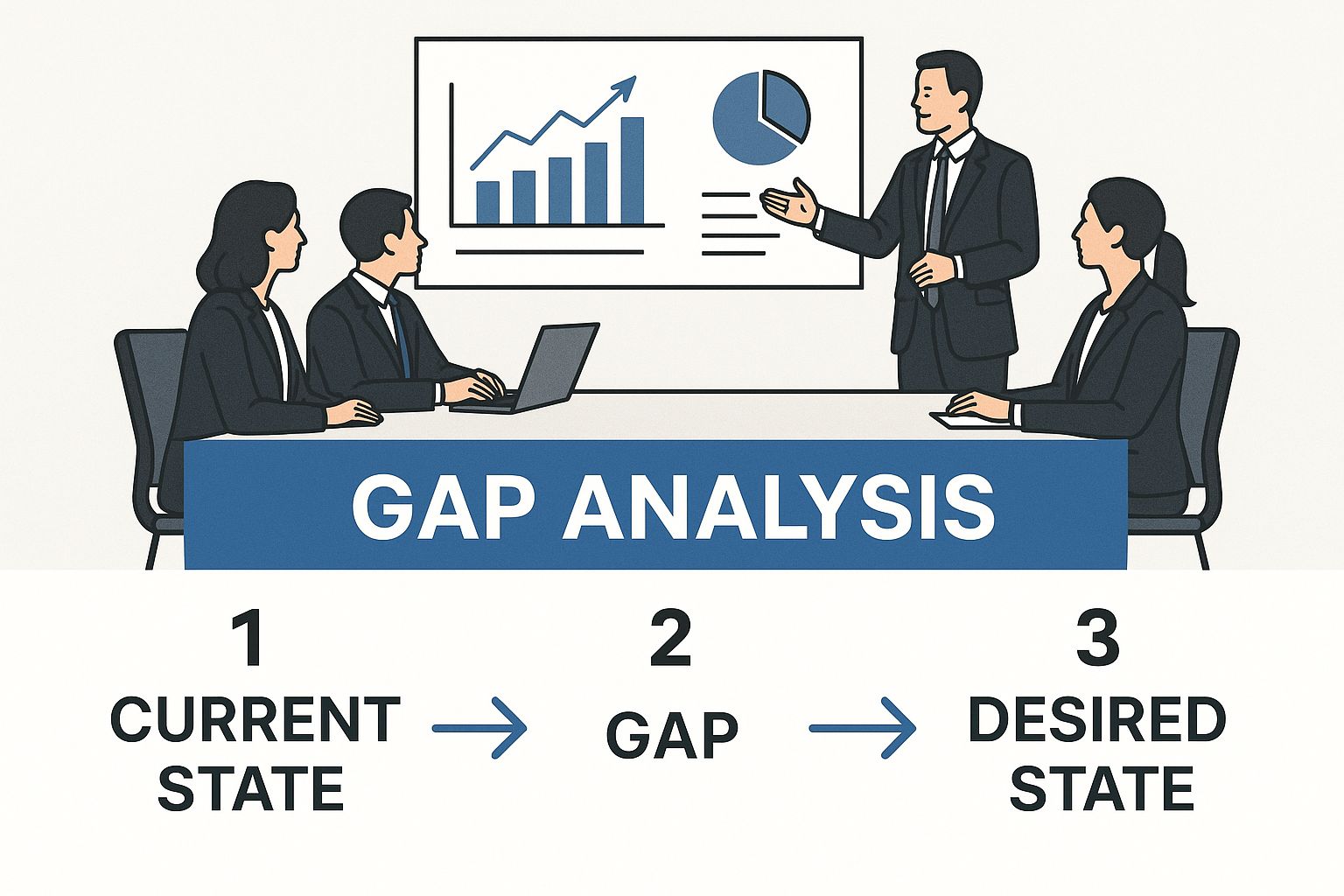
Once you’ve identified that talent gap, it becomes the trigger. It’s what kicks off concrete plans for recruitment, employee development, and internal promotions, turning strategic talk into tangible workforce changes.
Strategies for a Talent Shortage
Facing a talent shortage is a familiar headache, especially if you’re in a high-growth industry or need highly specialised skills. Your action plan needs to be aggressive but smart, focusing not just on hiring from the outside but also on nurturing the talent you already have inside your walls.
A multi-channel approach always works best:
- Aggressive Recruitment: This is way more than just posting a job ad. It means launching targeted campaigns to catch the eye of passive candidates, really leaning into your employee referral programmes, and building an employer brand that people want to be a part of. It’s about actively hunting for the skills you need.
- Internal Mobility: Before you look outside, look within. You might have employees in other departments with adjacent skills who, with a bit of training, could fill that gap perfectly. Promoting from within is a huge motivator and slashes the time it takes for someone to get up to speed.
- Upskilling and Reskilling: Invest in focused training programmes. If your marketing team needs to get better with data, design a course to build those specific skills. This isn’t a quick fix; it’s a long-term investment in your people’s capabilities.
When you’re actively recruiting to fill skill gaps, every new hire is both an opportunity and a risk. This is why embedding robust background verification isn’t just a final checkbox; it’s a foundational part of your quality control.
For any company that’s scaling up, you can’t afford to compromise on the integrity of your new hires. It’s non-negotiable. This is where a solution like SpringVerify becomes essential. By automating background checks right inside your hiring workflow, you protect your company culture, reduce risks, and make sure your recruitment efforts bring in high-quality, trustworthy people. It’s a vital piece of any serious talent acquisition strategy.
Addressing a Talent Surplus
On the other hand, finding out you have a talent surplus requires a much more delicate and strategic touch. This situation often pops up after restructuring, bringing in new automation, or seeing a shift in market demand. Here, the goal is to manage the surplus constructively, keeping employee morale high and holding onto valuable institutional knowledge wherever you can.
Your action plan for a surplus might involve:
- Strategic Redeployment: Can employees from an overstaffed team be moved to a part of the business that’s growing? This requires a sharp eye for transferable skills and a real commitment to helping people move internally.
- Retraining for New Roles: If automation has made some roles redundant, could you retrain those employees for new, emerging roles within the company? Offering a pathway to a different career inside the same organisation can be a powerful retention tool.
- Voluntary Separation Programmes: In some scenarios, offering attractive voluntary redundancy or early retirement packages can be a humane way to reduce your headcount without resorting to forced layoffs.
A talent gap analysis is a powerful tool to translate workforce data into clear, actionable strategies. The table below outlines some common scenarios and the corresponding actions an organisation can take to bridge the gap.
Talent Gap Analysis and Action Strategies
| Scenario | Description | Primary Action Strategy | Secondary Action Strategy |
|---|---|---|---|
| Skill Shortage | Not enough employees with specific, critical skills (e.g., AI specialists, data scientists). | Aggressive Recruitment | Upskilling & Reskilling |
| Leadership Gap | Insufficient internal candidates ready to fill senior or leadership roles. | Internal Mobility & Promotions | Leadership Development Programmes |
| Role Redundancy | A surplus of employees in roles becoming obsolete due to technology or market shifts. | Strategic Redeployment | Retraining for New Roles |
| High Attrition Risk | Key talent in high-demand roles are at risk of leaving the organisation. | Retention Programmes | Succession Planning |
By matching the specific challenge with the right combination of strategies—from recruitment and training to redeployment—you can build a resilient and agile workforce ready for what’s next.
As you build out your action plan, don’t forget to think long-term. This means proactively preparing for future leadership and critical role vacancies by exploring succession planning best practices. This forward-thinking approach ensures you have a pipeline of talent ready to step up, turning a potential crisis into a planned, smooth transition and safeguarding your organisation’s future.
Integrating Technology into Your HR Planning
Trying to manage a modern workforce with spreadsheets is like trying to navigate a bustling city with a hand-drawn map. It might have worked in the past, but today, you’re missing out on the speed, accuracy, and deep insights that technology offers. To make your human resource planning process genuinely strategic, you have to move beyond manual methods and embrace the right tools.
Modern HR technology is no longer just about digitising payroll. It’s about transforming your entire approach to workforce planning. Tools like Human Resource Information Systems (HRIS) and predictive analytics platforms are genuine game-changers, automating data collection and analysis to give you a powerful, real-time view of your organisation.
This shift isn’t just a fleeting trend; it’s a fundamental change in how HR operates. The HR tech space is exploding, with a projected compound annual growth rate (CAGR) of about 18.3%. This growth is fuelled by the rush to adopt automation and AI, as organisations look to improve everything from hiring to talent management. In fact, 70% of companies plan to make substantial investments in HR tech in the next year alone. You can dive deeper into this trend in the ETHRWorld Tech Transformations report.
Harnessing Data with HRIS and Analytics
Think of your Human Resource Information System (HRIS) as the central nervous system for all your people data. It’s a goldmine of information—from employee demographics and performance reviews to compensation history and skills. When you integrate it properly into your planning, an HRIS becomes an analytical powerhouse.
Instead of spending days manually pulling reports, you can generate instant dashboards that reveal critical trends. You might discover, for instance, that your top-performing sales team shares a specific educational background or that turnover is unusually high among employees with less than two years of tenure in a particular department.
Predictive analytics tools take this a massive step further. By crunching historical data, they can forecast future trends with surprising accuracy. These tools can help you answer mission-critical questions like:
- Which high-potential employees are most likely to leave in the next six months?
- What will our headcount needs be for the new product division in Q4?
- Which skills will become most critical to our business over the next three years?
By combining HRIS data with predictive analytics, you shift from reacting to workforce problems to proactively solving them before they even happen. This is the very essence of data-driven human resource planning.
Automating Recruitment and Development
Technology also completely changes how you execute your talent action plan. Modern tools can dramatically improve both the efficiency and effectiveness of your recruitment and development efforts, helping you build a stronger, more agile workforce.
Just consider the impact of these technologies:
- AI-Powered Recruitment Platforms: These systems can scan thousands of profiles to find best-fit candidates that your human recruiters might have missed. They analyse skills, experience, and even cultural fit indicators to surface hidden gems, expanding your talent pool far beyond the usual sources.
- Learning Management Systems (LMS): Once you’ve identified skill gaps, an LMS allows you to deploy targeted training at scale. You can create personalised learning paths for employees, track their progress, and measure the real impact of your development programmes, ensuring your upskilling initiatives actually deliver value.
A great real-world example is a fast-growing tech firm that used an AI platform to identify engineers with a rare mix of coding skills and project management experience. This allowed them to fill critical roles 30% faster than their previous methods. At the same time, they used their LMS to launch a company-wide cybersecurity training module, effectively closing a known skills gap and beefing up their overall security. This is how you use technology to build a truly proactive talent pipeline.
Measuring and Refining Your Workforce Strategy
A detailed workforce plan is a powerful tool, but its value vanishes if it just sits on a shelf collecting dust. The final—and arguably most important—phase of the human resource planning process is all about creating a continuous feedback loop. It’s where you measure, analyse, and constantly refine your approach.
This is what turns your strategy from a static document into a living, breathing part of your organisation’s operations. Without this commitment to monitoring, you’re just making a well-educated guess and hoping for the best. A dynamic strategy, on the other hand, adapts to real-world results and shifting business conditions.
Defining Meaningful Key Performance Indicators
The first step is to look beyond generic metrics like headcount and turnover. While these numbers are useful, they don’t tell the whole story. To truly understand if your plan is working, you need to define and track Key Performance Indicators (KPIs) that are directly tied to your strategic goals.
Think about what you’re really trying to achieve. Is it building a stronger leadership pipeline? A more skilled tech team? Lowering the costs that come with bad hires? Your KPIs need to mirror these specific objectives.
Here are a few examples of more impactful metrics to consider:
- Quality of Hire: This measures the actual value a new employee brings. You can track this by looking at the performance ratings of new hires after their first year, their retention rate compared to the average, or even how long it takes them to reach full productivity.
- Bench Strength: This KPI keeps a pulse on your internal talent pipeline. A simple way to measure it is the percentage of critical roles filled by internal promotions versus external hires. A higher percentage suggests your succession planning is on the right track.
- Time to Fill Critical Roles: How long does it take your team to fill those essential, high-impact positions? A decreasing time-to-fill shows that your recruitment and internal mobility strategies are getting more efficient and proactive.
By tracking these types of specific, outcome-focused KPIs, you can see the real-world impact of your human resource planning process. It’s the difference between knowing how many people you hired and knowing if you hired the right people.
Establishing a Rhythm for Review
Once you’ve got your KPIs, you need a consistent rhythm for reviewing them. This isn’t a once-a-year activity. A workforce plan has to be agile enough to pivot when market conditions change or business priorities shift unexpectedly.
We’ve found a two-tiered approach to reviews works best:
- Quarterly Check-ins: These meetings should bring together key stakeholders from HR and business unit leadership. The focus here is on tracking progress against your KPIs and spotting any immediate challenges or roadblocks.
- Annual Strategic Review: This is a much deeper dive. Here, you’ll conduct a full evaluation of the entire plan, reassess your initial assumptions, and make sure your workforce strategy aligns with the company’s goals for the year ahead.
This regular cycle is what keeps your plan relevant and effective. It transforms your strategy from a document into a dynamic management tool that helps build a more resilient and high-performing workforce. Ensuring these review processes are fair and documented is also crucial. For more details, you can explore our resources on maintaining legal and regulatory compliance in your HR practices.
The focus of these reviews should always circle back to engagement and effectiveness. Disengaged employees can undermine even the best-laid plans. This is a growing concern, as a recent report showed workforce engagement in India took a troubling dip to just 19% from 24%. This drop, highlighted in the ADP ‘People at Work’ report, signals an urgent need for companies to innovate their HR strategies, improve flexibility, and invest heavily in employee development to boost retention and productivity.
This constant feedback loop is what truly completes the human resource planning process. It allows you to learn from both your successes and failures, continuously fine-tuning your approach to ensure your people strategy always delivers a competitive edge.
Common Questions About Human Resource Planning
Even with the best roadmap, actually putting a human resource planning process into practice is where the real questions start to pop up. This is completely normal—after all, this process touches just about every moving part of the business.
Let’s walk through some of the most common queries I hear from HR professionals and business leaders. Getting these answers straight can turn a daunting concept into a series of achievable actions and give you the confidence to execute your plan effectively.
What Is the Most Critical Step in This Process?
If I had to pick just one, it’s the very first one: aligning your plan with the company’s strategic business objectives. Every other step builds on this foundation.
Without a crystal-clear understanding of where the business is headed—whether that’s breaking into new markets, undergoing a digital transformation, or launching a new product line—your workforce analysis and hiring plans will miss the mark. This initial alignment is what ensures HR is a strategic partner driving growth, not just a support function operating in a silo.
Think of it this way: if your business strategy is the destination, your human resource plan is the GPS. If you enter the wrong destination, it doesn’t matter how well the GPS calculates the route; you’ll still end up in the wrong place.
How Often Should a Company Review Its Plan?
Ideally, you should conduct a comprehensive review of your human resource plan annually. The best time to do this is alongside the business’s fiscal planning cycle, ensuring your workforce strategy is perfectly in sync with financial and operational goals for the year ahead.
But that’s just the big picture. Your plan shouldn’t be a static document you file away for a year. It needs to be a living, breathing guide. That’s why I always recommend quarterly check-ins. These more frequent reviews are crucial for:
- Assessing progress against your key performance indicators (KPIs).
- Making agile adjustments based on sudden market shifts or economic changes.
- Responding to unexpected turnover or internal restructuring.
This rhythm keeps the plan relevant and turns it into a genuinely useful tool for navigating whatever comes your way.
Is This Only for Large Corporations?
Absolutely not. This is one of the biggest misconceptions out there. While the scale and tools might differ, the core principles of human resource planning are just as vital for a five-person startup as they are for a multinational corporation.
For a small business, a simplified HRP can be a game-changer. It helps you spot critical skill gaps that could stall your growth, plan for key hires before you’re desperate, and avoid the crippling costs of a bad hire or unexpected turnover. It’s simply a structured way to think about your talent—which for any small business, is usually your most valuable and expensive asset.
Making informed hiring decisions is crucial, regardless of your company’s size. SpringVerify provides prompt, accurate, and seamless background verification services designed to give you confidence in every hire. By integrating with your existing systems, we help you secure your workforce and protect your culture as you grow. Learn more about making hiring faster and safer at SpringVerify.


