


Table of Contents
Why HR Compliance Software Is Your Business Guardian
Picture this: it’s 3 AM, and you’re lying awake wondering if your company might be accidentally violating an obscure labour regulation you’ve never even heard of. Modern HR compliance software is more than just another business tool; it’s your round-the-clock guardian that never stops for a coffee break. Think of it as the world’s most diligent compliance officer, one who has memorised every rule, tracks every deadline, and spots potential issues before they become expensive problems. This technology turns the confusing maze of legal rules into a clear, manageable system.
Just as businesses need solid resources for understanding compliance software in other areas, HR compliance solutions act as a vital protector for your company. Tracking compliance manually with spreadsheets and endless reminders is like trying to juggle flaming torches on a unicycle—it’s risky, tiring, and one small slip can lead to disaster. Smart organisations are moving away from this reactive fire-fighting and towards proactive protection.
From Reactive Panic to Proactive Protection
The main purpose of HR compliance software is to automate how you monitor and follow employment laws and company policies. It works like a central nervous system for your compliance work, linking various HR functions to ensure they all operate within legal limits. For instance, instead of manually checking if your hiring methods align with equal opportunity laws, the software can standardise job descriptions and interview questions to help remove unconscious bias.
This forward-thinking approach isn’t just about staying out of legal trouble. It’s about building a foundation of fairness and trust. When employees see that policies are applied consistently and their rights are protected, it helps create a healthier workplace culture. This digital guardian makes sure every part of the employee journey is handled correctly.
The Financial and Reputational Shield
The financial fallout from non-compliance can be severe. Penalties for breaking labour laws, from incorrect Provident Fund (PF) contributions to improper termination procedures, can cost lakhs of rupees. Beyond the direct fines, the damage to your reputation from a compliance lawsuit can weaken customer trust and make it harder to attract top talent. Effective HR compliance software offers a strong shield against these risks by:
- Automating Updates: It automatically updates policies based on the latest central and state government regulations.
- Ensuring Accuracy: It guarantees precise calculations for payroll, taxes, and benefits, which cuts down on human error.
- Creating Audit Trails: It keeps secure, time-stamped records of all compliance-related actions, which are incredibly useful during an audit.
The demand for these solutions is growing worldwide, with the market valued at roughly USD 2.4 billion in 2024 and expected to hit USD 6.8 billion by 2033. This growth shows a widespread move towards using technology for strong legal protection and better operational flow. You can find more details about the global HR compliance software market. For businesses in India, with its constantly changing rules, such a tool isn’t a luxury; it’s a core part of sustainable growth.
Navigating India’s Complex Regulatory Maze

If HR compliance were a video game, India would be the final, most challenging level. The country’s regulatory framework isn’t just complicated; it’s like a Rubik’s cube that keeps changing its colours. Juggling central government mandates, state-specific labour laws, and industry-wide rules leaves even the most experienced HR professionals feeling like they are constantly playing catch-up. This layered system means that a practice that is perfectly legal in one state could be a serious violation in another.
Trying to manage compliance in India with manual spreadsheets is like bringing a butter knife to a sword fight—it’s just not the right tool for the job. The consequences of mistakes go far beyond financial penalties. They can severely damage a company’s reputation, weaken employee trust, and pull precious time and resources away from growing the business. A single error in Provident Fund (PF) contributions or a failure to follow the details of contract labour laws can set off a chain reaction of problems.
The Labyrinth of State and Central Laws
A major hurdle for businesses in India is the tangled web of labour laws that differ greatly from one state to another. These aren’t minor tweaks; they are different rules for everything from minimum wages and working hours to professional tax rates and leave policies. For a company with offices across multiple states, this can quickly turn into an operational nightmare.
Take the Provident Fund (PF) and Employees’ State Insurance (ESI) schemes, for example. Although they are governed by central laws, their day-to-day implementation, contribution rates for certain businesses, and administrative steps can have state-level differences. Staying on top of these variations for every employee location demands constant attention and a thorough knowledge of local rules. This is where dedicated HR compliance software becomes a game-changer, acting as a single source of truth that automatically applies the correct regulations based on an employee’s location.
The Cost of Non-Compliance: More Than Just Fines
The direct costs of non-compliance, like penalties and legal fees, are just the tip of the iceberg. The hidden costs are often far more destructive. Regulatory audits can bring productivity to a standstill, create a climate of fear, and tarnish a brand’s public image. When employees lose confidence in their employer’s ability to handle their statutory payments and protect their rights, morale drops and employee turnover rises. To get a closer look at creating a compliant workplace, you can review our detailed information on statutory compliance in India.
Smart companies now treat compliance not as a chore, but as a strategic asset. By using technology to automate and manage these complexities, they build stronger operations and a culture of trust. This shift is reflected in market trends. The India human resource technology market was valued at about USD 1,120 million in 2024 and is expected to nearly double by 2033. This shows a clear move towards automating HR functions to handle the legal maze more effectively. You can learn more about the growth of HR tech in India. Investing in solid HR compliance software is no longer just about avoiding fines; it’s about building a sustainable and ethical business from the ground up.
Must-Have Features That Actually Make A Difference
When you start looking at HR compliance software, vendors often throw a long list of features at you. But how do you tell which ones will solve real problems and which just look good in a demo? The trick is to cut through the noise. Think of it like putting together a championship cricket team—you don’t just want the most players; you want the right players in the right positions. The real win is finding software with features that give you a clear return on your investment.
To make a smart choice, it helps to understand the main challenges this kind of software needs to tackle. This diagram shows the core hurdles that organisations often face when trying to get it right.
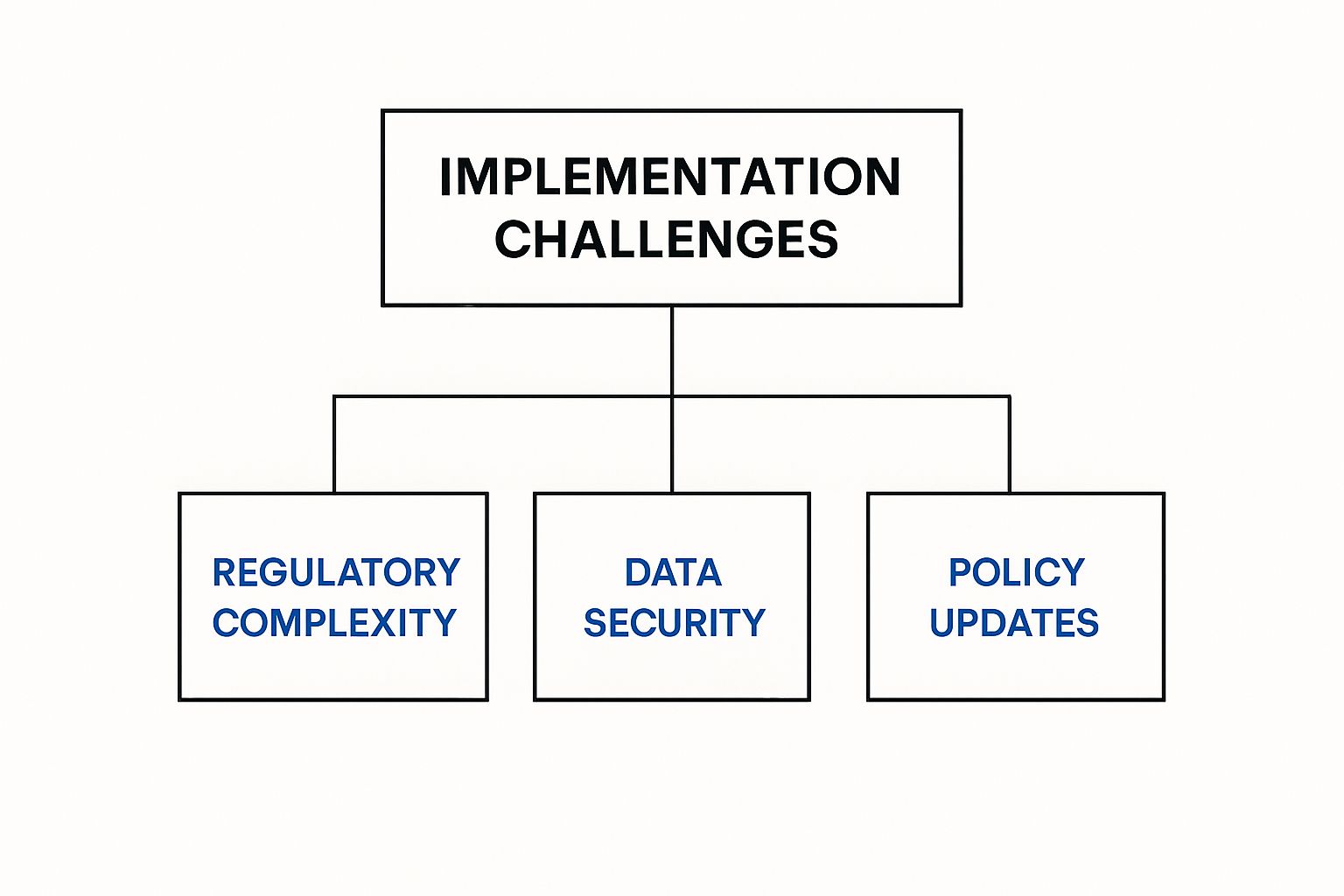
As the infographic shows, tangled regulations, data security worries, and constant policy updates are all linked. A solid software solution has to handle all three. Let’s look at the essential features designed to address these issues head-on.
Centralised Document Management
One of the biggest compliance risks is having employee records scattered everywhere. A key feature is a centralised document repository. This is much more than a simple digital filing cabinet; it’s a secure, organised hub for every employee document, from offer letters and policy sign-offs to performance reviews and exit paperwork.
- Secure Access: It controls who can see sensitive employee information, making sure only authorised people have access.
- Audit Trails: It keeps a log of who viewed or changed a document and when, creating a transparent history for any audit.
- Version Control: This ensures everyone is using the latest version of a policy or form, putting an end to confusion and mistakes.
This feature is your first line of defence against poor record-keeping, a common mistake that can cause serious trouble during legal issues or regulatory checks.
Automated Reporting and Alerts
Discovering a compliance mistake months after it happened is a situation no one wants to be in. Real-time reporting and automated alerts are essential. This feature works like an early warning system, flagging potential problems before they become big headaches. For example, it can alert you when an employee is nearing their overtime limit or when a mandatory certification is about to expire.
Good reporting transforms raw data into clear, actionable information, helping you manage risk proactively. Instead of spending hours manually compiling data for reports, the software automates the creation of audit-ready documents, which saves time and reduces human error. This is a critical function for any company wanting to shift from a reactive to a proactive approach to compliance. Many HR leaders agree that improving the overall human resources function often begins with solid reporting. You can learn more about this in our guide to modern HR practices.
Before we dive into the next feature, let’s compare how these capabilities stack up across different types of software. This table breaks down what you can typically expect from basic, advanced, and enterprise-level solutions.
| Feature Category | Basic Solutions | Advanced Solutions | Enterprise Solutions | Business Impact |
|---|---|---|---|---|
| Document Management | Simple cloud storage, manual folder organisation. | Version control, basic access permissions, digital signatures. | Full audit trails, role-based access, automated document retention policies. | Reduces risk of lost documents and ensures data privacy compliance. |
| Reporting & Alerts | Manual report generation, limited pre-set alerts. | Customisable reports, automated alerts for key dates (e.g., certification expiry). | Real-time analytics dashboards, predictive alerts for potential compliance breaches. | Moves HR from reactive problem-solving to proactive risk management. |
| Regulatory Updates | Manual updates or links to government websites. | Automated notifications for changes in central labour laws. | Geo-specific updates (central and state), with automated policy suggestions. | Guarantees the company’s internal rules are always aligned with the latest laws. |
| Employee Training | No built-in training modules. | Basic tracking for mandatory training completion (e.g., PoSH). | Integrated Learning Management System (LMS) with automated course assignments. | Creates a well-informed workforce and provides a clear record of compliance training. |
This comparison highlights that as you move from basic to enterprise solutions, the features become more automated and proactive, significantly reducing manual effort and potential for error.
Regulatory Database and Automated Updates
The core of any effective HR compliance software is its power to keep your business up-to-date with changing laws. A solution with a built-in, constantly updated regulatory database is a must. This feature automatically monitors changes to central and state labour laws—from new minimum wage mandates to updated Provident Fund regulations—and helps you revise your internal policies to match. It’s like having a legal expert on your team 24/7, making sure your company’s rulebook is never out of date.
Finding Your Perfect HR Compliance Software Match
Choosing HR compliance software can feel a bit like searching for the right business partner. You need a solution that gets your company’s unique needs, can grow with you, and doesn’t bring any unwelcome surprises down the line. The most impressive demo or the highest price doesn’t always mean it’s the right fit. A truly successful choice comes from a practical evaluation that looks past the surface to find real compatibility.
This means asking pointed questions that show whether a vendor truly understands your specific industry hurdles. A standard sales pitch won’t tell you if the software can manage the details of your multi-state operations or your mix of full-time and contract workers. It’s crucial to separate what a platform can genuinely deliver from what just sounds good. Many businesses have learned the hard way that a tool not built for their specific situation quickly becomes an expensive mistake.
A Practical Framework for Evaluation
To sidestep buyer’s remorse, it’s wise to structure your evaluation process to reveal the reality of each potential solution. This involves a close look at pricing, the implementation journey, and, most importantly, how the software actually performs in your day-to-day work.
Here are a few key areas to concentrate on during your assessment:
- Pricing Models: Don’t just glance at the monthly fee. Ask about the total cost of ownership. This includes setup fees, training expenses, charges for premium support, and costs for adding more users or features as your company expands. A per-employee, per-month model might look affordable at first, but hidden costs can quickly accumulate.
- Implementation Realities: A smooth setup is vital. Request a detailed project plan from potential vendors. Who will handle data migration? What internal team members and time will you need to commit? A vendor that glosses over the complexity of implementation might be setting you up for future headaches.
- Real-World Testing: A standard demo isn’t sufficient. You should insist on a sandbox trial or a pilot programme. This allows you to test the software with your own data and genuine compliance situations. It’s the only way to be certain the tool can manage your specific workflows and reporting requirements before you commit.
Vendor Selection Criteria Matrix
To make an objective comparison, a structured decision matrix is an invaluable tool. It prompts you to define what’s most important to your organisation and then score each vendor against those priorities. To help you get started, here is a framework you can adapt to evaluate potential software partners.
| Selection Criteria | Weight (%) | Evaluation Method | Key Questions | Deal Breakers |
|---|---|---|---|---|
| Industry-Specific Expertise | 25% | Case Studies & References | Can you provide examples of success in our industry? How does your platform handle [specific regulation]? | Inability to support our state-specific labour laws. |
| Scalability & Growth Path | 20% | Product Roadmap Review | What new features are planned for the next year? How does pricing scale as our team grows? | Inflexible user limits or excessively expensive upgrade paths. |
| Integration Capability | 20% | API Documentation & Demo | Does it connect with our current HRIS and payroll system? Is the API well-documented and accessible? | No pre-built integration with our essential business systems. |
| Implementation & Support | 15% | Talk to a Support Representative | What is included in the standard support package? What are your average support response times? | Consistently poor reviews on customer support quality. |
| Total Cost of Ownership | 20% | Detailed Quote Analysis | Are there extra fees for data migration, user training, or ongoing support? | A lack of clear and transparent pricing. |
Using a matrix like this removes emotion and guesswork from the decision. This data-first approach helps ensure you choose the HR compliance software that will best serve your organisation’s needs not just today, but for years to come.
Implementation Strategies That Actually Work

Even the most powerful HR compliance software can turn into a costly letdown without a smart implementation plan. Often, companies rush the launch or skip important prep work, then point fingers at the software when issues arise. Think of it like trying to renovate your house while still living in it—success depends on careful planning, realistic schedules, and smart ways to keep disruptions low. A successful launch is less about speed and more about building a strong foundation from the start.
This is especially relevant in India’s growing HR tech space. The human resource management software segment was the top revenue earner in the nation’s HR technology market in 2024. With a projected compound annual growth rate of 17.9% from 2025 to 2030, more businesses will face the challenge of implementation. You can learn more about the Indian HR management market’s rapid growth.
A Phased Approach to Reduce Risk
Instead of a “big bang” launch where everything goes live at once, a phased rollout is a much safer bet. This strategy means introducing the new software module by module or department by department. For instance, you could begin with the attendance and leave management module for a single team before introducing it to the whole company.
This method provides several clear benefits:
- Early Wins: It lets your team test the system in a controlled setting, catch problems early, and make necessary changes.
- Reduced Disruption: It lessens the impact on day-to-day work, as only a small group is getting used to the new system at any one time.
- Valuable Feedback: It helps you collect feedback from a pilot group, allowing you to improve training guides and procedures before the full rollout.
This deliberate, step-by-step approach builds confidence and momentum, making the change feel manageable rather than overwhelming.
The Human Side of Implementation
Technology is just one piece of the puzzle. Getting your team on board is equally important. Solid change management and training are essential for a smooth transition.
- Communication is Key: Keep everyone in the loop about the “why” behind the change, the planned timeline, and how the new software will simplify their jobs. Regular updates help stop rumours and build trust.
- Training That Sticks: Move beyond a single, generic training session. Offer role-specific training that covers the actual tasks each person will do. Provide quick-reference guides and ongoing support so users feel confident.
Finally, lay the technical groundwork. Smooth data migration from your old systems is critical. Clean up your current data before you move it to avoid carrying old issues into your new solution. Also, make sure the HR compliance software works well with your current payroll or HRIS systems. For a better grasp of how systems connect, exploring resources on API integrations can offer great insights into building a connected technology setup. By giving equal attention to people, processes, and technology, you prepare your implementation for lasting success.
Maximising Your HR Compliance Software Investment
Putting HR compliance software in place is a great first step, but getting the most out of it means looking past simple risk management. Your software shouldn’t just be a shield to ward off problems; it should be a strategic tool that creates real business value. The most forward-thinking organisations don’t just “use” their software; they weave it into their business strategy to build a competitive advantage.
This involves changing how you see the data it collects. Instead of being just a compliance checkbox, it becomes a wellspring of business intelligence. For instance, detailed reports on employee overtime aren’t solely for preventing wage violations. They can also shine a light on operational bottlenecks, pinpoint understaffed teams, and shape future workforce planning. By studying these trends, you can reallocate resources proactively, heading off burnout and boosting productivity before they become serious issues. This approach turns a reactive chore into a proactive strategic move.
From Cost Centre to Value Driver
To truly get the best return, you need to turn compliance tasks into chances for growth and efficiency. This requires a change in thinking, from viewing compliance as a necessary evil to seeing it as a way to stand out from the competition. Companies that do this well focus on three main areas:
- Advanced Reporting for Business Insights: Don’t just use the standard, pre-made reports. A solid HR compliance software solution lets you build custom dashboards that link compliance data to key business goals. You can track how safety training completion rates affect workplace accidents or dig into turnover data in certain departments to spot leadership problems. This data-first approach helps you make smarter, more informed decisions.
- Deep Integration for Smoother Operations: The true strength of your software is revealed when it works flawlessly with your other business systems. Integrating it with your payroll system ensures that wage and tax calculations are always accurate and automatic. Linking it to your recruitment platform guarantees that onboarding checklists and necessary documents are handled the same way for every new hire. These integrations break down data silos and do away with manual data entry, which not only cuts down on mistakes but also frees up your HR team for more strategic work.
- Process Optimisation for Long-Term Gains: Use your software to regularly check and improve your internal processes. If you see a lot of questions about a specific policy, that’s your cue to make the wording clearer or offer better training. By spotting these small points of friction and using the software to automate or simplify them, you create efficiency improvements that build up over time, lowering administrative costs and making for a better employee experience.
The image below from BambooHR‘s platform shows how a clean dashboard can bring critical compliance tasks, like managing required training and policy acknowledgements, into one place.
This centralised view is a perfect example of turning compliance into an efficient, trackable process, moving it from messy spreadsheets into an organised system.
Measuring the True Return on Investment (ROI)
The ROI of your HR compliance software is about more than just dodging fines. A full measurement should look at both tangible and intangible benefits. On the tangible side, you can track fewer administrative hours, lower fees for legal advice, and reduced costs linked to employee turnover.
On the intangible side, the benefits are just as important. Better employee morale, a stronger company reputation, and more trust between employees and management are all direct results of a well-run compliance programme. These elements lead to a more resilient and productive workforce, proving that a strategic approach to compliance is an investment that pays off across the whole organisation.
Future-Proofing Your Compliance Strategy
The world of HR is anything but static. New regulations, changing work models, and rapid technological shifts mean a compliance strategy that is solid today could be full of holes tomorrow. To stay ahead, your approach must be forward-thinking. This means shifting from simply reacting to current laws to actively anticipating what’s next. Think of it like a skilled ship captain who doesn’t just manage today’s weather but also studies long-range forecasts to chart a safer, more efficient course.
Organisations that will succeed in the coming years are the ones building adaptable compliance frameworks right now. This involves using HR compliance software not just as a digital filing cabinet, but as a proactive tool for managing risk and planning for the future.
Embracing Predictive Analytics and AI
The next great shift in compliance is from reactive alerts to predictive insights. Instead of a system flagging a problem after it has already happened, future-focused software will use artificial intelligence (AI) to spot potential risks before they become serious issues. For example, an AI-powered system could analyse working hour patterns across different teams to predict which groups are at risk of burnout or non-compliant overtime, allowing managers to step in and make adjustments.
This changes the role of HR from a compliance enforcer to a strategic partner. Key capabilities on the horizon include:
- AI-Powered Risk Prediction: Analysing past data to forecast potential trouble spots, such as departments with a high risk of harassment claims or pay equity gaps.
- Automated Regulatory Interpretation: Systems that not only tell you about a new law but also suggest specific policy updates needed to comply.
- Chatbot Support for Employees: AI-driven chatbots can give instant, accurate answers to common compliance questions, freeing up HR staff and ensuring everyone gets consistent information.
Adapting to Evolving Work Models
The growth of remote and hybrid work adds new layers of complexity, particularly in a country with diverse state-level laws like India. A future-ready strategy must be able to handle:
- Multi-State Compliance: Making sure payroll, labour laws, and professional taxes are correctly managed for employees working from different states.
- Data Security for Remote Teams: Protecting sensitive employee information when it’s being accessed from various home networks and locations.
- Digital Well-being Policies: Staying on top of new rules around the right to disconnect and managing conduct in a digital workplace.
A Human Resource Management System (HRMS) often helps visualise how these different functions connect, as shown in the diagram below.
This diagram illustrates how HR functions, from recruitment to performance appraisal, are interlinked. Future-proof HR compliance software must seamlessly integrate these processes while adapting to the distinct legal requirements of a distributed workforce. This calls for a flexible platform that can manage different regulatory environments within one system.
Building a resilient compliance strategy isn’t about planning for every single possibility. It’s about choosing technology and processes that are flexible and can grow with your business. By focusing on adaptability and using predictive tools, you can ensure your organisation stays compliant, agile, and prepared for whatever comes next.
Ready to build a hiring process that’s both compliant and efficient? Discover how SpringVerify provides fast, accurate, and secure background verification services to keep you ahead. Learn more about our solutions.


