

Imagine trying to run a modern company’s workforce with nothing but dusty ledgers and paper files. It would be painfully slow, riddled with errors, and completely unsustainable. That’s pretty much what manual HR feels like today.
HR automation, on the other hand, is like having a powerful, integrated GPS for your people operations. It’s what turns the HR department from an administrative hub into a strategic driver of growth.
Table of Contents
What Is HR Automation and Why Is It Essential?
At its core, HR automation is simply using technology to digitise and streamline the repetitive tasks that bog down human resources teams. Think of it as a smart assistant that never gets tired. Instead of spending hours on manual payroll data entry, tracking leave requests in messy spreadsheets, or sifting through mountains of CVs, automation handles these jobs with speed and accuracy.
This shift allows HR professionals in India to step away from the paperwork and focus on work that truly matters. We’re talking about high-impact activities like strategic workforce planning, fostering genuine employee engagement, and building a company culture that attracts and keeps the best talent.
The real point here isn’t to replace people; it’s to elevate their work. When you automate the mundane, you free up human intelligence for the things that require creativity, empathy, and strategic insight—qualities no software can ever truly replicate.
The Driving Force Behind HR Automation in India
The move towards HR automation in India is picking up serious momentum. The goal is no longer just about efficiency; it’s about transforming HR departments from administrative units into strategic powerhouses that directly fuel business growth.
The numbers tell a clear story. A recent report from early 2025 showed that about 69% of Indian companies have automated routine HR tasks like payroll and attendance. That’s a great start, but there’s still a massive opportunity in more strategic areas. For instance, complex functions like succession planning are only automated in 12% of companies.
This pattern is telling. Indian firms are using automation to get their operational house in order first, but the real prize lies in applying this technology to bigger, more strategic workforce challenges. To get a broader view of these changes, it’s worth exploring the impact of AI in HR, which touches everything from recruitment to the day-to-day employee experience.
To give you a clearer picture of this transformation, here’s a look at how automation redefines some core HR functions.
Key HR Functions Transformed by Automation
| HR Function | Before Automation (Manual Process) | After Automation (Automated Process) |
|---|---|---|
| Recruitment & Onboarding | Sifting through CVs, manual interview scheduling, endless paperwork for new hires. | AI-powered candidate screening, automated interview scheduling, digital document collection and e-signatures. |
| Payroll & Compensation | Manual data entry from attendance logs, complex calculations in spreadsheets, high risk of errors. | Integrated time tracking, automated salary calculations, direct deposit processing, and payslip generation. |
| Leave & Attendance | Tracking requests via email or paper forms, manual updates to spreadsheets, chasing managers for approvals. | Employee self-service portals for leave requests, automated approval workflows, and real-time attendance tracking. |
| Performance Management | Annual paper-based reviews, subjective feedback collection, difficult to track goals and progress. | Continuous feedback loops, automated reminders for reviews, data-driven performance analytics, and objective goal tracking. |
This table shows just how profound the shift can be. Automation takes fragmented, labour-intensive tasks and turns them into a smooth, integrated system that empowers both HR and employees.
Visualising the Core Functions
An HR automation system isn’t just a collection of separate tools; it connects the entire employee lifecycle. This diagram clearly illustrates how a central system unites critical functions like recruitment, onboarding, and payroll into one cohesive workflow.
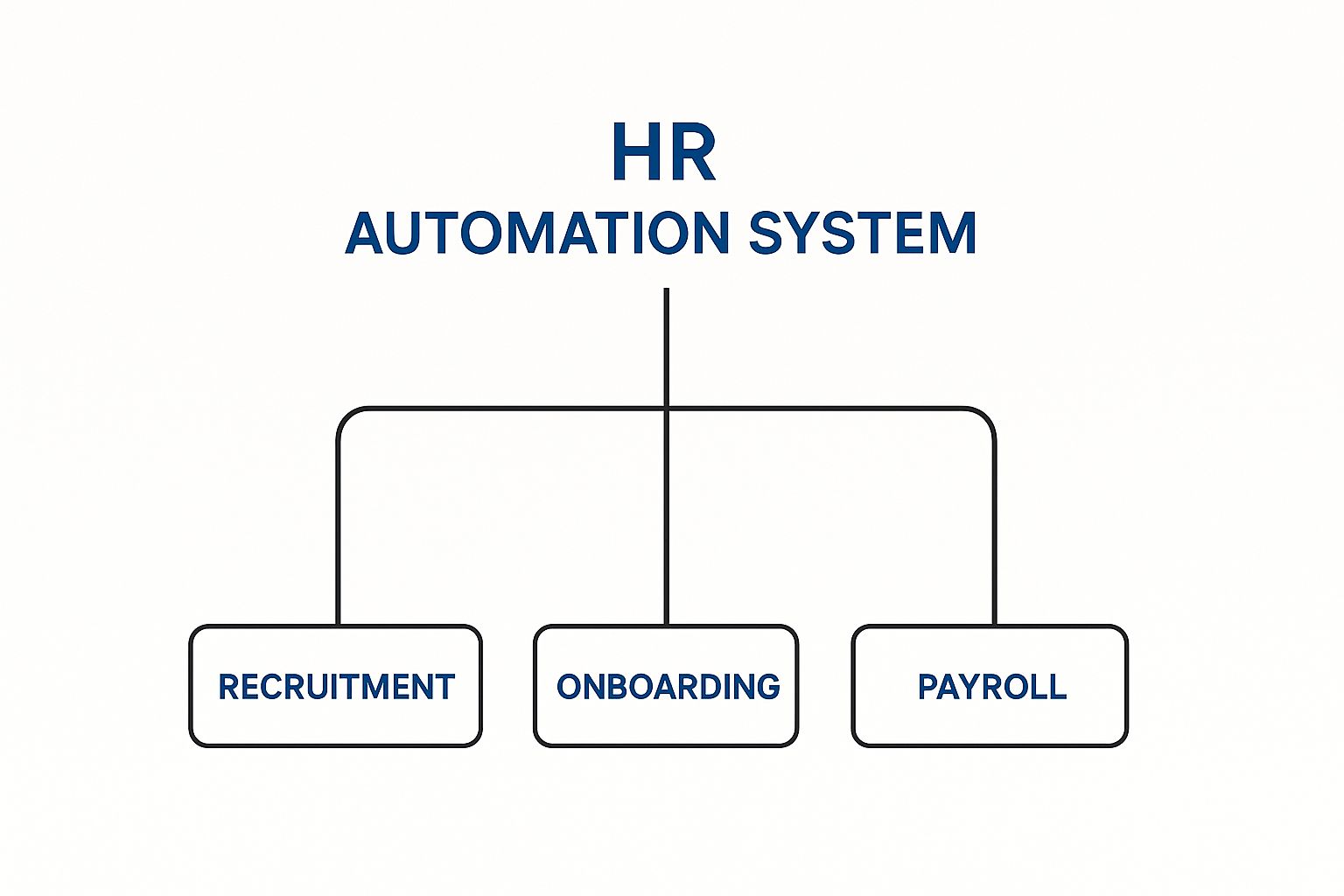
What this visual makes obvious is that these processes aren’t isolated. They are deeply interconnected parts of a unified strategy. A well-designed system ensures data flows seamlessly from one stage to the next—for example, when a new hire’s information from the recruitment stage is automatically used to kick off their onboarding and payroll setup.
By connecting these dots, businesses create a much more coherent and efficient experience for everyone involved. For a closer look at how these functions fit together, our guide on modernising your human resources practices is a great resource. This integrated approach is absolutely fundamental for any growing company in India looking to build a scalable and effective people operations function.
The Building Blocks of a Modern HR Automation System

A great HR automation system isn’t just a random collection of tools. It’s a complete ecosystem designed to support your people through their entire journey with you—from their first application to their last payslip. When you understand the core pieces, you can see how they fit together to build a more efficient and people-centric organisation.
Think of it like building a house. You need a solid foundation, strong walls, and a secure roof, all working in harmony. A modern HR automation platform is built the same way, from essential, interconnected modules that each solve a specific business challenge.
Let’s break down the core components that make these systems so effective for a growing Indian business.
Applicant Tracking Systems: The Smart Gateway
For most companies, the first and most visible component is the Applicant Tracking System (ATS). This is your company’s front door, the smart gateway that manages the entire recruitment process. It becomes the central hub for posting jobs, collecting applications, and screening every candidate who applies.
An ATS takes the most grinding, time-consuming parts of hiring off your plate. Instead of manually drowning in hundreds of CVs, the system can parse resumes for specific keywords, skills, and qualifications. This ensures your hiring managers see the best-fit applicants first, leading to a much faster and fairer screening process.
Imagine a fast-growing tech firm in Pune getting a flood of applications for a new software developer role. The ATS can instantly filter for candidates with Java experience and at least three years in a product-based company, shortlisting the top contenders in minutes.
Payroll Automation: The Guardian of Accuracy
Next up is payroll automation, the guardian of accuracy and compliance. Manual payroll is a minefield of human error, leading to incorrect salaries, compliance penalties, and unhappy employees. For businesses in India, with our complex statutory rules, that’s a risk you simply can’t afford.
Automated payroll systems hook directly into your attendance and leave management data. They automatically calculate salaries, deductions for Provident Fund (PF) and Employee State Insurance (ESI), and professional taxes based on rules you’ve already set.
By taking manual data entry out of the picture, payroll automation crushes the odds of making costly mistakes. It guarantees your team gets paid correctly and on time, every single time—a fundamental step in building trust and morale.
Employee Self-Service Portals: The Tools of Empowerment
Employee Self-Service (ESS) portals are another game-changing building block. These portals put your team in the driver’s seat, giving them direct control over their own personal and professional information. No more emailing HR for every tiny request.
With an ESS portal, an employee can:
- Update Personal Details: Change their address or update bank account information without a single piece of paper.
- Manage Leave Requests: Apply for time off, check their leave balance, and see the team calendar.
- Access Payslips and Tax Documents: Download salary slips and Form 16 whenever they need them.
This doesn’t just free up your HR team’s time; it creates a culture of transparency and ownership. When employees feel more connected and in control of their own admin, they feel more valued. And as you connect these systems further, exploring API integrations can link your HR platform with other vital tools, like background verification services, making your entire workflow even smoother.
The Tangible Business Impact of Automating HR
Moving beyond theory, what does HR automation actually deliver to the bottom line? The impact isn’t just about saving a few hours here and there; it’s about fundamentally rewiring how a business operates. Let’s look at the real-world results through the story of a mid-sized Indian manufacturing firm.
For years, this company grappled with familiar headaches. Their manual payroll process was a monthly minefield of stress and errors. The hiring cycle was painfully slow and inconsistent, often causing them to lose great candidates to faster-moving competitors. All their data was scattered across countless spreadsheets, making it impossible to see the bigger picture and figure out why skilled people were walking out the door.
When they finally implemented an integrated HR automation platform, the changes weren’t just noticeable—they were dramatic. The firm didn’t just save a bit of time; they unlocked genuine, measurable business outcomes.
Slashing Costs and Boosting Accuracy
One of the first and most immediate wins was in payroll. Before automation, manual calculations and data entry mistakes were a given, leading to frustrated employees and hours spent on corrections. After switching to an automated system, the results were stunning.
The company cut its payroll processing errors by an incredible 95%. This didn’t just save money on fixing mistakes; it massively boosted employee trust and morale.
This shift wasn’t just about becoming more efficient. It was about building a reliable, error-free foundation for their most critical HR function. Reducing operational costs became a clear, measurable victory that made the business case for HR automation impossible for leadership to ignore.
Accelerating Talent Acquisition
The firm’s slow hiring process was a huge competitive disadvantage. Top candidates would frequently accept other offers while stuck waiting for interview schedules and feedback. An automated system turned this weakness into a core strength.
A huge part of this transformation came from adopting automated job screening techniques, which had a massive impact on their entire hiring pipeline. By automating candidate screening and interview scheduling, the company completely changed its recruitment game.
- Time-to-Hire Reduction: They managed to slash their time-to-hire by a remarkable 40%.
- Improved Candidate Experience: Faster communication and a smoother process left a much better impression on applicants.
- Data-Driven Decisions: Hiring managers suddenly had clear, organised candidate data at their fingertips, helping them make smarter choices.
This newfound speed and efficiency meant they could finally secure top talent before the competition, directly impacting their workforce quality and capacity for innovation.
Gaining Strategic Insights from Data
Perhaps the most powerful benefit came from having all their people data in one place. For the first time, the leadership team could actually analyse trends in employee turnover, performance, and engagement. They could finally answer critical questions like, “Which departments have the highest attrition?” and “Are our top performers being recognised and rewarded?”
This access to accurate, real-time data allowed them to shift from reactive problem-solving to proactive, forward-thinking strategy. They could now design targeted retention programmes and make informed decisions about workforce planning. This level of insight is becoming essential across India, especially as government support through initiatives like the Union Budget 2025 aims to speed up HR automation adoption. A McKinsey report even projects that automation could boost India’s GDP by up to 2.2% annually by 2035, with HR playing a key part. If you want to dive deeper, you can explore how the budget can fuel HR digital transformation.
For this manufacturing firm, and countless others, this is the true power of automation: turning administrative data into a priceless strategic asset.
Here’s the rewritten section, crafted to sound like an experienced human expert, following all your specified requirements.
How Indian Companies Use HR Automation Daily
The real power of HR automation isn’t some far-off, futuristic concept. It’s happening right now, solving very real, everyday problems for businesses all across India. We’re talking about practical tools that make a direct impact, whether in a buzzing tech hub or a nationwide retail network.
Let’s move past the theory and look at how Indian companies are actually putting these systems to work.
Streamlining Recruitment for Speed and Scale
Picture a fast-growing financial tech startup in Bangalore. They need to hire top talent, and they need to do it yesterday. The problem? They’re getting swamped with thousands of applications for every open role. This is where HR automation steps in and becomes their secret weapon.
Instead of manually sifting through a mountain of CVs, their Applicant Tracking System (ATS) does the heavy lifting. It’s programmed to instantly spot keywords and specific skills like “Python,” “data analysis,” or “regulatory compliance.” In minutes, a sea of applicants is filtered down to a manageable shortlist of the most promising people. This isn’t just about being faster; it’s about being smarter, ensuring hiring managers only speak to top-tier candidates.
But the automation doesn’t stop there. Once the top candidates are picked out, the system takes over the painful task of scheduling interviews. It syncs with the hiring managers’ calendars, finds open slots, and sends automated invites to candidates.
Gone are the days of endless back-and-forth emails that kill momentum. The result is a much shorter time-to-hire, which is a massive advantage in a competitive tech market where the best people are off the market in a flash.
The rise of AI-powered tools is a huge reason for this shift. In fact, HR technology in India is seeing major growth because of these intelligent systems. AI can screen resumes, schedule interviews, and even use predictive analytics to gauge cultural fit. Many companies are now using AI chatbots to keep candidates engaged throughout the process. For a closer look at this trend, you can find more details on how AI is shaping HR tech.
Ensuring Consistency in National Operations
Now, let’s switch gears to a different challenge. Think of a large retail chain with hundreds of stores scattered across India. How do they make sure a new employee in Mumbai gets the exact same professional welcome as someone starting in Madurai? Doing this manually is a recipe for disaster, often leading to a confusing and inconsistent start for new hires.
This is where automated onboarding workflows make all the difference. The moment a candidate accepts their offer letter, the system jumps into action.
- Digital Documentation: New hires get a link to a secure portal. Here, they can upload their PAN and Aadhaar cards and digitally sign their employment contract. No paperwork, no fuss.
- Automated Welcome Kits: The system can trigger a welcome email from the CEO and automatically enrol the new employee in required online training modules.
- Pre-Scheduled Inductions: The platform schedules everything for their first week – orientation sessions, IT equipment setup, and meet-and-greets with their new team.
This automated sequence guarantees every new person gets the same high-quality welcome, reinforcing the company’s brand and culture from day one. It also frees up local store managers from administrative headaches, letting them focus on what really matters: in-person training and helping the new hire settle in.
Automation in this context isn’t just about efficiency; it’s about consistency at scale. It ensures that your company values and processes are upheld uniformly, no matter how geographically dispersed your workforce is.
Listening to the Workforce in Real-Time
Finally, consider a large services firm in Gurgaon. With thousands of employees, how can leadership possibly know what morale is like on the ground? The annual survey is too slow and often misses the day-to-day reality of the workplace.
Here, HR automation offers a brilliant solution: automated pulse surveys. Instead of one big survey once a year, the HR platform sends out short, frequent questionnaires via email or a mobile app. These might ask simple questions about workload, manager support, or team dynamics.
The magic happens when the system gathers all the responses in real-time. Using sentiment analysis, it can spot trends and flag potential areas of dissatisfaction before they become major issues. Leadership gets a dashboard showing which teams are thriving and which might need support. This allows them to be proactive, addressing problems before they lead to something bigger, like high employee turnover. It’s a strategy that builds a far more responsive and empathetic company culture.
Your Step-by-Step Implementation Roadmap
Getting started with HR automation can feel like a massive undertaking, but it doesn’t have to be. With a clear, structured roadmap, you can guide your company towards a smooth rollout and sidestep the usual pitfalls. Think of it less as a single, giant leap and more as a series of well-planned, manageable steps that build on each other.
A successful rollout starts long before you ever talk to a software vendor. It begins with an honest, hard look at your own internal processes. You need to be sure you’re solving the right problems from day one. Many companies rush this foundational work, which is a classic mistake that often leads to picking the wrong tools and seeing a poor return on investment.
This guide breaks down the implementation into clear phases. We’ll walk you through everything from assessing your current state to measuring success after launch, making sure your investment in HR automation delivers real, lasting value.
Phase 1: Assess Your Current HR Processes
Before you can automate a single task, you have to truly understand what you’re currently doing. The goal here is to pinpoint the exact sources of inefficiency, manual grunt work, and frustration buried in your existing HR workflows. Don’t just guess—get real feedback.
Talk to the people on the ground: your HR team, line managers, and even regular employees. Ask them direct questions to uncover the biggest headaches.
- Which HR task eats up the most manual hours every week?
- Where do mistakes happen most often (e.g., payroll calculations, leave tracking)?
- What part of our process creates the worst experience for candidates or new hires?
Your findings will naturally create a priority list. For instance, if payroll errors are a constant, costly problem, then automating payroll should be your top priority. If your time-to-hire is painfully slow, then focusing on an Applicant Tracking System (ATS) is the logical first move. This clarity is absolutely crucial for what comes next.
Phase 2: Choose the Right Software Partner
With your priority list in hand, you can now start looking at potential software partners. This is about more than just comparing feature lists; it’s about finding a partner that truly gets your specific needs, especially within the Indian business context.
A critical mistake is choosing a global platform that doesn’t understand the nuances of Indian statutory compliance. Ensure any vendor you consider has robust, built-in support for things like Provident Fund (PF), Employee State Insurance (ESI), and professional tax calculations specific to different states.
As you vet potential software, create a simple checklist based on your must-haves:
- Local Compliance: Does the platform correctly handle Indian payroll and labour laws out of the box?
- Scalability: Can the software grow with your company, from 50 employees to 500 and beyond?
- Integration: Will it connect smoothly with your existing tools, like your accounting software?
- Support: Do they offer reliable, local customer support during your business hours?
Always ask for a live demonstration and have them show you exactly how their system solves one of the specific pain points you identified back in Phase 1.
Phase 3: Plan Data Migration and Manage Change
Once you’ve chosen your partner, the real work begins. The first big technical hurdle is data migration—the process of moving all your employee information from scattered, messy spreadsheets into the new, clean system. Work closely with your software provider on a detailed plan for this. A pro tip: cleanse your data before you move it to avoid importing old errors into your shiny new platform.
Just as important is managing the human side of this shift. Change can be unsettling for employees, so a clear communication and training plan is non-negotiable for a smooth adoption.
- Communicate the “Why”: Explain to your team how this new system will benefit them directly. We’re talking less paperwork, faster access to their own information, and easier leave requests. Frame it as a win for them.
- Provide Thorough Training: Organise hands-on training sessions for different groups (the HR team, managers, and all employees) so everyone feels confident and comfortable using the new tool.
- Launch and Measure: After going live, set up key performance indicators (KPIs) to track your success. Start measuring metrics like the reduction in payroll errors, the decrease in time-to-hire, and the employee adoption rates of the self-service portal. This hard data is what will ultimately prove the value of your investment.
Integrating Background Checks Into Your HR Workflow

In the Indian hiring landscape, thorough background verification isn’t just a good idea—it’s an absolute must. Weaving this crucial step directly into your HR automation platform transforms it from a clunky, manual chore into a seamless and powerful part of your hiring engine. This integration is a game-changer for both compliance and speed.
Think about the typical hiring process. A candidate gets an offer and accepts. In a manual setup, this is where things often grind to a halt. HR teams scramble to email requests to a verification agency, then sit and wait for a separate report to land in their inbox.
An automated approach completely flips the script.
Triggering Verifications Automatically
With a modern, integrated system, the moment a candidate digitally signs their offer letter in your Applicant Tracking System (ATS), the background check kicks off automatically. No manual handoffs. No forgotten requests. No delays. The system securely sends the candidate’s details straight to your verification partner.
This isn’t just about saving time; it’s about eliminating the risk of human error. It guarantees that every single hire goes through the exact same compliant screening process, every single time. That kind of consistency is vital for maintaining a fair and defensible hiring practice.
An automated background check workflow creates a single, undeniable source of truth. The results are securely delivered and logged directly within the candidate’s profile in your HR system, creating a complete and auditable hiring record from start to finish.
This integration is your best defence against hiring risks. You can get a better handle on the different checks involved by learning more about professional employment verification processes, which confirm a candidate’s work history.
The Impact on Hiring Speed and Quality
The payoff for this seamless integration goes far beyond just managing risk. When you automate this step, you dramatically speed up your time-to-hire.
Here’s what that looks like in practice:
- Reduced Manual Work: Your HR team is freed from the administrative grind of chasing down checks. This lets them focus on more strategic work, like creating a great onboarding experience.
- Faster Turnaround Times: Integrated systems are built for speed, meaning you get the information needed to finalise a hire without any frustrating delays.
- Improved Candidate Experience: Candidates notice and appreciate a smooth, professional process. Automated updates keep them in the loop and engaged, which reflects incredibly well on your company’s brand.
Ultimately, by embedding background checks into your HR automation workflow, you’re able to lock in top talent faster and with greater confidence. And in today’s market, that gives you a serious competitive edge.
Answering Your Key Questions About HR Automation
Stepping into the world of HR automation can feel like a big leap, and it’s perfectly natural to have questions. For many businesses in India, the shift from familiar, manual ways of working to new technology brings up valid concerns about cost, job security, and data safety.
Let’s tackle some of the most common questions head-on. We’ll give you clear, straightforward answers to help you navigate this important decision with confidence. Think of this as your quick-start guide to the realities of bringing an automated HR system on board.
Will HR Automation Replace Jobs in Our Company?
This is often the first worry that comes to mind, but the reality is quite different. HR automation isn’t designed to make your valuable HR professionals redundant. Far from it. It’s built to supercharge their skills and free them from the daily administrative grind.
By taking over repetitive work like payroll calculations, leave tracking, and endless data entry, automation gives your HR team its time back. They can then pivot their focus to high-impact, strategic work that genuinely needs a human touch.
HR automation transforms the role from administrative to strategic. It allows your team to dedicate their time to talent development, improving the employee experience, and building a stronger company culture—activities that truly drive business value.
Is HR Automation Affordable for a Small Business in India?
Absolutely. The idea that HR automation is only for massive corporations is a persistent myth. The market has matured, and today, there are plenty of scalable, cloud-based HR solutions (SaaS) built specifically with small and medium-sized businesses in mind.
These platforms usually work on flexible subscription models. This means you can pay for what you use without needing a huge, upfront investment. When you measure the return on investment—through saved time, fewer costly errors, and stronger compliance—it often proves to be a highly cost-effective move for organisations of any size.
How Do We Ensure Data Security with an Automated HR System?
Data security is a non-negotiable, and any reputable HR automation vendor will treat it as their top priority. As you evaluate different platforms, it’s crucial to find providers who stick to international data protection standards and have solid security measures in place.
Here are a few key security features you should always look for:
- Data Encryption: This protects your sensitive employee data, both when it’s being sent and when it’s stored.
- Secure Cloud Hosting: Your information should be housed on reliable and secure infrastructure from trusted providers.
- Role-Based Access Control: This ensures that employees can only see the information that’s relevant to their specific jobs.
Always do your homework. Verify a vendor’s security credentials and compliance certifications before you sign on the dotted line. This simple diligence is the best way to keep your company and employee data safe.
Ready to build a more efficient, secure, and strategic hiring process? SpringVerify offers reliable, seamless background verification services that integrate perfectly with your HR workflows. Make informed hiring decisions faster.


