

Validating an Aadhaar number is a lot more than just making sure it has 12 digits. It’s a layered process, starting with simple format checks and moving all the way to robust, real-time API verification. This process is what guarantees data integrity, helps shut down fraud, and is frankly a non-negotiable step for any business operating in India today.
Table of Contents
Why Aadhaar Validation Is a Non-Negotiable Step
Figuring out how to validate Aadhaar number isn’t just a technical checkbox—it’s a critical business function. Skipping this can have some serious consequences, from financial fraud to major compliance headaches with your Know Your Customer (KYC) processes. Whether you’re a fast-growing fintech startup or a large enterprise, solid validation is the bedrock of user trust and operational integrity.
Think of it like checking a physical ID. A quick glance might tell you it looks real, but you need a closer look to be sure of its authenticity. Aadhaar validation works in much the same way, with multiple layers of scrutiny.
The Different Layers of Validation
The first layer is all about the basics: Is it 12 digits long? Does it only contain numbers? These simple rules catch obvious data entry errors right at the source.
The next layer is a bit more sophisticated. It uses a checksum algorithm to mathematically confirm that the number is internally consistent and not just a random string of 12 digits.
But the highest level of assurance comes from real-time verification through an API. This final step confirms not only that the number is valid but also that it’s active and linked to a real person in the UIDAI database. This comprehensive approach is central to secure digital identity verification in India.
The Real-World Impact on Governance
The importance of this process goes way beyond corporate compliance. Aadhaar validation is crucial for maintaining the integrity of social welfare and government schemes, directly impacting how subsidies and benefits are distributed.
Between 2022 and 2023, various government departments used Aadhaar validation to clean up their beneficiary databases, weeding out millions of fake or duplicate entries. For instance, the Department of Rural Development deleted 7.10 lakh fake job cards, and the Ministry of Minority Affairs removed 30.92 lakh fraudulent beneficiaries. You can read more about these anti-fraud measures on the Press Information Bureau website.
By implementing a multi-layered validation strategy, your organisation not only protects itself from risk but also contributes to a more secure digital ecosystem. It’s a fundamental practice for building reliable and trustworthy services.
Deconstructing the 12-Digit Aadhaar Number
Before you get tangled up in complex validation algorithms, the first step is always the simplest: understanding the basic anatomy of an Aadhaar number. Think of it as a quick visual check that catches the most obvious slip-ups right away. Getting this foundation right is key to building a solid process for figuring out how to validate Aadhaar number entries from the get-go.
When the Unique Identification Authority of India (UIDAI) rolled out Aadhaar back in September 2010, the goal was to create a reliable digital identity for every resident. This 12-digit number was designed to eliminate fakes and make verification straightforward. A key part of its design is that a valid Aadhaar number will never start with a 0 or 1, and it’s generated through a sophisticated randomization process. You can get the full story on the history and structure of Aadhaar on Wikipedia.
These simple structural rules are your first line of defence against common data entry mistakes.
The Three Foundational Rules
At its heart, every single Aadhaar number has to follow three non-negotiable rules. These checks are dead simple to put in place but are surprisingly effective at filtering out a huge chunk of bad data before it ever contaminates your systems.
- Must be exactly 12 digits: No more, no less. An Aadhaar number with 11 or 13 digits is an immediate red flag. This strict length is the most basic check you can perform.
- Must contain only numbers: The entire sequence has to be numeric (0-9). If you spot any letters, symbols, or special characters, it’s instantly invalid.
- Cannot start with ‘0’ or ‘1’: No legitimate Aadhaar number ever begins with a zero or a one. This is a deliberate design choice that helps distinguish it from other IDs.
These preliminary checks act as a gatekeeper. For instance, if a user accidentally types in their 10-digit mobile number, the 12-digit length rule will immediately flag the error and prompt them to correct it.
A simple front-end check enforcing these three rules can dramatically improve the quality of data you collect. It’s a low-effort, high-impact step that prevents garbage data from polluting your database and causing validation failures later.
A Practical Regex for Basic Validation
If you’re a developer or a systems admin, one of the most efficient ways to enforce these rules is with a Regular Expression, or Regex. A Regex pattern lets you check all three conditions in one clean, efficient step, making it perfect for web forms or database constraints.
You can use the following pattern to run this initial check:
^[2-9]{1}[0-9]{3}[0-9]{4}[0-9]{4}$
This tidy bit of code ensures the number starts with a digit from 2 to 9, is followed by exactly eleven more digits, and contains nothing else. By applying this Regex right at the point of data entry, you automate that first layer of validation, ensuring only structurally sound numbers move on to the more advanced checks.
Using the Verhoeff Algorithm for Checksum Validation
Once you’ve confirmed an Aadhaar number follows the basic format rules, it’s time for a more powerful, mathematical check. This is where the Verhoeff algorithm comes in. This clever checksum formula is the secret sauce that makes every Aadhaar number self-verifying, giving you a robust offline method to catch typos and other data entry mistakes.
Essentially, that final digit of an Aadhaar number isn’t just random. It’s a checksum, calculated with precision from the first 11 digits. If even one of those initial digits is off, the calculated checksum won’t match the last digit, and the number will fail the test. Simple as that.
This infographic gives a bird’s-eye view of how different validation methods, including SMS-based checks, fit into the broader verification picture.
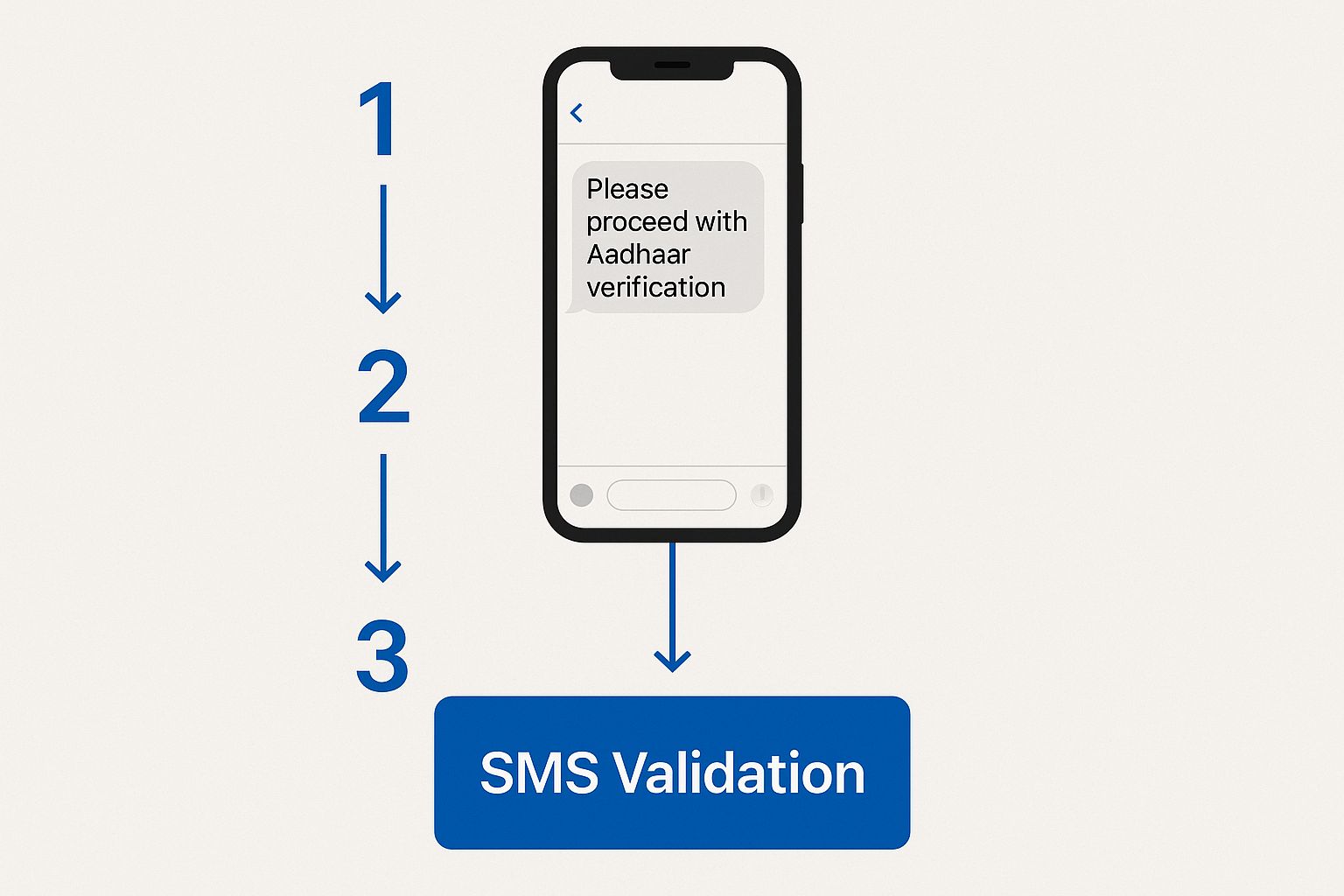
As you can see, there are multiple ways to verify an Aadhaar, each offering a different level of assurance—from a quick format check to a more complex, authenticated query.
How the Algorithm Actually Works
The Verhoeff algorithm is a dihedral group-based checksum method, and it’s known for being particularly good at catching common human errors. Think swapping adjacent digits or just plain mistyping a single number—this algorithm is designed to spot those.
It works its magic using a few predefined tables:
- A Multiplication Table (d): This isn’t your standard multiplication. It defines the results of a specific non-commutative operation used in the calculation.
- A Permutation Table (p): This table is all about shuffling digits based on their position in the number, which adds another layer of complexity to guard against transposition mistakes.
- An Inverse Table (inv): This table comes into play during the final step to produce the checksum digit.
To check a number, the algorithm crunches the first 11 digits through a series of lookups and operations using these tables. The final output is a single digit. If that calculated digit matches the 12th digit of the Aadhaar number you’re testing, the number is structurally valid.
Think of it like a secret recipe. The first 11 digits are your ingredients, the algorithm’s tables are the cooking instructions, and the 12th digit is the final dish. If the dish doesn’t taste right (i.e., the checksum doesn’t match), you know one of the ingredients was wrong.
A Walkthrough With a Sample Number
Let’s break this down with a real example. Say we need to validate the Aadhaar number 4760 3824 9815. Here, the final digit, our checksum, is 5.
The algorithm takes the first 11 digits (47603824981) and gets to work, performing its series of permutations and multiplications. It goes through each digit from right to left, applying the rules from its tables. After processing all 11 digits, it generates a checksum. For this specific number, the algorithm would calculate the checksum to be 5.
Since the calculated checksum (5) perfectly matches the last digit of our sample number, we can confirm it’s a validly constructed Aadhaar. Had the number been mistyped as 4760 3824 9814, the algorithm’s result wouldn’t be 4, and the validation would fail instantly. This built-in check is a solid layer of defence that doesn’t even need an internet connection.
Practical Code for Developers
If you’re a developer looking to build this check into your application, the logic can be implemented in pretty much any programming language. The first step is to define the multiplication, permutation, and inverse tables as arrays or matrices in your code.
Here’s a simplified Python example to give you a feel for the flow:
Predefined Verhoeff algorithm tables
multiplication_table = [[…], […]]
permutation_table = [[…], […]]
inverse_table = […]
def validate_aadhaar_verhoeff(aadhaar_string):
“”” Validates a 12-digit Aadhaar number using Verhoeff algorithm. “””
if not aadhaar_string.isdigit() or len(aadhaar_string) != 12:
return False
checksum = 0
# Reverse the number for processing
reversed_number = aadhaar_string[::-1]

for i in range(1, len(reversed_number)):
    digit = int(reversed_number[i])
    permuted_digit = permutation_table[i % 8][digit]
    checksum = multiplication_table[checksum][permuted_digit]

# Final check
return multiplication_table[checksum][int(reversed_number[0])] == 0
This snippet shows the core logic. A full implementation would require the complete tables, but it illustrates how you can create a function to run this vital offline check. It’s a critical security layer that can significantly improve the integrity of the Aadhaar data you handle.
Implementing Real-Time API Verification
While offline checks using format rules and the Verhoeff algorithm are a solid first line of defence, they have a major blind spot. They can tell you if an Aadhaar number is structurally sound, but they can’t confirm if it’s currently active or even exists in the UIDAI database.
For any process needing a high degree of trust, like KYC or employee onboarding, this is a critical gap. You’re left wondering if the number is real or just a cleverly constructed fake.
This is exactly where real-time API verification comes into play. It’s the definitive step when you need to know how to validate Aadhaar number with absolute certainty. By connecting to a verification service, you move from a theoretical check to concrete authentication against the official source.
The Power of an API Call
Think of an Application Programming Interface (API) as a secure messenger between your system and a verification provider. Instead of just checking the number’s structure on your own, you’re sending a direct query to a service that can confirm its status in real time.
This is the only way to know for sure if an Aadhaar number is valid, has been deactivated, or is simply a well-formatted but non-existent number.
For businesses, this is a game-changer. It means you can build a reliable, automated check right into your workflows. Every Aadhaar you collect is confirmed as legitimate before you move forward. When building this system, applying key principles from guides on API design best practices is crucial for creating a robust and secure verification mechanism.
Anatomy of a Verification Request
Integrating with a verification provider like SpringVerify usually means making a simple, secure HTTPS request to a specific endpoint. You’ll need an API key for authentication, which you get after signing up for the service.
The request you send will typically be in JSON format, containing the Aadhaar number you want to verify. A standard request payload might look something like this:
{
“aadhaar_number”: “476038249815”,
“consent”: “Y”
}
As you can see, you provide the number and confirm user consent—a non-negotiable compliance requirement.
Interpreting the API Response
Once your system sends the request, the verification service processes it and sends back a response, also in JSON format. This response contains the critical information you’re looking for. A successful verification might return a payload like this:
{
“status”: “VALID”,
“message”: “Aadhaar number is valid and active.”,
“data”: {
“gender”: “MALE”,
“state”: “Maharashtra”,
“age_band”: “30-40”
}
}
This response not only confirms the number is VALID but can also provide limited demographic data (without revealing sensitive PII) to help further confirm the identity.
The real value of an API is its ability to handle different outcomes gracefully. It won’t just tell you when things are right; it will also give you clear signals when they are wrong, allowing you to build smarter, more resilient workflows.
On the other hand, if the number is invalid, the response would be straightforward:
{
“status”: “INVALID”,
“message”: “Aadhaar number does not exist or has been deactivated.”
}
This clear feedback lets your system immediately flag the entry and prompt the user for a correction, stopping fraudulent or incorrect data in its tracks. For companies looking to embed these checks seamlessly into their hiring process, exploring dedicated API integrations can automate and simplify this entire workflow.
Comparing Aadhaar Validation Techniques
Choosing the right Aadhaar validation method depends entirely on your needs. Do you need a quick, offline check for structural correctness, or do you require definitive, real-time proof of validity? The table below breaks down the differences between manual methods and API-based verification.
| Feature | Regex & Verhoeff (Offline) | API Verification (Online) |
|---|---|---|
| Accuracy | Moderate. Validates format and checksum but cannot confirm existence. | High. Directly verifies against the UIDAI database for authenticity. |
| Speed | Instantaneous. All checks are performed locally without network delay. | Fast (milliseconds). Depends on API provider’s response time. |
| Data Source | Self-contained algorithms. No external database access. | Live connection to a verification provider linked to the UIDAI database. |
| Use Case | Basic form validation, initial data entry checks, filtering junk data. | Employee onboarding, KYC, loan applications, high-trust transactions. |
| Cost | Free to implement (development time). | Typically involves a per-check fee from the API provider. |
| Dependency | None, works completely offline. | Requires an active internet connection and an API subscription. |
| Security Insight | Cannot detect if a number is deactivated or fraudulent. | Confirms if the number is active, deactivated, or non-existent. |
Ultimately, while offline methods are useful for pre-screening, only an API call can provide the high level of assurance needed for critical business processes, confirming that an Aadhaar number is not just well-formed but genuinely valid and active.
Common Aadhaar Validation Mistakes to Avoid
Putting a solid Aadhaar validation system in place is about more than just writing code that works. You also have to sidestep the common pitfalls that can weaken security, frustrate users, and create headaches down the line. Getting this right from the start is key to a secure and reliable process.
One of the most frequent mistakes we see is relying only on format and checksum checks. These offline methods are great for catching simple typos, but they can give you a false sense of security. A number can pass the Verhoeff algorithm test with flying colours and still be completely fake or inactive.
This oversight can lead to accepting bad data, which creates a ripple effect of problems in your KYC process or employee records. It’s like checking if a key has the right shape without ever confirming it actually opens the lock.
Ignoring API Downtime and User Experience
Another critical mistake is not having a plan for when API services go down. No API has 100% uptime, and when a verification service is temporarily out, your entire user onboarding process can grind to a halt. This leads to a poor user experience and can cause people to just give up and leave.
A resilient system has to handle these situations gracefully. That means building in proper error handling, like:
- Automatic Retries: Trying the API call again after a short delay.
- Fallback Mechanisms: Letting users move forward temporarily with a “pending verification” status.
- Clear User Communication: Simply telling the user about the temporary hiccup and letting them know you’ll complete the check later.
Given the sheer scale of Aadhaar usage, system robustness is non-negotiable. In the fiscal year 2023 alone, cumulative Aadhaar authentication transactions blew past 94 billion. This number just goes to show how much everything from banking to government services depends on these systems. You can dig into more of these transaction volumes on Statista.
Your validation workflow needs to be as resilient as the infrastructure it depends on. Graceful failure handling isn’t an optional feature—it’s essential for maintaining business continuity and user trust.
Mishandling Sensitive Aadhaar Data
Perhaps the most serious error of all is storing Aadhaar data improperly. Keeping the full 12-digit number in plain text is a massive security risk and a compliance nightmare. Official rules state that organisations collecting Aadhaar details must mask the first 8 digits, showing only the last 4 for reference.
Failing to encrypt or mask this data opens your organisation up to serious penalties and reputational damage if a data breach happens. Always treat Aadhaar numbers as highly sensitive information and use strong encryption both at rest (in your database) and in transit (during API calls).
Got Questions About Aadhaar Validation?
When you’re dealing with something as critical as Aadhaar validation, questions are bound to pop up. Let’s tackle some of the most common ones we hear, giving you the clear, straightforward answers you need to build a verification process that’s both effective and compliant.
Is It Legal for My Business to Validate Aadhaar Numbers?
Yes, it absolutely is—as long as you have the user’s explicit consent. The whole process hinges on compliance. You have to follow the regulations laid out by UIDAI, no exceptions.
Where things get even more serious is storage. You should never, ever store an Aadhaar number in plain text. It needs to be kept in a secure, encrypted format and used only for the specific purpose the user gave you consent for. Getting this right is fundamental to protecting user data and staying on the right side of the law.
A quick but important point: people often mix up validation and authentication. Validation is an offline check to see if the number’s format is correct. Authentication, on the other hand, is an online process that checks the number against the UIDAI database to confirm someone’s identity.
Can I Validate an Aadhaar Number Completely Offline?
You can perform a solid partial validation offline. This is a great first step and involves two simple checks:
- Making sure the number is exactly 12 digits long and contains only numerals.
- Running it through the Verhoeff algorithm to check its structural integrity.
These offline checks are perfect for initial data screening. They’ll instantly flag any numbers that are obviously wrong. What they can’t do, however, is tell you if that Aadhaar is active, has been deactivated, or is actually linked to a real person. For that kind of certainty, you need an online API verification.
What if a Number Fails API Verification?
So, a number passes your offline format and checksum tests, but then it fails the real-time API check. This is a clear red flag. It could mean the number has been deactivated by UIDAI, or maybe it just doesn’t exist in their database at all.
In your system, this failure should be treated as an invalid entry, plain and simple. The best practice here is to prompt the user to double-check the number and try again. If it keeps failing, guide them toward providing an alternative ID. This keeps your process secure without creating a frustrating dead-end for the user. Building in these logical next steps is a huge part of creating a robust system that meets broader compliance standards.
Ready to build a foolproof identity verification process? With SpringVerify, you can automate Aadhaar checks through a powerful and easy-to-integrate API, ensuring every hire is verified quickly and accurately. Learn more at https://in.springverify.com.


