

Verifying an FSSAI license is thankfully pretty straightforward. You just need the official FoSCoS portal and the food business’s 14-digit license number or its registered name. This quick check is all it takes to confirm if a food business operator (FBO) is playing by the rules and meeting national food safety standards.
Table of Contents
Why Bother Verifying an FSSAI License?
Before we jump into the “how-to,” let’s quickly cover the “why.” It’s more than just a box-ticking exercise. For anyone buying food, it’s about peace of mind. Seeing that valid license means the business has met mandatory safety and hygiene protocols. You know you’re not taking a gamble.

If you’re a business owner, this verification is fundamental. It’s not just about dodging penalties; it’s about building trust with your customers and making sure your supply chain is solid. Imagine bringing on a new supplier without checking their license—you could be putting your entire operation on the line without even knowing it.
The Real Impact on Food Safety
The whole FSSAI system is built for transparency. That mandatory 14-digit license number you see on packaging and displayed at food joints? That’s there to empower everyone to be a food safety watchdog.
This public database is a crucial tool for keeping everyone accountable in India’s massive ₹22 trillion (approx. $263 billion) food processing industry. This simple act of checking a number helps uphold standards across the board. It’s a small step with a huge impact on public health and consumer confidence.
Key Takeaway: Checking an FSSAI license isn’t just a formality. It’s a proactive step that protects consumers, builds business credibility, and strengthens the integrity of the entire food industry.
And compliance doesn’t stop with the FSSAI license. For mobile businesses, getting a handle on all the food truck regulations and permits is just as critical. More broadly, maintaining legal compliance through things like background verification is essential for any growing company. You can learn more about building end-to-end https://in.springverify.com/compliance/ into your operations.
Navigating the FoSCoS Portal for Verification
The one-stop shop for any FSSAI-related check is the Food Safety Compliance System, better known as the FoSCoS portal. This is the official government hub where anyone, from a curious consumer to a business partner, can get the real story on a food business operator’s (FBO) license status.
Since its launch on 1 June 2020, FoSCoS has been a major upgrade over the old system. It’s not just more user-friendly for businesses but also gives the public a straightforward way to verify FSSAI licenses. It even supports modern touches like QR codes on licenses, which pull up details in a snap and let you file a complaint right then and there.
Finding the FBO Search Tool
When you first land on the FoSCoS homepage, it can look a little crowded. Don’t worry, finding what you need is simple once you know where to look. Your target is the “FBO Search” feature—that’s the tool built specifically for this job.
The portal gives you a couple of ways to look up a license, which is handy if you don’t have all the details.
- Search by License/Registration Number: This is your most direct route. You’ll need the full 14-digit FSSAI number you see on product packaging or displayed in the shop.
- Search by Company Name or Address: No number? No problem. You can try searching by the FBO’s name. This can be a bit tricky, as the registered name might not be the brand name you know, so getting specific helps.
This quick visual guide breaks down the process of checking an FSSAI license online.
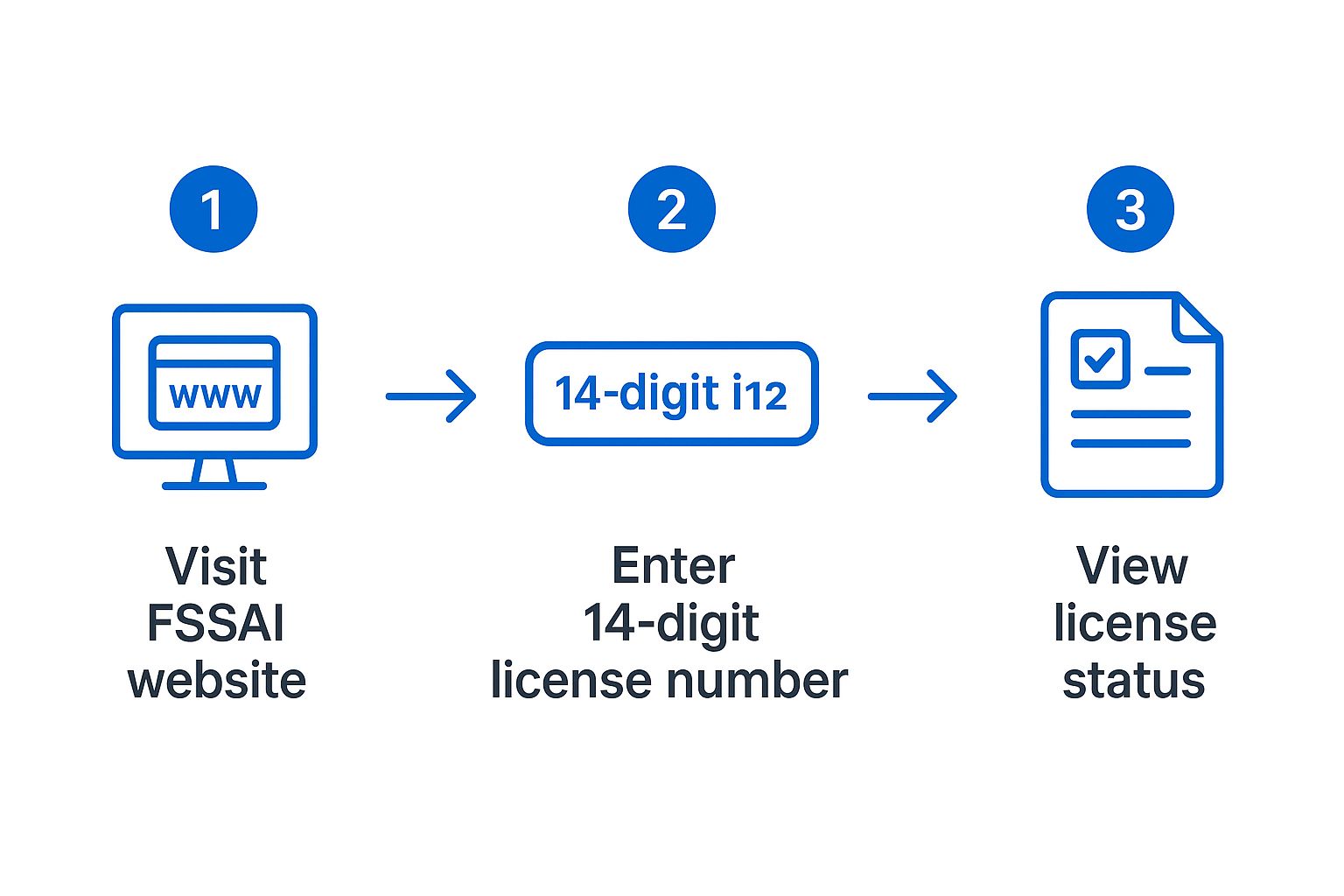
As you can see, it’s designed to be a simple path, getting you from the website to the results in just a few clicks.
Entering the Details Correctly
Once you’re on the FBO search page, you’ll find a simple form waiting for your input.
For businesses that need to run these checks regularly and in large numbers, doing it one by one quickly becomes a bottleneck. We’ve seen how integrating verification tools directly into existing systems can save a massive amount of time. If that sounds like you, exploring API integrations for background checks can be a much more scalable solution.
Pro Tip: When you’re searching by name, try a few different versions. A shop called “ABC Sweets” might be officially registered as “ABC Sweets Private Limited.” Searching for the most unique part of the name often gives you the best results.
Interpreting the Search Results
After you hit submit, the portal will show you the license status. Knowing what these terms mean is key to understanding whether the business is operating legally.
When you look up a license, the portal provides a wealth of information beyond just the status. This table breaks down what you’ll typically find.
Information You Can Find on the FoSCoS Portal
| Information Field | What It Means |
|---|---|
| FBO Name | The legally registered name of the food business operator. |
| License/Registration No. | The unique 14-digit number assigned to the FBO. |
| Address | The official registered address of the business premises. |
| Kind of Business | The type of food operation (e.g., manufacturer, retailer, caterer). |
| Product Category | The specific categories of food items the license covers. |
| Status | The current standing of the license (Active, Expired, etc.). |
| Validity | The date until which the license is valid. |
This detailed breakdown helps you confirm that you’re looking at the right business and that their license covers the products or services they are providing.
Here’s what each status means:
- Active: This is the green light. The license is valid, and the business is compliant.
- Expired: The license wasn’t renewed on time. Technically, the business is operating without a valid FSSAI license.
- Suspended: The license has been put on hold due to compliance problems. The FBO isn’t allowed to operate until the suspension is lifted.
- Cancelled: This is serious. The license has been permanently taken away, usually because of major violations.
This clear-cut system takes all the guesswork out of it, giving you a firm answer on whether a food business is legally allowed to operate.
Understanding the Three Types of FSSAI Licenses
When you’re checking an FSSAI license, it’s about more than just seeing if it’s “Active.” The real story is often in the type of license a business holds. This tells you about the scale of their operations and the level of scrutiny they should be under.
The FSSAI framework isn’t a one-size-fits-all deal. It’s smartly tiered to regulate everyone, from a local street food vendor to a massive multinational food processing giant.

This distinction is crucial. Imagine finding a large-scale manufacturer operating with only a Basic Registration. That’s a huge red flag. It could mean they’re trying to fly under the radar, avoiding the stricter compliance standards that come with their business size.
The Three Tiers of FSSAI Licensing
The whole system is broken down into three main categories. The tier a business falls into depends mostly on its annual turnover and the kind of operations it runs. Each level has its own set of rules and requirements.
- Basic FSSAI Registration: This is the entry point, designed for the smallest players in the food game. We’re talking about your local tea stalls, home-based bakers, or small retailers whose annual turnover is up to ₹12 lakh. It’s the foundational level of FSSAI compliance.
- FSSAI State License: This tier is for mid-sized businesses that have grown beyond the basic level. It covers restaurants, dairies, and manufacturers with an annual turnover between ₹12 lakh and ₹20 crore. As you’d expect, the regulations here are more stringent than the basic registration.
- FSSAI Central License: This is the top tier, reserved for the big leagues. It’s mandatory for large-scale food businesses like importers, exporters, major food chains, and manufacturers pulling in an annual turnover of over ₹20 crore. These businesses face the highest level of regulation and safety audits.
Knowing these categories adds a whole new layer to your verification process. When you check a license, you should be asking: does the license type match the business’s apparent scale? A bustling restaurant chain with multiple outlets should hold a State or even a Central license, not just a Basic Registration.
This knowledge changes the game. Your check goes from a simple yes/no verification to a much more insightful assessment of a business’s actual compliance. It gives you the power to spot discrepancies and make smarter decisions, whether you’re a customer deciding where to eat or a business vetting a new supplier.
Once you’ve looked up a business on the FoSCoS portal and the results pop up, you’re looking at more than just a simple pass or fail. That screen is packed with information that tells you the real story behind a business’s food safety compliance.
Knowing how to read these details properly is what separates a quick glance from a genuinely useful safety check. It’s about understanding the full picture.
At the heart of it all is the 14-digit FSSAI number. This isn’t just a random string of digits; it’s a structured code. Each part of that number actually means something specific about the business’s registration, location, and the year it was issued.
Decoding Key Information Fields
Beyond just the number, a few other fields need your attention. These are the details that give you the context to judge if a business is playing by the rules. Getting comfortable with these is key to doing a meaningful FSSAI license check.
- Kind of Business (KoB): This is probably the most critical field. It tells you exactly what the business is licensed to do—be it a manufacturer, distributor, simple retailer, or caterer. A mismatch here is a huge red flag.
- License Validity: An FSSAI license doesn’t last forever. It’s typically issued for a period of 1 to 5 years. Always, always check the expiry date to make sure the license is current and hasn’t lapsed.
- Product Category: This part gets specific, listing the exact types of food the business is legally allowed to handle. For example, a bakery’s license should mention bakery products. If you see it listing something completely unrelated, like meat processing, something is off.
Let’s walk through a real-world scenario. Say you look up your favourite local restaurant, and under “Kind of Business,” it only says “Retailer.” That’s a potential problem. It means they’re likely licensed to sell pre-packaged food items, but maybe not to cook and serve fresh meals. This is exactly the kind of discrepancy that should make you pause.
The real power of an FSSAI license check is in comparing what you see online with what you see in person. If the license says “Dairy Processing” but you’re standing in a fast-food joint, you’ve just spotted a major compliance issue.
A quick check on the FoSCoS portal can tell you a lot about the different stages a license might be in. Some statuses are fine, while others are clear warnings.
FSSAI License Status Meanings
This little table breaks down the common statuses you’ll encounter and what they mean for both the business and you, the consumer.
| License Status | What It Means for the Business | What It Means for the Consumer |
|---|---|---|
| Active | The license is current and valid. The business is compliant and can operate legally. | The business has met FSSAI standards. You can have a high degree of confidence in their food safety practices. |
| Expired | The license has passed its validity date. The business is operating illegally and is subject to penalties. | This is a major red flag. Avoid this business, as they are not legally compliant with food safety regulations. |
| Suspended | The license has been temporarily put on hold due to a compliance issue or investigation. | Proceed with caution. The FSSAI has found a problem serious enough to halt their operations temporarily. |
| Cancelled | The license has been permanently revoked due to severe violations of FSSAI regulations. | Do not buy from this establishment. Their license was taken away for serious safety or compliance failures. |
Understanding these statuses gives you a clear and immediate signal about whether a food business is trustworthy.
Ultimately, this kind of detailed review takes you way beyond a simple “yes, they have a license.” It gives you the power to confirm that the license they hold actually matches the food they’re selling, ensuring they’re following the right safety rules for their specific operation.
Troubleshooting Common FSSAI Check Issues
So, you’ve tried to check an FSSAI license and hit a wall. It happens more often than you’d think, but don’t worry—the fix is usually pretty simple. If your first search comes up empty, a few small tweaks to your approach can make all the difference.

The most common error you’ll see is “License Number Not Found.” Before you assume the worst, take a breath and double-check the 14-digit number for typos. It’s incredibly easy to mix up a ‘0’ with an ‘O’ or accidentally swap a couple of digits.
Another frequent problem is searching by the business name and getting zero results. This usually happens because the brand name you see on the storefront isn’t the same as its registered legal name. For instance, a local café you know as “Sunrise Brews” might be legally registered as “S.R.B. Hospitality Private Limited.”
Effective Search Strategies
When your first attempt fails, it’s time to get a bit creative. Don’t just keep entering the same information and expecting a different outcome.
- Vary the Name: Instead of the full name on the sign, try searching for just the most unique part. In our example, just “Sunrise Brews” might work.
- Use the Address Search: If you know the physical location of the business, switch over to the address search function. It’s a solid backup plan, though be prepared to sift through a few results if there are multiple businesses in the same building or area.
- Check for Old Numbers: Sometimes, businesses accidentally display an old or expired license number on their packaging or premises. If you can, it’s always best to ask them for their current one.
If you do find a license but the details look outdated or just plain wrong, that’s a major red flag. And if you have a strong reason to believe a business is operating with a fake or nonexistent license, you have a civic responsibility to report it.
Important: If you suspect a food business is non-compliant or using a fraudulent FSSAI number, you can—and should—report it directly through the FSSAI’s consumer grievance portal. This is how authorities stay informed and take action on food safety violations.
By working through these troubleshooting steps methodically, you can usually push past the common roadblocks and find the accurate information you’re looking for.
Got Questions About FSSAI Verification? We’ve Got Answers
Let’s tackle some of the common queries that pop up when you’re trying to check an FSSAI license. Here are some quick, clear answers to help you navigate the process like a pro.
How Often Should I Check a Business’s License?
For businesses, verifying a supplier’s FSSAI status is non-negotiable. You should do it before signing any contract and then periodically after that—an annual check is a good rule of thumb.
If you’re a consumer, a quick check before trying a new restaurant or buying from a new brand is a smart move. It’s a simple way to ensure you’re making safe choices for yourself and your family.
What if a Business Refuses to Show Their License Number?
This is a major red flag. A legitimate food business operator is legally required to display their 14-digit FSSAI license number prominently on their premises and packaging.
A refusal to share it likely means they’re operating without a valid license. In that case, it’s best to walk away from their products or services.
The FSSAI mandates this display for a reason: it empowers consumers to perform their own independent checks. This transparency is a cornerstone of public food safety and helps weed out fraudulent operations.
Penalties for not displaying or renewing a license can be severe, including hefty fines or even having the license cancelled altogether. As background verification becomes standard in sectors like fintech, these same principles of transparency are vital for building trust. You can learn more about the importance of compliance for Fintech companies in India. These data-driven policies are crucial for maintaining high standards across the board. For a closer look, you can explore official statistics on FSSAI penalties and license actions.
At SpringVerify, we understand that thorough verification builds trust and ensures compliance. Our background screening services provide the confidence you need to make informed hiring decisions, securely and efficiently. Discover how SpringVerify can protect your business.


