

So, how does a background verification actually work? It’s not just a quick phone call anymore. These days, it’s a detailed investigation that relies heavily on technology and direct database integrations to confirm a candidate’s identity, qualifications, and past history.
Modern verification has moved past simple reference checks, using digital tools to deliver speed and, most importantly, accuracy.
Table of Contents
The Modern Background Verification Process Explained
Think of a background check as piecing together a puzzle to build a complete, trustworthy profile of a potential hire. It’s a multi-stage journey that verifies everything from a person’s legal identity to their professional experience and educational claims. The whole point is to make sure the person you’re about to bring into your organisation is exactly who they say they are.
The entire process is built on a foundation of trust and legality, which means it always starts with getting explicit consent from the candidate. Once that’s secured, the real work begins, branching out into several critical checks. Each part of the process is designed to give you a clearer picture and help you avoid specific hiring risks.
Core Components of a Modern Check
The verification journey usually follows a logical path, starting with the basics and then digging deeper into more detailed validations.
- Identity Verification: This is always the starting point and arguably the most important step. We’re talking about confirming the candidate is who they say they are by validating official documents like an Aadhaar or PAN card against government databases. Without this, the rest of the checks are pointless.
- Criminal Record Screening: This is a non-negotiable for many roles, especially those involving security, finance, or vulnerable people. This check scours court and police records to uncover any criminal history that could pose a risk to your organisation.
- Employment and Education Validation: This is where we confirm the accuracy of a candidate’s resume. It involves reaching out directly to past employers and educational institutions to verify job tenures, roles held, degrees earned, and other qualifications. It’s amazing what you sometimes find.
This infographic lays out the typical flow, showing how the different checks build upon one another.
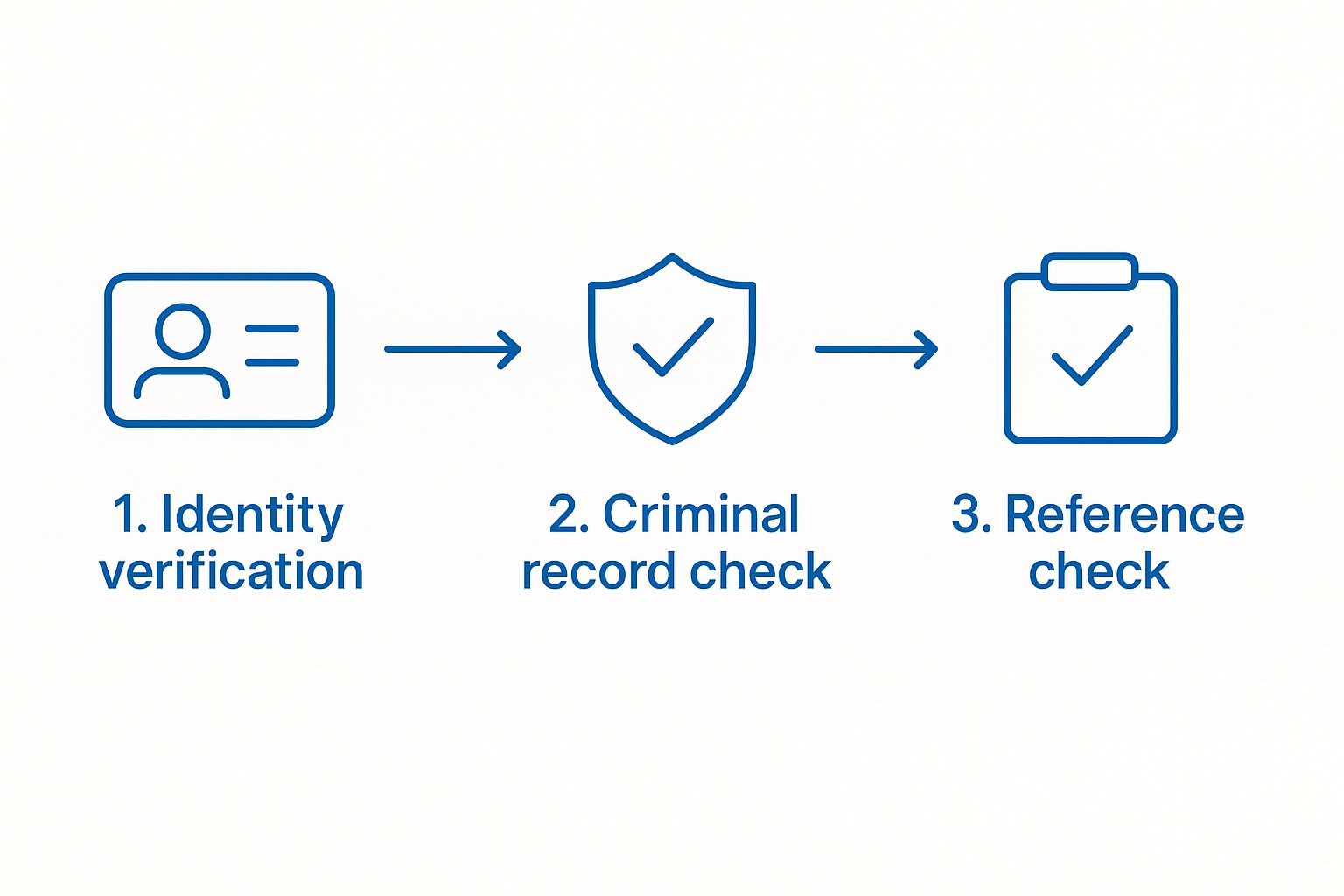
As you can see, a solid process always starts with identity and then broadens to cover criminal and professional histories.
A common myth I hear is that background checks are slow and bureaucratic. While that might have been true a decade ago, technology has completely changed the game.
What used to take 7 to 15 days has been massively accelerated. With today’s digital platforms, AI, and API integrations, background verification in India can now complete over 70% of verifications within just 48 hours, especially for key documents like Aadhaar and PAN cards. If you’re interested in the tech behind this, you can discover more insights about this accelerated process on ongrid.in.
To give you a bird’s-eye view, the table below breaks down the key stages and what each one sets out to achieve.
Key Stages of a Background Verification
This table summarises the core components of a typical background verification process and what each stage aims to achieve.
| Verification Stage | Objective | Common Methods |
|---|---|---|
| Identity Verification | To confirm the candidate’s legal name, age, and address are authentic. | API validation of Aadhaar, PAN card, and Voter ID. |
| Criminal Record Check | To identify any past criminal convictions or pending court cases. | Searching district, state, and national court record databases. |
| Employment History | To validate past job roles, tenures, and reasons for leaving. | Direct communication with previous employers’ HR departments. |
| Education Validation | To confirm degrees, diplomas, and other academic credentials. | Contacting university or board registrars for verification. |
Each of these stages provides a crucial piece of the puzzle, helping you build a comprehensive and reliable picture of your candidate before making a final hiring decision.
Right, let’s get into the nitty-gritty of how a background check actually kicks off. It all begins with two things that are absolutely non-negotiable: the candidate’s explicit consent and a complete set of their documents.
Think of this as the foundation of the entire process. It’s not just red tape; it’s about building trust from the very start. You can’t—and shouldn’t—start digging into someone’s past without their clear, written permission. Doing so is a major ethical misstep and a serious breach of privacy laws.
Typically, this happens right after a candidate accepts a conditional job offer. This is your cue to lay all your cards on the table. You need to be transparent about what you’ll be checking and get their formal sign-off. This simple act of communication sets a professional, respectful tone for the entire relationship.
Gathering the Paperwork
Once you have the green light, it’s time to collect the necessary documents. What you need can change depending on the seniority of the role or the specific checks you plan to run, but for most hires in India, the list is fairly standard.
You’ll almost always need:
- Identity Proof: The Aadhaar card is the go-to here. It’s the most reliable way to confirm who a person is and where they live.
- Permanent Account Number (PAN) Card: This is crucial for verifying a person’s financial identity and is often used to cross-reference other official records.
- Educational Certificates: You’ll need copies of degrees, diplomas, and mark sheets to make sure their academic qualifications are legitimate.
- Previous Employment Letters: Things like offer letters, experience certificates, or relieving letters from past employers are essential for validating their work history.
Thankfully, we’re moving past the clunky, insecure process of swapping endless email attachments. Modern HR teams now use secure digital portals or even incredibly simple tools like KYC on WhatsApp to handle this. It makes life so much easier for the candidate and drastically cuts down on admin work for your team. It’s a genuine win-win that gets the ball rolling much faster.
Why Accuracy is Everything from Day One
You might be surprised at how often the information a candidate provides doesn’t quite line up with the official records. It’s not a rare occurrence.
For example, a report from the verification platform OnGrid revealed they handled over 5 million verification cases in a single fiscal year. Out of that huge number, a significant 7.2% of individuals had at least one discrepancy that caused a check to fail. This just goes to show how vital it is to verify every detail. You can read more about these common discrepancies in candidate profiles.
From my experience, the document collection stage is your first real chance to catch a potential red flag. If a candidate is hesitant to provide certain documents or keeps submitting incomplete files, it might be an early sign that something isn’t quite right.
To avoid delays, clear communication is your best friend. Give your candidates a straightforward checklist and dead-simple instructions for uploading their documents. This small step ensures you get everything you need on time, allowing the rest of the verification process to run like a well-oiled machine.
Verifying Identity and Screening for Criminal Records

Once all the candidate’s documents are in, the real work begins. This is the part of the process where we move beyond what a candidate has told us and start verifying the facts. We’re essentially asking two critical questions: Is this person really who they say they are, and does their past hold any risks for our organisation?
First, we tackle identity verification. This isn’t just about looking at a picture on an Aadhaar or PAN card. True verification involves tapping directly into official government databases via secure APIs. This gives us an instant, automated confirmation that the name, photo, and birth date on the document are an exact match with the government’s records.
This initial check is the foundation for everything else. If the details don’t line up, every other claim the candidate has made is immediately cast into doubt. You can’t build a trustworthy hire on a shaky identity.
Diving into Criminal Record Screening
With identity confirmed, we shift our focus to the more sensitive task of criminal record screening. This isn’t just one search; it’s a comprehensive sweep of court and police records across multiple jurisdictions in India. You have to be thorough because a clean slate in one state doesn’t mean a clean slate everywhere else.
Our screening process digs through a massive network of legal databases, looking for any history of criminal cases. We’re specifically searching for:
- Convictions: Final judgements where the person was found guilty.
- Pending Cases: Active legal matters that are still working their way through the courts.
- Warrants: Any outstanding orders for arrest.
This multi-pronged approach helps us build a complete picture of an individual’s legal standing, leaving no stone unturned.
One thing people often get wrong is thinking all court records are the same. A key part of doing background verification right is knowing the difference between a civil and a criminal case. A property dispute is a world away from a criminal charge like theft.
This distinction is crucial. A trained verification analyst will look at the nature of any record we find and weigh its relevance to the job. For instance, a minor traffic fine from five years ago is probably meaningless for an office worker, but a history of fraud is a huge red flag for anyone being hired into a finance role.
Why This Scrutiny Is Essential
Think about what’s at stake. For any role that involves handling company funds, customer data, or working with vulnerable people like children, a deep criminal check is absolutely essential. It’s one of the most powerful tools you have for managing risk.
Imagine a fintech company hires a new accounts manager without a proper check. If that person has an undisclosed history of financial misconduct, they are now in a prime position to cause immense damage—leading to huge financial losses and ruining the company’s reputation. This is exactly the kind of preventable disaster that proper screening helps you avoid. If you want to get into the nuts and bolts of the process, our guide on comprehensive identity verification breaks it down even further.
Ultimately, these two checks—identity and criminal—work hand-in-hand to answer a simple but profound question: Is this person who they claim to be, and can we trust them?
Once you’ve confirmed a candidate is who they say they are, the real detective work begins. This next phase is all about digging into their professional and academic claims, which is where we often find the most significant red flags.
Think of a resume less as a factual document and more as a marketing pitch. It’s our job to treat every claim on it as something that needs to be independently proven.
Getting the Real Story on Employment History
Verifying a candidate’s work history is far more involved than a simple phone call. It’s a methodical process where we contact the Human Resources departments of their previous employers to get concrete, specific answers.
When we reach out, we’re not just looking for a thumbs-up. We have a precise checklist to validate against the CV.
- Employment Dates: We pin down the exact start and end dates. It’s amazing how often a slight “stretch” of a few months is used to cover up an employment gap or a job they only held for a very short time.
- Job Title: We confirm their official designation. Someone who listed “Project Lead” on their resume might have officially been an “Associate,” which paints a very different picture of their actual responsibilities and experience.
- Reason for Leaving: This can be tricky, as not all companies will share details. However, we always ask a key question: “Is this individual eligible for rehire?” The answer to that speaks volumes.
This structured approach is crucial. As our in-depth guide to employment history verification explains, these checks give you a much clearer, more honest view of a candidate’s career path.
From my experience, the biggest headache isn’t just fudged dates anymore; it’s entirely fake companies. I’ve seen candidates submit polished experience letters from businesses that only exist on paper, complete with a slick website and a friend on standby to act as the “manager” on a verification call.
To catch this, we’ve had to get smarter. We now cross-reference company details with official business registries like the Ministry of Corporate Affairs (MCA) to confirm a company is legitimate. In more suspicious cases, a physical address check might be the only way to expose a “ghost” company.
Validating Educational Credentials
It’s the same story with education. Simply accepting a scanned copy of a degree certificate just doesn’t cut it.
The only way to be certain is to go directly to the source. Our team contacts the registrar’s office at the university or educational board to confirm the degree’s authenticity, the specific course completed, and the year of graduation. This direct confirmation is non-negotiable.
You’d be surprised how common fake degrees are. We’ve seen everything from candidates claiming qualifications from universities that don’t even exist to highly sophisticated forgeries of certificates from prestigious institutions.
The numbers back this up. An eye-opening study by Ernst & Young (EY) found that among profiles with discrepancies, a massive 85% involved mismatches in employment history. Even more alarming, the study revealed that 32% of candidates in the IT sector had submitted fake documents from fabricated companies. It’s a clear signal that strong, tech-driven checks are more important than ever. You can read more about these findings and the need for tech-enabled vigilance in hiring.
Ultimately, you can’t afford to skip these meticulous checks. They are the only reliable way to ensure you’re bringing genuinely qualified talent on board and protecting your company from the high cost of a bad hire.
Reviewing the Final Report and Making a Decision

After all the individual checks are done—ID, criminal records, employment, and education—everything gets pulled together into a single, comprehensive report. This is the moment of truth. It’s where all the verified data lands on your desk to help you make a solid hiring decision. But let’s be honest, a massive data dump isn’t what you need. The real value is in how that information is presented.
We’ve found that the best verification platforms know that hiring managers are juggling a dozen things at once. That’s why modern reports often use a simple, visual system to show the results at a glance. It’s a lot like a traffic light.
- Green: This is the best-case scenario. It means everything the candidate told you has checked out, and there are no red flags to worry about. It’s the all-clear you were hoping for.
- Amber: This signals a minor issue that needs a second look. Maybe there’s a small discrepancy in employment dates, or a reference couldn’t be reached. It’s not necessarily a deal-breaker, but it does mean you’ll need to investigate a bit further.
- Red: This is a major warning. It points to a significant problem, like a fake degree, a serious undisclosed criminal conviction, or a completely fabricated job on their resume. A red flag demands serious attention.
This traffic light system immediately cuts through the complexity, letting you see the risk level straight away and decide where to focus. An amber flag on a job title, for example, might be cleared up with a quick chat. A red flag on a criminal check? That’s a much more serious conversation.
Streamlining Decisions With API Integration
For companies hiring in large volumes, kicking off checks and downloading reports one by one is a huge time sink. This is where an API integration really makes a difference.
Modern verification services like SpringVerify can plug directly into your Applicant Tracking System (ATS) or other HR software, creating a smooth, automated process.
Imagine this: you initiate a background check with one click inside your ATS. Once it’s complete, the final report—with its clear green, amber, or red status—pops up right on the candidate’s profile. No more toggling between systems, downloading PDFs, or manually updating records.
This kind of automation isn’t just about saving time. It dramatically cuts down on human error, keeps the process consistent for every single candidate, and ultimately shrinks your time-to-hire.
Making the Final Call
When you’re looking at a report, especially one with amber or red flags, context is everything. It’s so important to have clear internal policies that guide how you make these decisions. Your policies need to be fair, applied consistently, and, of course, legally sound.
Understanding your legal responsibilities is non-negotiable. To make sure your process is both effective and lawful, it’s a good idea to familiarise yourself with the essentials of background check compliance in India.
Ultimately, the final report is more than just data; it’s a powerful tool. It provides the actionable intelligence you need to move forward, helping you build a trustworthy and skilled team with complete confidence.
Answering Your Top Questions About Background Verification
It’s natural to have questions when you’re navigating the background verification process, whether you’re an employer or a prospective employee. Getting straight answers is the first step towards a process that’s smooth, transparent, and fair for everyone. Let’s break down some of the most common questions we hear about how background verification works in India.
How Long Does a Background Check Actually Take?
This is usually the first thing on everyone’s mind. Traditionally, a thorough background check could stretch out, often taking anywhere from 7 to 15 days. The biggest delays usually came from waiting on third parties, like universities or past employers, to get back with the required information.
Thankfully, things have changed. Modern digital platforms have dramatically sped up the process. By tapping directly into government databases through APIs and using smart, AI-driven tools, many critical checks—like identity and address verification—can now be wrapped up within 48 hours. The final timeline still depends on how deep the check goes and how responsive those external sources are.
What Happens if a Discrepancy Shows Up?
Finding a discrepancy doesn’t automatically mean the end of the road. It really comes down to the nature of the issue. Most verification services use a simple traffic light system to classify findings.
- Amber Flag (Minor Issue): Think of this as a small inconsistency, maybe a start or end date for a previous job that’s off by a few weeks. In this case, the employer will usually just reach out to you for a quick clarification or ask for another document to clear things up.
- Red Flag (Major Issue): This is the serious stuff. We’re talking about a fake degree, a criminal record that wasn’t disclosed, or a previous employer that never existed. A major red flag like this almost always results in the job offer being withdrawn because it breaks that fundamental layer of trust.
The best policy for any candidate is honesty. Most companies have a clear process for handling discrepancies, but being upfront from the start prevents major issues down the line.
Is Candidate Consent Mandatory for a Background Check?
Yes, one hundred percent. In India, getting explicit, written consent from a candidate before initiating a background check isn’t just good practice—it’s a legal and ethical must-have. This step ensures the whole process is transparent and respects the individual’s privacy.
Running a check without the candidate’s permission is a major violation of privacy laws. The consent form itself should clearly outline exactly what parts of their background will be reviewed.
What Are the Most Common Red Flags You See?
While a red flag can pop up in any part of a check, some issues are far more common than others. Drawing from industry data and our own experience at SpringVerify, we consistently see a few key problem areas.
- Employment History Mismatches: This is the big one. It covers a wide range of issues, from slightly inflated job titles and fudged employment dates to roles that were completely made up.
- Fake Educational Documents: Claiming a degree or certificate from a non-existent university or an unaccredited institution is a surprisingly frequent and serious issue.
- Undisclosed Criminal Records: Failing to be transparent about a past criminal conviction is a major red flag for obvious reasons and can have serious implications for the role.
Knowing about these common pitfalls helps everyone—both employers and genuine candidates—understand why a detailed verification process is so crucial for building a foundation of trust.
Ready to make your hiring process faster, safer, and more reliable? With SpringVerify, you can automate checks, get accurate results quickly, and integrate seamlessly with your existing HR tools. Discover how our tailored verification solutions can help you build a trustworthy team with confidence. Learn more about SpringVerify.


