

In India, most companies don’t handle background checks themselves. Instead, they team up with specialised third-party verification agencies. These partners do the legwork, digging into a candidate’s credentials across key areas like their employment history, educational qualifications, criminal records, and permanent address. This entire process is about reducing the risks that come with hiring and making sure trustworthy people are joining the team.
Table of Contents
Why Background Checks Are Now Standard Practice in India

Before we get into the nitty-gritty of how these verifications happen, it’s worth understanding why they’ve become so essential in the Indian hiring scene. The biggest reason? Résumé fraud. Misrepresented credentials are a massive problem, leading to bad hires, financial hits, and damage to a company’s reputation.
A background check isn’t just a box to tick anymore; it’s a fundamental business practice for building a company on a foundation of trust. Companies have come to realise that every employee is an investment, and verifying their background is just smart asset protection.
The Business Case for Verification
For businesses in India, the logic for running thorough background checks is crystal clear. It’s not just about catching lies; it’s about being proactive and managing risk from day one.
Here’s what it boils down to:
- Dodging Costly Hiring Mistakes: A bad hire costs more than just a salary. Verification helps you weed out candidates with made-up qualifications or a troubling work history, so you end up with reliable, qualified people.
- Protecting Your Brand: Hiring someone with an undisclosed criminal past or a history of fraud can explode into a legal and PR nightmare. It’s a risk no company wants to take.
- Keeping the Workplace Safe: For any role that handles sensitive data, money, or involves working with the public, confirming a candidate’s background is non-negotiable. It’s a basic step to ensure a secure environment for everyone.
- Building a Culture of Honesty: When every single new hire goes through the same vetting process, it sends a powerful message. It tells everyone that your organisation values integrity and transparency right from the start.
A thorough background check isn’t about suspicion; it’s about due diligence. It establishes a baseline of trust that is essential for any successful employer-employee relationship, safeguarding both the company’s interests and the integrity of its existing team.
Ultimately, to understand how companies do background checks in India, you first have to appreciate their strategic role. They are a crucial tool for making smart, informed hiring decisions in a market that’s more competitive and complex than ever.
Navigating the Legal Rules for Background Screening
Conducting a background check in India isn’t as simple as just deciding to do one; it’s a process governed by a growing body of privacy laws. The foundational principle for any legally sound verification is explicit candidate consent. Without this, you cannot proceed.
Before you even think about verifying a single detail, you must get clear, written permission from the candidate. This isn’t just a formality—it’s a hard legal requirement. The consent form needs to be crystal clear, spelling out exactly what information you’ll be collecting, why you need it, and how it will factor into the hiring decision.
Think of this document as your legal basis for processing their personal data. It sets the stage for a transparent, trustworthy relationship right from the get-go.
Understanding Data Privacy Obligations
The Digital Personal Data Protection (DPDP) Act has significantly reshaped how companies must handle candidate information. This legislation places strict responsibilities on employers to protect the personal data they gather during screening. One of the core principles is data minimisation—you should only collect information that is absolutely necessary for the specific job role.
For example, running a credit check on a software developer might be seen as excessive. But for a senior finance position? It’s perfectly reasonable. The bottom line is you must be able to justify every single piece of data you collect.
On top of that, the DPDP Act mandates secure storage and sets clear retention periods. You can’t just hang onto candidate data forever.
The core idea behind these regulations is to balance a company’s need for due diligence with an individual’s fundamental right to privacy. A compliant background check process respects both, building trust while mitigating hiring risks.
Working with Third-Party Verifiers
Most companies in India don’t run background checks in-house; they partner with specialised agencies. When you do this, you’re not outsourcing your legal responsibility. You’re still the one on the hook for how your candidate’s data is handled.
This is where a Data Processing Agreement (DPA) is non-negotiable. A DPA is a legally binding contract between you and your verification partner that details their data protection obligations. It ensures they follow the same strict privacy standards you’re bound by. For a deeper dive, check out our detailed guide on background check compliance.
The legal landscape here is always evolving to better protect candidate data. By 2025, compliance will demand explicit consent, purpose limitation, and defined data storage periods—typically three years for general roles and five for regulated industries. All sensitive data must be transferred over encrypted channels and stored in DPDP-compliant data centres, with access strictly limited to authorised personnel. You can learn more about the essentials of background check compliance in India on zellascreenings.com.
Ultimately, a well-structured, legally sound screening process does more than just tick a box. It shows that your company is committed to ethical practices and respects individual privacy—a powerful way to attract top talent.
The Key Components of a Thorough Background Check
So, what are companies really looking at when they run a background check? It’s not just one single action. Think of it as a collection of different verifications, each one designed to confirm a specific claim on a candidate’s CV. A standard screening package in India is built around a few core pillars that, together, paint an accurate picture of a candidate’s history and qualifications.
Getting a handle on these individual checks is key. It shows you exactly how companies do background checks in India—by putting together a targeted and relevant screening strategy. Not every role needs every possible check, of course. The secret is to match the verification to the job’s actual responsibilities.
Criminal Record Verification
This is often the first and most critical step for ensuring a safe workplace. Verifiers scan a whole host of databases to check for any criminal history linked to the candidate.
The search typically involves:
- Court Records: Sifting through district, high court, and Supreme Court records for any civil or criminal cases.
- Police Databases: Checking local police station records in the areas where the candidate has lived.
This verification is non-negotiable for roles involving public interaction, security, or access to sensitive company data. It’s a fundamental part of mitigating risks before they walk through your door.
Employment and Education History Verification
These two are the bread and butter of any background check. They validate a candidate’s professional and academic claims, and you’d be surprised how often discrepancies pop up here. Even small ones can be major red flags.
With employment history verification, the process is straightforward. Verifiers get in touch with the HR departments of past employers listed on the CV to confirm details like:
- Tenure (start and end dates)
- Job title or designation
- Reason for leaving
Similarly, education verification involves contacting the registrar’s office of the university or college the candidate says they attended. The goal is simple: confirm the degree, the specialisation, and the graduation year. It’s a basic step, but it’s vital for weeding out candidates with fake or inflated qualifications. For a closer look, you can explore a detailed guide on https://in.springverify.com/screenings/employment-verification/.
You might wonder if these checks are really that important. Well, in the 2024-25 fiscal year, a shocking 3,60,000 individuals in India failed at least one part of their background check. That number alone shows the sheer scale of misrepresentation out there and explains why companies are doubling down on their screening efforts.
A background check isn’t just about catching lies; it’s about confirming competence. Making sure a candidate has the experience and education they claim is the first step toward building a capable and effective team.
A background check is more than just a formality; it’s a strategic tool for making informed hiring decisions. The table below breaks down the most common types of verifications conducted in India, giving you a clear picture of what each check entails and why it’s important.
Common Background Verification Checks in India
| Verification Type | Purpose | What is Checked |
|---|---|---|
| Criminal Record Check | To ensure workplace safety and mitigate risks of misconduct. | Court records (District, High, Supreme), police station databases for any past civil or criminal cases. |
| Employment History | To validate professional experience and claims made on the CV. | Job title, tenure (start/end dates), reason for leaving, confirmed via past employers’ HR departments. |
| Education Qualification | To confirm academic credentials and prevent hiring based on fraudulent qualifications. | Degree awarded, specialisation, year of graduation, confirmed with the respective university or college. |
| Address Verification | To verify a candidate’s identity and current or permanent place of residence. | Physical visit by a field agent or digital verification using official proof of address documents. |
| Reference Check | To gain qualitative insights into a candidate’s skills, character, and work ethic. | Conversations with professional references provided by the candidate (e.g., former managers, colleagues). |
| Global Database & Credit Scan | To assess financial responsibility and check for high-risk profiles. | International sanctions lists, watchlists, and credit history reports (for finance-related roles). |
By selecting the right combination of these checks, you can tailor your screening process to fit the specific needs of each role, ensuring you hire with confidence every time.
Address and Specialised Checks
Address verification confirms where a candidate actually lives. This can be done the old-fashioned way with a physical visit from a field agent or digitally, using validated proof of address documents. It’s a foundational check for identity verification and often a must-have for legal and compliance reasons.
Beyond these core components, companies often add specialised checks depending on the role’s seniority or sensitivity. These can include:
- Global Database Search: Scans international watchlists and sanctions lists for high-risk individuals.
- Credit History Review: Essential for roles in finance or accounting to assess an individual’s financial responsibility.
- Reference Checks: Involves speaking directly with professional references to get real, qualitative insights into a candidate’s performance and character.
If you’re looking to get the most out of this particular step, it helps in understanding the steps for a thorough reference check. By carefully mixing and matching these verifications, employers can build a robust screening package that aligns with their risk tolerance and lets them hire with complete confidence.
The Verification Process from Start to Finish
Once you’ve made a conditional job offer, the real work of the background check begins. Think of it as a structured journey: it starts with gathering data, moves through a methodical series of verifications, and ends with a clear report that gives you a full picture of your candidate.
It all kicks off the moment the candidate gives their consent and submits their documents. That’s the green light for your verification partner to start digging into the candidate’s professional and personal history. Each check runs on its own timeline, but they all come together in the final, comprehensive report.
This visual breaks down the core stages of a typical background check in India, from the first application right through to the final decision.
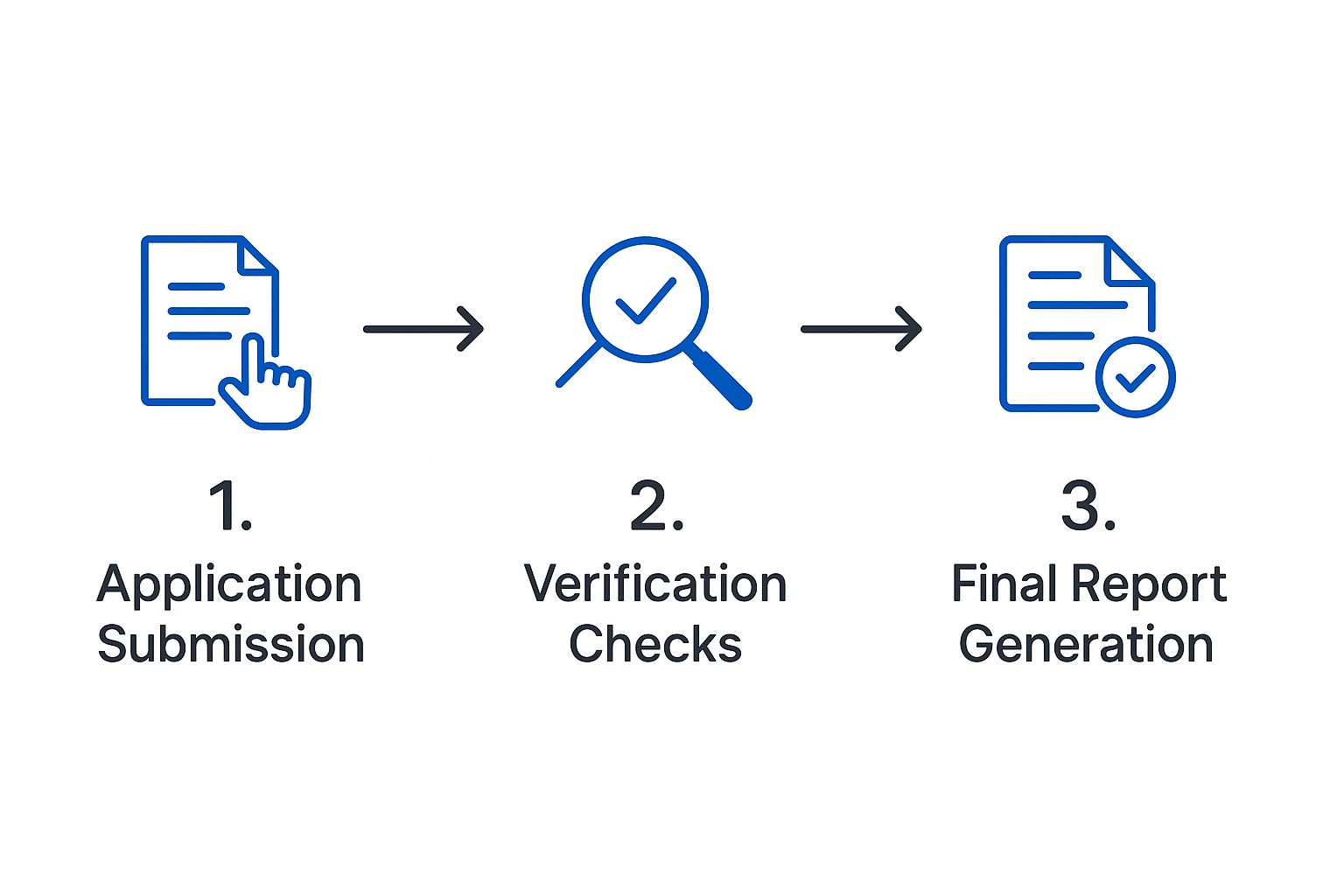
As you can see, the process is a logical progression. Each step builds on the last to make sure the outcome is both thorough and reliable.
Initiating and Executing the Checks
With the candidate’s signed consent form and necessary documents—like degree certificates and proof of address—in hand, the verification agency gets down to business. This isn’t just one single action; it’s a series of parallel investigations, each moving at its own pace.
For example, checking a candidate’s employment history means reaching out to the HR departments of their previous companies. This is usually handled over email or a dedicated portal, but sometimes a follow-up call is needed to get the job done. The goal is simple: confirm the candidate’s tenure, designation, and reason for leaving.
At the same time, the education verification gets underway. This involves contacting the registrar’s or administrative office of the university or college they listed. While many Indian institutions have shifted to digital verification platforms, some still rely on manual outreach, which can definitely stretch the turnaround time.
Criminal record checks are another critical piece of the puzzle. Verifiers access digitised court records and coordinate with local police authorities in the areas where the candidate has lived. Address verification is often the most “boots-on-the-ground” part of the process, sometimes requiring a field agent to physically visit the location to confirm the candidate actually resides there.
Compiling the Final Report
As each check wraps up, the findings are pulled together into one consolidated report. This isn’t just a raw data dump. A good report is an organised summary designed so that HR managers can grasp the key takeaways quickly and easily. In India, you can typically expect a standard set of checks to take anywhere from 5 to 15 working days, depending on how complex the case is and how responsive the various institutions are.
The final report is the culmination of the entire process. Its clarity and accuracy are what empower HR teams to make confident, informed, and fair hiring decisions without getting bogged down in the details.
To make things even simpler, it’s common industry practice to use a colour-coded system to classify the results:
- Green: Everything checks out. All the information the candidate provided has been verified with no issues.
- Amber: Minor discrepancies were found. This could be a small mismatch in employment dates or a job title that doesn’t quite line up. These cases usually just need a bit of clarification from the candidate.
- Red: A major discrepancy or a serious negative finding has come to light. This could be anything from a fake degree to an undisclosed criminal record.
This system lets HR teams see the risk level at a glance and decide on the next steps, turning the complex process of a background check into a systematic journey that leads to a clear, actionable outcome.
How to Handle Discrepancies and Red Flags

Let’s be realistic—not every background check report is going to come back perfectly “Green.” When you see an ‘Amber’ or ‘Red’ flag, it’s a critical moment. Your next move needs to be guided by a clear, fair, and consistent process.
Jumping to conclusions is the worst thing you can do. You might lose a fantastic candidate over a simple misunderstanding, or even worse, land your company in legal trouble.
The very first step? Pause. Take a breath and actually evaluate what the discrepancy is. There’s a world of difference between a minor slip-up and a serious red flag, and your response has to be proportional.
From experience, the most professional and ethical path is to give the candidate a chance to respond. Mistakes are more common than you’d think—HR departments can give out the wrong dates, or old university records might have errors. By opening up a dialogue, you’re not just being fair; you’re gathering the full context you need to make a smart decision.
Differentiating Minor Issues from Major Red Flags
Getting a handle on the severity of a discrepancy is everything. Not all issues are created equal, and your company’s reaction needs to reflect that. Nailing this part is a crucial element of how companies do background checks in India the right way.
Minor issues are often just administrative hiccups. Think things like:
- Slight Date Mismatches: The candidate says they left a job in June, but their former employer’s records show it was May.
- Job Title Variations: They used a common internal title like “Project Lead” on their resume, but the official HR record calls them a “Senior Software Engineer.”
Major red flags, on the other hand, are a different beast entirely. They are far more serious and often point to deliberate deception. These demand immediate and careful handling.
Serious red flags usually fall into these categories:
- Fake Degrees: The verification comes back showing the candidate never attended or graduated from the university they claimed.
- Undisclosed Criminal Convictions: The check uncovers a criminal record that’s directly relevant to the job’s duties.
- Falsified Employment: The candidate claims to have worked for a company that has zero record of them ever being there.
The goal isn’t to play ‘gotcha’ with candidates. It’s about verifying the information they’ve provided. Always approach discrepancies with a mindset of clarification before you jump to conclusions. This protects the candidate’s rights and, just as importantly, your company’s reputation.
Industry Context and Decision-Making
How you react to a red flag often comes down to your industry. A financial services firm, for instance, is going to have zero tolerance for any history of financial fraud. It’s an immediate deal-breaker.
Conversely, a minor criminal offence from a decade ago might be overlooked in a creative agency but could be an absolute no-go for a teaching position.
Employment fraud is still a huge problem across key Indian sectors. A recent analysis found that a staggering 83% of healthcare professionals who failed checks did so because of faked educational qualifications. In the financial services world, 88% of offenders were experienced employees, not freshers. This just underscores the need for constant, tech-enabled vigilance in hiring. You can learn more about how rising fraud risks are shaping hiring practices in India on ey.com.
Ultimately, your final decision should always circle back to a pre-defined company policy. This ensures every candidate is treated with the same fairness and consistency. Make sure you document every single step of the process—from flagging the issue to the final decision—to keep a clear and defensible record.
Common Questions About Background Checks in India
The background verification process can feel like a bit of a black box, leaving both employers and candidates with a lot of questions. How long does this whole thing actually take? Is it even legal for a company to poke around my university records?
Getting clear on these points makes the entire hiring journey a lot less stressful and way more transparent for everyone. It helps candidates know their rights and lets employers set realistic expectations from the get-go.
How Long Does a Background Check Usually Take in India?
This is easily the most common question we get. While there’s no single magic number, a standard set of verifications in India typically wraps up anywhere from 5 to 15 working days.
But that timeline can stretch or shrink based on a few key things:
- The Types of Checks: A quick address and ID verification is worlds away from a deep dive that involves digging into multiple past jobs and university records.
- How Fast Institutions Respond: Some universities or previous employers are on the ball and reply in hours. Others, especially government bodies, might take days or even weeks to get back to a verification request.
- The Candidate’s History: Someone with a complex work history—think multiple short-term roles across different cities—will naturally take longer to verify than a candidate with a more straightforward career path.
For employers, the big takeaway is to build this buffer into your hiring timeline. For candidates, remember that a short delay isn’t a red flag. A thorough and accurate check just takes time.
Can a Company Really Verify My University Degree?
Yes, absolutely. Education verification is a completely standard and legal part of the background check process, as long as the company has your written consent to do it. With nearly 80% of applicants admitting they’d consider fudging something on their résumé, you can see why companies are so diligent about this. Educational credentials are a prime target for this kind of falsification.
The process is pretty direct. A company or their verification partner will contact the registrar’s office of the college or university you listed. They’ll provide your name (including any previous names, like a maiden name), the dates you attended, and the degree you claim to have. The institution simply confirms if their records line up. It’s a straightforward way to make sure a hiring decision isn’t based on a fake degree.
What Happens if I Have a Criminal Record?
Finding a criminal record doesn’t mean an automatic rejection. What really matters is the context. Companies in India will look at the nature of the offence, when it happened, and how relevant it is to the job you’re applying for.
For instance, a minor traffic violation from five years ago is highly unlikely to affect your chances for a software developer role. But a conviction for financial fraud? That would be a massive red flag for any job in the banking or finance industry. The final call always comes down to a risk assessment based on the specific role.
Navigating the ins and outs of background checks is fundamental to building a team you can trust. SpringVerify offers fast, reliable, and fully compliant verification services, giving you the confidence to make the right hiring decisions. Find out how SpringVerify can streamline your hiring process today.


