

Hiring isn’t just about finding someone with the right skills anymore. It’s about building a team you can trust. That’s where a solid background check process comes in—it’s less of a single action and more of a structured workflow that mitigates risk from day one.
So, how do companies actually run these checks? Most partner with a specialised third-party, like SpringVerify, to handle the heavy lifting. The process kicks off by getting the candidate’s consent, then systematically verifies their identity, employment history, criminal records, and other crucial details. It’s a methodical way to confirm that the person you’re about to hire is exactly who they say they are.
This isn’t just about ticking boxes. It’s a non-negotiable strategy for modern businesses focused on protecting their assets, reputation, and, most importantly, their workplace culture. Each check is designed to validate a specific piece of information from a candidate’s resume, ensuring every claim is backed up by a reliable source—be it a university registrar, a past employer’s HR department, or a court database.
What Does a Standard Background Check Actually Involve?
While the exact checks can change depending on the role or industry, a thorough screening process usually covers a few core components. Each one serves a distinct purpose in painting a complete picture of a candidate.
Before we dive into the details, here’s a quick overview of the five critical checks most companies run on prospective employees and why each one is so important.
Core Components of a Standard Background Check
| Verification Type | What It Verifies | Why It Matters |
|---|---|---|
| Identity Verification | Confirms the candidate’s name, date of birth, and other personal details using government-issued IDs like Aadhaar or PAN cards. | It’s the foundational step to ensure you’re screening the right person from the very beginning. |
| Employment History | Verifies past job titles, tenures, and reasons for leaving by contacting previous employers. | This check quickly uncovers any discrepancies between a resume and a candidate’s actual work history. |
| Education Credentials | Confirms degrees, certifications, and attendance dates directly with educational institutions. | Crucial for roles requiring specific academic qualifications, this validates their educational claims. |
| Criminal Record Search | Involves searching court and police records to identify any past criminal convictions. | Helps identify red flags that could pose a potential risk to the company, its employees, or its customers. |
| Address Verification | Confirms the candidate’s current and permanent addresses through on-ground or digital checks. | This is often necessary for compliance reasons and ensures you have accurate contact information. |
Together, these verifications form a comprehensive safety net, giving you the confidence to make informed hiring decisions. Let’s break down each one.
A common misconception is that background checks are invasive. In reality, they are a professional due diligence process that requires explicit candidate consent at every stage, ensuring the entire workflow is transparent and legally compliant.
Table of Contents
Navigating the Complexities of Background Checks in India
Running background checks in India comes with a unique set of challenges you just don’t find elsewhere. It’s far from a simple database query. The process demands deep local knowledge and a meticulous, often manual, approach to get things right.
One of the biggest hurdles is the lack of a single, unified national database for criminal, educational, or employment records. Instead, all this critical information is scattered across countless government agencies, local police departments, and individual universities.
This decentralisation means verifications can be painfully slow and labour-intensive. Delays are almost a given, especially when you’re trying to get records from universities or past employers who are still stuck with manual, paper-based systems. It’s like putting together a puzzle, piece by piece, by contacting dozens of different sources.
Tackling Widespread Document Fraud
Another massive issue is the sheer volume of fraudulent documents. It’s not at all uncommon to come across counterfeit degree certificates, completely fabricated experience letters, and wildly inflated job titles. This unfortunate reality forces verification providers to go way beyond a simple confirmation call.
You need specialised expertise to spot the subtle signs of forgery. We’re talking about things like:
- Inconsistencies in document formatting or institutional logos.
- Contact information for previous employers that leads nowhere.
- Degrees from universities that are unaccredited or, in some cases, don’t even exist.
The number of discrepancies we see means that a basic check just won’t cut it. Verifiers have to actively hunt for red flags and dig deeper, turning the process into more of an investigation than a simple validation exercise.
Navigating Legal and Regional Differences
Just to add another layer of complexity, administrative procedures and regulations vary wildly from one Indian state to another. A verification process that works smoothly in Maharashtra might hit a brick wall in Tamil Nadu. Companies have to constantly adapt their strategies based on local nuances and bureaucratic quirks.
On top of that, evolving data privacy laws, particularly under the Information Technology Act, demand strict compliance. Employers must handle sensitive personal data with extreme care, ensuring they have explicit consent and follow all legal protocols to avoid hefty penalties. These factors make background checks in India both resource-intensive and legally tricky, pushing businesses to find verification experts who truly understand the local landscape. You can learn more about these verification challenges from experts in Indian employment law.
This intricate environment makes a strong case for partnering with a specialised firm like SpringVerify. Trying to navigate this terrain without expert guidance can easily lead to inaccurate results, serious compliance risks, and ultimately, bad hires. An experienced partner knows exactly how to manage these hurdles efficiently.
A Detailed Breakdown of the Verification Process
Ever wonder what actually happens behind the scenes during a background check? It’s not some mysterious black box. It’s a methodical process, moving through clear stages to confirm that a candidate is exactly who they say they are. The entire workflow is built on transparency and legal compliance, and it all starts with one crucial, non-negotiable step.
The journey always begins with explicit candidate consent. Before a single check is run, the candidate must provide clear, written authorisation. This isn’t just a courtesy; it’s a legal requirement that ensures the person is fully aware of and agrees to the process. No reputable company or third-party verifier will move forward without this signed consent.
Once that’s secured, the verification engine kicks into gear, often tackling multiple checks at once to build a complete picture.
The Core Verification Stages
The process works its way through several key areas, each providing a different piece of the puzzle. It starts with the absolute basics and then expands to create a comprehensive candidate profile.
First up is identity and address verification. This initial step confirms the candidate’s identity using government-issued documents like an Aadhaar or PAN card. At the same time, their current and permanent addresses are verified—sometimes digitally, sometimes with a physical visit—to make sure you have legitimate contact details.
From there, the focus shifts to their professional history. This means taking a close look at both their employment and educational claims to see if they line up with what’s on their CV.
This simple workflow gives you a good sense of how these pieces fit together.
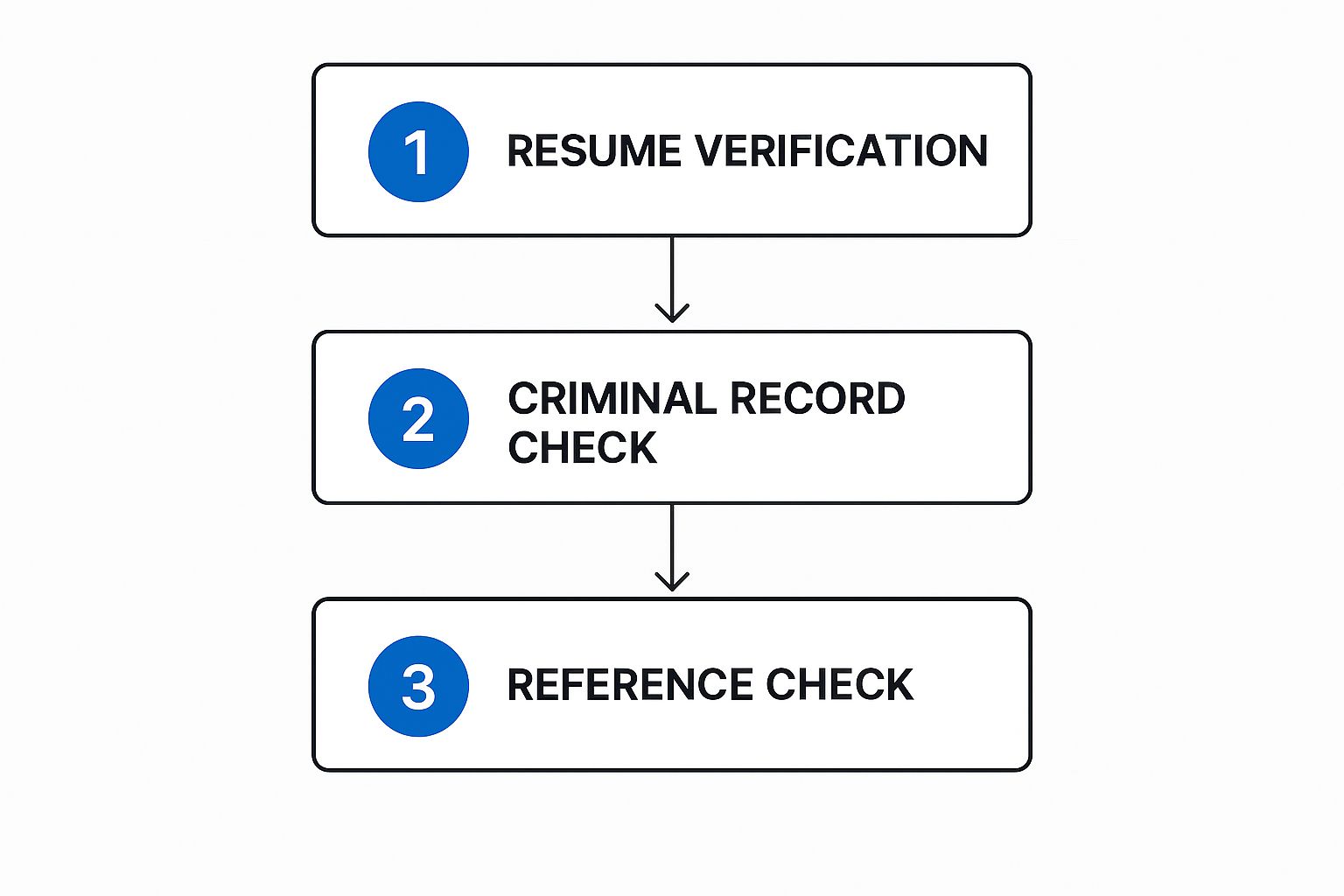
As you can see, after confirming what’s on the resume, the process widens to include legal and reputational checks for a truly well-rounded assessment.
Validating Professional and Educational Claims
Employment verification is often one of the most revealing parts of the process. Our team contacts the HR departments of the previous employers a candidate has listed. The goal here is to confirm a few key details:
- Dates of employment
- Job title or designation
- Reason for leaving
This is where discrepancies usually pop up. Maybe someone listed their title as “Senior Manager” when it was officially “Team Lead,” or perhaps they stretched their employment dates to cover a gap. If a past employer doesn’t respond, we pivot to alternative methods, like asking for salary slips or offer letters to back up their claim. To see how deep this can go, you can explore the nuances of a thorough employment verification process.
Running in parallel is education verification, which confirms academic qualifications. The team gets in touch with the registrar’s office at the candidate’s university or college to validate their degree, major, and graduation year. This is absolutely critical for roles where a specific educational background is non-negotiable.
A common hurdle we see is dealing with unresponsive institutions or discovering degrees from unaccredited “degree mills.” This is where an experienced verification partner proves its worth, using established networks to get confirmations that would be nearly impossible to get otherwise.
Finally, a criminal record check is run by searching through court databases and police records. This search is designed to identify any past convictions that could pose a risk to the workplace, helping you maintain a safe environment for everyone. Each step, from getting consent to delivering the final report, is designed to be thorough, fair, and insightful.
Why Background Checks Are More Critical Than Ever

Thinking about skipping a background check to speed things up? It’s a tempting shortcut, but the real-world consequences can be pretty severe. In today’s job market, resume discrepancies aren’t just common—they’re a growing trend that puts companies like yours at significant risk.
This shifts verification from a simple box-ticking exercise to an essential risk management tool. It’s your first and best line of defence against hiring someone unqualified, exposing your company to internal threats, or damaging the reputation you’ve worked so hard to build. Just one bad hire can poison team morale, compromise sensitive data, or lead to staggering financial loss.
Recent data paints a very clear picture. The number of candidates with fudged details on their profiles is surprisingly high, and a smaller—but far more critical—percentage have multiple red flags. This isn’t just about small exaggerations anymore; we’re seeing a pattern of manipulated documents and outright lies about past employment or education.
The Real Cost of a Bad Hire
When you hire someone based on false information, the fallout goes way beyond the initial recruitment costs. Think about the ripple effects: lost productivity as the role sits empty or is filled by an underperformer, potential legal headaches, and the toxic impact on your company culture. It’s a costly mistake, and it’s entirely preventable.
A bad hire isn’t just an HR problem; it’s a business problem. The true cost includes everything from recruitment expenses and training investments to the potential for reputational damage and legal entanglements.
This is exactly why so many companies are leaning into more thorough checks. Data from OnGrid, a major Indian verification platform, showed that in FY 2024–25, roughly 7.2% of over 5 million individuals failed at least one background check. Even more concerning, nearly 26,000 candidates had 50% or more of their checks come back with issues, pointing to significant fraudulent activity. You can dig deeper into these findings in the full OnGrid report.
Discrepancy Rates by Verification Type
Understanding where candidates are most likely to bend the truth helps companies focus their verification efforts. Certain checks consistently reveal higher rates of discrepancies, highlighting key areas of risk for employers.
| Check Type | Common Discrepancies | Industry Impact |
|---|---|---|
| Employment History | Inflated job titles, stretched employment dates, ghost companies | Leads to hiring underqualified talent, creating productivity gaps and team friction. |
| Educational Degrees | Fake certificates, degrees from unaccredited “diploma mills” | Puts the company’s credibility at risk, especially in roles requiring specialised knowledge. |
| Address Verification | False or temporary addresses provided | Can pose a security risk and complicates legal or communication follow-ups. |
| Criminal Records | Undisclosed criminal history, pending court cases | Creates significant safety, financial, and reputational risks, particularly in trust-based roles. |
This data isn’t meant to create suspicion but to empower hiring managers. By knowing where the pitfalls lie, you can build a smarter, more targeted verification process that protects your business without slowing you down.
Where Discrepancies Commonly Occur
While fraud can pop up anywhere, our experience shows a few hotspots where people tend to exaggerate or outright fabricate details. Knowing these helps you focus your verification efforts where they count most.
- Employment History: It’s easy for candidates to inflate old job titles, tweak employment dates to hide awkward gaps, or even invent roles at companies that have since closed down.
- Educational Qualifications: This is a big one. We see everything from candidates claiming degrees from unaccredited universities to people faking certificates entirely. A proper education verification process is absolutely vital to catch this.
- Criminal Records: An undisclosed criminal history introduces a massive risk, especially for roles that handle money, security, or work with vulnerable people.
Every inconsistency, big or small, tells you something about a candidate’s integrity and reliability. Ignoring these signals means you’re missing a fundamental part of how companies do background checks effectively. This process isn’t about catching people out—it’s about building a foundation of trust and safety for your entire organisation. A diligent process protects your assets, your people, and your future.
Let’s be honest, the old way of doing background checks—piles of paperwork, endless phone calls—just doesn’t cut it anymore. It’s slow, clunky, and a massive bottleneck in modern hiring. Today, technology is what separates a frustrating, drawn-out process from a slick, seamless part of your recruitment workflow. This isn’t just a nice-to-have; it’s a necessity if you want to stay competitive.
Automation is the real game-changer here. Instead of your HR team spending hours chasing down contacts or sitting on hold, automated platforms can kick off multiple checks at once. These systems fire off requests, follow up automatically, and pull all the results into one simple dashboard. This gives you a real-time view of a candidate’s progress, so you’re never left wondering where things stand.
The Shift to Intelligent Verification
We’re moving beyond basic automation now. Advanced tech like Artificial Intelligence (AI) and Machine Learning (ML) are becoming crucial players, especially when it comes to spotting fraud. These systems can catch forged documents with a precision that the human eye could easily miss.
For example, AI algorithms are now smart enough to:
- Analyse the tiny details on a degree certificate—like the typography, watermarks, and seals—to flag any signs of forgery.
- Spot oddities in a document’s metadata that might suggest it’s been tampered with.
- Cross-check information across different documents to make sure everything lines up perfectly.
This layer of tech provides a powerful defence against the increasingly sophisticated world of resume fraud.
“Technology isn’t just making background checks faster; it’s making them smarter. By automating repetitive tasks and using AI to detect fraud, we’re freeing up HR professionals to focus on what truly matters—making great hires.”
Seamless Integration with Your HR Systems
One of the most powerful ways to use this technology is through API (Application Programming Interface) integration. Modern verification platforms, like SpringVerify, are built to plug directly into the HR tools you already use, like your Human Resource Management System (HRMS) or Applicant Tracking System (ATS).
This integration creates a single, unified workflow. Imagine this: a candidate reaches the final hiring stage in your ATS, and the background check is triggered automatically. No more switching between different systems or manually re-entering candidate data. This drastically cuts down on admin work and slashes the risk of human error. For any well-run human resources team, this kind of streamlined process is fundamental.
The benefits are immediate. You get a hiring process that’s not just faster, but also more secure and reliable. For companies dealing with high-volume hiring, this level of automation is essential to maintain both speed and quality.
Recent findings show just how critical this vigilance has become. A major EY study looking at over one million pre-employment screenings in India found a shocking rise in employment fraud. The report found that 96% of healthcare candidates and 88% in financial services failed parts of their checks. Even more telling, 13% of all discrepancies were tied to fake educational qualifications. With the rise of bogus documents and even deepfake technology, the study makes it clear: tech-led verification is no longer optional for maintaining hiring integrity. You can find the full report on the challenges of modern employment fraud.
Common Questions About Background Checks

Even with the clearest process mapped out, you’re always going to run into practical, on-the-ground questions when you start running background checks. We’ve been there. So, we’ve put together the most frequent queries we hear from HR managers and founders to give you straight, actionable answers.
Getting these details right is a huge part of learning how companies do background checks in the real world. From timelines to handling tricky findings, here’s what you need to know.
How Long Does a Typical Background Check Take in India?
This is the big question, and the honest answer is: it varies. The turnaround time for a background check in India really depends on which checks you’re running and, frankly, how quickly universities or past employers get back to us.
Some verifications, like a digital identity check, are nearly instant. But the manual stuff takes time. Verifying someone’s education or employment history can take anywhere from 3 to 15 business days. This is often because records are scattered across different systems and institutions all over the country.
This is where a modern, tech-first platform really helps. By leaning on digital processes and established networks, a full, comprehensive check can often be wrapped up within 5-7 days. That’s a massive step up from the old-school, manual approach.
What Happens If a Discrepancy Is Found?
Finding a discrepancy isn’t an automatic “no,” but it absolutely requires a clear, pre-defined process. What happens next should be dictated by your own internal policy. Your verification partner will flag the issue in their final report, usually classifying it as either major or minor.
A minor issue—say, a slight difference in employment dates—might just need a quick chat with the candidate for clarification. A major red flag, however, like a fake degree certificate or an undisclosed criminal record, could be grounds for immediately withdrawing the job offer.
It is absolutely crucial to have a fair, consistent, and legally sound policy for handling these situations. Being prepared protects you from potential legal headaches down the line.
Is It Legal for Companies to Check Social Media Profiles?
This is a hot topic and, legally speaking, a bit of a grey area in India. While social media profiles are technically public, screening them as part of a background check is riddled with risk. It’s incredibly easy to fall into the trap of unconscious bias based on someone’s personal life, political views, or religious affiliations.
Beyond that, it opens up serious privacy questions under the Information Technology Act. For these reasons, most professional background check firms steer clear of social media screening for pre-employment checks. Unless the role specifically requires it (like a social media manager), our advice is to avoid it. It’s the best way to ensure fairness and stay on the right side of the law.
Ready to build a trustworthy team with a background check process you can rely on? SpringVerify offers fast, accurate, and compliant verification solutions designed for modern businesses. Get started with SpringVerify today and make your next hire your best hire.


