

Think of hiring someone new as handing them a key to your house. You wouldn’t just give it to a stranger without knowing who they are, right? Employee verification services are basically that essential check you do before trusting someone with the keys to your business. They’re professional services that dig in and confirm a candidate’s credentials, work history, and identity, acting as a critical risk management shield for your organisation.
Table of Contents
Why Employee Verification Is Non-Negotiable
Relying on a gut feeling or a polished resume is a huge gamble in today’s world. The fallout from a bad hire goes way beyond just having to let someone go. It can ripple through your company’s finances, tarnish your reputation, and even put your team’s safety at risk. Getting this right isn’t just a box-ticking exercise; it’s the bedrock of a secure and thriving business.
Just think about the risk for a moment. Bringing someone on board without proper checks could mean inviting an individual with a history of misconduct into your workplace, immediately compromising team safety. Or, it could be a candidate who fibbed about their qualifications, leading to costly mistakes and serious damage to your company’s hard-earned reputation.
Mitigating Critical Hiring Risks
Every person you hire brings with them a set of potential risks. Employee verification services are your first and best line of defence, methodically checking the facts to make sure the person you’re about to hire is exactly who they say they are. It’s all about building a foundation of trust from day one.
At its core, the process is about validating the key information a candidate gives you. This typically includes:
- Confirming Identity: Making sure the candidate is who they claim to be to prevent identity fraud.
- Validating Experience: Verifying past jobs, roles, and tenures to get a real picture of their professional journey.
- Checking Credentials: Ensuring degrees, diplomas, and professional certifications are legitimate and not just made up.
By getting these fundamental details confirmed, you shift from hoping you made the right call to knowing you did. That move from assumption to certainty is what saves your organisation from preventable headaches that drain time, money, and morale.
A quick look at the core objectives shows just how vital this process is for any business looking to grow safely.
| Objective | Business Impact |
|---|---|
| Identity Confirmation | Prevents identity fraud and ensures you’re hiring a legitimate individual. |
| Credential Validation | Protects against unqualified hires, ensuring competence and quality. |
| Experience Verification | Reduces performance issues and confirms a candidate’s professional history. |
| Criminal Record Check | Safeguards the workplace from potential threats and misconduct. |
| Reputation Protection | Upholds company integrity and trust with customers and partners. |
Ultimately, these pillars work together to create a stronger, more resilient organisation.
Protecting Your Company’s Reputation and Safety
Your reputation is one of your most precious assets. A single incident caused by a poorly vetted hire can unravel years of hard work building trust with your customers and partners. When you diligently screen new employees, you’re sending a clear message that you value integrity and security.
This is especially relevant in India, where the focus on a high-quality workforce is stronger than ever. In fact, India’s employment screening market is set to grow from USD 306.88 million to an estimated USD 650 million by 2035. This boom isn’t just a number; it shows a massive shift in how businesses are prioritising thorough background checks to maintain high standards. You can learn more about the rise of professional screening in India and why it’s becoming standard practice.
This proactive stance also helps cultivate a safer work environment for everyone. When your team knows that every new colleague has been carefully screened, it builds a culture of security and mutual respect—which is absolutely vital for productivity and well-being. At the end of the day, a robust verification process shows you put your team and your company’s integrity first.
The Anatomy of a Background Check
A comprehensive background check isn’t one single, straightforward task. It’s more like putting together a detailed puzzle of a candidate’s professional life; each piece gives you a vital part of the bigger picture. When you work with professional employee verification services, you’re not just running a single search. You’re commissioning a multi-layered investigation to build a complete and trustworthy profile.
Miss even one piece, and you could be left with a significant gap in your understanding—a gap that might lead to a bad hire.

So, let’s break down the core components that make up a thorough verification. Think of each check as answering a specific question about the candidate. Together, they create a strong defence against dishonesty and risk.
Validating Employment History
This is often the most important part of any background check. It’s one thing for a candidate to list impressive past roles on their CV; it’s another thing entirely to have those claims independently confirmed. A detailed employment history check verifies these key details directly with previous employers.
This check confirms crucial data points, such as:
- Dates of Employment: Was the candidate really at their last company for five years, or was it only five months?
- Job Titles and Roles: Did they actually hold the senior position they claimed, or was their role more junior?
- Reason for Leaving: Understanding the circumstances of their departure can offer incredibly valuable context.
Failing to verify this information can have immediate consequences. Imagine hiring a “Senior Developer” who was really an intern at their last job. This could easily lead to project failures and wasted resources. You can explore how professional services provide a clearer picture of a candidate’s work history by reviewing the specifics of employment background verification.
Confirming Educational Credentials
A candidate’s educational background is often a key indicator of their foundational knowledge and skills. Unfortunately, embellishing or outright faking degrees is a surprisingly common problem. An education verification check contacts the listed universities or colleges directly to confirm the candidate’s claims.
This check is not just about catching lies; it’s about confirming competence. If a role requires a specific degree in engineering or finance, verifying that qualification is fundamental to ensuring the candidate can perform their duties effectively and safely.
An unverified degree could mean you’ve hired someone who lacks the essential qualifications for their role, putting your projects, and even your team, at risk.
Screening for Criminal Records
Workplace safety is non-negotiable, and a criminal record check is a vital tool for protecting your employees and your company. This screening searches through court records and police databases to identify any relevant criminal history, from minor offences to serious convictions.
The scope of this check is important. It helps you assess potential risks tied to a candidate’s past behaviour, allowing you to create a safer environment for everyone. For instance, discovering a history of financial fraud would be a massive red flag for someone applying for an accounting position.
Verifying Identity and Address
The most basic check is also one of the most critical: is the person you are hiring who they say they are? Identity verification confirms a candidate’s identity using official government-issued documents like an Aadhaar card, PAN card, or passport. This step is your first line of defence against identity fraud.
Similarly, address verification confirms that the candidate lives where they claim. This is essential for communication, logistics, and just establishing a baseline of honesty. The need for these identity checks is growing fast across all industries. The identity verification market in India, valued at USD 451.1 million, is projected to soar to USD 1,719.7 million by 2033, a surge driven by the expansion of digital services.
Each of these checks acts as a layer of security. When combined, they paint a comprehensive and reliable portrait of a candidate, giving you the confidence to make the right hiring decision.
How the Verification Process Actually Works
So, what really goes on behind the scenes after a candidate says “yes” to your job offer and the background check begins? What used to be a clunky, manual process of phone calls and endless paperwork has, thankfully, been transformed by technology. Today’s employee verification services take this complex task and turn it into a structured, reliable workflow that genuinely protects your business.
It all starts the moment a candidate gives their legally required consent. This isn’t just a box-ticking exercise; it’s the green light that officially kicks off the entire verification sequence, authorising the service provider to start digging.
Securing Consent and Collecting Data
First things first: you absolutely must get explicit consent from the candidate. In India, this is a non-negotiable legal and ethical requirement. Any reputable verification partner will make this step completely seamless with a digital, easy-to-use interface where candidates can approve the check and upload their documents.
Once that consent is locked in, the data collection phase begins. The candidate is prompted to provide key information and documents, such as:
- Identity Proof: Aadhaar Card, PAN Card, or Passport details.
- Address Proof: Utility bills or other official documents to confirm where they live.
- Educational Certificates: Copies of degrees, diplomas, and mark sheets.
- Employment History: Details of previous employers, including their contact information and dates of employment.
Handling this digitally not only speeds everything up but also cuts down on human error, making sure the information is correct right from the start.
Executing the Checks and Verifying Information
With all the necessary data in hand, the real detective work begins. The verification provider methodically works through the different checks you’ve asked for. This isn’t a one-size-fits-all job; it’s a series of specific actions designed to validate each piece of information.
The heart of the process is verifying documents, checking references, and confirming identity.
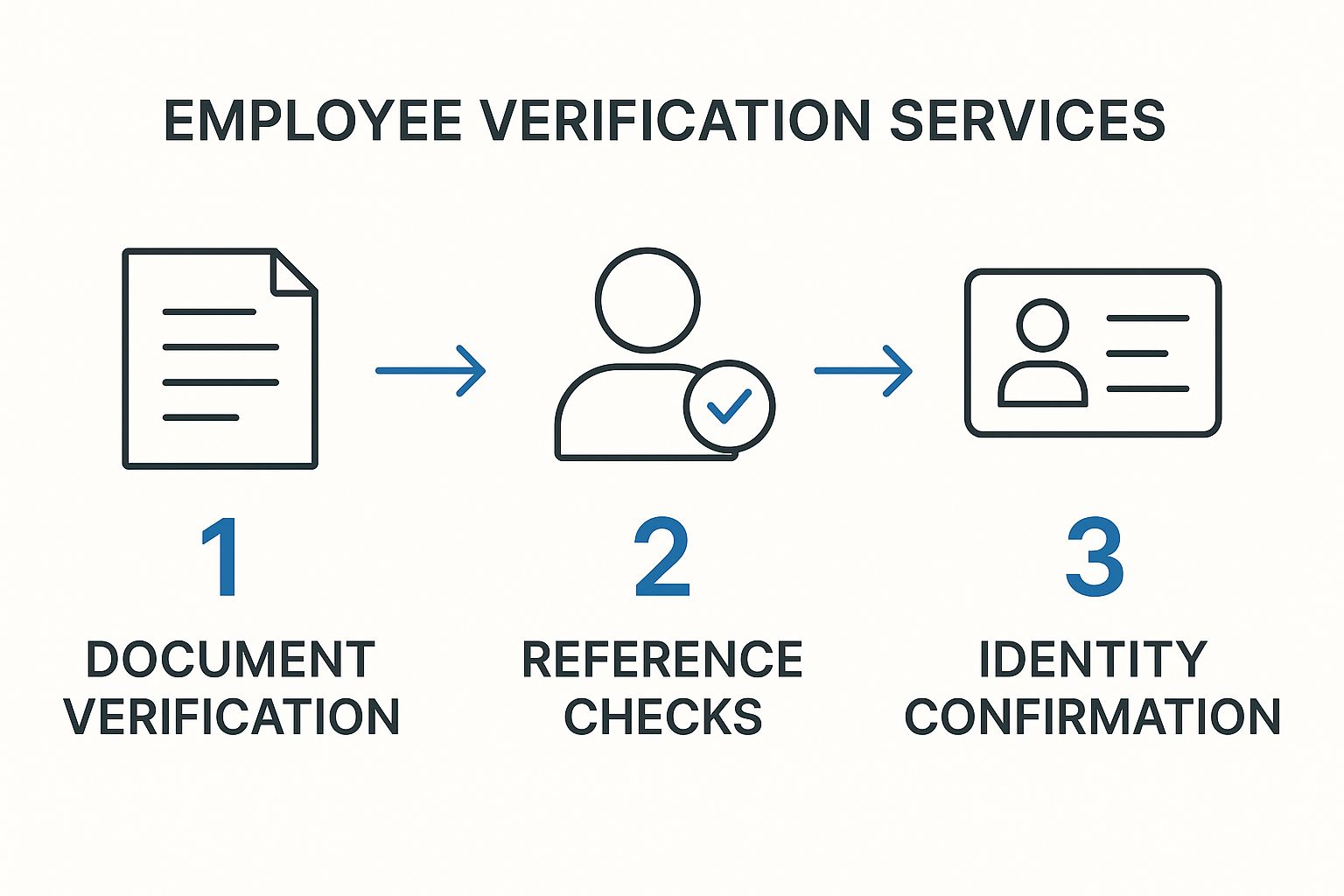
This visual breaks down how each stage builds on the last, from validating paperwork to confirming personal and professional histories. For instance, a provider will contact universities to confirm degrees, get in touch with the HR departments of past employers to verify job titles, and run searches through official databases for criminal records.
Every single check is a careful process of cross-referencing what a candidate has claimed against authentic, official sources. As verification evolves, many services are exploring advanced methods for efficiency, including streamlining aspects like employee onboarding through Robotic Process Automation, which helps cut down manual work and deliver faster results.
Compiling and Delivering the Final Report
As each check wraps up, the findings are organised into a central dashboard or report. This is where a modern verification partner really proves their worth. Instead of dumping a pile of disconnected documents on your desk, they present the results in a clear, easy-to-digest format.
The goal of the final report is not just to present data, but to provide actionable insights. A well-designed report will use clear markers—like green for verified, yellow for discrepancies, and red for major concerns—to help you quickly assess a candidate’s profile.
This lets HR managers and hiring teams see the whole picture at a glance. They can review all the verified information, look into any flagged issues, and make a solid hiring decision with total confidence. This final step turns raw data into the clarity you need to build a team you can trust. The entire workflow, from consent to final report, is built to be efficient, compliant, and transparent for everyone involved.
Staying Compliant with Indian Privacy Laws
In India, running a background check is more than just a smart hiring move—it’s a serious legal responsibility. When you handle a candidate’s personal information, you’re taking on a duty of care. Get it wrong, and you could face significant legal and financial blowback. This is where partnering with professional employee verification services becomes so crucial; they help ensure your process is not just sharp but also fully compliant with local laws.
Think of it this way: your organisation becomes a custodian of someone’s personal data. You’re responsible for keeping it safe, using it only for the intended purpose, and respecting the candidate’s rights every step of the way. Nailing this builds trust from day one and protects your business from risk.
Obtaining Legally Sound Candidate Consent
The entire verification process rests on one critical foundation: getting explicit and informed consent from your candidate. This isn’t just a tick-box exercise; it’s a legal cornerstone. In India, the law requires you to be crystal clear about what information you’re checking, why you need it, and how you plan to use it.
Proper consent has to be:
- Explicit and Unambiguous: The candidate must actively agree. A pre-ticked box or passive acceptance just won’t cut it.
- Informed: You need to spell out the specific checks you’ll be running, from employment history to criminal record checks. No surprises.
- Freely Given: You can’t force consent or make it an unfair condition of their application.
The best way to manage this is through a digital, auditable consent process, often provided by a verification partner. It creates a clear, time-stamped record that proves you’ve met your legal duties before any check even begins.
Handling Sensitive Data and Candidate Rights
Once you have consent, the focus shifts to how you handle the data. Candidates are trusting you with their sensitive personal information (SPI), and Indian law is very clear that you must treat it with the highest level of care. This means protecting it from any unauthorised eyes and making sure it’s only used for the verification itself.
At its core, compliance is about fairness and transparency. A candidate has the right to know what information is being collected about them and has the right to review it for accuracy. Failing to provide this transparency can undermine the entire process and expose your organisation to risk.
Candidates also have specific rights that you must honour. They are entitled to see their final verification report and dispute any information they believe is inaccurate. Your process has to provide a clear channel for them to raise these concerns and get them resolved. This commitment to fairness is a non-negotiable part of an ethical and legally compliant hiring framework. For a deeper look into building a compliant process, check out these valuable insights on ensuring compliance in background verification.
Your Obligations as an Employer
As an employer, your responsibilities don’t stop at data protection. You must ensure that the information you gather is used to make fair, non-discriminatory hiring decisions. The data from a background check is meant to assess a candidate’s suitability for a specific role, not as a tool to unfairly filter them out based on unrelated history.
This sharp focus on compliance and quality is fuelling massive growth in the industry. The global employment screening services market was valued at USD 6.97 billion and is projected to skyrocket to USD 17.56 billion by 2033. India is a huge part of this growth, driven by its enormous workforce and an increasing regulatory spotlight. You can read the full research about these market trends to grasp the global shift toward more rigorous verification.
By sticking to these legal standards, you’re not just protecting your business—you’re building a culture of respect and integrity from the very first hello.
How to Choose the Right Verification Partner
Picking a partner for your employee verification services is a huge decision. It’s not just another vendor relationship; this is about finding a company that will safeguard your workplace and strengthen your hiring process. Not all providers are created equal. The right one can supercharge your hiring, while the wrong choice can create frustrating bottlenecks and expose your business to unnecessary risk.
Think of it less like buying software and more like forming a long-term partnership for your company’s growth and security. The real goal is to find a service that feels like a natural extension of your own HR team. This means looking way beyond the price tag to evaluate the factors that will genuinely impact your daily operations and hiring wins.
Evaluate Data Accuracy and Turnaround Time
Let’s be blunt: the entire point of a background check is to get accurate information. A verification partner that gives you spotty or incorrect data is worse than useless—it creates a dangerous false sense of security. Before you sign anything, ask potential providers about their data sources, how they actually verify the information, and what quality checks they have in place. You need to know you can trust their reports, period.
In today’s competitive hiring market, speed is just as critical. A slow verification process means you risk losing your best candidates to companies that can move faster.
A verification report that takes weeks to arrive can derail your entire hiring pipeline. The ideal partner balances thoroughness with efficiency, delivering accurate results within a timeline that supports your business agility.
Look for providers that give you clear, realistic turnaround times. A modern platform should also have a real-time dashboard where you can see the progress of every check. No more being left in the dark, wondering about a candidate’s status.
Assess Technology and Platform Integration
The user experience of the verification platform matters—a lot. It’s not just about fancy features; it’s about how it feels for your HR team and your candidates. A clunky, confusing interface is a recipe for frustration and will slow everyone down. The best platforms are intuitive, easy to navigate, and make ordering checks and reviewing reports simple.
Just as important is how well the platform plays with your other HR tools. Seamless integration with your Applicant Tracking System (ATS) or Human Resource Information System (HRIS) is a total game-changer. It gets rid of manual data entry, slashes the risk of errors, and creates one smooth, unified workflow for your team.
This integration transforms background checks from a clunky, separate task into a seamless step in your hiring process. When you’re talking to potential partners, be sure to ask about their API capabilities and any pre-built integrations they offer. This technical muscle is essential for scaling your hiring efficiently and is a cornerstone of modern talent acquisition strategies.
Key Criteria for Selecting a Verification Partner
To make a truly informed decision, you need a structured way to compare your options. It’s also smart to see what the best in the business are doing by looking at leading international background check services to understand industry best practices.
Use this table as a checklist to help you systematically assess potential partners.
| Evaluation Criterion | What to Look For | Why It Matters |
|---|---|---|
| Accuracy & Reliability | Direct-source data, quality checks, low dispute rates. | Ensures you’re making decisions based on factual, trustworthy information. |
| Turnaround Speed | Clear timelines, real-time tracking, efficient processing. | Helps you secure top talent quickly without sacrificing due diligence. |
| Technology Platform | Intuitive dashboard, easy navigation, robust reporting. | Improves user experience for your HR team and reduces administrative burden. |
| Integration Capability | Pre-built ATS/HRIS integrations, strong API support. | Automates workflows, eliminates manual work, and boosts overall efficiency. |
| Customer Support | Dedicated account manager, responsive helpdesk, clear SLAs. | Provides peace of mind and ensures quick resolution if issues arise. |
| Scalability & Pricing | Flexible plans, transparent pricing, ability to handle volume. | Supports your company’s growth without unexpected costs or service limits. |
By carefully weighing these factors, you can move beyond a simple price comparison. You’ll be able to choose a verification partner that truly aligns with your strategic goals, helping you build a more secure and talented workforce.
The Future of Employee Verification in India
The world of talent verification is moving at a breakneck pace, and what’s coming next promises even smarter, faster, and more secure ways to check backgrounds. For businesses in India, keeping up with these changes isn’t just about looking modern; it’s about turning your hiring process into a genuine competitive edge. The next wave of employee verification services is all about intelligent automation and new tech that makes background checks more insightful than ever before.
We’re already seeing this shift happen. The industry is moving beyond old-school manual checks into an era where technology gives you a much deeper level of assurance.
The Rise of AI and Machine Learning
At the heart of this transformation are Artificial Intelligence (AI) and machine learning. These technologies are being woven into verification platforms to handle repetitive tasks, which dramatically speeds up the whole process. Think about it: AI algorithms that can scan documents in a flash, spot tiny inconsistencies, and flag potential forgeries with an accuracy that might escape the human eye.
This isn’t some far-off dream; it’s happening right now. AI-powered systems can sift through huge amounts of data to find patterns that could signal fraud, adding a powerful layer of security to your hiring. This automation also frees up your HR teams from soul-crushing admin work, letting them get back to the human side of recruiting.
By automating routine checks and applying intelligent fraud detection, AI is making the verification process not only faster but also more robust. It turns a standard background check into a dynamic risk assessment tool.
What this really means is that companies can get trustworthy results in a fraction of the time it used to take. That’s a huge advantage when you’re trying to lock down top talent before your competitors do.
Continuous Monitoring and Verifiable Credentials
Another massive change on the horizon is the shift from one-time, pre-hire checks to continuous monitoring. In today’s dynamic workplace, an employee’s situation can change. Continuous monitoring services keep you in the loop after someone is hired, alerting you to new, relevant information that could affect their role or your organisation’s security.
Looking even further ahead, technologies like blockchain have incredible potential. They could pave the way for secure, tamper-proof professional credentials that change the game entirely.
- Digital Wallets: Imagine professionals keeping their verified employment and education records in a secure digital wallet.
- Instant Verification: They could then grant employers instant, permission-based access to these verified credentials.
This kind of system would make verification almost instantaneous while giving individuals far more control over their personal data. Understanding these shifts is key to building a hiring strategy that isn’t just effective today but is ready for whatever the future of work throws at it.
Frequently Asked Questions
Diving into employee verification services for the first time? It’s natural to have a few questions. We’ve put together some straightforward answers to the queries we hear most often from employers, helping you get the clarity you need to hire with confidence.
How Long Does a Background Check Take in India?
There’s no single answer here, as the timeline really depends on what you need to check. A quick identity and address verification can often be turned around in a day or two. Simple as that.
But for more comprehensive checks—like contacting multiple past employers or digging into educational records—it naturally takes a bit longer. On average, you can expect a full background check to be completed within 5 to 10 business days. The best providers will give you a real-time dashboard so you’re never left guessing about the status.
Is It Legal to Conduct a Check Without Consent?
Absolutely not. In India, running any kind of background check without the candidate’s clear and informed consent is a serious breach of privacy laws. You must get their permission in writing before you kick off the process.
This isn’t just a guideline; it’s a legal line you can’t cross. Skipping this step can land your company in hot water with significant legal penalties and completely delegitimise your hiring efforts.
What Should I Do if a Discrepancy Is Found?
First off, don’t jump to conclusions. A discrepancy doesn’t automatically disqualify a candidate. The best approach is to be fair and transparent. Sit down and discuss the issue directly with the candidate. Often, it’s just a simple clerical error or a misunderstanding.
Give them the opportunity to see the report and provide an explanation or additional documents. This isn’t just about being fair; it also ensures your final decision is based on the full picture, protecting you from any potential claims of unfair hiring practices.
Can a Candidate Refuse a Background Check?
Yes, they certainly can. A candidate has every right to say no to a background check. However, as an employer, you also have the right to make a successful background check a mandatory condition of employment.
If someone refuses, you are well within your rights to withdraw the job offer. The key is to communicate this policy clearly and early in the hiring process. That way, everyone is on the same page about what’s required for the role.
Ready to make your hiring process faster, safer, and more reliable? SpringVerify offers comprehensive, compliant, and efficient background screening solutions designed for modern businesses. Get started with SpringVerify today!


