

Skipping a proper background check is a huge business risk. Thinking of a standardised employee verification format as just more HR paperwork is a mistake—it’s actually a critical shield against hiring disasters, protecting your company from serious financial loss and reputational damage.
Table of Contents
Why Your Business Needs a Standardised Verification Format

Let’s walk through a scenario I’ve seen play out before. A promising tech startup, laser-focused on rapid growth, hires a senior developer. His resume is impressive, and he nails the interview. Their verification process? A quick, informal call to one reference that misses every single red flag.
Six months down the line, the company is hit with a major data breach. The investigation traces it back to the new hire, who had falsified his credentials and had a history of corporate espionage. The fallout is catastrophic: massive financial losses, shattered client trust, and a brand reputation in tatters. This entire disaster was preventable with a more structured process.
The Dangers of Inconsistent Checks
An inconsistent approach to verification leaves your company wide open to risk. Without a standard format, different hiring managers might check different things. Worse, they might skip crucial checks altogether when they’re pressed for time. This kind of haphazard method is exactly how bad hires slip through the cracks.
A formal employee verification format ensures every single candidate is vetted against the same essential criteria. This consistency is your first line of defence. It provides a reliable, repeatable framework for your entire https://in.springverify.com/talent-acquisition/.
Misrepresentation Is More Common Than You Think
The need for a formal process isn’t just theoretical; the data is alarming. In India, resume fraud is a persistent and growing problem. One recent report revealed that a staggering 17% of resumes contained mismatched credentials. Even more concerning, 13% of employment checks failed outright. This points to widespread misrepresentation by candidates across all sorts of industries. You can dig into more of these hiring red flags in the full AuthBridge report.
By standardising your verification, you move from a reactive, hope-based hiring model to a proactive, data-driven one. It’s an essential tool for any smart business in India looking to reduce risk and improve hiring quality.
Building a Bulletproof Verification Document
Crafting an employee verification format that actually works is about more than just ticking boxes on a checklist. It’s about designing a structured document that consistently gets you the information you need, while staying fair and compliant. A solid format is your roadmap, making sure you cover every crucial detail for every single candidate.
The first layer, naturally, is the personal details. This means the candidate’s full name, current address, contact info, and a government-issued ID like an Aadhaar or PAN card. This might sound incredibly basic, but you’d be surprised how often discrepancies pop up right here. It’s often the very first red flag that points to potential identity issues.
From there, you need to meticulously go through their employment history. This isn’t just about confirming dates and job titles. You’re digging deeper to understand their actual role, their responsibilities, and the real reason they left their previous position.
What to Look for in Employment History
- Company Names and Addresses: First things first, do these companies actually exist? A quick check ensures the businesses listed are legitimate and operational.
- Dates of Employment: Pinpoint the exact start and end dates. This helps you spot any unexplained gaps or, sometimes, overlapping employment periods that need clarification.
- Positions Held: Does the job title on their application match what their former employer has on record? This simple check confirms they aren’t inflating their experience.
- Reporting Manager’s Contact: Getting in touch with a former supervisor is gold. It offers invaluable, firsthand insight into the candidate’s performance, work ethic, and general conduct.
A key piece of evidence in an employee’s record is their official employment agreement. Using standardised employment agreement templates can create a consistent baseline for everyone you hire, which makes pulling up details for future verifications much simpler.
A truly effective verification document doesn’t just confirm a few facts—it paints a complete picture of a candidate’s professional integrity. Think of each section as a piece of a puzzle. Skipping even one can leave you with a critical blind spot.
Moving on from work experience, educational qualifications are another vital checkpoint. You absolutely have to confirm the authenticity of any degrees, diplomas, or certifications a candidate claims. This usually involves contacting the educational institution directly to verify their attendance dates and graduation status. Falsified educational credentials are one of the most common issues we see during background checks.
To help structure this, here’s a breakdown of the core elements you should include in your verification form.
Core Elements of an Employee Verification Form
A checklist of essential sections and the key data points to collect within each for a thorough verification process.
| Verification Section | Key Information to Collect | Purpose of Verification |
|---|---|---|
| Personal Information | Full Name, Address, Contact Details, Government ID (Aadhaar/PAN) | Confirms the candidate’s identity and provides a baseline for all other checks. |
| Employment History | Company Names, Dates of Service, Job Titles, Manager’s Contact Info | Validates work experience, job roles, and reasons for leaving. Uncovers gaps or inconsistencies. |
| Educational Qualifications | Institution Name, Degree/Diploma, Dates of Attendance, Graduation Status | Verifies academic credentials and ensures the candidate has the required qualifications. |
| Reference Checks | Names and Contact Details of Professional References | Gathers qualitative feedback on skills, work ethic, and team collaboration. |
| Criminal Record Check | Consent for Police/Court Record Search (where permissible) | Identifies potential risks for roles involving high levels of trust or security. |
Putting these pieces together creates a comprehensive and reliable verification process.
Finally, your format should have sections for reference checks and, depending on the role’s sensitivity and local laws, criminal record checks. For references, don’t just ask if they were a good employee. Ask targeted questions about their skills, how they handle pressure, and their ability to work with others. This qualitative feedback adds much-needed colour to the black-and-white data you’ve collected.
When you bring all these elements together, your employee verification format transforms from a simple form into a powerful tool for making confident hiring decisions. To really nail down the specifics, our guide on comprehensive employment verification offers more strategies and best practices.
Putting Your Verification Format into Action
Alright, let’s move from theory to practice. Drafting and rolling out your employee verification format is a mix of clear structure, professional language, and a bit of strategic thinking. This isn’t just about creating another form; it’s about designing a smooth, repeatable process that gathers the right information efficiently and respectfully.
Think of a well-designed format as a guide for your HR team. It standardises the questions you ask, the documents you collect, and the steps you take. This consistency removes the guesswork from the equation for everyone involved.
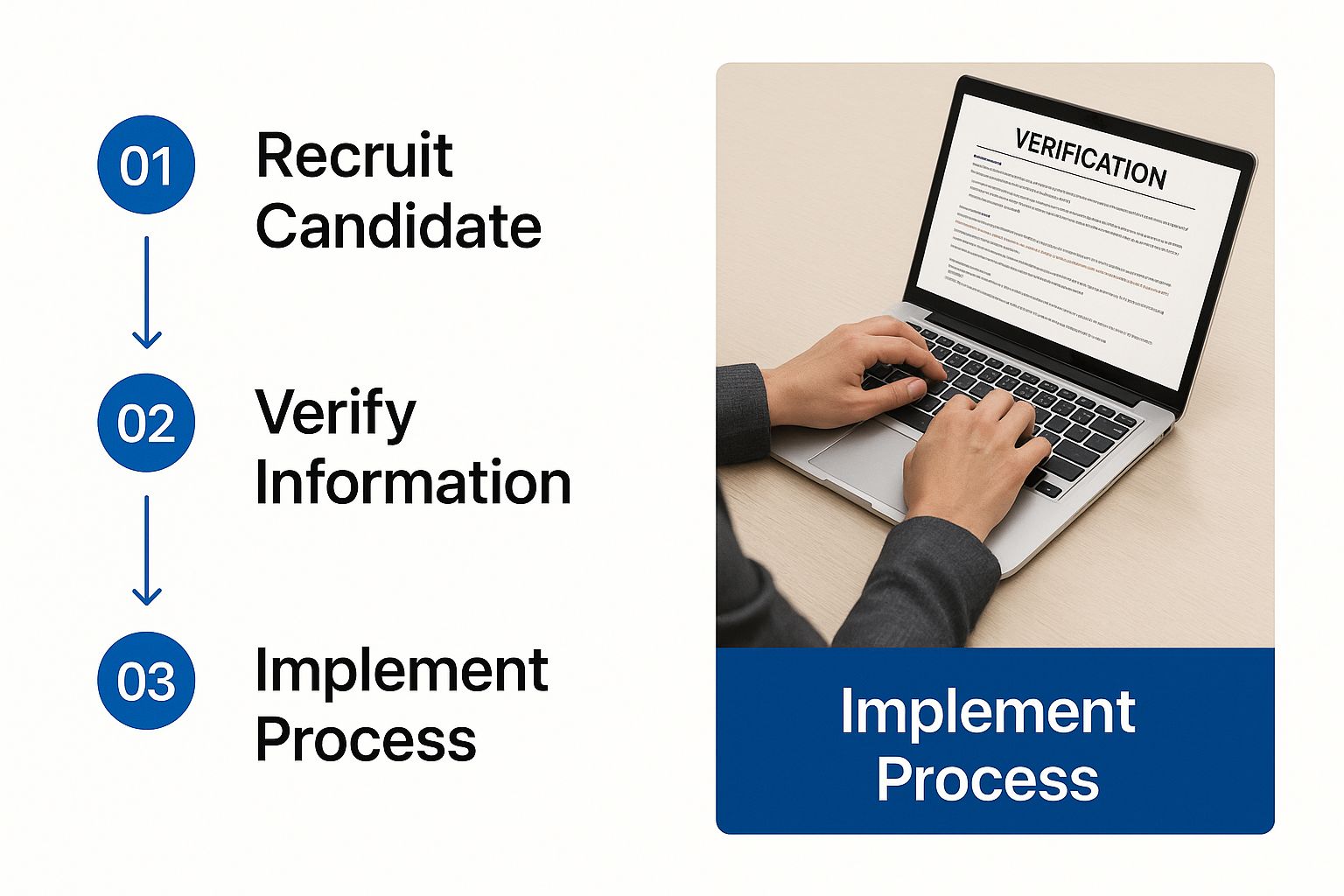
As you can see, a successful rollout is more than just the document itself. It’s a full-cycle approach that makes verification a seamless part of your hiring workflow, not a bottleneck.
Getting Candidate Consent Gracefully
First things first: you must get the candidate’s explicit, written consent. In India, this is non-negotiable from both a legal and ethical standpoint. It’s best to frame this not as a hurdle, but as a standard, transparent part of your professional hiring process.
How you ask really matters. Instead of hitting them with a blunt, demanding form, integrate the consent request smoothly into your application workflow. A simple, clear statement explaining what you’ll be checking and why is usually enough to avoid creating any friction.
Insider Tip: Keep the tone of all your verification requests professional, neutral, and unbiased. The goal is to verify facts, not to interrogate. Phrasing your requests politely and directly often leads to faster and more accurate responses from previous employers and institutions.
Structuring Your Verification Requests
When you’re reaching out to previous employers, clarity is everything. Vague questions just lead to vague answers, so get straight to the point. A well-structured request makes it easy for the recipient to give you the information you need quickly.
For the best results, make sure your outreach includes these key elements:
- A Clear Subject Line: Something like, “Employment Verification Request for [Candidate Name].”
- The Candidate’s Details: Include their full name, job title, and dates of employment to help the other company locate records easily.
- Specific Questions: Ask directly about job title, responsibilities, and reason for leaving.
- The Attached Consent Form: Always include the candidate’s signed consent form. This proves you have permission to ask for this information.
Maintaining a clear documentation trail is also crucial for compliance and any future reference. For businesses wanting to streamline this entire workflow, looking into API integrations for background checks can be a game-changer. These tools can connect with your existing HR systems, automating requests and consolidating all the records into a single, secure platform. This digital approach ensures every step is logged and easily auditable.
Tackling Unique Verification Challenges in India
Hiring in India isn’t like hiring anywhere else. It comes with a unique set of hurdles that a generic, one-size-fits-all employee verification format simply can’t handle. The sheer diversity of the country’s educational and professional landscape demands a much more nuanced approach.
Think about it: you might need to verify a degree from one of hundreds of different educational boards, each with its own process. This complexity means your format has to be flexible. Verifying a candidate from a tier-1 city might involve straightforward digital checks, but someone from a remote area could require a completely different, more manual process. A rigid format will only cause delays and frustration.
Navigating Educational and Informal Work Histories
One of the biggest headaches is validating credentials from India’s vast and fragmented educational system. Your verification format needs to be designed to capture precise details—like the specific board, university affiliation, and year of passing—to have any hope of streamlining the outreach.
Then there’s India’s massive informal and blue-collar workforce. This is another significant hurdle. Many incredibly skilled workers just don’t have a neatly documented, formal work history. An effective employee verification format has to account for this. It should include fields for alternative validation, such as contacting previous supervisors directly or even using practical skill assessments.
A common mistake is applying a white-collar verification standard to every single role. The key is to tailor your approach to the specific segment of the workforce you’re hiring from, ensuring your process is both thorough and fair.
Thankfully, modern technology is starting to simplify some of these complexities. Tools like Aadhaar e-KYC provide a quick and reliable way to confirm a candidate’s identity and address almost instantly. Digital record platforms are also gaining traction, making it easier to access and verify academic credentials from a growing number of institutions.
India’s blue-collar workforce, in particular, faces its own set of verification challenges, often driven by high turnover and a lack of formal identification. To tackle this, verification formats for this sector are increasingly integrating technology. Think mobile apps that use biometrics and cloud databases for quick, real-time checks, helping to build trust in what has traditionally been an informal hiring landscape. You can find more insights on these verification opportunities on Securecheck360.com.
By building these region-specific considerations right into your format, you can sidestep common roadblocks and make much more confident hiring decisions.
Staying Ahead of Modern Employment Fraud

Let’s be honest, standard background checks are starting to feel a bit old-fashioned. The hiring landscape today is a whole different ball game, filled with sophisticated new ways to deceive. We’re seeing everything from counterfeit experience letters from companies that don’t even exist to candidates secretly juggling multiple full-time jobs.
If your employee verification format hasn’t changed in the last few years, it’s probably not equipped to catch these modern threats.
The scale of this problem is staggering. A recent EY study focusing on India’s IT sector found that a massive 85% of discrepancies in background checks were tied to employment history. Digging deeper, 32% of candidates were caught submitting fake documents from these “ghost” companies, and another 45% were found to be moonlighting. These aren’t just edge cases; they’re becoming the norm. The full EY report on tech-enabled vigilance makes it clear that we need a much stronger verification process.
Simply ticking boxes and confirming dates isn’t enough anymore. Your verification process has to actively hunt for the inconsistencies and red flags that give away potential fraud.
This means you need to shift from a passive check to a proactive defence. A great place to start is by building digital footprint analysis into your routine to spot signs of dual employment or conflicting professional profiles online.
Upgrading Your Verification Toolkit
To really get ahead of the curve, you have to integrate more advanced tactics directly into your employee verification format and overall hiring strategy. It’s about changing your mindset as much as your tools.
Here are a few practical strategies to consider:
- AI-Powered Document Scrutiny: It’s time to bring in the big guns. Use tools that can analyse digital documents for subtle signs of tampering, inconsistent fonts, or metadata that just doesn’t line up.
- Digital Footprint Analysis: Go beyond the resume. Systematically review professional networking sites and other public online activity. You’re looking for any inconsistencies with a candidate’s stated work history. It’s amazing what you can find.
- Targeted Physical Visits: For those critical senior roles, don’t underestimate the power of a quick physical site visit. Driving by a previous employer’s listed address can instantly confirm if the company is legitimate or just a mailbox.
As you start using more integrated digital systems, protecting sensitive data becomes paramount. It’s vital to learn the best practices for securing API keys in your projects. Adopting these methods will transform your verification process from a simple checklist into a genuinely powerful fraud detection machine.
Your Employee Verification Questions Answered
Running a background check in India involves navigating a few legal and practical details. It can feel a bit tricky, but getting straight answers to the most common questions is the key to building a hiring process that’s both compliant and effective.
Is Applicant Consent Mandatory Before a Check?
Yes, it absolutely is. In India, you are legally and ethically required to get explicit, written consent from a candidate before you start any kind of background check.
This isn’t just a casual heads-up; it needs to be a formal step in your process. You have to clearly outline what you’ll be verifying. Skipping this step can land you in serious legal trouble for privacy violations.
How Long Should Verification Records Be Kept?
This is a great question. While there isn’t one single law that dictates a universal retention period for all companies, the widely accepted best practice is to keep these records for the entire time the person is employed with you, plus a few years after they leave.
Why? It protects your company in case any legal disputes pop up down the line. It’s always a smart move to chat with a legal expert to set a formal company policy that makes sense for your specific industry.
Remember, the point of verification isn’t to catch candidates out. It’s simply to confirm that the information they’ve shared is accurate. A process that’s fair and transparent from the get-go builds trust.
What if We Find a Major Discrepancy?
First things first: don’t jump to conclusions. It’s easy to assume the worst, but the initial step should always be to double-check your own information to make sure there wasn’t a simple error on your end.
If the discrepancy is real, the next step is to give the candidate a professional and fair chance to explain the situation. Based on how they respond and how serious the issue is, you can then make an informed decision. Sometimes, this might mean withdrawing the job offer, but not always. Whatever happens, make sure you carefully document every part of this conversation.
Ready to build a hiring process you can trust? SpringVerify provides fast, accurate, and compliant background checks designed for Indian businesses. Simplify your verification and make confident hiring decisions. Learn more at SpringVerify.


