

An employee reference check form is so much more than just another piece of HR paperwork. Think of it as a vital strategic tool, one that lets you verify a candidate’s claims and get a much clearer picture of their professional history. It standardises the questions you ask, which is crucial for fairness, consistency, and staying on the right side of the law.
Table of Contents
Why a Formal Reference Check Form Is Essential

Let’s be real—hiring is a high-stakes game. A structured form is your best defence against a bad hire. It takes you far beyond just confirming job titles and employment dates, turning what could be a casual chat into a proper, methodical investigation.
This structured approach means you evaluate every candidate against the exact same criteria. This is key to removing unconscious bias and making sure your comparisons are fair. It creates a level playing field where decisions are built on solid data, not just gut feelings or how charming a particular reference sounds on the phone.
Uncovering Deeper Insights
A well-crafted employee reference check form is your secret weapon for digging into the specifics of a candidate’s past performance. It gives you the framework to ask targeted questions about things that really matter, like:
- How did they actually collaborate when a project was under pressure?
- What was their real-world approach to solving problems?
- How did they react to constructive feedback?
- Would they genuinely fit into your company culture?
Suddenly, the reference check isn’t just a box-ticking exercise. It’s a strategic move to build a high-performing team. Here in India, this kind of thoroughness has become a standard part of hiring for many top organisations. They rely on reference checks to verify crucial details like job titles and responsibilities, ensuring the professional information provided by candidates is accurate.
By standardising your questions, you gather comparable data points on every candidate. This makes your final decision more defensible and evidence-based. It’s not just good practice; it’s smart risk management.
Ultimately, formalising this step builds trust right from the start. Documenting your processes, a core principle behind a reference check form, is also essential for wider organisational efficiency, a concept explored by many business process documentation template tools. It transforms a subjective conversation into a reliable data-gathering exercise, giving you the confidence you need to make the right hire.
What Goes Into a Great Reference Check Form?
Crafting a solid employee reference check form is more art than science. The goal is to create something that guides the conversation, helps you gather crucial details, and doesn’t make the reference feel like they’re filling out a tax return. A sloppy, confusing form is the fastest way to get vague, unhelpful answers.
Before you even think about what questions to ask, the absolute first step is getting candidate consent. I can’t stress this enough. You need explicit, documented permission from the applicant before reaching out to anyone. In India, this is a legal requirement to protect everyone involved—your company included. Make this section crystal clear and ensure it requires a signature.
Designing a Form That Delivers Real Insights
Once you have consent, the form itself needs a logical flow. If it’s all over the place, you’ll end up with patchy information that’s hard to compare between candidates. Think of it as steering a conversation.
Here’s how I recommend breaking it down:
- The Basics First: Start with simple employment verification. This is where you confirm the facts—job title, employment dates, and their core duties. It’s a quick way to see if their CV lines up with reality.
- Digging into Performance: Now, shift from facts to feedback. I find a mix of rating scales (like a 1-5 for dependability) and open-ended questions works best. Ask about their standout achievements or areas where they needed a bit more guidance.
- Understanding the Person: This is where you get a feel for cultural fit. Ask about how they communicate, if they’re a team player, and how they react to constructive feedback or a stressful deadline.
This image shows a really simple way to think about the structure.
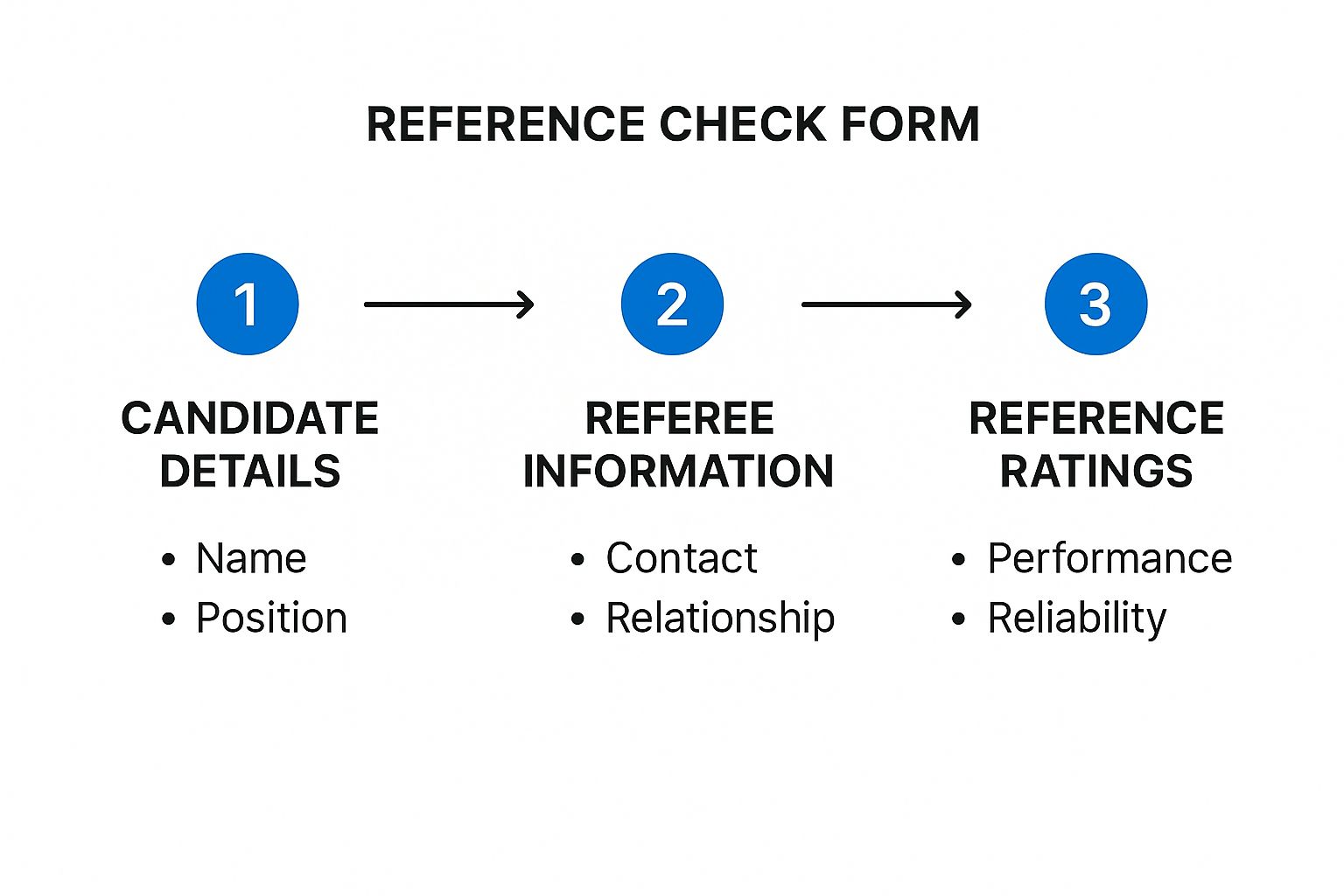
As you can see, it’s a natural progression from confirming what’s on paper to understanding the person behind the CV.
To help you get started, here’s a breakdown of the key sections you should always include in your reference check form. Each part serves a distinct purpose, ensuring you cover all your bases from compliance to culture fit.
Key Sections for Your Reference Check Form
| Section Name | Purpose | Example Question |
|---|---|---|
| Candidate Consent | To obtain legal permission to contact references. | “I, [Candidate Name], authorise [Your Company Name] to contact the references listed below.” |
| Reference’s Details | To confirm the identity and relationship of the reference. | “What was your professional relationship with the candidate and for how long did you work together?” |
| Employment Verification | To validate the factual details provided by the candidate. | “Can you confirm the candidate’s job title and their dates of employment from [Start Date] to [End Date]?” |
| Performance & Skills | To assess job-specific abilities and overall performance. | “On a scale of 1-5, how would you rate their technical skills for the role? Can you provide an example?” |
| Soft Skills & Team Fit | To gauge interpersonal skills and cultural alignment. | “How would you describe their communication style and ability to collaborate with a team?” |
| Final Recommendation | To get a concluding thought on the candidate’s suitability. | “Based on your experience, would you rehire this individual? Why or why not?” |
Having these distinct sections makes the form much easier for the reference to complete and, more importantly, for your team to interpret consistently.
A truly effective reference check tells a story. It starts with confirming the facts, moves on to what the candidate actually accomplished, and ends with how they went about their work. This narrative gives you a much richer, more complete picture than a simple Q&A ever could.
By breaking the form down this way, you turn a simple administrative task into a powerful decision-making tool. It standardises your approach, so you can fairly compare apples to apples. If you want to explore this further, you can learn more about professional reference verification and how it can seriously strengthen your hiring game.
Crafting Questions That Uncover Real Insights

The real value of your employee reference check form isn’t just in ticking a box; it’s in the questions you ask. Let’s be honest, asking “Was she a good employee?” will get you a polite, but useless, answer. We need to do better.
Your goal should be to get the reference talking—to share stories and specific examples that paint a clear picture of who the candidate really is. I’ve always seen a great reference check as the final piece of the puzzle. It’s where you can confirm strengths or, sometimes, uncover red flags that didn’t surface during the interviews.
The trick is to ask open-ended questions. Instead of yes/no queries, frame your questions to demand a narrative.
My Go-To Tip: I always ask the reference to “Describe a time the candidate faced a significant team conflict. What was their role in resolving it?” This simple shift forces them to recall a specific event, giving me a concrete example of how the candidate actually handles pressure and collaborates with others.
This approach transforms a routine check-up into a genuinely insightful conversation. You start to understand not just what the candidate accomplished, but how they did it.
Tailoring Questions for Specific Roles
I’ve learned over the years that generic questions yield generic answers. You have to customise your questions for the role you’re hiring for. It’s the only way to get information that’s truly relevant.
For instance, when hiring a junior developer, I’m more interested in their ability to learn and how they take feedback on their code. But for a senior sales manager, my questions will dig into their leadership style and strategic mind.
Here are a few examples of how you can adapt your questions:
- For a Creative Role: “Can you give me an example of a project where the candidate had to think outside the box to solve a problem? What was their process like?”
- For a Leadership Role: “How did the candidate go about giving difficult feedback to a direct report? Can you tell me how that situation turned out?”
- For a Customer-Facing Role: “Walk me through a time the candidate had to deal with a particularly unhappy client. How did they turn things around?”
By tailoring your questions like this, you move beyond surface-level details and get a much clearer, more complete picture of your potential hire. This is a core practice in modern human resources, turning a simple form into a powerful tool for predicting future success and building a team that truly fits.
Navigating Legal and Compliance Risks in India
When you’re conducting reference checks in India, winging it simply isn’t an option. Without a solid understanding of the local legal landscape, you’re not just being careless—you’re exposing your organisation to some serious legal and financial heat. Every single employee reference check form you create has to be built with compliance as its cornerstone.
First things first, and this is non-negotiable: you absolutely must get documented consent from the candidate. This means getting their explicit, written permission before you even think about picking up the phone or sending an email to a reference. Think of it less as a polite formality and more as a crucial legal shield for both the candidate’s privacy and your company’s protection.
Staying Compliant with Data Protection Laws
The rules around data privacy in India have become much stricter recently, and this has a direct impact on how we handle reference checks. Compliance isn’t just a best practice anymore; it’s a firm legal and operational necessity.
For example, companies in India now need to secure digital consent for checks. Any mandatory verification, like for criminal records or education, has to be directly relevant to the job and fall squarely within data privacy agreements. The stakes are incredibly high. Getting this wrong could lead to penalties of up to ₹250 crore per instance under the new Data Protection Board’s rules.
A clear, documented trail proves you followed a fair and consistent process for every candidate. This includes recording when consent was obtained, who was contacted, what was asked, and the information received.
Your best defence, if a hiring decision is ever questioned, is meticulous documentation. This paper trail shows you’ve been fair and consistent with every single candidate.
Finally, let’s talk about the questions themselves. Every question on your form must be directly related to the job and completely non-discriminatory. You have to steer clear of anything touching on a candidate’s age, marital status, religion, or any other protected characteristic. Stick to what matters: can they do the job? For a closer look at this, our guide on maintaining compliance during verification is a great resource. Focusing on job-related skills not only keeps you on the right side of the law but also helps you make better hiring decisions based purely on merit.
Making Sense of the Feedback and Making the Final Call

Once you’ve collected all the responses from your employee reference check form, the real work begins. Now you have to sift through the feedback and turn it all into a confident hiring decision. This isn’t just about tallying up good and bad comments; it’s about seeing the whole picture and making a call you can stand behind.
Your first move? Look for patterns. Spread out the feedback you’ve received from all the references and see how their stories align. Does one absolutely glowing review clash with two that are just lukewarm? Consistent feedback across the board, whether positive or negative, almost always carries more weight than a single outlier.
Also, think about where the feedback is coming from. A comment from a direct manager who saw the candidate in action every day for three years is going to be far more telling than feedback from a colleague who sat on a completely different team.
Weighing the Evidence
Let’s be honest, not all feedback is created equal. A vague, hesitant comment like “Yeah, he was fine” paints a very different picture from something specific and enthusiastic, such as “She single-handedly turned around our most difficult client account.” You have to learn to read between the lines.
Sometimes, a reference is legally constrained from saying anything explicitly negative. In those situations, what isn’t said can be incredibly revealing. Pay close attention to long pauses, hesitations, or praise that feels overly generic. These can be subtle red flags that hint at underlying issues.
A single negative reference shouldn’t be an automatic deal-breaker. Instead, treat it as one more piece of the puzzle. Weigh it against the candidate’s interview performance, their other references, and the overall impression they’ve made throughout the process.
This level of diligence is more crucial than ever. A recent EY India study brought a sharp rise in employment fraud to light, finding that fraudulent claims are most common among experienced professionals. For instance, 96% of fraudulent claims in healthcare and 88% in financial services were from seasoned individuals, which really drives home the need for thorough verification. You can explore the full findings on employment fraud risks in the report.
Ultimately, your decision should be a synthesis of everything you’ve learned—from the initial application right through to this final reference check. This comprehensive approach is what helps you move beyond just filling a vacancy and toward making a genuinely strategic addition to your team.
Navigating Common Reference Check Scenarios
Even with the best employee reference check form in hand, you’re bound to run into some tricky situations. Let’s walk through some of the practical questions I see hiring managers and HR teams grapple with all the time.
What if a Reference Doesn’t Respond?
First off, don’t panic or assume the worst. People are busy, emails get buried, and voicemails go unheard. Your first move should be to calmly let your candidate know you haven’t been able to connect with their contact. A simple “Could you help me double-check their details?” or “Is there a better time to reach them?” often solves the problem.
If you’ve made a couple of attempts and are still met with silence, it’s completely reasonable to ask the candidate for an alternative professional reference. Just be sure to document your efforts. While one unresponsive reference isn’t a massive red flag, a candidate who struggles to provide reliable, quality contacts might be something to think about.
Can I Ask About Past Salary in India?
Legally speaking, there’s no national law in India that stops you from asking about a candidate’s previous salary. However, it’s a practice that’s quickly falling out of favour, and for good reason. Progressive recruitment is about what a candidate can bring to your organisation, not what they were paid somewhere else.
Focusing on past salary can perpetuate pay gaps and lead to biased negotiations. It’s far more effective to discuss salary expectations for the role you’re hiring for. This ensures you’re on the same page from the very beginning.
How Should I Handle a Negative Reference?
Receiving negative feedback can be jarring, but it shouldn’t be an automatic deal-breaker for a strong candidate. The key is to look at it with a wider lens. Is this one person’s isolated opinion, or does it echo a doubt you already had during the interviews?
Always look for patterns across all the feedback you’ve collected. If one comment stands out as an outlier, weigh it against the positive information you have. You could even give the candidate an opportunity to respond to the concern in a general way—without revealing your source, of course. Hearing their perspective can provide crucial context before you make that final hiring decision.
At SpringVerify, we know how critical it is to get every hire right. Our comprehensive background verification services are built to give you the confidence you need to build a talented, trustworthy team. Make informed hiring decisions faster with SpringVerify.


