

When you start a new job, you hand over a lot of personal information—your Aadhaar number, bank details, maybe even health records.When you start a new job, you hand over a lot of personal information—your Aadhaar number, bank details, maybe even health records. While companies certainly need this data to manage payroll and other essentials, you have a fundamental right to know how your information is being used and to have it kept secure.
Table of Contents
Your Fundamental Privacy Rights at Work
Think of your employer as a guardian for your personal data. In legal terms, they act as a data fiduciary, which is a formal way of saying they have a duty to protect your sensitive information.
It’s a bit like how a bank safeguards your money. You trust the bank to keep your funds safe, and there are laws ensuring they do. Similarly, your employer has a legal and ethical obligation to protect your personal data. This isn’t just about being a good company; it’s a core part of your employee privacy rights.
The image below breaks down the three most important rights you have in the workplace.
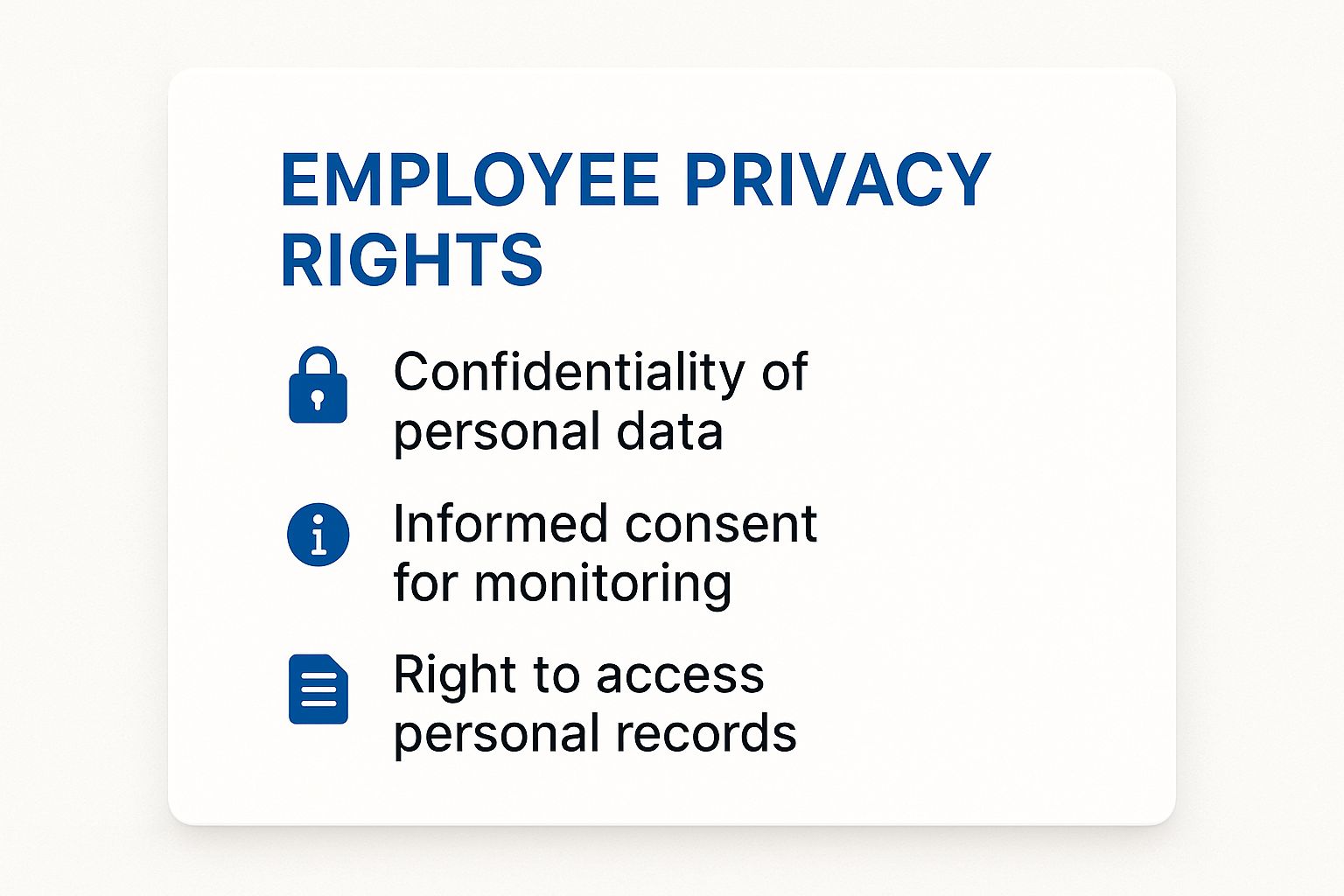
As you can see, these rights—confidentiality, consent, and access—are the pillars of a fair and transparent work environment where your privacy is respected.
The Employer as a Data Guardian
The idea of a data fiduciary is key to understanding your rights. It changes the dynamic from a simple transaction to a relationship built on trust and accountability. Your employer can’t just collect your data “just in case” or use it for reasons they never told you about.
Their duty as a data guardian means they must:
- Be Transparent: Tell you exactly what data they are collecting and for what specific purpose.
- Keep it Secure: Use reasonable security measures to stop your data from being leaked or misused.
- Stick to the Purpose: Only use your data for the legitimate reason it was collected.
If you’re interested in the broader principles of how data is protected online, these General Privacy Guidelines offer a good overview of the concepts that also apply at work.
Employee Privacy Rights at a Glance
To make this crystal clear, your rights and your employer’s obligations are two sides of the same coin. For every right you hold, your employer has a corresponding duty they must fulfil. This ensures a healthy balance between business needs and your personal privacy.
The table below summarises the core privacy rights you have in India and the matching responsibilities of your employer.
| Employee Right | Employer Obligation |
|---|---|
| Right to Data Confidentiality | To implement security measures that protect personal and sensitive information from unauthorised access or disclosure. |
| Right to Informed Consent | To clearly communicate all data collection and monitoring activities and, in many cases, get explicit consent beforehand. |
| Right to Access and Rectification | To provide you with access to your personal data upon request and allow you to correct any mistakes. |
| Right to Grievance Redressal | To set up a clear process for you to raise privacy concerns and have them handled by a designated officer. |
This framework is the foundation for every interaction involving your personal data at work, ensuring your privacy is always a priority.
How the DPDP Act Reshaped Workplace Privacy

The arrival of the Digital Personal Data Protection (DPDP) Act, 2023, marked a massive shift in the landscape of employee privacy rights in India. This isn’t just another piece of legislation; it’s a game-changer that completely recalibrates the relationship you have with your employer regarding your personal information.
Before the DPDP Act, the rules of the game were often blurry and open to interpretation. Now, the law is crystal clear: your employer is a ‘data fiduciary’. This isn’t just a fancy legal term. It means they are legally on the hook for protecting your personal data with the highest degree of care. Think of them as a legal guardian for your information, responsible for every aspect of its handling from your first day to long after you’ve moved on.
This new reality empowers you, the employee, by setting a firm standard for accountability. No longer can an employer collect your data on a whim or use it for reasons you were never aware of. Every piece of your information they collect, store, and use must now be justified, secured, and handled responsibly.
Legitimate Reasons for Data Processing
The DPDP Act isn’t unreasonable. It understands that employers need to process some of your personal data to keep the business running smoothly. But—and this is a big but—it puts strict guardrails on when they can do this without getting your direct, explicit consent. This ensures their business needs don’t trample all over your fundamental right to privacy.
These “legitimate uses” are not a free pass for unchecked surveillance. They are specific, clearly defined situations that are directly tied to your employment.
“Under the DPDP Act, an employer’s ability to process data without consent is tightly controlled. It is strictly limited to actions essential for managing the employment contract, such as payroll administration, or protecting the company from genuine threats like corporate espionage.”
For instance, your employer can generally process your data for:
- Managing Your Employment: This covers the absolute essentials, like processing payroll, administering your health benefits, managing leave requests, and conducting performance reviews.
- Protecting Business Interests: An employer has the right to process data to protect themselves from serious risks like corporate theft, safeguarding valuable trade secrets, or preventing fraud.
- Ensuring Workplace Safety: This might involve keeping records for health and safety compliance or looking into incidents of harassment to maintain a secure environment for everyone.
This framework creates a crucial balance. It lets businesses function efficiently while making sure your personal information isn’t misused for invasive or unrelated purposes, cementing your employee privacy rights in the day-to-day reality of the workplace.
The Real Cost of Non-Compliance
To make sure these new rules have teeth, the DPDP Act brings in some hefty penalties for organisations that don’t comply. We’re not talking about small slaps on the wrist; these fines are big enough to make data protection a C-suite priority for every company in India. This forces companies to build strong data protection policies, be transparent about what they’re doing, and provide clear ways for employees to raise concerns. For a deeper look at maintaining these standards, you can find detailed guidance on workplace compliance.
The legal scales in India have now tipped decisively in favour of protecting employee data. The DPDP Act, 2023, puts the official title of ‘data fiduciary’ on employers and demands they follow strict privacy rules. While they can still process personal data without consent for legitimate business needs—like managing benefits or protecting company secrets—getting it wrong can lead to severe penalties. Fines for breaking the rules can soar as high as INR 250 crore (around $30 million USD), which shows just how seriously these employee rights are now being taken.
What Personal Data Can Your Employer Legally Collect?
When you’re trying to figure out your privacy rights at work, one of the biggest questions is: where does the line get drawn? It’s a given that your employer needs certain information to manage your job, but their right to know isn’t a free-for-all. The boundary is defined by a core legal principle known as data minimisation.
Think of it as a “need-to-know” basis. Your employer is only allowed to access information that is strictly required for them to do their job—like processing your salary or managing benefits. They can’t just hoard extra data “just in case” it might be useful down the road. Every piece of information they ask for must have a clear, direct, and legitimate business purpose behind it.
This simple principle is what protects you from overly nosy data collection and ensures your personal life stays personal.
Defining Personal Data in the Workplace
“Personal data” is a pretty broad term, covering any bit of information that can identify you as a person. It’s not just your name and phone number. In a work context, this data falls into two main categories, and both are protected under your employee privacy rights.
1. Standard Personal Information: This is the basic data nearly every job requires. It’s the essential stuff needed for HR and administrative tasks to function smoothly.
- Identification Details: Your full name, address, date of birth, and contact information.
- Financial Information: Bank account details to get your salary and your PAN/Aadhaar number for tax purposes.
- Employment History: Details from your CV, like past job titles, companies, and qualifications, which are used for verification.
2. Sensitive Personal Data: This category covers information that’s far more private and demands a much higher level of protection. An employer must have an exceptionally strong and legitimate reason to collect this kind of data.
- Health and Medical Records: Information on your physical or mental health, usually needed for things like health insurance, medical leave, or making workplace accommodations.
- Biometric Data: This includes fingerprints or facial scans, sometimes used for tracking attendance or giving access to secure areas.
- Religious or Political Beliefs: This information is almost never necessary for employment and shouldn’t be collected unless there’s a very specific, lawful reason to do so.
Crucially, your employer has to be upfront about collecting any of this. They can’t just gather it in secret.
The Right to Be Notified
A cornerstone of your privacy rights is the right to notice. Your employer can’t just ask for your data without telling you why. They are legally required to inform you what they’re collecting, the reason they need it, and how it will be used and kept safe.
This transparency isn’t optional. If an employer asks for personal information, you have every right to ask, “Why do you need this?” and “How will you protect it?” A legitimate request will always come with a clear and reasonable explanation.
This notice should be given right when the data is being collected. You’ll typically find it in your employment contract, the employee handbook, or a dedicated privacy notice. This empowers you to know what’s happening and helps you spot the difference between a standard request and a potential invasion of your privacy. It makes you an informed participant, not just a subject of data collection.
Your Employer’s Duty to Protect and Store Your Data

Once you’ve handed over your personal information, your employer’s responsibility has only just begun. Their role as a data guardian is an ongoing commitment, stretching through your entire employment and, in many cases, for years after you’ve moved on. This duty is a cornerstone of your employee privacy rights.
Think of your data’s journey as a complete lifecycle. The collection part is just the first step. The real test is how that data is protected, stored, and eventually, disposed of. Your employer is legally and ethically on the hook to shield your data from prying eyes, theft, or misuse at every single stage.
This isn’t just a “set it and forget it” task. It demands active, continuous effort to keep everything from your bank details to your performance reviews confidential and secure.
What Reasonable Security Safeguards Look Like
The law says employers must put “reasonable security safeguards” in place, but what does that actually mean on the ground? It’s a lot more than just locking a filing cabinet. In today’s workplace, it means building a multi-layered defence system to protect both digital and physical records.
These safeguards are the practical measures that bring your employee privacy rights to life. They’re usually a mix of technical tools and organisational policies.
A solid security setup typically includes:
- Encryption: This involves scrambling your data into an unreadable code to stop unauthorised access. It’s especially crucial for sensitive files sitting on servers or being sent over the internet.
- Access Controls: This ensures only the right people—like your direct manager or specific human resources staff—can see your data, and only on a need-to-know basis.
- Regular Security Audits: Smart companies proactively poke and prod their own systems to find security weaknesses before a hacker does.
- Secure Data Destruction: This means having clear rules for securely shredding or deleting your data once it’s no longer legally needed.
Following these legal and ethical rules is a huge part of protecting employee privacy. For a deep dive into this area, a complete guide to call center compliance offers many principles that are relevant across industries.
The Lifespan of Your Data After You Leave
It’s a common question: what happens to all my personal data after I resign or my contract ends? Your employer can’t just hang onto it forever. But they can’t hit ‘delete’ the moment you walk out the door, either. Specific legal duties require them to keep your records for a set amount of time.
The key principle here is purpose limitation. Once the original reason for collecting your data (your employment) is over, and any legal retention periods have passed, that data has to be securely erased. Hoarding ex-employee data without a valid reason is a major breach of privacy principles.
This retention period isn’t just a random number. In India, it’s often linked to the statute of limitations for legal claims. This ensures that if a dispute crops up later, the necessary records are still available.
For instance, Indian employers are generally required to hold onto an employee’s personal data for a minimum of three years after they leave. This is tied directly to the time limit for filing civil legal cases, making sure the records are there if needed. This puts a big responsibility on companies to keep that data secure for the entire retention period to prevent any breaches or misuse.
This makes it absolutely essential for employers to have a clear, documented data retention policy. This policy should spell out what data is kept, why it’s kept, and for exactly how long. As an employee, you have every right to be informed about this policy.
Understanding Workplace Monitoring and Surveillance
This is where the line between an employer’s rights and an employee’s privacy gets tested most often. In any modern workplace, it’s almost a given that some form of monitoring is happening—from CCTV cameras in common areas to software that keeps an eye on computer activity. The real legal puzzle is striking the right balance between protecting legitimate business interests and respecting your reasonable expectation of privacy.
The law doesn’t just give employers a free pass to watch your every move. It expects them to be transparent, have a solid reason for monitoring, and keep it from being overly intrusive. Think of it this way: a security camera pointing at a cash register to prevent theft is one thing. That’s generally fine. But putting a camera inside a locker room? That’s a clear violation of privacy.
This balance is everything. While your employer has every right to protect company assets and make sure work is getting done, you still have a right to a degree of personal space and confidentiality, even when you’re on the clock.
The Role of a Clear Monitoring Policy
The single most important document that determines if monitoring is legal is a clear, transparent, and consistently applied policy. This policy is your roadmap. It should tell you exactly what is being monitored, why, and how that information will be used. It cuts through the ambiguity and makes sure everyone knows where they stand.
For an employer, having a well-written policy isn’t just good practice; it’s a legal shield. Without one, any monitoring they do is on shaky ground. This document needs to be specific, spelling out whether company emails are scanned for security threats or if internet browsing history is logged. It’s also a vital part of an effective talent acquisition and retention strategy because it builds trust right from the start.
A monitoring policy isn’t just a legal formality; it’s a social contract between you and your employer. It defines the boundaries of privacy in your workplace and demonstrates the organisation’s commitment to respecting your rights while protecting its own interests.
This policy has to be shared with everyone, usually during onboarding or via the company’s internal portal. You should be asked to read and acknowledge it, so there are no surprises down the line.
Acceptable vs. Unacceptable Surveillance
Let’s get practical. The difference between what’s okay and what crosses a line often boils down to the context and whether you have a reasonable expectation of privacy.
Acceptable Monitoring Scenarios:
- Company Email: It’s fair game for employers to monitor company-provided email accounts for security risks or to look into policy violations. After all, the device and the account belong to them.
- CCTV in Public Areas: Using cameras in non-private spaces like entrances, hallways, and stock rooms to boost safety and security is standard practice.
- Company Network Traffic: Analysing internet usage on the company network to block malicious sites or manage bandwidth is also generally acceptable.
Unacceptable Monitoring Scenarios:
- Personal Email: Accessing your personal, password-protected email account (like your private Gmail) on a work computer without a warrant or your direct permission is a major no-go.
- Private Conversations: Secretly recording audio of employees chatting in a break room is a significant breach of privacy.
- Biometric Data Without Cause: Collecting sensitive biometric data like fingerprints “just in case” without a clear and necessary purpose, like securing a high-security lab, is not justifiable.
It’s not just about what data is collected; your employer also has a duty to protect it. For example, if screen sharing is part of your job for collaboration or IT support, it’s crucial to think about the security side of things. It can be helpful to review guidance on understanding the safety of screen sharing and data protection to learn more.
What to Do When You Suspect a Privacy Violation

It’s an unsettling and often intimidating feeling to think your employee privacy rights have been violated. But you’re not powerless. There’s a clear, structured path you can follow to get things addressed, starting with internal steps before you even think about escalating things externally.
Your first move is always to get your facts straight. Before you confront anyone, you need to be absolutely sure about what happened. This means documenting everything with the precision of a detective building a case.
Save any relevant emails or messages. Take screenshots where you can. Jot down the specific dates, times, and details of what you believe was a violation. The more solid proof you have, the stronger your position will be, whether you’re talking to HR or, later, a legal body.
Your Internal Action Plan
Once you have your evidence organised, the next logical step is to handle the matter within the company. Most organisations would much rather resolve these issues in-house, and in many ways, the law encourages this as a first resort. The goal here is to give your employer a fair chance to fix the problem.
- Review Company Policies: Dig out your employee handbook and any specific privacy policies. You need to understand the company’s own rules on data handling and monitoring. This lets you frame your complaint in the context of their own stated policies, which is always a stronger approach.
- Contact the Right Person: Your next stop is usually the Human Resources department or your company’s designated Grievance Redressal Officer. The DPDP Act actually requires companies to have a point of contact for these exact issues. When you do approach them, be professional and present your documented evidence calmly.
- Put it in Writing: After any verbal conversation, always follow up with a formal email. This creates a paper trail of your complaint and the company’s response. This written record is absolutely vital if you need to take the matter further down the line.
Taking these internal steps demonstrates that you’ve acted in good faith and tried to solve the issue directly. It’s an essential part of the process and will only strengthen your case if you have to move forward.
Remember, asserting your rights isn’t about being confrontational; it’s about making sure the law is being followed. A structured, evidence-based approach protects you and encourages a fair resolution from your employer.
Escalating Your Complaint Externally
What if the internal process doesn’t work? If you get an unsatisfactory response or, worse, no response at all, you have every right to escalate the issue outside the company. In India, the main authority for this is the Data Protection Board of India (DPBI).
Filing a complaint with the DPBI is the official step to have your case reviewed by a legal authority. You’ll need to submit all that evidence you gathered and clearly explain how your employee privacy rights were breached. The Board will then investigate your claim and has the power to hit non-compliant employers with significant penalties. This external escalation ensures there’s an impartial body to enforce your rights and hold organisations accountable.
Frequently Asked Questions
Got questions about your privacy at work? You’re not alone. Let’s dive into some of the most common scenarios people ask about and clear up how employee privacy rights actually work in the real world.
Can My Employer Read My Personal Emails on a Company Computer?
This is a big one. Generally speaking, what you do on a company computer can be monitored by your employer. They own the equipment, after all. However, that right isn’t a blank cheque. If you’re logged into a personal, password-protected account (like your private Gmail), you have a much higher expectation of privacy.
For an employer to access those personal emails, they’d typically need a very strong, documented business reason—think a formal investigation into serious misconduct. The company’s own written policy is key here. A clear, upfront policy about monitoring gives them more legal ground. The safest bet? Always assume anything you do on a work device isn’t truly private.
What Happens to My Data After I Quit My Job?
Your former employer can’t just hang onto your personal data forever. While they can’t delete it the day you walk out the door, they also can’t keep it indefinitely. They are legally required to hold onto your data for a certain amount of time, often at least three years, to meet legal duties, like being prepared for potential lawsuits.
But once that mandatory period is over, laws like the DPDP Act kick in. The principle of “purpose limitation” means they must securely and permanently erase your data. They can’t just keep it “just in case.” You have every right to ask them about their specific data retention policy.
Can My Employer Use My Photo for Marketing Without Asking?
Absolutely not. Your employer can’t take your picture and splash it across a marketing brochure or social media campaign without your explicit permission. Your photograph is your personal data, and using it for advertising is well outside the normal scope of an employment relationship.
To do this legally, they must get your specific, informed, and freely given consent for that exact purpose. A sneaky little clause buried deep in your employment contract usually won’t cut it for something so public.
Is GPS Tracking on My Personal Phone Legal?
This is a very tricky and legally risky move for any employer. Forcing you to install tracking software on your own personal phone is almost certainly an overreach and a major privacy intrusion.
If GPS tracking is genuinely necessary for the job (for instance, if you’re a delivery driver), the company should provide a dedicated, company-owned device for that purpose. Using your personal phone requires your clear, unforced consent, and any tracking must be strictly limited to your working hours. Any kind of 24/7 monitoring would be a blatant and illegal violation of your privacy.
Making informed hiring decisions quickly and confidently is crucial. SpringVerify provides reliable, comprehensive background verification services tailored for companies of all sizes, from agile startups to large enterprises. Discover how we can help you build a trusted team by visiting https://in.springverify.com.


