

First impressions are final, especially in the corporate world. A disorganised, chaotic first day can erode a new hire’s enthusiasm and set a negative tone for their entire tenure. Conversely, a structured, welcoming, and empowering onboarding experience can transform new employees into engaged, productive, and loyal team members from the outset. In today’s competitive talent market, simply having a checklist isn’t enough; you need a strategic framework. This guide provides a comprehensive employee onboarding checklist, breaking down the critical phases from pre-arrival to full integration.
We will explore actionable steps, best practices, and real-world examples to help you craft an onboarding process that not only prepares employees for their roles but also deeply integrates them into your company culture. This ensures long-term success for both the individual and the organisation. This isn’t just about paperwork; it’s about building a foundation for a lasting professional relationship. For organisations looking to optimise their new hire experience, especially with distributed teams, understanding a comprehensive onboarding process for remote employees is key to achieving consistent and effective integration, regardless of location.
From pre-arrival documentation and first-day welcomes to 90-day check-ins and cultural immersion, this listicle covers every crucial touchpoint. You will learn how to set up new hires for success by systematically addressing their technical, social, and performance-related needs. Let’s delve into the essential items that will help you rethink your welcome and build a world-class onboarding programme.
Table of Contents
1. Pre-arrival Preparation and Documentation
The period between a candidate accepting an offer and their first day is a critical, often overlooked, part of the employee onboarding checklist. Effective pre-arrival preparation, also known as pre-boarding, sets the tone for the entire employee experience. It involves organising all necessary paperwork, technology, and access in advance, ensuring the new hire feels expected, valued, and ready to contribute from the moment they begin.
This phase transforms a potentially anxious waiting period into an engaging introduction to the company. By handling administrative tasks early, you free up the first day for more meaningful activities like team introductions, cultural immersion, and strategic orientation. A disorganised start, where a new employee spends hours waiting for a laptop or access, can create a lasting negative impression and hinder initial productivity.
Why Pre-arrival Preparation is Crucial
A structured pre-boarding process demonstrates organisational efficiency and a genuine commitment to your new team member. It alleviates first-day jitters and allows the employee to familiarise themselves with company policies and culture at their own pace.
- Boosts Engagement: Early engagement keeps the new hire excited and connected to the company, reducing the risk of them reconsidering their decision.
- Improves Day-One Productivity: With equipment and access ready, the new hire can hit the ground running, integrating into their role much faster.
- Enhances the Employee Experience: A smooth, welcoming start significantly improves morale and sets a positive precedent for their tenure.
For example, Salesforce sends new hires a digital welcome packet that includes personalised video messages from their future team members. This small gesture helps build connections before day one. Similarly, Google utilises a pre-boarding portal where new employees can complete paperwork, learn about the company’s mission, and even take virtual tours.
Pre-arrival Timeline: Key Milestones
To ensure nothing is missed, it’s vital to follow a structured timeline for pre-arrival tasks. This timeline visualises the critical milestones in the two weeks leading up to the new employee’s start date.
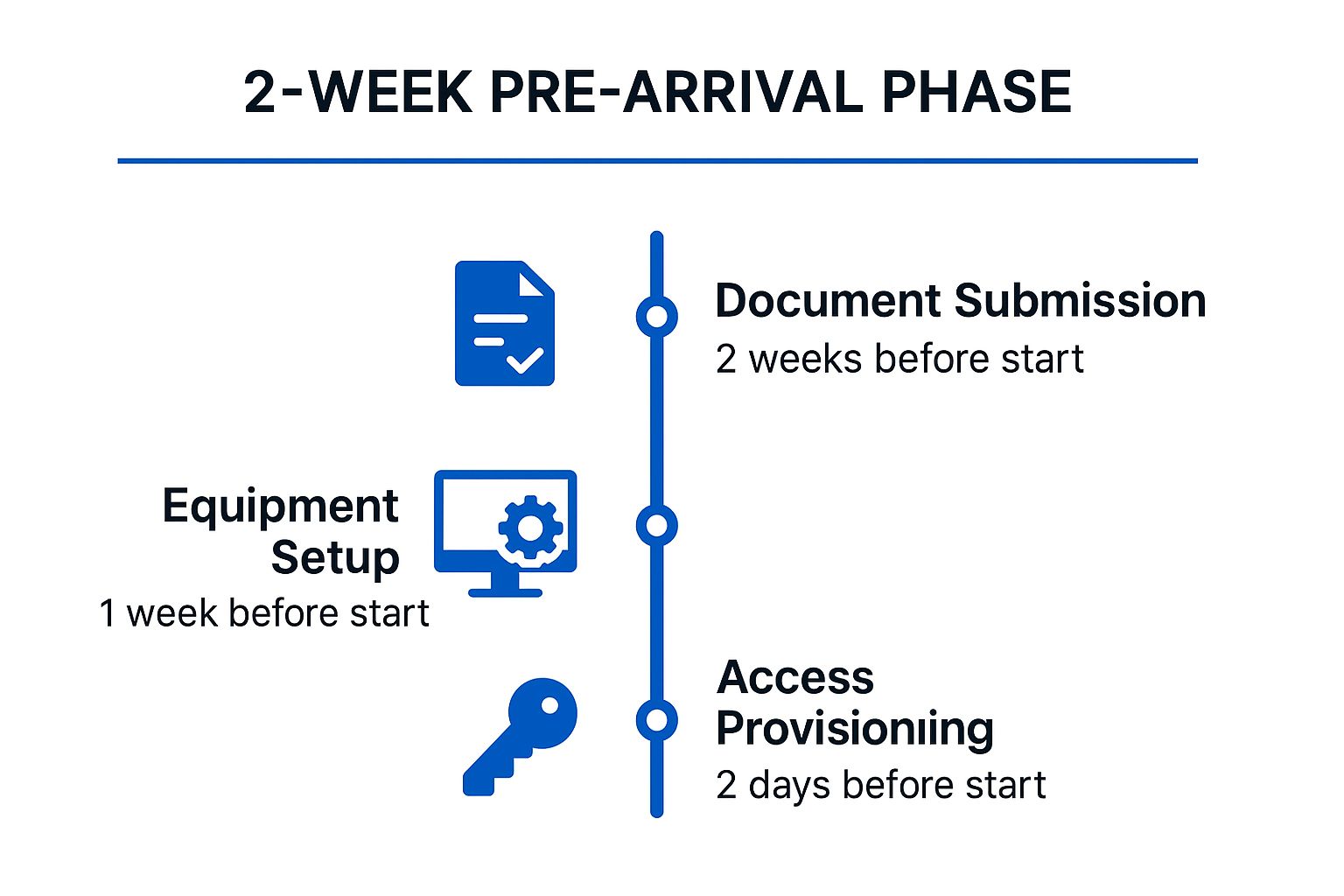
This structured progression ensures that administrative, IT, and access-related tasks are completed sequentially, preventing last-minute rushes and making the first day seamless.
Actionable Tips for Implementation
- Use a Checklist Template: Create a detailed pre-boarding checklist that can be customised for different departments and roles. This should be a core part of your broader talent acquisition strategy. For more insights on integrating this into your hiring process, you can find valuable information on optimising talent acquisition.
- Leverage Technology: Employ e-signature platforms like DocuSign or HelloSign to streamline the collection of employment contracts, tax forms, and policy acknowledgements.
- Coordinate Across Departments: Ensure seamless communication between HR, IT, and facilities. Use a shared project management tool to track tasks like workspace setup, equipment procurement, and creation of system credentials.
- Send a Welcome Package: For both in-office and remote employees, a physical welcome kit with company merchandise, a welcome note from the CEO, and a first-week agenda can make a powerful impact. For remote staff, ensure equipment is shipped to arrive 2-3 days before their start date.
2. First Day Welcome and Orientation
The first day is a cornerstone of the entire employee onboarding checklist, setting the definitive tone for a new hire’s perception of the company. A well-orchestrated welcome and orientation process transforms a potentially overwhelming day into an inspiring and reassuring experience. It is the moment where the company’s promises about its culture and values are put to the test, making a memorable first impression that can significantly influence long-term engagement and retention.
This initial phase moves beyond administrative formalities and focuses on human connection and cultural immersion. It is about making the new employee feel genuinely welcomed, valued, and connected to the company’s mission from their very first interaction. A chaotic or impersonal first day can create doubt and disengagement, whereas a structured, warm welcome confirms they made the right decision and energises them for the journey ahead.

Why First Day Orientation is Crucial
A meticulously planned first day demonstrates that you value people over processes. It helps new hires navigate the initial uncertainty, build foundational relationships, and understand the unwritten rules of the organisation. This focus on culture and connection is a powerful driver of early success.
- Reduces Anxiety: A friendly welcome, a clear schedule, and introductions to the team help alleviate the natural nervousness associated with starting a new job.
- Accelerates Cultural Integration: Immersing new hires in the company’s values, mission, and communication style from day one helps them align and adapt more quickly.
- Builds Early Relationships: Facilitating introductions and social interactions, like a team lunch, helps new employees build a support network immediately.
For instance, Zappos is famous for its intensive, week-long culture immersion that begins on day one. New hires learn about the company’s history and its ten core values, ensuring everyone is aligned with their customer-centric philosophy. Similarly, Netflix organises a “New Employee College” to familiarise new team members with its unique culture of freedom and responsibility.
Actionable Tips for Implementation
- Assign an Onboarding Buddy: Pair the new hire with an experienced team member who can act as a go-to resource for informal questions, show them around, and help them navigate social dynamics.
- Schedule a Team Welcome Lunch: Organise a casual lunch with the immediate team. This creates a relaxed setting for the new employee to get to know their colleagues on a personal level, away from the pressures of the workspace.
- Prioritise Connection Over Tasks: Keep the first-day agenda light on heavy work. Focus on introductions, a facility tour, a meeting with their manager to discuss expectations, and sessions on company culture and vision.
- Provide a Welcome Kit: Have a physical welcome kit waiting at their desk. Include company merchandise (swag), a welcome note from the CEO or team lead, an employee handbook, and a detailed first-week schedule.
- End with a Manager Check-in: The direct manager should have a brief, informal chat with the new hire at the end of the day. This is a chance to answer any lingering questions, gauge their experience, and reinforce their excitement for the role.
3. Job-Specific Training and Skills Development
Once a new hire is settled in, the focus must shift to equipping them with the specific skills needed to excel in their role. Job-specific training is a core component of any effective employee onboarding checklist, moving beyond general company orientation to provide a tailored programme that addresses the unique demands of the position. This involves a deep dive into technical skills, software proficiency, internal processes, and hands-on learning.
This phase is about transforming a promising new hire into a confident, competent contributor. A well-structured training plan accelerates the learning curve, ensuring the employee can handle their responsibilities independently and effectively. Neglecting this step can lead to prolonged ramp-up times, frequent errors, and a sense of being overwhelmed, which undermines both morale and productivity.
Why Job-Specific Training is Crucial
A customised training programme demonstrates an investment in the employee’s professional growth and their success within the company. It provides the clarity and tools necessary for them to meet and exceed performance expectations.
- Accelerates Proficiency: Tailored training directly addresses the skills gap between the new hire’s existing knowledge and the specific requirements of their new role.
- Reduces Errors: By thoroughly explaining processes and providing hands-on practice, you minimise costly mistakes and ensure quality standards are met from the start.
- Increases Confidence and Retention: Employees who feel competent and supported in their roles are more likely to be engaged, satisfied, and committed to the organisation long-term.
For instance, Amazon’s Career Choice programme pre-pays tuition for employees to pursue certifications in high-demand fields, even if those skills aren’t directly related to their current job, showcasing a deep commitment to skill development. Similarly, HubSpot requires new marketing and sales hires to complete its robust inbound marketing certification, ensuring they embody the company’s core philosophy.
Actionable Tips for Implementation
- Create Modular Training Content: Develop training materials in smaller, distinct modules (e.g., software tutorials, process guides, product deep dives). This makes it easier to update individual components without overhauling the entire programme.
- Incorporate Multiple Learning Styles: Cater to diverse learning preferences by using a mix of visual aids (videos, infographics), auditory content (podcasts, lectures), and kinesthetic activities (simulations, hands-on projects).
- Use a Microlearning Approach: Break down complex topics into short, focused sessions (5-10 minutes). This approach improves knowledge retention and allows employees to fit learning into their daily workflow without feeling overwhelmed.
- Schedule Regular Progress Checks: Implement regular check-ins with the manager or a designated mentor to assess understanding, answer questions, and adjust the training pace as needed. An essential component of this involves effective knowledge transfer. Explore proven knowledge transfer best practices to ensure new hires quickly grasp critical information and procedures.
4. Technology Setup and System Access
Seamless access to technology is the backbone of a productive start for any new employee. This step in the employee onboarding checklist involves provisioning all necessary hardware, software, and system credentials before day one. It is about more than just handing over a laptop; it’s about ensuring the new hire can immediately access the digital tools required to perform their role, communicate with their team, and integrate into the company’s operational workflow.

A well-organised technology setup prevents the frustrating first-day experience of waiting for IT support or being locked out of essential platforms. When a new hire logs in and finds their email, communication tools, and core software ready to go, it sends a powerful message of preparedness and value. This initial digital experience directly impacts their ability to learn, contribute, and feel like a part of the team.
Why Technology Setup is Crucial
A proactive and organised approach to technology onboarding directly correlates with early productivity and employee satisfaction. It eliminates technical roadblocks that can cause significant delays and frustration during a new hire’s critical first few days.
- Accelerates Productivity: With immediate access to tools, the new employee can begin training and completing initial tasks without delay.
- Reduces First-Day Anxiety: Knowing that all systems are set up and ready eliminates a major source of stress for new hires.
- Strengthens Security: A formalised process ensures access is granted securely and appropriately, protecting company data from the outset.
For instance, Slack uses an automated provisioning system that creates accounts across its integrated tool stack as soon as a new user is added. Similarly, companies using single sign-on (SSO) solutions like Okta allow new hires to access all their applications with one set of credentials, simplifying the login process and enhancing security.
Actionable Tips for Implementation
- Create Role-Based Templates: Develop standardised technology packages for different roles (e.g., developer, marketer, salesperson). These templates should list the required hardware, software licences, and access levels for each position.
- Leverage Identity Management Systems: Use platforms like Microsoft’s Azure Active Directory or Okta to automate the creation, modification, and deactivation of user accounts across multiple systems. This ensures consistency and security.
- Provide Clear Documentation: Prepare a “Tech Starter Guide” for new hires that outlines how to access key systems, who to contact for IT support, and basic security protocols. This empowers them to self-serve for common issues.
- Establish a Remote Setup Protocol: For remote employees, ensure all hardware is configured, tested, and shipped to arrive at least two days before their start date. Include clear, step-by-step instructions for unboxing and initial login. For more insights into streamlining these processes, explore how to enhance your operational efficiency.
5. Mentor/Buddy Assignment and Relationship Building
Integrating a new hire into the company culture is as crucial as equipping them for their role, making a formal mentorship or buddy system an indispensable part of any modern employee onboarding checklist. This practice involves strategically pairing new employees with experienced team members who offer guidance, support, and cultural assimilation. This relationship extends beyond formal training, providing a safe space for informal advice, networking, and emotional support during the challenging transition period.
The mentor or buddy acts as a trusted, non-managerial resource for questions a new hire might hesitate to ask their direct supervisor. This connection helps demystify unwritten social rules, accelerates relationship building across teams, and significantly shortens the time it takes for a new employee to feel a true sense of belonging. An effective buddy programme transforms a potentially isolating experience into a supported and connected one.
Why a Mentorship Programme is Crucial
Assigning a dedicated buddy or mentor demonstrates a deep investment in the new hire’s personal and professional integration. It humanises the onboarding process and shows that the organisation values collaborative support and psychological safety.
- Accelerates Cultural Integration: A mentor can explain company norms, communication styles, and team dynamics in a way that formal documentation cannot.
- Increases Employee Retention: Employees who feel supported and connected from the start are more likely to stay with the company long-term.
- Boosts Confidence and Productivity: Having a go-to person for questions removes roadblocks and empowers the new hire to tackle challenges with greater confidence.
For instance, Johnson & Johnson uses a global mentoring platform that connects employees across different locations and functions, fostering a vast internal support network. Similarly, Adobe’s ‘Check-In’ programme thoughtfully combines continuous performance conversations with mentorship, ensuring ongoing guidance is embedded in the employee’s growth journey.
Actionable Tips for Implementation
- Match Pairs Thoughtfully: Go beyond just departmental alignment. Match mentors and mentees based on complementary skills, shared interests, or compatible personalities to foster a genuine connection.
- Provide Mentor Training: Equip your mentors with the necessary skills. Offer training on active listening, providing constructive feedback, and effective guidance techniques to ensure they are prepared to support their mentee.
- Set Clear Expectations: Define the programme’s structure from the outset. Set clear expectations for meeting frequency (e.g., weekly for the first month), duration, and the types of topics to be covered.
- Create Structured Conversation Guides: Help break the ice by providing a simple guide for the first few meetings. This could include topics like career journey discussions, explaining key team projects, or introducing them to essential contacts.
- Establish a Feedback Mechanism: Regularly collect feedback from both mentors and new hires to continually refine and improve the programme. Use short surveys or informal check-ins to assess its effectiveness.
6. Goal Setting and Performance Expectations
A critical component of any effective employee onboarding checklist is the collaborative process of setting clear, measurable objectives. Establishing performance expectations early provides new hires with a defined roadmap for success, outlining what they need to achieve in their first 30, 60, and 90 days. This process ensures their efforts are aligned with team and broader organisational goals from day one.
Without clear goals, new employees can feel directionless and struggle to understand how their role contributes to the company’s mission. This ambiguity can lead to disengagement and a longer ramp-up time. By defining success criteria upfront, you empower the new hire to take ownership of their role, focus their energy on high-impact activities, and understand the standards by which their performance will be evaluated.
Why Goal Setting is Crucial
A structured approach to goal setting transforms a new hire’s initial uncertainty into focused action. It provides a framework for regular feedback and helps managers track progress, offering support where it is needed most.
- Provides Clarity and Direction: Clear goals eliminate ambiguity and help new employees prioritise their tasks effectively.
- Aligns Individual and Team Objectives: It ensures the new hire’s contributions directly support the team’s and the company’s strategic priorities.
- Creates a Foundation for Feedback: Well-defined objectives serve as a benchmark for constructive performance conversations and continuous improvement.
For instance, Google famously applies its OKR (Objectives and Key Results) system to new hire integration, giving them clear, ambitious goals. Adobe’s Check-In process involves frequent, informal conversations between managers and new employees to set and recalibrate goals, fostering an environment of continuous alignment and support.
Goal Setting Timeline: Key Milestones
To structure this process, it’s beneficial to establish goals for specific intervals. This 30-60-90 day plan helps break down the learning curve into manageable phases, each with a distinct focus.
- First 30 Days: Learning and Observation. Goals should centre on understanding the role, company culture, key processes, and building relationships. Success is measured by knowledge acquisition and integration.
- First 60 Days: Contribution and Application. The focus shifts to applying learned knowledge. Goals become more hands-on, involving contributing to smaller projects or taking ownership of specific tasks.
- First 90 Days: Autonomy and Initiative. By this stage, goals should reflect the employee’s ability to work more independently, take initiative, and deliver measurable results on core responsibilities.
This phased approach prevents overwhelm by building complexity gradually, allowing the new hire to build confidence as they progress.
Actionable Tips for Implementation
- Start with Learning-Focused Goals: Initially, prioritise objectives related to training, understanding systems, and meeting key stakeholders before transitioning to purely performance-based targets.
- Use Collaborative Goal-Setting Sessions: Instead of a top-down assignment, work with the new employee to set their goals. This fosters buy-in and ensures the objectives are realistic and motivating.
- Include Both Individual and Team Objectives: This helps the new hire understand their personal responsibilities while also seeing how their work fits into the larger team effort.
- Celebrate Early Wins: Acknowledge and celebrate the achievement of initial milestones. This positive reinforcement boosts morale and motivation, validating their progress and efforts.
7. Company Culture and Values Integration
A new hire understanding their job responsibilities is only half the battle; understanding how to perform their role within the organisation’s unique cultural framework is what leads to true, long-term success. Company culture and values integration is the deliberate process of immersing new employees into the organisation’s mission, vision, and behavioural norms. This goes far beyond a brief mention in a handbook; it’s about translating abstract values into tangible, everyday actions.
This phase of the employee onboarding checklist is what separates a good onboarding programme from a great one. It involves teaching the unwritten rules, communication styles, and decision-making philosophies that define the workplace environment. When employees deeply understand and align with the company culture, they become more engaged, collaborative, and effective brand ambassadors.
Why Culture and Values Integration is Crucial
A structured approach to cultural immersion helps new hires navigate the social and professional landscape of their new workplace with confidence. It ensures they feel a sense of belonging and can contribute in a way that is consistent with organisational expectations.
- Accelerates Social Integration: It helps new employees build relationships and understand team dynamics, reducing feelings of isolation.
- Improves Decision-Making: When employees internalise company values, they are better equipped to make autonomous decisions that align with the organisation’s strategic goals.
- Boosts Retention and Engagement: A strong cultural fit is a leading indicator of job satisfaction and employee loyalty. Feeling disconnected from the company’s mission is a common reason for early turnover.
For example, Patagonia integrates its environmental activism value by encouraging new hires to participate in conservation projects. Similarly, Zappos famously prioritises cultural fit by offering new trainees a bonus to quit after the first week of training, ensuring that only those truly committed to their unique customer service-centric values remain.
Key Focus Areas for Cultural Onboarding
To effectively integrate a new employee, focus on activities that bring your culture to life. This should be a continuous effort throughout the first few months, not just a one-day event.
- Week 1: Foundations & Storytelling: Introduce the company’s mission, vision, and the stories behind its core values.
- Month 1: Observation & Participation: Provide opportunities for new hires to observe cultural rituals (e.g., all-hands meetings, team celebrations) and participate in low-stakes cultural activities.
- Month 3: Contribution & Ambassadorship: Encourage the new employee to contribute to cultural initiatives and connect them with established “culture carriers” within the organisation.
This phased approach allows new hires to gradually absorb and internalise the company culture, moving from passive learning to active participation.
Actionable Tips for Implementation
- Use Storytelling: Instead of just listing values on a slide, share specific stories of how employees or leaders have demonstrated those values in real-world situations. This makes abstract concepts relatable and memorable.
- Connect with Culture Ambassadors: Assign a culture buddy or mentor from a different department. This provides a safe space for the new hire to ask questions about “how things are really done around here.”
- Integrate into Daily Work: Weave cultural elements into regular team meetings, project kick-offs, and performance discussions. For instance, begin meetings by sharing a “customer win” that reflects a core value.
- Create Immersive Experiences: If possible, create experiences that embody your values. For a company that values community, organise a team volunteer day during the new hire’s first month. You can discover more about embedding culture within your HR frameworks.
8. 30-60-90 Day Check-ins and Feedback Sessions
The first 90 days are a pivotal period that often determines a new employee’s long-term success and retention. A structured 30-60-90 day plan with regular check-ins moves beyond a one-time welcome, creating a framework for continuous integration, feedback, and development. This process involves scheduled, meaningful conversations that track progress against initial goals and align expectations between the employee and the manager.
By establishing these key milestones, you create dedicated opportunities for two-way dialogue. This ensures that potential issues are identified and addressed early, preventing small misunderstandings from escalating into significant problems. It formalises the support system around the new hire, demonstrating that their growth and successful integration are a priority for the organisation.
Why 30-60-90 Day Check-ins are Crucial
Structured feedback sessions are a core component of any effective employee onboarding checklist, providing clarity and direction during the critical initial months. They help build a strong foundation for performance management and foster a culture of open communication.
- Clarifies Expectations: Ensures both the new hire and their manager are aligned on role responsibilities, performance metrics, and cultural norms.
- Accelerates Integration: Helps the employee quickly understand their contribution to team and company goals, fostering a sense of purpose and belonging.
- Reduces Early Turnover: Proactively addressing challenges and providing support makes employees feel valued and more likely to stay with the company long-term.
For instance, Atlassian uses its ‘Team Playbook’ framework to facilitate feedback sessions that help new hires adjust and align with their teams. Similarly, LinkedIn encourages reflection through ‘InDay’ sessions, where new employees can assess their own integration progress and provide valuable feedback on the onboarding process itself.
Actionable Tips for Implementation
- Prepare a Structured Agenda: For each check-in (30, 60, and 90 days), create an agenda with distinct goals. The 30-day session might focus on initial training and cultural fit, the 60-day on project contributions, and the 90-day on long-term goals and autonomy.
- Focus on Two-Way Feedback: Ask open-ended questions like, “What has been the biggest surprise so far?” or “What resources would help you be more effective?” This encourages honest feedback about the role, the team, and the company.
- Document Key Insights: After each session, document the key discussion points, achievements, identified challenges, and agreed-upon action items. This creates a clear record of progress and accountability.
- Involve Multiple Stakeholders: While the manager should lead these sessions, gathering feedback from peers or an assigned onboarding buddy can provide a more holistic view of the new employee’s integration.
Employee Onboarding Checklist Comparison
| Item | Implementation Complexity | Resource Requirements | Expected Outcomes | Ideal Use Cases | Key Advantages |
|---|---|---|---|---|---|
| Pre-arrival Preparation and Documentation | High – Requires cross-department coordination and advance planning | Moderate to high – equipment, systems, and admin time | Smooth first day, immediate productivity focus, reduced anxiety | Before new hire start to ensure ready workspace and access | Eliminates first-day delays, professional impression, reduces confusion |
| First Day Welcome and Orientation | Medium – Structured agenda and team participation needed | Moderate – supervisors’ and team members’ time | Improved cultural integration, reduced nervousness, clear expectations | New hire’s first day for welcoming, introductions, and orientation | Creates belonging, accelerates culture fit, sets tone for tenure |
| Job-Specific Training and Skills Development | High – Custom curriculum, assessments and mentorship | High – training resources and ongoing development | Accelerated competency, confidence, standardized skills | Role-specific skill building post onboarding | Reduces learning curve, builds job proficiency, boosts confidence |
| Technology Setup and System Access | Medium to high – hardware/software setup, security protocols | High – IT resources, licenses, security infrastructure | Immediate access to tools, secured systems, reduced support tickets | At or before start date to ensure operational readiness | Ensures security compliance, standardized tech experience, boosts productivity |
| Mentor/Buddy Assignment and Relationship Building | Medium – Matching process, training mentors, ongoing interaction | Moderate – time commitment from mentors and mentees | Faster cultural and social integration, increased engagement, support network | Early employment phase for guidance and informal support | Builds relationships, improves retention, develops leadership skills |
| Goal Setting and Performance Expectations | Medium – Collaborative planning, regular reviews | Low to moderate – management time, tools for tracking | Clear direction, motivation, aligned objectives, measurable progress | Initial employment period to set focus and standards | Provides clarity, drives accountability, motivates achievement |
| Company Culture and Values Integration | Medium – Interactive sessions, storytelling, participation | Moderate – workshops, ambassador programs, time investment | Deep cultural understanding, reduced conflicts, increased retention | Early to ongoing phase for embedding values and norms | Strengthens culture fit, promotes alignment, enhances satisfaction |
| 30-60-90 Day Check-ins and Feedback Sessions | Medium – Structured feedback processes and multiple stakeholders | Moderate to high – manager time, tracking tools | Early issue identification, continuous improvement, motivation | During first 3 months for performance and integration reviews | Enables adjustments, reinforces support, fosters ongoing communication |
From Checklist to Culture: Embedding Onboarding into Your Organisation’s DNA
Navigating the extensive employee onboarding checklist we have detailed can feel like assembling a complex puzzle. From the critical pre-arrival preparations and documentation to the structured 30-60-90 day check-ins, each piece is vital. However, the true mastery of onboarding lies not in simply ticking boxes, but in weaving these actions into the very fabric of your organisation’s culture. The goal is to transform a transactional process into a transformational journey for every new hire.
A well-executed checklist provides structure and ensures consistency. It guarantees that every employee receives the necessary tools, training, and introductions. But a cultural approach to onboarding does more; it imbues this structure with purpose and a human touch. It is the difference between an employee knowing what the company values are because they read them in a handbook, and them feeling those values in every interaction from day one.
Recapping the Core Pillars of Effective Onboarding
Let’s revisit the foundational stages we’ve covered. Each one is a crucial touchpoint that builds upon the last, creating a seamless and supportive experience:
- Pre-Arrival & Documentation: This is your first opportunity to make a lasting impression. Efficiently handling paperwork and communicating proactively shows respect for the new hire’s time and builds excitement.
- First Day Welcome: The first day sets the tone for the entire employment journey. A warm, organised welcome with a prepared workspace and a clear plan demonstrates that the new employee is a valued and anticipated addition to the team.
- Job-Specific Training & Mentorship: This phase is about empowerment. Pairing practical skills development with a dedicated buddy or mentor accelerates the learning curve and fosters crucial early relationships, building a support network from the start.
- Ongoing Integration & Feedback: Onboarding is not a one-week event. Regular check-ins, clear goal setting, and consistent feedback loops ensure the employee feels supported, aligned, and engaged long after their first month. This continuous dialogue is the engine of long-term retention and performance.
Beyond the List: Strategic Implementation
The true value of a comprehensive employee onboarding checklist is unlocked when it becomes a living document, a strategic tool that evolves with your organisation. It should not be a rigid, one-size-fits-all document but a flexible framework that can be adapted to different roles, departments, and individual learning styles.
Consider the ripple effect of this strategic investment. When employees feel genuinely welcomed and supported, they reach full productivity faster. More importantly, they become engaged brand ambassadors who are more likely to stay with the company, reducing costly turnover. This positive experience directly contributes to a stronger, more cohesive organisational culture where people feel a sense of belonging and purpose.
Your next steps are to move from theory to action. Do not just download a template; take the principles outlined in this guide and customise them for your unique environment.
- Assemble an Onboarding Team: Involve representatives from HR, IT, and the specific departments to ensure a holistic approach.
- Gather Feedback: Survey recent hires about their onboarding experience. What worked well? What could be improved? Use this direct feedback to refine your process.
- Leverage Technology: Identify manual, time-consuming steps, particularly in the pre-arrival phase, that can be automated. This frees up your HR team to focus on the high-impact, human-centric elements of onboarding.
Ultimately, viewing your employee onboarding checklist as a strategic asset rather than an administrative burden is a profound mindset shift. It is an ongoing commitment to setting every new member of your team up for success. By investing in a world-class onboarding programme, you are not just welcoming an employee; you are strengthening your culture, boosting productivity, and building the foundation for sustained organisational growth.
A secure and seamless start is the first critical step in any great onboarding experience. SpringVerify automates and streamlines background verifications, ensuring compliance and freeing up your team to focus on creating a memorable welcome. Integrate our reliable, fast, and compliant verification solutions into your pre-hire checklist by visiting SpringVerify today.


