

Drug testing employees in India isn’t just a trend; it’s becoming a cornerstone of workplace safety and productivity. Think of it as a proactive step companies are taking to create a secure environment, especially in safety-critical industries. It’s all about spotting potential risks before they turn into real incidents, protecting both employees and the business itself.
Table of Contents
Why Indian Companies Are Adopting Drug Testing

The conversation around drug testing at work has changed dramatically in India. What was once a rare practice is now a key part of the safety and wellness strategy for many forward-thinking organisations. This isn’t about a lack of trust. It’s a responsible move to manage risks that can affect everyone.
Imagine a manufacturing plant. An employee operating heavy machinery while under the influence is a danger to themselves and everyone around them. Or consider the fast-paced IT sector, where client trust and data security are everything. A clear-headed workforce is non-negotiable for keeping the business running smoothly.
The Data Driving the Decision
Recent studies have brought a new sense of urgency to this topic. A two-year study by OnGrid, an Indian background verification firm, tested over 5,000 employees and made a startling discovery: 7.3% were exposed to drugs. The numbers showed significant drug use across different corporate sectors, with the IT industry surprisingly showing the highest rates. The full research on drug use among professionals is worth a read. This data highlights a real, tangible risk that companies simply can’t afford to ignore anymore.
A proactive drug testing policy isn’t just a reaction to a problem. It’s a foundational piece of a strong safety culture, showing a company’s deep commitment to its people’s well-being and its own operational standards.
More Than Just Compliance
Putting a drug testing programme in place is a decision with many layers, and it goes far beyond just ticking a box. The main reasons companies are moving in this direction often include:
- Enhanced Workplace Safety: The number one goal is to cut down on accidents and injuries. This is especially vital in roles that involve driving, operating machinery, or any kind of physical labour.
- Improved Productivity: When you address substance abuse, you often see a drop in absenteeism, a rise in employee engagement, and better performance all around.
- Protecting Company Reputation: Maintaining a drug-free workplace helps build and keep client confidence, which is crucial for protecting the company’s brand and public image.
At the end of the day, the goal isn’t to punish people but to prevent problems before they start. It’s about building a supportive and secure framework that benefits everyone—the employees and the organisation. This guide will walk you through how to set up a programme that’s fair, legally sound, and actually works, starting with the legal side of things. For more ideas on building strong workplace policies, feel free to explore our other guides for human resources professionals.
Navigating the Legal Maze of Employee Drug Screening
Implementing a policy for drug testing employees in India isn’t as straightforward as you might think. Unlike many other countries, India doesn’t have one single law that tells private companies exactly how to run a drug testing programme.
This lack of a central statute doesn’t mean it’s a free-for-all. Far from it. It actually puts a huge emphasis on the core principles of privacy, fairness, and, most importantly, consent.
Your entire drug screening framework has to be built on the solid ground of informed, written consent. This is your single most important legal safeguard. An employee needs to fully understand the policy, the what and why of the testing procedure, and the potential outcomes before they ever agree to be tested. This consent must be clearly documented, usually as a clause within the employment agreement they sign before day one.
The Cornerstone of Consent and Privacy
When you’re drafting your policy, remember that the right to privacy under the Indian Constitution is a major factor. Any test you conduct has to be reasonable and directly justified by the nature of the job. You simply can’t force an employee to take a drug test—that’s not a legally sound path.
Instead, the consequences of refusing a test should be spelled out in black and white within the policy that every employee agrees to when they join.
While India may not have specific nationwide laws for workplace drug testing, the expectation is that employers will follow ethical best practices. This means getting informed consent, protecting data privacy, and generally aligning with globally recognised standards.
The golden rule is transparency. A policy that is clear, consistently applied, and communicated effectively is your best defence against legal challenges. Ambiguity creates risk.
Handling Real-World Legal Scenarios
Let’s walk through a common situation. An employee is involved in a workplace accident and is showing clear signs of impairment. Your company policy allows for post-accident testing, but when asked, the employee refuses. What now?
You can’t physically force them to take the test. However, because your policy—which they signed and agreed to—makes testing a condition of employment in these exact scenarios, their refusal can be treated as a direct violation of company policy. This allows you to initiate the disciplinary actions laid out in your employee handbook.
To make sure your programme can stand up to legal scrutiny, it absolutely must be:
- Non-Discriminatory: The policy has to apply evenly to all employees in similar roles. You can’t single people out without just cause, as that opens the door to discrimination claims.
- Justified: Testing should always be tied to legitimate business needs, like ensuring safety in high-risk jobs. It’s crucial to understand all the legal nuances, including specific industry mandates like DOT post-accident drug testing.
- Procedurally Fair: The entire process, from collecting the sample to handling the results, must be professional, confidential, and accurate. This minimises any risk of errors or privacy breaches.
Building a legally sound framework is non-negotiable. It protects your organisation while also respecting employee rights. For a deeper dive into workplace rules, you can read our other guides on ensuring corporate compliance. This careful planning is what separates an effective, fair programme from a legal headache waiting to happen.
Crafting a Fair and Effective Workplace Drug Policy

Your workplace drug policy is the single most important document in your entire testing programme. It’s far more than just a set of rules; it’s the foundation for every action you take, making sure every decision is consistent, fair, and legally defensible. A well-written policy eliminates guesswork and protects both the company and your employees.
Think of it as the constitution for your approach to drug testing employees. It needs to be clear, thorough, and shared with everyone it affects. Flying blind without this document is a surefire way to make inconsistent decisions, which can lead to legal headaches and tank employee morale. A strong policy is your roadmap to a safer, more predictable workplace.
Defining the Purpose and Scope
Right at the beginning, your policy needs to state why it exists. Is your main goal to boost safety in a high-risk environment like a factory or construction site? Or is it about maintaining client trust in an IT firm where data integrity is paramount? Explaining the “why” upfront helps employees understand the logic behind the rules.
Next, you have to be crystal clear about who the policy applies to. Does it cover every single person, from the CEO down to part-time staff? Or is it limited to people in specific safety-sensitive roles? This is a critical detail.
For example, a logistics company might classify drivers and warehouse operators as holding safety-sensitive positions. This would make them eligible for random testing, while office-based admin staff might only be tested before employment or if there’s reasonable suspicion. Making this distinction is vital for fairness and staying on the right side of the law.
Specifying Testing Triggers and Procedures
Your policy must spell out the exact circumstances that will trigger a drug test. This is not the place for vague language; that’s just asking for trouble. Be specific and outline each trigger so there’s no room for misinterpretation.
Common situations you absolutely need to cover include:
- Pre-Employment Screening: This happens after a conditional job offer has been made.
- Reasonable Suspicion: This is triggered by observable evidence of impairment, like erratic behaviour, the smell of substances, or slurred speech. Your policy should define “reasonable suspicion” and state who is authorised to make that call.
- Post-Accident Testing: This is for any workplace incident that causes an injury or significant property damage.
A policy without clear consequences is just a suggestion. Your document must transparently explain what happens after a confirmed positive test, leaving no room for subjective interpretation during a critical moment.
Outlining Consequences and Support Systems
This part of your policy is where your company culture really comes through. So, what happens when an employee tests positive? The disciplinary actions must be clearly laid out. For a first offence, this could be anything from a formal warning to immediate termination, depending on the job, the substance, and the specifics of the situation.
But a modern, effective policy often balances discipline with support. Think about including provisions for rehabilitation. This might involve referring the employee to an Employee Assistance Programme (EAP) and offering a “last chance agreement,” where they agree to treatment to keep their job.
This approach shows you’re committed to your employees’ well-being, not just punishing them. By documenting these steps clearly, you ensure every case is handled the same way, which is the whole point of a fair and effective drug testing policy.
Choosing the Right Drug Testing Methods and Partners
Once you’ve got a solid policy on paper, the next question is a practical one: how are you actually going to conduct these drug tests? This isn’t just about the science; it’s a careful balance between accuracy, cost, employee experience, and what your workplace genuinely needs.
Think of it this way: each testing method has its own strengths and weaknesses. A urine test, for example, is the go-to for many companies because it’s affordable and picks up on recent drug use, usually within the last few days. But then you have saliva testing, which is less invasive and much harder to cheat, making it a great option for on-the-spot screening, like after a workplace accident.
Selecting the Best Testing Method
If you’re looking for a longer history, hair testing is the answer. It can reveal patterns of substance use stretching back 90 days, which is ideal for roles where long-term trustworthiness is paramount. Blood tests, on the other hand, are the most accurate but also the most invasive and expensive. You’ll typically only see them used in specific situations where you need to confirm immediate impairment without a doubt.
Ultimately, your choice should circle back to your goals. Are you screening new hires before they join, or are you investigating a specific incident that just happened? The “why” will point you to the “how.” A government report, ‘Magnitude of Substance Use in India 2019’, really brought home the growing need for proactive screening to keep our workplaces safe.
Here’s a quick look at how companies typically approach testing:
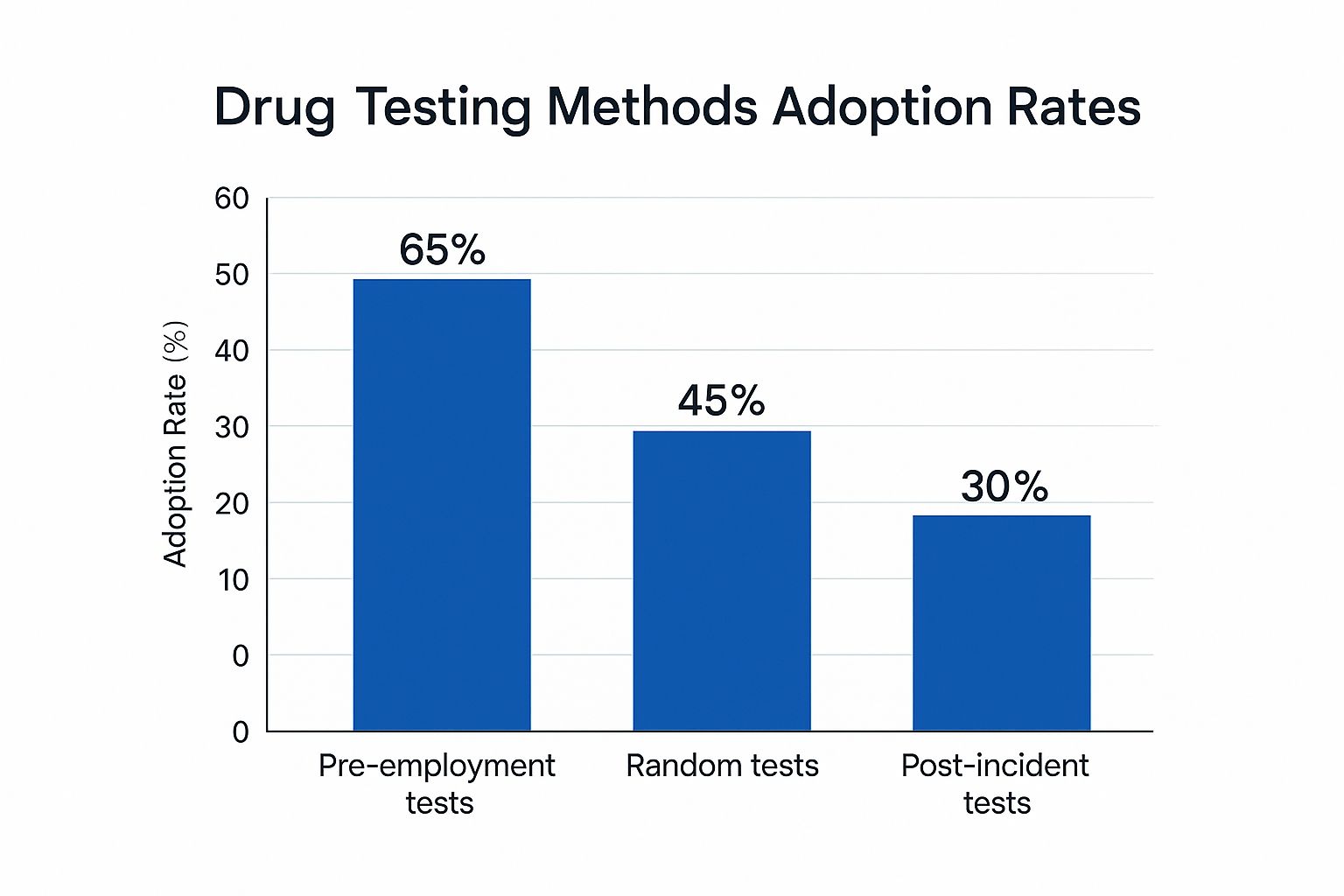
As you can see, pre-employment screening is by far the most common practice. Most companies want that initial layer of assurance before a candidate officially joins the team.
To make the decision a bit easier, I’ve put together a table comparing the most common methods side-by-side.
Comparison of Common Drug Testing Methods
| Test Type | Detection Window | Cost | Invasiveness | Best For |
|---|---|---|---|---|
| Urine | 1-7 days | Low | Moderate | Pre-employment, random, and post-accident screening. |
| Saliva (Oral Fluid) | 24-48 hours | Low-Moderate | Low | Reasonable suspicion and post-accident testing for recent use. |
| Hair Follicle | Up to 90 days | High | Moderate | Identifying long-term, patterned use; pre-employment for safety-sensitive roles. |
| Blood | A few hours to 2 days | High | High | Determining current impairment, typically after accidents or for legal purposes. |
This comparison should give you a clear framework for deciding which method—or combination of methods—is the best fit for your policy and your people.
Finding a Reliable Testing Partner
Choosing your testing vendor is just as important as picking the method itself. This is a partnership, not just another line item in your budget. You’re trusting them with incredibly sensitive employee data and relying on their accuracy to make critical hiring and employment decisions.
When you’re vetting potential partners, don’t be shy. Ask the tough questions:
- Accreditation: Are their labs properly certified? This is non-negotiable if you want results that will hold up legally.
- Chain of Custody: Walk me through your process. How do you collect, seal, and track samples to ensure there’s zero chance of tampering or mix-ups?
- Data Security: What measures do you have in place to protect our employees’ confidential information and test results?
- Support: Do you provide access to a Medical Review Officer (MRO)? An MRO is crucial for verifying positive results and ruling out legitimate medical explanations.
Don’t fall into the trap of choosing the cheapest vendor. A credible partner is your best defence against legal challenges, ensuring your programme is not just accurate, but also fair and defensible.
Think of a great testing partner as an extension of your own HR team. They’re the experts who help you execute your policy flawlessly, every single time. For a deeper dive into managing the results, you can explore our guide on drug test verification.
What to Do When an Employee’s Drug Test Comes Back Positive
Getting a positive drug test result for one of your employees can be a tricky situation, but it doesn’t have to descend into chaos. If you have a clear, confidential, and compassionate process in place, you can handle things professionally while staying true to your company’s policies. The key is to avoid a knee-jerk reaction and instead, stick to your established protocol.
The very first and most critical step is to have the result verified by a Medical Review Officer (MRO). An MRO is a licensed doctor who meticulously reviews the lab results and gets in touch with the employee directly. This is a non-negotiable part of the process. It helps rule out legitimate medical explanations for a positive result, like a prescription medication, preventing a “false positive” from causing unfair consequences.
The Medical Review Officer’s Role is Crucial
Once a lab flags a sample as a preliminary positive, the MRO’s work begins. Their job is to have a confidential conversation with the employee to see if there’s a valid medical reason for the result.
For example, an employee might test positive for opiates because they’re on prescribed painkillers after dental surgery. The MRO will verify that prescription. If it checks out, the result is reported back to you as negative. This simple step is vital—it protects the employee’s privacy and stops the company from making a snap decision based on incomplete facts.
Only move forward with any action after the MRO confirms a positive result with no valid medical explanation. This verification process is your shield against potential legal issues and ensures every decision is grounded in fact, not assumption.
Deciding on What Comes Next
Once you have that MRO confirmation, your response should be dictated entirely by your workplace drug policy. Consistency is everything here. A one-size-fits-all approach rarely works, which is why your policy should lay out a clear spectrum of possible actions.
This is where you need to consider your company culture and the specifics of the employee’s job. For a first-time offence in a non-safety-sensitive position, the goal might lean more towards support than immediate termination.
Your policy might outline actions like these:
- Offer Support: The best first step is often connecting the employee with your Employee Assistance Programme (EAP). EAPs are a fantastic resource, offering confidential counselling and support for all sorts of personal issues, including substance abuse.
- A Last-Chance Agreement: You could offer an agreement where the employee agrees to complete a rehabilitation programme and submit to follow-up testing in order to keep their job. This approach creates accountability while still offering a path to recovery.
- Disciplinary Action: For repeat violations or for any positive test in a safety-critical role, your policy might dictate more serious actions, such as suspension or even termination.
When you’re providing resources, it’s also incredibly helpful to offer guidance on things like Navigating Insurance Coverage for Addiction Treatment. Handling these conversations with empathy and professionalism is the goal. It shows you’re treating your employee with dignity while still upholding your company’s commitment to a safe workplace.
Frequently Asked Questions About Drug Testing Employees
Navigating the world of employee drug testing often brings up a lot of practical questions. Even with a rock-solid policy on paper, real-world situations pop up that need clear, direct answers. Let’s tackle some of the most common queries we hear from HR managers and business owners across India.
Getting these answers straight helps you act with consistency and confidence. It’s all about making sure your programme is not just compliant, but fair when you put it into practice.
Can We Conduct Random Drug Tests On All Employees In India?
This is a tricky one. While it’s technically possible if you’ve clearly outlined it in your company policy and the employee has agreed to it, random drug testing is a legal grey area in India. The biggest hurdle? It can be seen as stepping on an employee’s right to privacy unless you have a very strong reason.
That reason usually boils down to significant safety concerns directly linked to the job. For instance, random testing for someone operating heavy machinery or a commercial driver is far easier to justify than for an admin assistant working in an office. This is why most companies in India stick to pre-employment, reasonable suspicion, and post-accident testing—they are much more straightforward and legally sound.
If you’re set on a random testing programme, it has to be genuinely random and non-discriminatory. We can’t stress this enough: talk to a legal expert to make sure your policy and selection method can hold up against any potential challenges.
What Happens If an Employee Refuses a Drug Test?
An employee’s refusal to take a drug test should be handled strictly by the book—your book, that is. Your pre-defined company policy is your guide here. You can’t physically force someone to provide a sample.
However, if their employment contract and your company policy—both of which they signed and agreed to—state that testing is a condition of employment, a refusal becomes a direct policy violation. The consequences, whether it’s disciplinary action or even termination, must be spelled out clearly in that same policy. The key is to carefully document the refusal, preferably with a witness, and then simply follow the steps you’ve already laid out.
Are Home Drug Testing Kits Reliable for Workplace Screening?
In a word: no. At-home or instant-result drug testing kits just aren’t cut out for official workplace screening. They might give you a quick indication, but they completely lack the accuracy and—most importantly—the legal defensibility of professional lab testing.
Official workplace drug testing has several non-negotiable parts that home kits can’t offer:
- A Strict Chain of Custody: This is the documented trail that follows the sample from collection to testing, proving it hasn’t been tampered with.
- Laboratory Confirmation: Any initial positive result (a “presumptive positive”) has to be confirmed by a more sophisticated and accurate test in a certified lab.
- Medical Review Officer (MRO) Verification: As we’ve discussed, a qualified MRO must review every confirmed positive to rule out legitimate medical explanations, like prescription medication.
Making a disciplinary decision based on a home test kit is asking for trouble. It exposes your company to massive legal and financial risks. Always, always use an accredited laboratory and a professional collection service for any official programme for drug testing employees. It’s the only way to ensure your results are accurate, reliable, and can stand up in court.
Ready to build a drug testing programme that is both efficient and compliant? SpringVerify offers comprehensive screening services, including drug testing, to help you make informed hiring decisions with confidence. Our seamless integration and commitment to accuracy make us the preferred partner for India’s leading companies. Learn more about how SpringVerify can help you maintain a safe and productive workplace.


