

A data retention policy is so much more than a dry legal document. Think of it as a strategic framework that outlines precisely how long your business keeps specific data, how it’s stored, and, just as importantly, when it must be securely destroyed. Using a data retention policy template is your first step towards getting this right, ensuring your organisation in India manages its information efficiently, securely, and in full compliance with the law.
Table of Contents
Why a Data Retention Policy Is a Business Essential

Let’s be blunt: a data retention policy isn’t some “nice-to-have” checkbox for the legal team. It’s a critical asset for any modern business operating in India. The fallout from not having a clear policy is real, and it can be severe. Picture a fast-growing startup drowning in a swamp of disorganised customer data. Or imagine an established company paralysed by a legal discovery request because its records are a complete mess.
These aren’t just hypotheticals. I’ve seen situations like this cripple businesses, leading to hefty financial penalties, operational gridlock, and a painful loss of customer trust. That’s exactly why we need to start with the ‘why’ before jumping into the ‘how’.
Moving Beyond a Tick-Box Exercise
A solid policy is your company’s first line of defence on several fronts. It’s the official rulebook that stops data from being kept indefinitely “just in case.” That common practice, which has been dubbed data hoarding, massively increases your risk profile. The more data you hold onto, the bigger the prize for attackers and the greater the potential damage from a breach. A well-defined policy shuts this down by enforcing the principle of storage limitation.
It’s like organised spring cleaning for your company’s data. You regularly and systematically get rid of what’s no longer needed, and the benefits are immediate:
- Reduced Storage Costs: Let’s face it, storing huge amounts of data, whether on-premise servers or in the cloud, costs money. Methodically deleting old information frees up valuable resources and slashes unnecessary spending.
- Improved Operational Efficiency: When your teams need to find something specific, they aren’t wading through years of irrelevant files. This simple change makes everything from customer support to financial audits faster and far more accurate.
- Enhanced Data Security: By shrinking the volume of data you store, you shrink the potential target for cybercriminals. If a breach does happen, the impact is significantly smaller if you’ve already disposed of old, sensitive information.
Navigating the Indian Legal Landscape
Here in India, the need for a formal data retention policy has been cranked up a notch by the Digital Personal Data Protection (DPDP) Act. This legislation introduced strict rules about how personal data is collected, used, and—crucially—retained. A core principle is ‘purpose limitation’, which means you can only hold onto data for as long as needed to fulfil the specific purpose you collected it for.
A robust data retention policy is the very foundation of DPDP Act compliance. It provides auditable proof that your organisation respects data privacy principles and takes its stewardship responsibilities seriously, protecting you from potentially huge penalties.
Without a documented policy, proving compliance becomes nearly impossible. If you’re ever audited or investigated, you need to show not just that you have rules, but that you consistently follow them. A data retention policy template gives you the structure to build this essential documentation, making it clear that your approach is deliberate, not accidental. It transforms data management from a reactive chore into a proactive business strategy.
Navigating India’s Data Protection Legal Framework
Trying to get your head around India’s legal requirements for data retention can feel like you’re putting together a complex puzzle with a few pieces missing. But for any business operating here, it’s something you absolutely have to get right. The entire landscape has been reshaped by one landmark piece of legislation that every single organisation needs to know inside and out.
The central pillar is now the Digital Personal Data Protection (DPDP) Act, 2023. This law is the new gold standard for how companies must handle the personal information of Indian citizens. It pulls data privacy out of the shadows and puts it front and centre as a business priority, introducing specific obligations that will directly shape how you retain data.
The Core Principles: Purpose and Storage Limitation
At the very heart of the DPDP Act are two principles that should guide your entire data retention strategy: purpose limitation and storage limitation. They might sound a bit technical, but the ideas behind them are actually pretty straightforward and logical.
Purpose Limitation basically means you can only collect and keep personal data for a specific, clear reason that you’ve told the individual about. You can’t just collect a customer’s delivery address and then, years down the line, decide to use it for a completely unrelated marketing campaign without getting their permission all over again.
Storage Limitation flows directly from that. It means you can only hold onto that data for as long as it’s truly necessary to fulfil the original purpose. Once a product has been delivered and the return window has slammed shut, there’s no longer a “purpose” to keep that customer’s address—unless, of course, another law specifically requires you to.
These principles force a huge shift in thinking. We’re moving away from the old “keep everything, just in case” mentality to a much more disciplined approach: “keep only what you need, for only as long as you need it.”
What Counts as Personal Data?
To apply these principles properly, you first need a clear understanding of what “personal data” actually is. Under the DPDP Act, the definition is broad. It’s pretty much any data about an individual who can be identified from that information.
This obviously covers the usual suspects, but also includes data that can identify someone when pieced together.
- Direct Identifiers: Think name, Aadhaar number, phone number, or email address.
- Indirect Identifiers: This could be IP addresses, cookie data, location data, or even a specific combination of a job title and company that points to one person.
The bottom line is, if the information can be linked back to a living person, it’s personal data and falls under the Act’s protection.
The “Blacklist” Approach to Moving Data
For companies with a global footprint, a major question is how data can be transferred across borders. India’s framework, shaped by the DPDP Act, 2023, and the draft rules for 2025, takes a unique “blacklist” approach. Instead of creating a “whitelist” of approved countries, the central government can restrict data transfers to specific nations it deems unsafe.
This actually provides a lot more flexibility. By default, it allows data to flow to all countries except for those explicitly banned by the government. This is a crucial point for any business using international cloud services or collaborating with partners overseas.
The DPDP Act marks a major evolution in India’s privacy laws. It squarely places the burden of proof on organisations to justify why they’re holding onto data, making a formal, well-thought-out policy an essential tool for demonstrating both compliance and accountability.
Phased Rollout and Industry-Specific Rules
It’s also important to know that the DPDP Act isn’t being switched on all at once. Its provisions are being rolled out in phases, which gives businesses some much-needed time to adapt their systems and processes. For example, the rules for setting up the Data Protection Board might come into force before the more day-to-day operational rules, giving you a chance to prepare.
On top of the general DPDP Act, certain sectors like finance and healthcare have their own, often stricter, data retention rules. Financial technology companies, for instance, face a unique set of challenges and obligations. If you’re in this space, understanding the nuances of data retention compliance in the FinTech industry is non-negotiable. Your policy needs to be a comprehensive document that accounts for all applicable regulations, not just the big-picture framework.
How to Build Your Data Retention Schedule
This is where the rubber meets the road. A data retention policy template is great in theory, but it’s the schedule that puts it into practice. This schedule is the most critical piece of the puzzle—it’s the document that spells out exactly what data you keep, for how long, and why. Without it, your policy is just words on a page.
The process has to start with an exercise that, frankly, too many businesses skip: data mapping. Think of it as a full inventory of every single piece of information your company collects, processes, and stores. You can’t decide what to do with your data if you don’t even know what you have. This means identifying the specific types of data, where they live (physically or digitally), and the business reason you’re holding onto them in the first place.
For example, a single sales transaction can create data that ends up in your CRM, your accounting software, and your email marketing platform. Data mapping forces you to trace that flow, giving you a crystal-clear picture of your company’s entire data footprint.
Start with Data Classification
Once you’ve mapped everything out, the next logical step is to classify it. Trying to set a rule for every individual data point is a recipe for disaster. By grouping similar types of information into logical categories, you can make the task of assigning retention periods manageable and bring some order to the chaos.
For most businesses in India, these categories usually look something like this:
- Employee Records: This is a big one, covering everything from job applications and performance reviews to payroll information and exit interview notes.
- Customer Information: This includes personal details, purchase history, support tickets, and any data you collect to deliver your services.
- Financial Documents: Think invoices, tax filings, expense reports, and audit records. This category is always heavily regulated.
- Marketing and Sales Data: This bucket holds lead information, campaign analytics, website user data, and customer feedback.
This image breaks down the core components that form the backbone of a solid data retention policy.
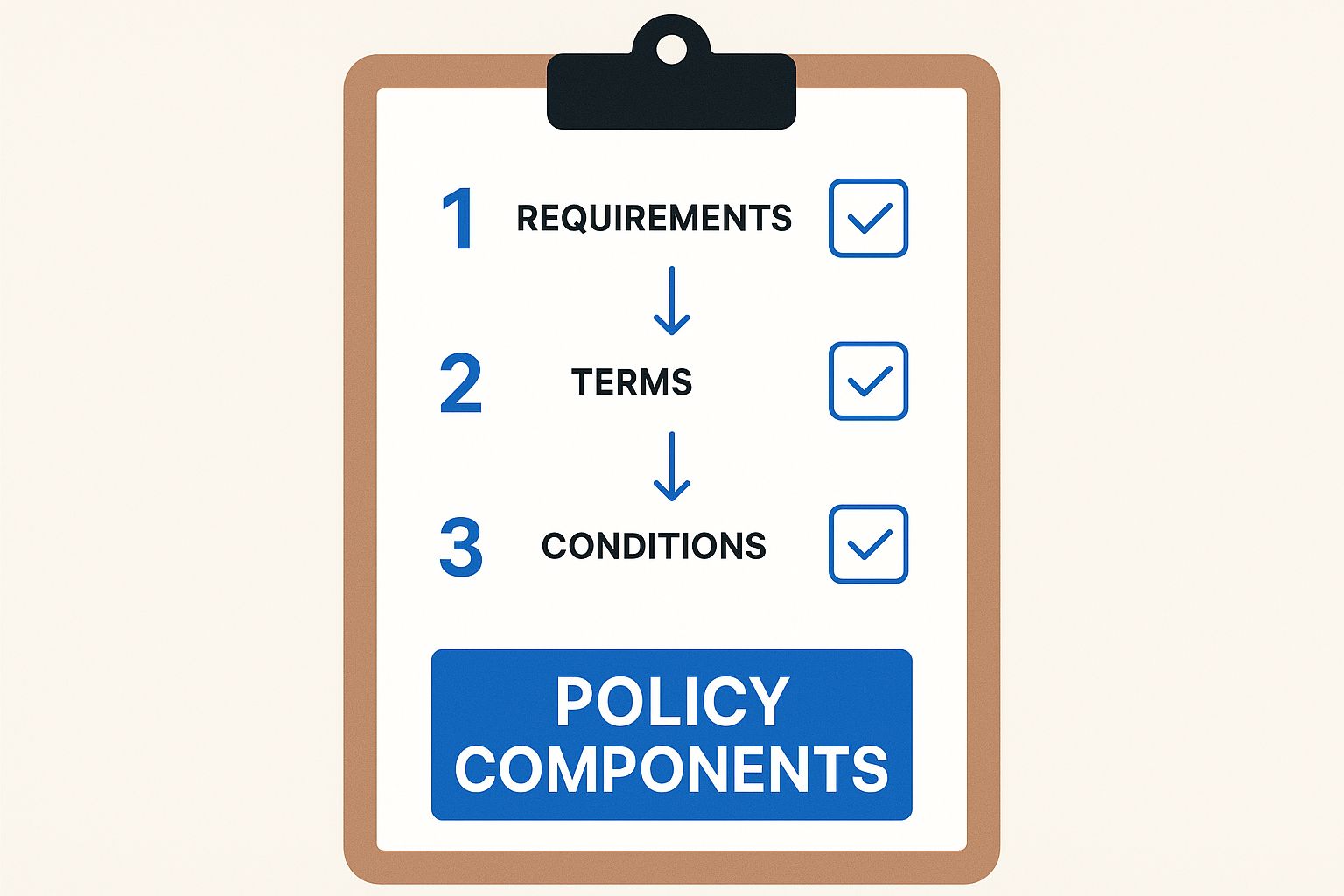
Visualising these elements like a checklist helps to reinforce that a strong policy is built by methodically ticking off each component, from classifying your data all the way to secure disposal.
Assigning Retention Periods for Each Category
With your data neatly categorised, it’s time to assign the actual retention periods. This isn’t guesswork. Every decision has to be justified by one of three things: legal requirements in India, legitimate business needs, or established industry standards.
For instance, the Companies Act, 2013, mandates that businesses must maintain their books of account for at least eight financial years. That’s a non-negotiable legal deadline for your financial records. In contrast, you might only need marketing data for 18-24 months—a period justified by its business value for analysing trends, after which it becomes stale.
Your data retention schedule should be a living document. This isn’t just about ticking a compliance box; it’s about operational excellence. A well-managed schedule prevents data hoarding, which quietly drains your resources and cranks up security risks.
To give you a head start, here’s a table with some common data types and suggested retention periods relevant for businesses operating in India. Remember, these are just examples. You’ll need to adapt this to your specific operational context and verify it against current laws.
Sample Data Retention Periods for Indian Businesses
This table provides illustrative retention periods for common types of data, helping businesses establish a baseline for their own schedule. Note these are examples and should be verified against specific legal and business requirements.
| Data Category | Example Data Types | Typical Retention Period (India) | Primary Justification |
|---|---|---|---|
| Employee Records | Recruitment data (unsuccessful candidates) | 6 months – 1 year | Purpose Limitation (DPDP Act) |
| Employee Records | Core HR files (contracts, salary details) | 7 years post-employment | Contractual & Legal Obligations |
| Financial Records | Invoices, receipts, accounting ledgers | 8 years | Companies Act, 2013 |
| Customer Data | Active customer account information | Duration of business relationship | Business Necessity, Consent |
| Tax Documents | GST filings, income tax returns | 8 years from end of assessment year | Tax Laws & Regulations |
| Marketing Data | Website analytics, campaign data | 18 – 24 months | Business Need for Analysis |
This framework provides a solid starting point, but always consult with legal counsel to ensure your schedule is fully compliant.
Managing Exceptions and Legal Holds
Life happens, and no schedule can predict every curveball. Your process needs to be flexible enough to handle exceptions, the most common of which is a legal hold. This is a formal directive to preserve specific data related to actual or anticipated litigation, which immediately overrides any scheduled destruction.
Let’s say an employee dispute is heading toward litigation. Your legal team would issue a hold on that employee’s emails, performance records, and related communications. Your policy must have a clear procedure for initiating, managing, and eventually lifting these holds to prevent the accidental—and potentially disastrous—destruction of critical evidence. A well-structured policy is a cornerstone of smooth business processes. For those looking to refine their broader workflows, exploring ways to improve operational efficiency through better HR practices can offer valuable insights that perfectly complement your data management strategy.
Drafting Your Policy with Our Downloadable Template
Once you’ve nailed down your data retention schedule, the next step is to make it official by drafting a formal policy document. This isn’t just about ticking a box. It’s the critical move that turns your schedule from a simple guideline into a standard that everyone in the company must follow.
A well-written policy brings clarity, assigns ownership, and acts as your official proof of compliance. Think of your schedule as the “what” and “when.” The policy document builds on that by explaining the “who,” “how,” and “why.” This document will become the single source of truth for your entire organisation on how data is handled from creation to deletion.
Core Components of a Strong Policy
A truly solid data retention policy template stands on a few key pillars. Each one handles a specific piece of the data management puzzle, leaving no room for guesswork. A vague policy is a useless policy, so your main goal here is precision.
First up, your policy needs to clearly state its purpose and scope. The purpose should be short and to the point: the policy exists to meet legal duties (call out the DPDP Act specifically), control storage costs, and safeguard company and customer information.
The scope then defines exactly who and what the policy covers—think all employees, contractors, third-party partners, and all company-owned data, no matter where it lives.
After setting the scene, you need to spell out who is responsible for what.
- Data Protection Officer (DPO) or Equivalent: This person (or team) is in charge of making sure the policy is followed, answering compliance questions, and keeping it up-to-date.
- IT Department: They handle the technical side of things, like securely wiping data and setting up retention rules in your systems.
- All Employees: Everyone in the company has a role to play. They need to understand the policy and follow it in their day-to-day work.
The real power of a data retention policy lies in its ability to create accountability. By clearly assigning roles, you ensure that data management isn’t just an abstract concept but a concrete responsibility shared across the organisation.
Secure Disposal and Auditing Procedures
One of the most crucial parts of your policy is the section on secure data disposal. It’s not enough to just say data will be “deleted.” You have to get specific about the methods.
For digital data, this could mean cryptographic erasure or using special software that makes the information completely unrecoverable. For paper records, it means cross-cut shredding.
Your policy also needs a plan for regular training and audits. An annual review is a standard best practice. It ensures the policy keeps up with any changes in the law or how your business operates. Audits—whether done by your own team or an external one—are there to check that the rules you’ve set are actually being followed.
When putting together comprehensive policies, don’t forget to consider all the different document types and what they might need, like essential confidential cover sheet templates, to ensure total data protection.
Customise Our Template for Your Business
To make this whole process a lot simpler, we’ve put together a customisable data retention policy template. It’s built to give you a strong foundation, covering all the essential sections we’ve just talked about.
Here’s a preview of what the downloadable file looks like, all ready for you to make it your own.
This .docx file comes with pre-written sections that you can easily tweak with your company’s details, your specific retention schedule, and the roles you’ve assigned. Just download it, open it up, and start filling in the bracketed information. This quickly turns a generic template into a practical, tailored policy that fits your business and India’s legal requirements perfectly.
Putting Your Policy into Practice and Staying Compliant

Let’s be honest: a perfectly drafted policy is worthless if it just sits in a shared drive collecting digital dust. The real work begins when you turn those words into action. This is where you bring your data retention policy to life, embedding it into the very fabric of your daily operations to make sure you stay compliant.
The first move? Communication. It’s the most critical step. You can’t expect your team to follow rules they don’t even know exist. Announce the new policy everywhere—through company-wide emails, team meetings, and your internal portal. Make it crystal clear that this isn’t just an IT issue; it’s everyone’s responsibility.
From there, you need to get serious about training. A general announcement isn’t enough. You need to run regular, role-specific training sessions that break down what the policy means for each department. A sales team member, for instance, needs to understand the rules for CRM data, while the HR team needs to know the ins and outs of handling employee records.
Integrating Rules into Daily Workflows
Real compliance happens when your policy is baked directly into your IT systems and daily workflows. The goal is to make the right choice the easy choice. This means translating your retention schedule into automated rules within your software.
For example, your document management system can be set up to automatically flag files for deletion once they hit their expiry date. This kind of proactive automation is far more reliable than crossing your fingers and hoping someone remembers to do a manual clean-up.
This operational side is especially important for staying compliant with India’s DPDP Act and its related rules. Properly managing user consent and processing data deletion requests are no longer nice-to-haves; they’re fundamental legal requirements. For a wider look at staying on the right side of the law, this essential guide for nonprofit compliance offers some great insights.
Managing DPDP Act Requirements
The draft Digital Personal Data Protection Rules, 2025, have raised the bar for data handling in India. One major new requirement is that businesses must notify individuals at least 48 hours before erasing their personal data—a significant move towards greater transparency.
The rules also demand that consent must be ‘free, specific, informed, unconditional, and unambiguous’. This means you need very clear notices about how data is used and how users can withdraw their consent. These evolving regulations create fresh operational challenges, making it vital to have solid processes for strict policy adherence and timely data deletion.
To handle this, you need a robust process for managing data subject requests. When a user asks for their data to be deleted, you must have a clear, documented workflow to:
- Verify the User’s Identity: First, make sure the request is legitimate.
- Locate All Relevant Data: You need to check every system where their data might be stored—from your main database to backups and third-party tools.
- Execute Deletion Securely: Use methods that render the data completely unrecoverable, not just move it to a recycle bin.
- Notify the User: Finally, inform them that their data has been erased, as required by the new rules.
Establishing Breach Reporting and Grievance Redressal
Building trust in India’s digital economy means having a plan for when things go wrong. Your data retention policy needs to be backed up by solid procedures for breach reporting and grievance redressal.
A well-defined grievance redressal mechanism isn’t just a legal necessity; it’s a powerful tool for customer retention. It shows you respect user rights and are committed to resolving issues transparently, which is vital for building lasting trust.
Set up a clear, easy-to-find channel for users to raise concerns about their data, like a dedicated email address or a simple form on your website. Then, define the internal process for investigating and responding to these grievances within a specific timeframe.
Similarly, an internal breach reporting procedure is non-negotiable. Every employee must know exactly who to contact the moment they suspect a data breach. Quick action can massively limit the damage and is a key part of responsible corporate compliance in India. By operationalising your policy this way, you move from just having a document to practising active, vigilant data governance.
Common Questions About Data Retention Policies in India
Even with a solid guide and a ready-to-use data retention policy template, questions always pop up. I’ve seen countless business owners and compliance officers run into unique situations when trying to put their policies into practice here in India. This section cuts right to the chase, answering the most common questions we hear from people on the ground.
Think of this as the practical advice you need to bridge the gap between the policy on paper and its real-world application.
What Is the Biggest Mistake Companies Make with Data Retention?
Without a doubt, the single riskiest mistake is accidental data hoarding. It’s the habit of keeping every scrap of data forever, driven by a vague feeling that it might be useful someday. In reality, this practice, often called over-retention, isn’t just messy—it’s a massive liability.
It massively expands your attack surface for data breaches. More data means more for criminals to steal. It also turns legal discovery requests into a costly nightmare and flies in the face of the “storage limitation” principle in India’s DPDP Act. A proper policy flips the script, forcing you to justify why data is kept, not why it’s deleted.
The biggest pitfall is treating data retention as a passive, “just-in-case” activity. A proactive policy isn’t about what you keep; it’s about what you have a legitimate, documented reason to delete. This simple shift in perspective is the key to minimising risk and cost.
How Often Should We Review Our Data Retention Policy?
A data retention policy is a living document, not a “set it and forget it” file you archive somewhere. To keep it effective and compliant, it needs regular attention. We strongly recommend a full, top-to-bottom review at least once a year.
But some events should trigger an immediate review, no matter when your annual check-up is scheduled. These include:
- Changes in Law: New regulations or amendments, like the finalisation of the DPDP Rules, demand an immediate policy update.
- New Business Systems: Rolling out a new CRM, ERP, or any other major software will almost certainly introduce new types of data and workflows.
- New Data Collection: If you start collecting a new category of personal information, your policy has to reflect that.
- Market Expansion: Moving into a new region might put you under a different set of legal requirements.
Think of these reviews as tune-ups that ensure your policy keeps pace with your business and the law.
Does This Policy Apply to Data Backups Too?
Yes, absolutely. This is a critical point that’s surprisingly easy to miss. A compliant data retention policy must cover every single copy of your data, and that explicitly includes backups and archives. If you ignore them, you’re leaving a massive compliance blind spot.
Your policy needs to spell out the retention schedule for the backup media itself. For instance, you might keep daily backups for a week, and weekly backups for a month. More importantly, it must detail a secure process for ensuring that data is permanently wiped from these backups once its retention period is over. Otherwise, data you thought was gone could still be lurking, leaving you exposed to legal requests and breaches.
What Is a Legal Hold and How Does It Affect Our Schedule?
A “legal hold” is a formal directive to preserve all information that could be relevant to a lawsuit or investigation. When a legal hold is issued for specific data—say, an employee’s emails related to a contract dispute—it instantly overrides your standard retention schedule for that information.
This means the data must not be deleted until your legal team gives the all-clear, even if its normal destruction date has come and gone. Destroying evidence under a legal hold, even by accident, can lead to severe penalties. Your data retention policy must include a clear, step-by-step procedure for how your team will initiate, manage, and release legal holds to ensure you handle these critical events correctly.
Making informed hiring decisions quickly and confidently is crucial for growth. SpringVerify offers reliable and comprehensive background verification services designed for Indian businesses of all sizes. From instant KYC checks to in-depth employment history verification, our solutions integrate seamlessly with your existing HR platforms, ensuring a secure and efficient process. Discover how we can support your hiring needs at https://in.springverify.com.


