

Table of Contents
Why Criminal Background Checks Matter More Than Ever
Think of hiring like building a house. You wouldn’t build on a shaky foundation, would you? Using weak materials leads to cracks, instability, and eventual collapse. Hiring the wrong person can have a similar impact on a company, damaging its reputation, finances, and chances of success. Criminal background checks aren’t just about basic safety anymore; they’re a vital part of building a solid foundation of trust and security in the workplace.
I’ve been talking to HR professionals across India, and there’s a definite shift happening. More and more, they see thorough background checks as a strategic tool, not just a compliance checkbox. Some companies using comprehensive screening programs have seen big improvements in employee retention and a more positive work environment. It’s all about the feeling of security and trust these checks create, boosting morale and minimizing internal conflicts.
Sadly, some companies still rely on outdated methods that miss important warning signs. The consequences can be devastating, highlighting the difference between proactive prevention and reactive damage control. Imagine the cost of a bad hire: lost productivity, potential lawsuits, damaged team morale, and the expense of finding and training a replacement. Investing in robust screening might seem like an extra cost upfront, but it’s nothing compared to the potential fallout.
The growing importance of background checks in India is clear from the market itself. Revenue is projected to jump from $176.44 million to $263.226 million over a specific period. This growth reflects the rising demand for these checks in a country where the crime rate is increasing. The National Crime Records Bureau (NCRB) reported a rise from 422.2 crimes per million in 2022 to 445.9 crimes per million in 2024. Discover more insights about the Indian criminal background check market. In today’s competitive business world, criminal background checks aren’t just a good idea – they’re essential for building a strong, secure, and thriving business.
Walking Through The Background Check Process Step-by-Step
Think of a criminal background check like detective work. It’s methodical, thorough, and more complex than you might think. It’s not a simple “yes” or “no” but a multi-stage process. Let’s explore what happens from the moment a check is requested to when you receive the final report.
First, there’s the consent phase. Imagine asking someone to open their personal history for inspection. It requires trust and transparency. In India, this means getting explicit written consent from the candidate. This consent outlines what the check covers and how the information will be used. It’s the ethical and legal foundation of the entire process.
Next, the information gathering begins. Depending on the type of check, the search could involve local police stations, district courts, or even national criminal databases. This is where the real detective work begins. Trained professionals meticulously examine records, verifying information and ensuring accuracy. It’s like piecing together a puzzle.
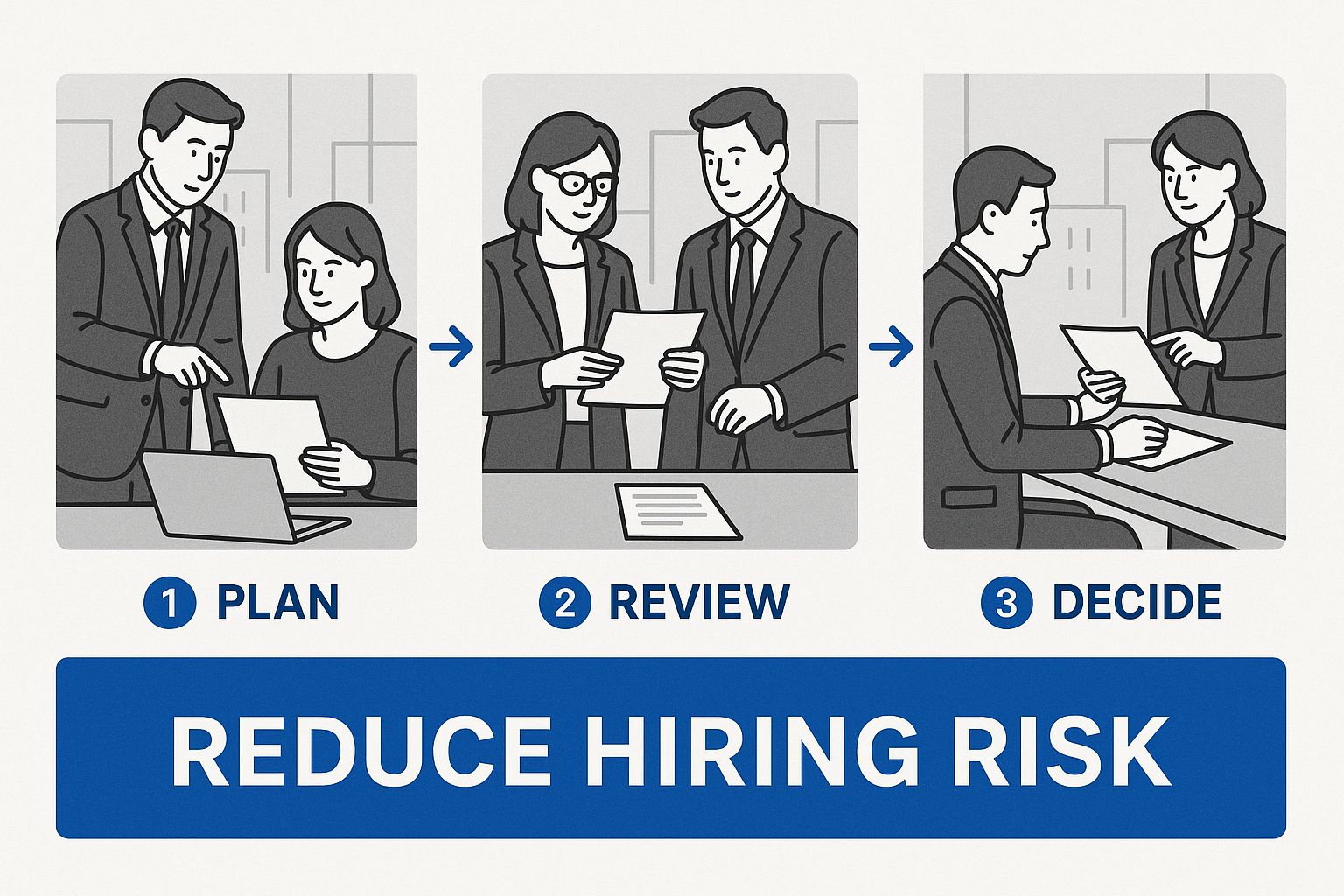
This infographic depicts the process flow of a criminal background check, showing professionals diligently reviewing documents in a corporate office setting, emphasizing risk reduction.
This infographic illustrates the methodical nature of a thorough background check and how careful review mitigates hiring risks. This thorough approach takes time. Traditionally, criminal background checks in India involve manual processes, often requiring 7 to 15 working days or more. However, technology like AI-powered solutions from Verifyin is changing this, improving efficiency and speed. Learn more about background check timelines.
This time is essential for confirming court records, cross-referencing databases, and ensuring accuracy. These steps protect both the candidate and the employer from incorrect or misleading information.
Understanding the Timeline and Accuracy of Background Checks
Why do some searches take days and others weeks? The complexity of the search and how accessible the records are play a significant role. A simple check with readily available records might be completed quickly. However, a complex search requiring manual retrieval of court records from multiple jurisdictions will naturally take longer.
Accuracy also requires time. Think of it like double-checking your work—it’s crucial to avoid costly mistakes. Rushing the process might lead to overlooking vital details and potentially basing a hiring decision on incomplete information. This careful approach ensures a more reliable result, giving employers greater confidence in their hiring decisions.
Let’s look at a comparison of traditional and modern background checks:
To understand the difference in timelines, here’s a comparison of traditional and AI-driven approaches:
| Process Stage | Traditional Method | AI-Driven Method | Time Difference |
|---|---|---|---|
| Candidate Consent | Manual forms and signatures | Digital forms and e-signatures | Reduced by a few days |
| Data Collection | Manual retrieval from various sources | Automated data retrieval from integrated databases | Reduced significantly |
| Verification | Manual cross-referencing and confirmation | AI-powered verification and anomaly detection | Reduced significantly |
| Report Generation | Manual compilation and review | Automated report generation | Reduced by a few days |
| Overall Time | 7-15+ working days | Potentially a few days, depending on the complexity | Substantial reduction in most cases |
As you can see, using AI can drastically reduce the time it takes to complete a background check. While some complexities might still require more time, the overall process is much more efficient.
Setting Realistic Expectations
Understanding the complexities of the process helps set realistic expectations for both the timeline and the thoroughness of the check. A criminal background check isn’t a simple database query; it’s a multifaceted process involving human expertise and, increasingly, advanced technology. By appreciating the steps involved, from the initial consent to the final report, you can understand the value of a comprehensive and accurate criminal background check. Ultimately, this process contributes to a safer and more trustworthy work environment for everyone.
Navigating Legal Requirements Without Getting Lost
The legal side of criminal background checks can feel like wandering through a maze. But don’t worry, with a good grasp of the basics, the path becomes much clearer. Let’s explore the essential rules, from getting consent to using information appropriately in hiring.
First things first: consent. Think of it like this – you wouldn’t walk into someone’s house without knocking, right? Getting background information is similar. You absolutely need the candidate’s clear, written permission. This consent should spell out what the check involves and how the information will be used. It’s a legal must-do and just plain respectful.
Then comes the matter of using the information legally. Just because information is available doesn’t mean it’s fair game for hiring decisions. Some details, like arrests without convictions, might not be relevant or fair to consider. Knowing the difference between access and ethical use is vital. For more on compliance in India, see our guide: Compliance and Background Verification Services in India.
Data Protection and Retention: Handling Sensitive Information Responsibly
Data protection and retention rules are like the locks on your doors – they keep sensitive information safe. You’re handling personal data, so responsibility is key. This means secure storage, restricted access, and clear rules on how long to keep data and how to securely dispose of it. You can’t just hold onto this information forever.
Navigating Industry-Specific Regulations and Potential Pitfalls
Different industries have their own quirks. Think of the financial services world – they face tough rules about background checks because of the sensitive nature of the work. The new FDIC regulations (starting October 1, 2024) are a good example. These aim to make it a little easier to hire people with certain criminal histories, even some drug-related offenses. This just goes to show how the legal landscape is always changing, and staying up-to-date is crucial.
Knowing what you can legally ask during interviews is also essential. Asking about certain kinds of criminal offenses might be off-limits. Understanding these fine points helps you avoid legal headaches and ensure fair hiring. Mistakes can lead to legal trouble and hurt your reputation, so knowing the rules is a big deal.
Building a Compliant and Effective Background Check Process
Building compliant processes isn’t just about dodging legal issues; it’s about building trust and fairness. It tells candidates you respect their rights and hire ethically. In the end, handling these legal aspects correctly helps you make smart hiring decisions while protecting both your company and the people you screen.
Industry-Specific Challenges: What Financial Services Teaches Us

The financial services industry offers a fascinating look into how complex criminal background checks are becoming. Imagine a high-stakes chess match: one wrong move, and the consequences can be devastating. The lessons learned here apply across industries, especially as fraud gets smarter and our digital lives become more vulnerable.
Two major factors complicate background checks in finance: the sheer volume of daily transactions and the diverse workforce. This combination creates many opportunities for fraud, making thorough screening absolutely essential. The sensitive nature of financial data adds another layer of complexity, as does the risk of insider threats. Choosing the right vendors is crucial, so understanding their security practices is key. Check out this resource on Vendor Risk Management for more information.
Identity Verification: A Growing Concern
In finance, confirming someone’s identity is like authenticating a priceless work of art. A quick glance isn’t enough; you need expert analysis and multiple layers of verification. Why such meticulous care? Because financial institutions are prime targets for identity theft and fraud.
The Banking, Financial Services, and Insurance (BFSI) sector in India knows this firsthand. In the 2023-24 financial year, background check discrepancies hit 10.4%, an 18.1% jump from the previous year. A whopping 73.4% of these discrepancies stemmed from identity verification issues. Learn more about these discrepancies in the BFSI sector.
Let’s look at the specific requirements and challenges various industries face regarding background checks:
To help illustrate the diverse landscape of background checks, the following table provides a snapshot of various industry requirements. It highlights the differences in what’s checked, how long it takes, and the types of discrepancies often found.
| Industry | Check Requirements | Average Processing Time | Common Discrepancy Types | Compliance Level |
|---|---|---|---|---|
| Financial Services | Credit history, criminal record, identity verification, employment verification, regulatory checks (e.g., FINRA) | 5-7 business days | Identity theft, employment history misrepresentation, financial fraud | Very High |
| Healthcare | Criminal record, license verification, drug screening, education verification | 3-5 business days | License discrepancies, employment gaps, inaccurate education credentials | High |
| Technology | Criminal record, education verification, employment verification, reference checks | 2-4 business days | Employment history discrepancies, inflated skill sets | Moderate |
| Retail | Criminal record, employment verification, reference checks | 1-3 business days | Employment gaps, inaccurate references | Moderate |
| Manufacturing | Criminal record, drug screening, employment verification, skills assessment | 2-4 business days | Employment history discrepancies, falsification of skills | Moderate |
As you can see, industries have unique needs when it comes to background checks. Understanding these differences is key to building a successful screening program.
Adapting Screening Strategies for a Changing Landscape
Leading financial institutions are tackling these challenges head-on. They’re moving beyond traditional methods and embracing technology-driven solutions to analyze massive amounts of data and detect even subtle inconsistencies. For example, some now use AI-powered systems to cross-reference data from various sources—including social media and public records—to build a more complete picture of a candidate.
This proactive approach helps identify potential risks early in the hiring process, preventing costly mistakes down the line. Learn more about this with resources like Fintech Background Checks. These advanced techniques aren’t just about catching criminals; they’re about safeguarding the entire financial system.
Learning from the Financial Sector: Implications for All Industries
The challenges faced by financial services companies offer invaluable lessons for other sectors. As fraudsters become more sophisticated, the need for robust and adaptable background check processes becomes universal. This means prioritizing identity verification, investing in advanced screening tech, and keeping up with the latest fraud prevention trends. By learning from the financial sector’s experience, organizations across all industries can strengthen their hiring practices and protect themselves from potential risks.
How Technology Is Revolutionizing Background Verification

This screenshot showcases the Verifyin platform, highlighting its user-friendly interface for managing background checks. The clean design and clear data presentation suggest an emphasis on efficiency and ease of use. This type of intuitive platform simplifies the background check process for HR professionals.
Imagine shortening the turnaround time for a criminal background check from weeks to mere hours, all while increasing accuracy. This is precisely what current technology enables. AI-powered verification systems are reshaping the process. Let’s delve into how these advancements are changing the landscape of background checks.
The Power of AI and Machine Learning
Machine learning algorithms can sift through massive databases concurrently—a task virtually impossible for humans to perform efficiently. These algorithms can pinpoint subtle discrepancies that a human reviewer might miss, flagging potential inconsistencies for expert evaluation. Think of it as having a dedicated research assistant capable of processing information at incredible speed and with remarkable precision.
For instance, AI can swiftly scan multiple databases for name variations, prior addresses, or other identifying details that might be missed during a manual review. This accelerates the process and improves accuracy.
Real-World Examples of Tech-Driven Success
Many organizations in India have adopted these technologies and witnessed significant improvements. They have seen faster processing times, increased accuracy, and reduced manual workloads, freeing up HR teams to concentrate on other strategic activities. HR Chatbots can further streamline HR processes, such as scheduling interviews and addressing candidate questions.
Balancing Technology with Human Oversight
While technology plays a vital role, human oversight remains indispensable. Consider AI a powerful tool, not a substitute for human judgment. Final hiring decisions should always take into account the specific context and circumstances, ensuring fair and thorough consideration for every candidate. This balanced approach guarantees both efficiency and ethical practices.
Evaluating Different Technological Solutions
It’s important to remember that not all tech solutions are equal. Some prioritize speed, while others focus on particular types of checks. Evaluating different options requires careful consideration of your organization’s specific needs.
Factors such as integration with existing HR systems, data security, and compliance with local regulations in India are crucial. Understanding your specific needs will guide you to the right solution. A thorough evaluation ensures that the chosen technology aligns with your overall hiring strategy. By considering these factors, you can implement a technologically advanced system that enhances both the speed and accuracy of your criminal background checks.
Avoiding Common Mistakes That Derail Background Check Programs
Even with the best of intentions, organizations can stumble into some serious pitfalls when setting up their criminal background check programs. Some of these missteps have bigger consequences than others. Let’s explore some common traps that can lead to legal headaches, missed red flags, or unfair treatment of candidates.
The Danger of Cutting Corners
One major mistake is skimping on documentation. Think of it like building a house without blueprints—it’s a recipe for disaster. Similarly, incomplete or inaccurate documentation during the background check process can cause serious legal trouble.
This includes failing to get proper consent, not keeping accurate records, or neglecting to follow up on discrepancies. These oversights can create a legal minefield and completely undermine the screening process.
Inadequate Policies: A Breeding Ground for Liability
Another common trap is having weak or inconsistent policies. A generic, one-size-fits-all approach rarely works well in practice. Your policies should be tailored to your specific industry, location, and the types of jobs you’re filling.
This means having clear guidelines on which types of checks are conducted, how the information is used, and how you keep candidates informed. Without these safeguards, you risk legal challenges and accusations of discrimination. You might be interested in: Human Resources and Background Checks in India.
Generic Approaches Rarely Work: The Need for Tailored Strategies
Using a generic background check approach is like trying to use the same key for every lock—it simply won’t work. Different roles require different levels of scrutiny.
A cashier position doesn’t need the same level of background checking as a senior executive with access to sensitive information. By tailoring your approach to the risks associated with each role, you can build a more effective and efficient screening program. To further improve background verification, consider API integration platforms.
Learning from Real-World Scenarios
I’ve talked with HR professionals who’ve made these mistakes, and the stories are illuminating. One company faced a lawsuit after relying on an out-of-date database with inaccurate information. Another ran into trouble by not properly documenting the consent process.
These real-world examples show just how important careful planning and precise execution are.
Building Effective Safeguards: Protecting Your Organization and Candidates
By understanding these common pitfalls, you can develop strategies to avoid them. This means investing in training for your HR team, establishing clear policies and procedures, and using reliable, current technology.
This careful approach protects your organization from legal and reputational damage while ensuring fair treatment for all applicants. Building effective safeguards isn’t just about compliance; it’s about creating a culture of trust and responsibility. This ultimately creates a safer and more secure work environment for everyone.
Your Action Plan For Background Check Success
So, we’ve covered the ins and outs of criminal background checks. Now, let’s talk about how to actually build a successful program in your own organization. Think of it like setting up a new kitchen – you need the right appliances (technology), a clear recipe (policies), and skilled chefs (your HR team).
Building Your Background Check Program: A Step-by-Step Guide
Whether you’re starting from scratch or tweaking what you already have, a structured approach is key. Here’s how to get started:
- Define Your Scope: Figure out which jobs actually need background checks and what kind of checks make sense. Imagine hiring a cashier versus a CFO – the checks needed will obviously be different.
- Develop Clear Policies: Put everything in writing. This policy is your recipe book – it keeps everyone on the same page and makes sure things are fair and transparent.
- Secure Consent: Getting written consent isn’t just a good idea, it’s the law. Make the process crystal clear for your candidates.
- Choose the Right Technology: There are tons of background check providers out there – like SpringVerify. Find one that fits your budget and integrates with your existing HR systems.
- Train Your Team: Make sure your HR team knows the rules of the road – both legally and ethically. This prevents mistakes and keeps you compliant.
- Monitor and Review: Regularly check how your program’s doing and make changes as needed. Laws and best practices change, so staying up-to-date is vital.
Timelines and Benchmarks for Implementation
Setting up or changing a background check program takes time. Think of it like renovating a house – a small bathroom remodel will be faster than a whole-house overhaul.
- Small Organizations (1-50 employees): Think 1-2 months. You’re focusing on the essentials – basic policies, procedures, and a simple background check tool.
- Medium-Sized Organizations (50-250 employees): Expect 2-4 months. You’ll need more detailed policies, integration with your existing systems, and more team training.
- Large Enterprises (250+ employees): This could take 4-6 months or more. You’ll need to coordinate across departments and may need a customized background check solution.
How do you know if it’s working? Here are some key benchmarks:
- Reduced Time-to-Hire: Are background checks slowing down your hiring process? Aim for efficiency without cutting corners.
- Improved Quality of Hire: Are you hiring better people? Look at employee performance and how long they stay with the company.
- Compliance with Regulations: Are you following all the rules? Regular audits will help you stay out of trouble.
Recognizing When Your Process Needs an Update
Just like a car needs regular maintenance, your background check program needs attention. Here are some warning signs:
- Slow Turnaround Times: Are background checks taking forever? This can really hurt your hiring efforts.
- High Discrepancy Rates: Are there lots of errors in the reports? This could point to problems with data quality or your process.
- Compliance Concerns: Laws change, so you need to stay informed. An outdated process puts you at risk.
- Lack of Integration: Is your background check process separate from your other HR systems? This can create extra work and slow things down.
By following these guidelines and addressing problems head-on, you can create a background check program that’s both effective and sustainable. It’s all about building a safer and more secure workplace. Want to learn more about building a robust program? SpringVerify offers comprehensive background verification services. Contact us today.


