

In today’s competitive Indian market, knowing your cost per hire (CPH) isn’t just a good-to-have HR metric; it’s a strategic necessity. It’s the clearest way to see how efficient your talent acquisition efforts truly are.
By simply dividing your total recruitment costs by the number of people you hired, you get a single, powerful number. This figure helps you justify your budget, find and fix expensive bottlenecks in your hiring process, and ultimately improve your company’s financial health.
Table of Contents
Why Cost Per Hire Is Your Most Important HR Metric

Think of the cost per hire formula as a health check-up for your entire recruitment engine. A high CPH might be a red flag, pointing to sourcing channels that aren’t delivering or an interview process that’s dragging on for too long.
On the flip side, a low CPH could be a sign of a strong employer brand that’s pulling in great candidates organically. It gives you a clear return on investment for every Rupee spent on hiring.
In India, this formula is a key benchmark for recruitment efficiency. The calculation should include everything from agency fees and job ad spending to background checks and onboarding costs. For example, if a company spends ₹5,00,000 in a year on recruitment and brings on 50 new employees, the CPH is ₹10,000. This figure is often more favourable than in Western markets, largely due to more cost-effective overheads here.
Getting the Numbers Right: What to Include
To get a truly accurate CPH, you need to be meticulous about tracking both your internal and external recruitment costs. It’s easy to miss the small expenses, but they add up and can seriously skew your data, leading you to make the wrong strategic calls.
Below is a breakdown of the typical costs you absolutely must include for an accurate calculation.
Essential Recruitment Costs for Your Calculation
| Cost Category | Specific Examples |
|---|---|
| Internal Costs | Recruiter salaries and benefits, hiring manager’s time (interviews, meetings), employee referral bonuses, administrative support staff time. |
| External Costs | Recruitment agency fees, job board subscriptions (e.g., Naukri, LinkedIn), Applicant Tracking System (ATS) fees, background check services, advertising campaigns, career fair expenses. |
Getting a firm handle on these components is the first real step toward mastering your company’s hiring strategy. It’s not just about crunching numbers; it’s about understanding the story those numbers tell about your recruitment process.
A well-calculated CPH shifts the conversation from “we need a bigger budget” to “here’s how we can invest our budget for the best possible return.” It turns HR from a perceived cost centre into a genuine strategic partner for the business.
The Strategic Value of CPH
Tracking your cost per hire isn’t just an accounting chore—it’s foundational to building a scalable and efficient organisation.
When you analyse this metric, you can pinpoint which sourcing channels deliver the highest-quality candidates for the lowest cost. You might discover, for instance, that your employee referral programme brings in better hires at one-third the cost of using external recruitment agencies.
This kind of data-driven insight is incredibly powerful. It allows you to reallocate your budget with confidence, doubling down on what works and pulling back from what doesn’t. It also lays the groundwork for more advanced HR analytics and smarter workforce planning for the future.
Calculating Your Cost Per Hire Like a Pro
Let’s get down to business and demystify the cost per hire formula. It’s a powerful metric, but only if you use it correctly. The basic calculation is straightforward enough: (Total Internal Costs + Total External Costs) / Total Number of Hires.
Sounds simple, right? The real trick is in getting an accurate, honest tally of all those costs. A small miscalculation can throw off your entire dataset, leading to poor strategic decisions down the line. Nailing this first step is everything when it comes to optimising your recruitment budget.
Breaking Down the Costs
To get a truly accurate CPH, you have to meticulously track two very different kinds of expenses.
First up are Internal Costs. These are the expenses generated by your own team and resources. They’re often the easiest to overlook but can represent a massive chunk of your total spend. You need to think beyond just salaries.
- Recruiter & HR Team Time: This isn’t their full salary, but a prorated portion reflecting the time they dedicate purely to recruitment activities.
- Hiring Manager Time: Think about the hours your managers spend sifting through CVs, prepping for interviews, and actually conducting them. That time has a real cost.
- Employee Referral Bonuses: Every cash or non-cash incentive you pay out for a successful referral needs to be counted.
- Administrative Support: Don’t forget the time your support staff spends scheduling interviews and handling all the background logistics.
Then you have External Costs. These are much more direct as they involve paying outside vendors and services. Tracking them is usually simpler because they correspond to specific invoices.
- Job Board Fees: Your subscriptions or per-post costs for platforms like Naukri, IIMJobs, or LinkedIn.
- Recruitment Agency Commissions: The fees you pay to external headhunters for sourcing, especially for those hard-to-fill roles.
- System Subscriptions: The recurring costs for your Applicant Tracking System (ATS) or other specialised HR software.
- Screening Services: Any expenses for background verification, skills assessments, and drug tests.
This infographic does a great job of simplifying the main cost buckets you need to keep an eye on.
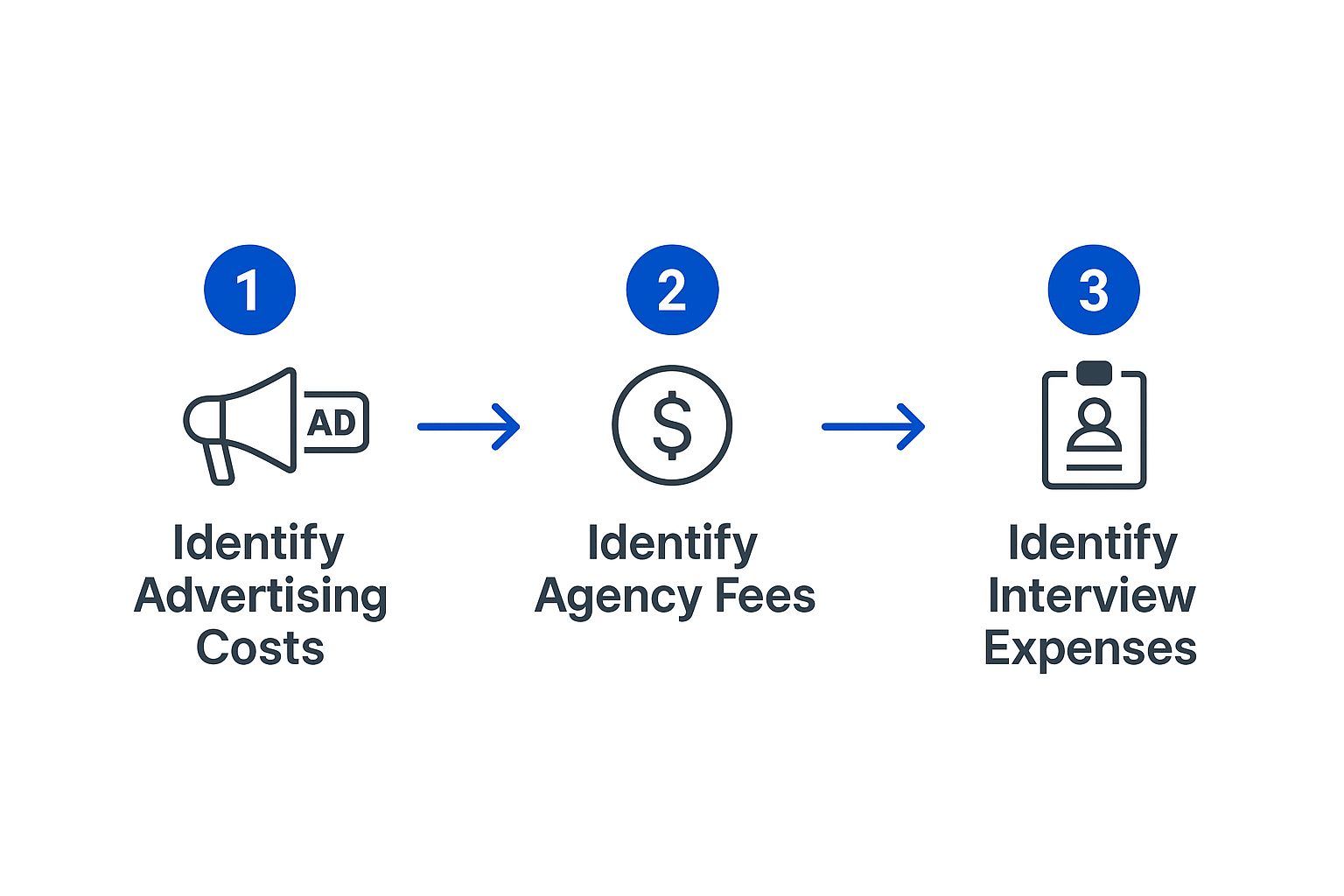
As the visual shows, your advertising, agency fees, and interview-related expenses are really the core pillars of your total recruitment spend.
A Real-World CPH Calculation
Let’s put this into practice with a realistic scenario. Picture a mid-sized fintech company in Mumbai trying to figure out its CPH for the last quarter (Q3).
First, they need to add up all their recruitment costs.
- Internal Costs: They calculate ₹2,50,000 which includes the prorated salaries of their two recruiters, referral bonuses paid out, and an estimate of manager time spent in interviews.
- External Costs: This comes to ₹4,00,000, covering their Naukri subscription, hefty agency fees for two senior hires, their ATS licence, and background checks from a service like SpringVerify.
This brings their Total Recruitment Costs for the quarter to ₹6,50,000.
Over that same period, the company successfully onboarded 10 new employees. This includes a mix of junior analysts and the two senior positions filled by the agency.
Now, we can plug these figures straight into the cost per hire formula:
CPH = ₹6,50,000 (Total Costs) / 10 (Total Hires)
The company’s cost per hire for Q3 is ₹65,000.
Suddenly, they have an incredibly valuable number. This isn’t just an abstract concept; it’s a hard, data-backed benchmark. They can now track this metric quarter-over-quarter, see how new strategies affect it, compare the ROI of different hiring channels (like that expensive agency), and make much smarter budget forecasts for the future. It’s a concrete performance indicator that drives real business decisions.
The Hidden Costs Beyond the Initial Hire

Calculating your cost per hire is a great start, but let’s be honest—the real expenses have only just begun once that offer letter is signed. To truly grasp the financial commitment you’re making, especially in the Indian context, you need to look far beyond the initial recruitment spend.
These ongoing costs often dwarf the one-time hiring expense and have a direct, long-term impact on your company’s financial health. I’ve seen too many businesses get this wrong, leading to serious budget miscalculations down the road.
Mandatory Contributions and Statutory Payouts
In India, an employee’s total compensation package isn’t just their salary. It includes several mandatory employer contributions that will significantly inflate your budget. These aren’t optional perks; they are legal requirements that must be factored into your financial planning for every single new hire.
Some of the most significant post-hire costs you can’t afford to ignore include:
- Employees’ Provident Fund (EPF): As an employer, you’re legally required to contribute 12% of the employee’s basic salary to their EPF account. This is a substantial and recurring monthly expense for every person on your payroll.
- Gratuity: This is a lump-sum payment you make to employees who complete at least five years of service. While it’s not an immediate cash-out, you absolutely must account for this future liability from day one.
- Statutory Bonus: The Payment of Bonus Act mandates an annual bonus for eligible employees, which adds another unavoidable layer to your total employee cost.
A critical mistake I see is treating the cost per hire formula as the final word on hiring expenses. The real cost is a combination of the initial CPH and the cumulative, long-term costs of employment.
This broader perspective is vital for accurate forecasting. A detailed look at India’s employment cost structure reveals just how significant these mandatory contributions are. For roles with an annual salary benchmark of around ₹85 lakh, employers in India often find themselves paying an additional 20-30% in taxes and statutory bonuses.
To put that into numbers, employer taxes can amount to roughly ₹17 lakh, with statutory bonuses adding another ₹7 lakh to ₹17 lakh on top.
The Financial Impact of Employee Turnover
Beyond the statutory payouts, there’s another huge hidden expense: the cost of attrition. Every time an employee walks out the door, you don’t just lose a team member; you trigger a whole new, expensive recruitment cycle.
This is where the numbers really start to hurt. The cost of employee turnover is one of the most substantial hidden expenses impacting your long-term CPH.
It means you have to pay the full cost per hire all over again—from job board advertising and agency fees to the countless hours spent on interviews and onboarding. High turnover can effectively multiply your hiring expenses, making retention an absolutely critical part of your cost management strategy. It’s a stark reminder of how a simple recruitment metric is tied directly to your company’s stability and bottom line.
Proven Strategies to Reduce Your Hiring Costs
Knowing your cost per hire is one thing, but actively reducing it is where you’ll see the real value. The goal isn’t just about cutting corners or hiring cheaper; it’s about hiring smarter. By putting a few targeted, battle-tested strategies into play, you can seriously trim down those expenses and boost your overall recruitment efficiency.
Let’s move beyond the generic advice. In the dynamic Indian market, specific tactics are needed. For instance, data shows the average cost per hire here can swing anywhere from ₹30,000 to ₹70,000, depending heavily on the industry and city. What drives this up? Often, it’s long hiring cycles and pricey advertising. But with a few strategic shifts, you can bring that number down. You can find more detail in this report on reducing hiring expenses for 2025.
Supercharge Your Employee Referral Programme
Honestly, your current employees are probably your most powerful and cost-effective recruitment channel. Referrals don’t just bring in candidates; they bring in high-quality people who are already familiar with your company culture and, in my experience, tend to stick around longer.
But a passive programme won’t cut it. You need to really get it firing on all cylinders.
- Offer Compelling Incentives: Think beyond just cash bonuses. What about offering extra paid time off, public recognition at a town hall, or even experience-based rewards?
- Make it Easy to Participate: Give your team pre-written templates they can blast out on their LinkedIn or other social networks. Make the submission process crystal clear and simple.
- Keep Referrers in the Loop: Nothing kills motivation faster than silence. Always give feedback on where their referred candidate is in the process. It keeps them engaged and ready to help again.
Build an Unbeatable Employer Brand
A strong employer brand is like a magnet for top talent. It pulls in great people organically, which means you can rely less on expensive job boards or recruitment agencies. This is especially true if you’re trying to attract talent in hyper-competitive hubs like Bengaluru or Pune.
A powerful employer brand doesn’t just lower your cost per hire formula; it also reduces the time-to-fill and improves the quality of applicants. It’s an investment that pays dividends across your entire talent acquisition function.
Start by actively showcasing your company culture on platforms like LinkedIn. Share employee success stories, highlight unique company benefits, and actually engage with your followers. This isn’t just posting into the void; it’s about building a pipeline of candidates who want to work for you before you even have an opening. You can find excellent guidance on nurturing your teams within our other articles on human resources best practices.
Optimise Your Interview Process
Time is money. Nowhere is that more obvious than in a clunky interview process. A long, drawn-out cycle doesn’t just frustrate candidates; it racks up hidden costs through the billable hours of your hiring managers and recruitment team.
Streamline your interviews by:
- Using Structured Interviews: Ask every candidate for a specific role the same core set of questions. It’s the only way to ensure a fair, consistent, and efficient evaluation.
- Consolidating Interview Rounds: Avoid making candidates jump through endless hoops. If you can, group stakeholders into a single panel interview instead of scheduling multiple, redundant conversations.
- Leveraging Technology: Use one-way video interviews for initial screenings. It’s a massive time-saver for everyone involved and helps you screen a larger pool of candidates faster.
Ultimately, one of the most effective long-term strategies is simply focusing on retention. High turnover keeps you stuck in a costly cycle of hiring. Creating a work environment people don’t want to leave is a huge win. For some great ideas on this, check out these proven strategies for reducing employee turnover.
Turning Your CPH Data Into Strategic Decisions

Figuring out your cost per hire is the easy part. The real magic happens when you turn that one number into a strategic roadmap for smarter, more efficient hiring.
Sure, an overall company CPH is a good starting point, but the truly actionable insights are hiding much deeper in your data. To really understand what’s going on, you have to stop looking at just a single average figure. You need to start segmenting your CPH data to uncover the stories it has to tell. This approach transforms a passive metric into an active, powerful lever for optimising your entire talent acquisition function.
Segmenting Your CPH For Deeper Insights
Don’t settle for a single, company-wide number. The most valuable analysis comes from slicing and dicing your CPH across different categories. This process is like shining a spotlight on your hiring engine, revealing which parts are running smoothly and which ones are costing you a fortune.
You should start by analysing your CPH across these key segments:
- By Department: Does it cost more to bring someone into your tech team than your sales team? A higher CPH in one department might point to a fiercely competitive talent market or a clunky hiring process for those specific roles.
- By Seniority Level: It’s no surprise that hiring a Vice President will cost more than hiring a junior analyst. Tracking this helps you set realistic budgets and truly grasp the investment needed for leadership versus entry-level talent.
- By Source of Hire: This is often the most revealing segment of all. Compare the CPH for candidates who came from recruitment agencies, employee referrals, job boards like Naukri, and your own careers page.
For instance, you might discover that your CPH for hires made through recruitment agencies is three times higher than for those from your employee referral programme. That’s a powerful, data-backed reason to rethink your budget and invest more in strengthening your referral incentives.
The goal is to move beyond simply knowing your cost per hire formula and start using it to ask strategic questions. Where is our money going, and is it delivering the best possible return on investment?
Benchmarking and Optimising Your Strategy
Once you have your segmented CPH data, the next step is to see how you stack up. Benchmarking your figures against industry averages in India provides crucial context. Are your costs in line with your competitors, or are you overspending to acquire similar talent?
This analysis directly fuels your strategic decisions. If your CPH for tech roles is 25% higher than the industry average in your city, that’s a massive red flag telling you to investigate. Is your sourcing strategy just not working? Is your employer brand failing to connect with tech professionals?
This data-driven approach allows you to continuously fine-tune your strategy. For example, integrating your ATS with other HR tools can automate chunks of the screening process, saving invaluable recruiter time. You can learn more about how powerful API integrations can streamline your workflows and directly slash your hiring costs.
Ultimately, this isn’t just about saving money; it’s about building a more efficient, responsive, and effective recruitment machine.
Got Questions About Cost Per Hire? We’ve Got Answers
Even when you’ve got the cost per hire formula down, practical questions always pop up. Let’s be real—business leaders and HR pros are dealing with unique challenges every single day. Knowing how to actually use this metric can make all the difference.
This section is all about getting past the theory. We’re here to give you quick, clear, and actionable answers to the most common queries so you can start making real improvements to your hiring strategy.
How Often Should We Calculate Our Cost Per Hire?
For most organisations, running the numbers on your cost per hire every quarter is the sweet spot. It’s frequent enough to catch new trends and see if the changes you’ve made to your recruitment process are actually working, but it won’t bury you in administrative work.
An annual calculation is the bare minimum, but you’ll likely miss out on short-term insights that could save you a lot of money. On the flip side, if your company is in a massive growth spurt or you’re trying out new hiring channels, doing a monthly CPH calculation can give you the immediate feedback you need to stay agile.
What Is a Good Cost Per Hire in India?
There’s no magic number here. A “good” CPH can vary wildly depending on the industry, the seniority of the role, and even the city in India. What’s considered a great cost per hire for a startup hiring graduate developers in a Tier-2 city will be worlds away from what a multinational bank spends to find a new Vice President of Sales in Mumbai.
Instead of chasing a universal figure, focus on these two things:
- Benchmark against yourself. Your most important competitor is your past performance. Track your CPH over time to see if you’re getting more efficient.
- Look at industry data. When you can, find benchmarks for similar roles in your specific sector and region. It’s a great way to see how you measure up against the competition.
The real goal isn’t hitting some arbitrary number. It’s about achieving continuous improvement and efficiency within the context of your business. Your best benchmark is always what you spent last quarter.
How Can We Calculate CPH Without an Expensive ATS?
You absolutely do not need a fancy, high-priced Applicant Tracking System (ATS) to get started. Honestly, a simple spreadsheet works perfectly well for tracking your hiring costs.
The secret is just being organised and consistent. Set up columns for each of your main cost categories, like:
- Job board ads
- Recruitment agency fees
- Employee referral bonuses paid out
- Recruiter salaries (prorated for time spent on open roles)
Log every expense as it happens. In another tab, keep a running list of every person you hired during that same period. At the end of the quarter (or whatever timeframe you choose), just add up all the costs and divide by your total number of new hires. Diligence beats expensive software every time.
Making smart hiring decisions is about more than just calculating costs; it’s about ensuring the quality and integrity of every person you bring on board. SpringVerify offers fast, accurate, and seamless background verification services designed for Indian businesses, from high-growth startups to large enterprises. Our powerful API plugs directly into your existing HR systems, automating checks and saving you valuable time. Ensure your next hire is a great one with SpringVerify.


