

Conducting employee background checks isn’t just a box to tick in the hiring process; it’s a strategic business practice. Think of it as an essential shield, protecting your company’s assets, the integrity of your workforce, and your hard-earned reputation from the very real risks that come with a single bad hire.
Table of Contents
Why Background Checks Are Your First Line of Defense

When you’re hiring, you’re essentially building a fortress. Each new employee is a stone in that wall. A thorough background check ensures every single stone is solid, secure, and fits perfectly, reinforcing your entire structure. If you skip this step, you’re knowingly using a cracked stone—creating a vulnerability that could bring down everything you’ve built.
This is especially true in high-stakes sectors like IT and finance, where the risks are magnified. The consequences of a “bad hire” go far beyond just poor performance. They can set off a domino effect of internal chaos, lost client trust, and severe financial and reputational damage.
The Real-World Impact of Negligent Hiring
It’s not hard to imagine a scenario. A fast-growing fintech company brings on a new hire in the finance department. The credentials seemed fine, but they were never properly verified. This individual, who falsified their background, now has access to sensitive client data.
Suddenly, you’re facing data breaches, regulatory fines, and a complete breakdown of customer trust that could take years to rebuild. This isn’t just a hypothetical situation; it’s a stark reality many organisations have had to confront.
To really get why these checks are so important, it helps to place them within the broader framework of due diligence. Doing so reframes screening from a simple procedural task to an indispensable part of your corporate risk management strategy.
Essential Screening in the Indian Context
In India, while not always legally mandatory across the board, employee background checks have become a standard and vital part of hiring, especially in key industries.
Take the IT sector, which employs over 5.4 million people and is a massive contributor to the nation’s GDP. This industry relies heavily on screenings to maintain the integrity of its talent pool. We’ve all seen the headlines about high-profile incidents at major firms involving fake employee credentials, which have only underscored how necessary thorough verification really is.
A robust background check isn’t a sign of distrust. It’s a commitment to building a secure, high-integrity workplace. It shows your team, your clients, and your stakeholders that you prioritise safety and quality right from the very first step.
Ultimately, a structured verification process does more than just weed out unsuitable candidates. It actively fosters a culture of trust and security. That foundation is absolutely critical for sustainable growth, particularly in India’s hyper-competitive business environment. It protects what matters most: your people, your data, and your reputation. By treating background checks as a proactive strategy rather than a reactive task, you are investing in the long-term health and stability of your entire organisation.
Navigating India’s Legal Maze for Background Checks
In India, running an employee background check isn’t just a simple HR task—it’s a process that’s increasingly governed by a serious legal framework. You can’t just decide to run a check on a whim. To do it right, you have to understand the legal boundaries to steer clear of hefty penalties and potential lawsuits.
The absolute cornerstone of this entire process is consent. Let me be clear: you cannot run a background check on any candidate without their explicit, written permission. This isn’t some fine-print clause you can bury in a long document. The consent form has to be crystal clear, transparent, and specific about exactly what information you plan on verifying.
Ambiguity is your worst enemy here. A vague form that doesn’t spell out the scope of the check can be legally challenged down the line. It needs to state precisely what you’re looking at, whether it’s employment history, educational degrees, or criminal records. This level of transparency not only builds trust from day one but also gives you a solid legal footing.
The Cornerstone of Compliance: Consent and Data Privacy
With the Digital Personal Data Protection (DPDP) Act on the horizon, how you handle a candidate’s information is more critical than ever. This legislation puts strict rules on companies for how they collect, store, and process personal data. Every single piece of information you gather during a background check—from an Aadhaar number to feedback from a past employer—is considered sensitive.
This means your entire verification process needs to be built with data security in mind. Understanding the best practices in data privacy is no longer just a good idea; it’s a fundamental requirement for hiring compliantly. You are, in effect, the custodian of this personal data, and any breach or misuse can bring about severe consequences.
Think of it like this: a candidate is handing you the keys to their personal life. The law demands that you guard those keys carefully, use them only for the exact purpose you stated, and then securely get rid of them once they’re no longer needed. For a deeper look at the specifics, you can learn more about SpringVerify’s compliance standards and see how we help organisations build processes that are both effective and legally sound.
Handling Discrepancies the Right Way
So, what do you do when a background check comes back with a discrepancy? This is a crucial moment, and it’s where many companies stumble legally. The right move isn’t to immediately reject the candidate. Instead, you need to follow a principle of fairness, often called an “adverse action” process.
Legally and ethically, you are obligated to inform the candidate about the specific issue found in their report. This isn’t just being polite; it’s a critical part of due process.
The goal of a background check is not to catch people out, but to verify information. Giving candidates a chance to explain discrepancies protects them from errors and protects your company from claims of unfair hiring practices.
This conversation is vital for two main reasons:
- It allows for clarification. The issue could be a simple misunderstanding, a typo from a previous HR department, or even an error by the verification agency itself.
- It gives the candidate a chance to respond. They might have a perfectly valid explanation or the necessary documents to clear up the inconsistency.
For instance, a report might show a different end date for a previous job. By simply talking to the candidate, you might discover they took a contract extension that was never formally updated in the central HR system. Rejecting them without that conversation means you could lose a fantastic hire over a minor clerical error. Following a fair and transparent process here drastically reduces your legal risk and cements your reputation as an equitable employer.
A Comprehensive Checklist for Indian Employers
Knowing you should do employee background checks is one thing. Actually putting a solid, effective process in place is another challenge entirely. To build a screening programme that’s both robust and compliant, you need a clear checklist of what to verify. This isn’t just about ticking boxes; it’s about knowing which checks provide the most value for specific roles within the Indian context.
Let’s move beyond theory and get into the practical side of a thorough verification. A well-designed process confirms you’re bringing on credible, qualified people who genuinely fit your organisation’s standards.
Core Verifications for Every Hire
A few verifications are the absolute bedrock of any reliable background check. Think of these as the foundational elements you should run on nearly every candidate, no matter how senior they are. They establish a baseline of trust and confirm the most basic claims made on a CV.
- Employment History Verification: I’d argue this is the most critical check of all. It confirms where a candidate has worked, their tenure, the positions they held, and sometimes even why they left. Discrepancies here are a major red flag, as data consistently shows this is where people tend to fudge the details most often. To see how technology can ensure accuracy, it’s worth exploring the nuances of comprehensive employment verification in India.
- Educational Qualification Check: Does your candidate really have that degree they’re claiming? This check validates their educational credentials directly with the university or institution itself. For any role that hinges on specific technical skills or academic qualifications, this is completely non-negotiable.
- Identity and Address Verification: This is fundamental. You have to confirm that a candidate is who they say they are. This usually involves checking government-issued IDs like an Aadhaar Card or PAN Card. Address verification adds another layer by confirming their place of residence, which is a standard part of due diligence for most Indian companies.
This infographic breaks down the essential workflow for employee background checks, from getting permission to making that final call.
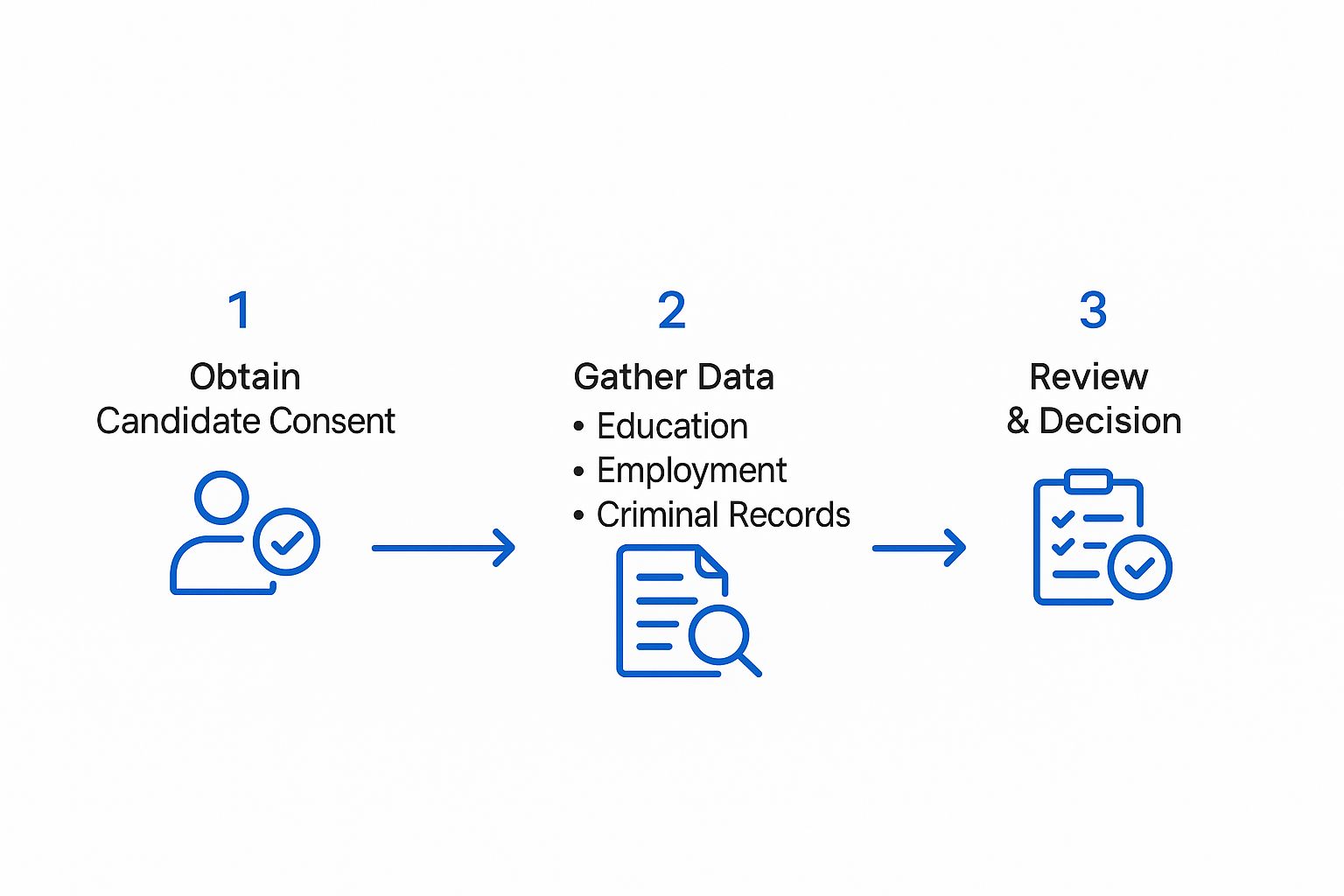
As you can see, the whole process starts with candidate consent and ends with a fair, careful review of the findings.
Recommended Background Checks by Role Level
Not every role needs the same level of scrutiny. A one-size-fits-all approach is inefficient and can leave you exposed. Tailoring your checks to the role makes your process smarter and more effective. Below is a quick guide to help you decide which checks are most important for different levels within your organisation.
| Role Level | Essential Checks | Recommended Additional Checks |
|---|---|---|
| Entry-Level/Fresher | Identity, Address, Education | Basic Criminal Record |
| Mid-Level/Experienced | Identity, Address, Education, Employment History | Criminal Record, Reference Checks |
| Senior Management/Leadership | All Mid-Level Checks | Credit History, Global Sanctions, Social Media Scan |
| Specialised Roles (Finance, IT Security) | All Mid-Level Checks | Credit History, Advanced Criminal & Court Records |
This table provides a solid starting point. By customising your checks, you ensure you’re gathering the most relevant information to make a confident hiring decision without overspending on unnecessary verifications.
Advanced and Role-Specific Checks
For positions that come with greater responsibility, access to sensitive data, or financial oversight, you need to dig a bit deeper.
Think of it like this: you wouldn’t run the same diagnostics on a family hatchback as you would on a high-performance sports car. In the same way, the checks for an entry-level associate will naturally differ from those you’d run for a Chief Financial Officer.
A “one-size-fits-all” approach to background screening is both inefficient and often ineffective. Customising checks based on role-specific risks ensures you gather the most relevant information to make a confident hiring decision.
Here are a few more advanced checks to consider for specific situations:
- Criminal Record Checks: This one is sensitive but often essential, especially for roles in security, finance, or those involving work with vulnerable people. While navigating the legalities of criminal checks in India requires care, it’s a vital tool for reducing workplace risk.
- Credit History Checks: For roles in finance, accounting, or senior management where someone has fiduciary duties, a credit check can offer insight into their financial responsibility. Be warned, though—this is legally complex and requires separate, explicit consent from the candidate.
- Social Media Screening: This is a newer area and still a bit of a legal grey zone. A candidate’s online footprint can give you clues about their professionalism, but it must be handled very carefully to avoid any hint of discrimination. Using a third-party service is a good way to filter out protected characteristics and focus only on publicly available, business-relevant red flags, like hate speech or illegal activity.
By thoughtfully combining these core and advanced checks, you can create a customised screening policy that protects your organisation while remaining fair and compliant. This tailored approach is really the hallmark of a mature and strategic hiring process.
Understanding the Evolving Nature of Employment Fraud

As hiring has shifted online, so have the methods of deception. The days of simply spotting a slightly exaggerated skill on a paper CV are long gone. Today, we’re up against far more sophisticated tactics, and staying one step ahead is absolutely essential to protect your organisation.
Employment fraud isn’t just an issue with entry-level hires making up stories about their internships. It’s a significant and growing problem among experienced professionals, especially in high-stakes industries where trust is paramount. The very nature of this deception has evolved, demanding a more vigilant and tech-driven approach to employee background checks.
The New Wave of Candidate Deception
The classic forms of fraud, like fudging job tenures or buying a fake degree, are unfortunately still very much alive. But the digitisation of hiring has opened the door to a new, more alarming set of threats that are much harder to spot with the naked eye.
- Advanced Resume Falsification: This is more than just tweaking a few dates. It now involves creating entirely fictional work histories, complete with fake company websites and professional-looking references who are actually in on the scheme.
- Fake Educational Credentials: The market for counterfeit degrees has become incredibly sophisticated. These documents often look nearly identical to the real thing, making manual verification a real challenge. Using a reliable education verification service that contacts institutions directly is the only sure-fire way to confirm a candidate’s qualifications.
- Emerging Digital Threats: Perhaps the most concerning development is the use of deepfake technology. A fraudster can use AI to appear as someone else during a video interview, using a stolen identity to breeze through initial screening.
This shift means our traditional, manual methods of verification just don’t cut it anymore. Relying on a quick phone call or a glance at a PDF certificate is like bringing a knife to a gunfight; you’re simply not equipped for the modern battlefield of hiring fraud.
Fraud in High-Stakes Indian Industries
The problem is particularly acute in sectors where credibility and security are non-negotiable. A recent study by EY paints a stark picture of the situation in India, highlighting that as companies embrace technology for hiring, the complexity of fraud rises right alongside it.
The research, which analysed over a million pre-employment screenings, found that deceit is rampant among seasoned professionals. A staggering 96% of fraudulent cases in the healthcare sector and 88% in financial services involved experienced individuals, not freshers. You can dig into the full findings to better understand how tech-enabled vigilance is crucial in today’s hiring environment.
The takeaway is clear: the more responsibility a role holds, the greater the incentive for sophisticated fraud. Manual checks are simply not enough to detect these advanced deceptions.
This escalation underscores the critical need for modern, technology-driven verification tools. These systems are designed to go beyond surface-level checks, using data analytics and direct-source verification to uncover discrepancies that would otherwise go completely unnoticed.
Why Technology Is Your Best Defence
Picture this scenario: you’re hiring a senior developer for a critical project. A candidate submits a perfect resume and absolutely aces the technical interviews. But their identity was stolen, and the person on the video call was a deepfake. A manual background check would likely clear them without a second thought.
A technology-driven platform, however, can run much deeper checks. It can cross-reference digital footprints, use biometric verification for identity confirmation, and connect directly with university and employer databases through secure APIs. This automated, data-centric approach is built to spot the tiny inconsistencies that signal advanced fraud.
By integrating these modern tools into your hiring workflow, you not only strengthen your defences but also create a far more efficient process. These solutions significantly cut down the time it takes to get reliable reports, allowing you to make faster, more confident hiring decisions. Ultimately, this ensures you’re building a workforce based on verified trust, securing your company’s future in an environment of increasing risk.
Analysing Discrepancy Trends Across Industries

When you’re running background checks, it’s easy to paint risk with a broad brush. But the truth is, not all industries are created equal when it comes to hiring risks.
The red flags you’re looking for in the financial sector are completely different from those in retail or manufacturing. A one-size-fits-all screening process isn’t just inefficient—it’s a surefire way to miss your biggest vulnerabilities.
Getting a real handle on your industry’s specific risk profile is the first move towards a smarter screening strategy. By digging into data-driven trends, you can shift from a generic checklist to a process that’s finely tuned to the challenges you actually face. This means putting your resources where they count and catching the discrepancies that are most common in your field.
This isn’t about catching more people out; it’s about smart risk management. It gives you the context to make informed decisions and ensures your background checks are genuinely protecting your business.
Where Discrepancies Are Most Common
Recent data tells a very clear story: some sectors are just more prone to discrepancies than others. While a general benchmark is good to know, understanding where your industry stands is what really gives you an edge. It helps you anticipate problems before they happen and tweak your verification process accordingly.
A recent report on Indian employment screening trends reveals some telling statistics. The data showed an overall discrepancy rate of 9.83% across all sectors, but some industries shot way past that average. The report singled out BFSI (Banking, Financial Services, and Insurance), BPO, Manufacturing, Retail, and Telecom as hotspots for inconsistencies. You can explore the full breakdown to discover more about sector-specific screening trends in India.
This is invaluable intel. If you’re hiring in one of these high-risk fields, it’s a clear signal that a more rigorous approach to background checks isn’t just a good idea—it’s essential.
A discrepancy isn’t just a lie on a CV; it’s a potential business risk. Understanding the type of discrepancies common in your industry allows you to tailor your verification process to address those specific threats directly.
Understanding the Nature of the Discrepancies
Knowing which industries have higher discrepancy rates is only half the story. The other, more critical half is knowing what those discrepancies actually are. The trends show that most issues fall into a few key buckets.
- Employment History: This is, and has always been, the number one area for falsification. Candidates might inflate job titles, stretch employment dates to hide gaps, or fudge their reasons for leaving a past role.
- Educational Claims: Verifying academic credentials is non-negotiable. It’s common for candidates to falsify degrees or certifications to meet job requirements they wouldn’t otherwise qualify for.
- Criminal Records: An undisclosed criminal history is a massive concern, especially for roles with access to sensitive data, finances, or vulnerable people.
Think about it in practice. In the BFSI sector, a doctored employment history could be a huge red flag, possibly hiding a termination for misconduct. In manufacturing, an undisclosed criminal record for theft could pose a direct threat to your assets.
Recognising these patterns helps you move beyond a simple pass/fail mindset. It equips you to assess the context and severity of a discrepancy in relation to the specific demands and risks of the role you’re trying to fill. This nuanced view is the hallmark of a mature and strategic approach to building a trustworthy workforce.
Got Questions About Indian Background Checks? We’ve Got Answers.
Once you’ve got your background check policy drafted, the real work begins. Moving from paper to practice is where the rubber meets the road, and it’s completely normal for practical questions to pop up. This isn’t just about ticking boxes; it’s about navigating real-world hiring situations with confidence. Let’s walk through some of the most common queries we hear from Indian employers.
One of the first things on every hiring manager’s mind is speed. “How long is this going to take?” A typical background check in India, covering the essentials like employment, education, and address verification, usually wraps up within 5 to 15 working days. Of course, if you’re digging into records from other states or need international verification, you’ll need to account for a longer timeline.
Handling Consent and Existing Employees
What if you’ve found the perfect candidate, but they refuse to sign the consent form? It’s a delicate spot to be in. The first thing to remember is that you absolutely cannot proceed without their explicit, written permission. It’s non-negotiable.
Your best move is to have an open, honest conversation. Explain why the check is a standard part of your hiring process for the role and be transparent about what you’re verifying. If they still say no, you have to respect their decision. That said, this refusal can be a perfectly valid reason to withdraw a conditional job offer, as long as you apply this standard consistently to every candidate for that position.
Your background check policy isn’t just for new hires. Think of it as a living document that grows with your company. Applying it consistently during promotions is key to maintaining fairness and organisational integrity at every level.
Another frequent question revolves around screening your current team. Can you run a background check on an existing employee who’s up for a promotion or moving into a role with more responsibility? The answer is yes, and frankly, it’s a smart move.
Imagine an employee is moving into a senior finance role. They probably didn’t need a credit history check when they joined as a junior analyst, but now it’s essential. Running a new, more relevant check is just good due diligence. Just like with new hires, the rules of engagement are clear:
- Get fresh consent. You must obtain new written permission specifically for this check.
- Be transparent. Explain why the check is necessary for the new role.
- Apply the policy fairly. Ensure everyone being considered for similar roles goes through the same process.
This is often called post-hire or continuous screening, and it helps you avoid “negligent retention”—the risky situation of keeping an employee who no longer meets the standards for their evolving responsibilities. It’s all about ensuring your team’s integrity grows right alongside their careers, protecting your organisation from the inside out.
Ready to build a trusted workforce with confidence? SpringVerify offers fast, reliable, and compliant background checks designed for Indian companies. Streamline your hiring process and make informed decisions with ease. Learn more about our verification services at SpringVerify.


