

Imagine you’re trying to understand someone’s history, but you’re only looking at one side of the coin. That’s what happens when you skip a civil records check. It’s the other side of the story, completely separate from a person’s criminal history.
Think of it this way: a civil record check pieces together the public, non-criminal legal life of an individual. It’s all about their civil responsibilities and how they’ve handled disputes in the past, from a contract disagreement to a property line tiff.
Table of Contents
What a Civil Records Check Actually Reveals
 So, what are we actually looking for? While a criminal check searches for convictions, a civil records check dives into lawsuits and disputes between private parties. These are cases handled in civil court, not criminal court, and they reveal a completely different, yet equally vital, side of a person’s character.
The details you find here can paint a picture of someone’s financial habits and social conduct. The whole point is to spot patterns or potential liabilities that would never show up on a standard criminal background screen.
Types of Information Uncovered
The scope of a civil records check can be surprisingly wide, covering a lot of ground in a person’s legal life. The main goal is to get a clear view of their litigation history and any other major actions filed in civil court.
Here’s a taste of what you might find:
- Financial Disputes: This is a big one. You might see everything from lawsuits over unpaid bills and collections to full-blown bankruptcy filings. This gives you a real-world look into their financial stability and sense of responsibility.
- Breaches of Contract: Has this person ever failed to honour a legal agreement? This is critical information, especially if you’re considering them for a role with fiduciary duty or as a business partner.
- Property and Personal Disputes: These records can highlight issues like messy landlord-tenant disagreements, conflicts over property ownership, or even restraining orders.
- Life Events: Basic identity verification often starts here. Civil courts are where you find records of legal name changes, marriages, and divorces.
A civil records check isn’t about passing judgement on someone’s past. It’s about understanding the full context. It provides a factual, documented basis for assessing risk—whether that’s the risk of hiring a manager who is financially irresponsible or partnering with someone who is quick to sue.
At the end of the day, this information is crucial for making smart, informed decisions. For an employer, it can flag a candidate who might be a financial or reputational risk. For a potential business partner, it helps ensure you’re getting into business with someone who takes their commitments seriously. It’s about seeing the whole picture before you make a move.
Why Civil Records Are Key to Smart Due Diligence
 It’s easy to think of a civil records check as just another box to tick on a compliance checklist. But seeing it that way is missing the point entirely. This isn’t just about procedure; it’s a crucial piece of your risk management puzzle, one that directly protects your company’s bottom line and its good name.
Think about this all-too-common scenario. A rapidly expanding company hires a new Chief Financial Officer. His resume is flawless, and he nails every interview. Six months later, it comes to light that he’s embroiled in a massive lawsuit from his previous job, accused of serious financial mismanagement. The news causes chaos, spooking investors and creating a full-blown internal crisis.
This entire nightmare could have been avoided. A straightforward civil records check would have instantly raised a red flag about the ongoing lawsuit. It would have given the hiring team the critical information they needed to sidestep a catastrophic hire. This story is a powerful reminder of what’s really at stake.
Mitigating Hidden Organisational Risks
One bad hire is damaging enough, but a pattern of overlooking civil litigation history can point to much deeper problems. A comprehensive civil records check acts as your first line of defence against a whole host of threats that a standard background screening simply won’t catch. It’s about protecting your organisation from the inside.
Let’s break down the kinds of hidden risks these checks bring to light:
- Undisclosed Financial Instability: A history of lawsuits over unpaid debts, bankruptcy, or other money-related disputes can signal that a candidate struggles with financial responsibility. That’s a massive red flag, especially for any role with financial oversight.
- Patterns of Litigious Behaviour: Does the candidate have a track record of frequently suing or being sued? This could suggest a tendency to escalate workplace disagreements into legal battles, creating a potentially toxic environment.
- Hidden Conflicts of Interest: Civil court records can uncover business disputes or links to competitors that a candidate might conveniently forget to mention. This helps you get ahead of potential conflicts before they become a real problem.
- Reputational Threats: Bringing someone into your organisation who is involved in unsavoury civil cases—like fraud or serious negligence—can do lasting damage to your company’s public image and the trust you’ve built.
In the end, a civil records check is about proactive protection. It gives you an objective, fact-based window into a candidate’s past civil conduct, helping you gauge potential liabilities before they walk through your door and become your company’s problems.
By making this check a standard part of your due diligence, you shift from reacting to problems to preventing them in the first place. You aren’t just filling a position; you’re safeguarding your assets, your workplace culture, and your hard-earned reputation. It’s a small step that adds a huge layer of security.
How to Navigate India’s Complex Civil Court System
Trying to run a civil records check in India can sometimes feel like navigating a maze. The system is layered, complex, and has a long history that shapes how it works today. But instead of seeing it as a roadblock, think of it as a landscape you can master with the right map and guide.
The first thing to grasp is the sheer scale. India’s judiciary is one of the busiest on the planet, and that directly affects how quickly and thoroughly you can get information. Accepting this reality from the start is crucial for setting up a background check process that actually works.
This isn’t just about a big number, either. That massive backlog has real-world effects. A quick, automated search might only give you a surface-level view, completely missing details on cases that have been moving through the courts for years.
Understanding Case Backlogs and Their Impact
The backlog of cases is the elephant in the room. In January 2025, the National Judicial Data Grid reported a staggering 1.1 crore (11 million) civil cases pending in Indian courts. A huge chunk of these—about 62.64%—have been open for over a year, and more than 800,000 have been stuck in the system for over a decade.
What this data really tells us is that a pending case isn’t a simple tick-box exercise. It’s an ongoing story. This is precisely why having an expert look at the findings from a civil records check is so valuable.
Think about it this way: a long-running property dispute might be a major red flag for a senior finance hire, but a minor, recently filed consumer complaint probably isn’t. The context is everything, and an expert can tell the difference between a small issue and a serious risk.
The Need for Expert Interpretation
With all this complexity, just pulling a raw court record often isn’t enough. While a top legal case management system can centralise court information, what an HR professional really needs is to understand what that data means for their hiring decision.
Here’s why having a specialist analyse the results is non-negotiable:
- Decoding the Jargon: Court documents are full of legal terms that can be confusing. An expert translates this into plain English, so you know what a filing actually means.
- Judging Relevance: Is the case even relevant to the job? An expert can assess this, ensuring you don’t unfairly penalise a candidate for something that has no bearing on their role.
- Navigating the System: India has a tiered court system. A proper search means knowing exactly where to look—from District Courts to High Courts and other tribunals.
By taking a smarter, more informed approach, you can transform what seems like a daunting task into a genuinely powerful due diligence tool. To get into the nitty-gritty, have a look at our guide to a comprehensive court record check. This will help set realistic expectations and make your screening process both effective and fair.
What a Civil Records Check Actually Uncovers
So, what information can you expect to find when you run a civil records check? It’s not about abstract ideas of a person’s past; it’s about getting concrete, documented facts about their non-criminal legal history. Knowing what this check digs up is essential to making sense of the results.
Think of it like this: a criminal check looks at offences against the state, but a civil check reveals how someone has handled their private disagreements and responsibilities, especially when things escalated to the courts. This gives you a much richer, more nuanced picture of a candidate.
The different kinds of information you’ll find fall into specific categories, each shedding light on a different aspect of an individual’s background and potential risks.
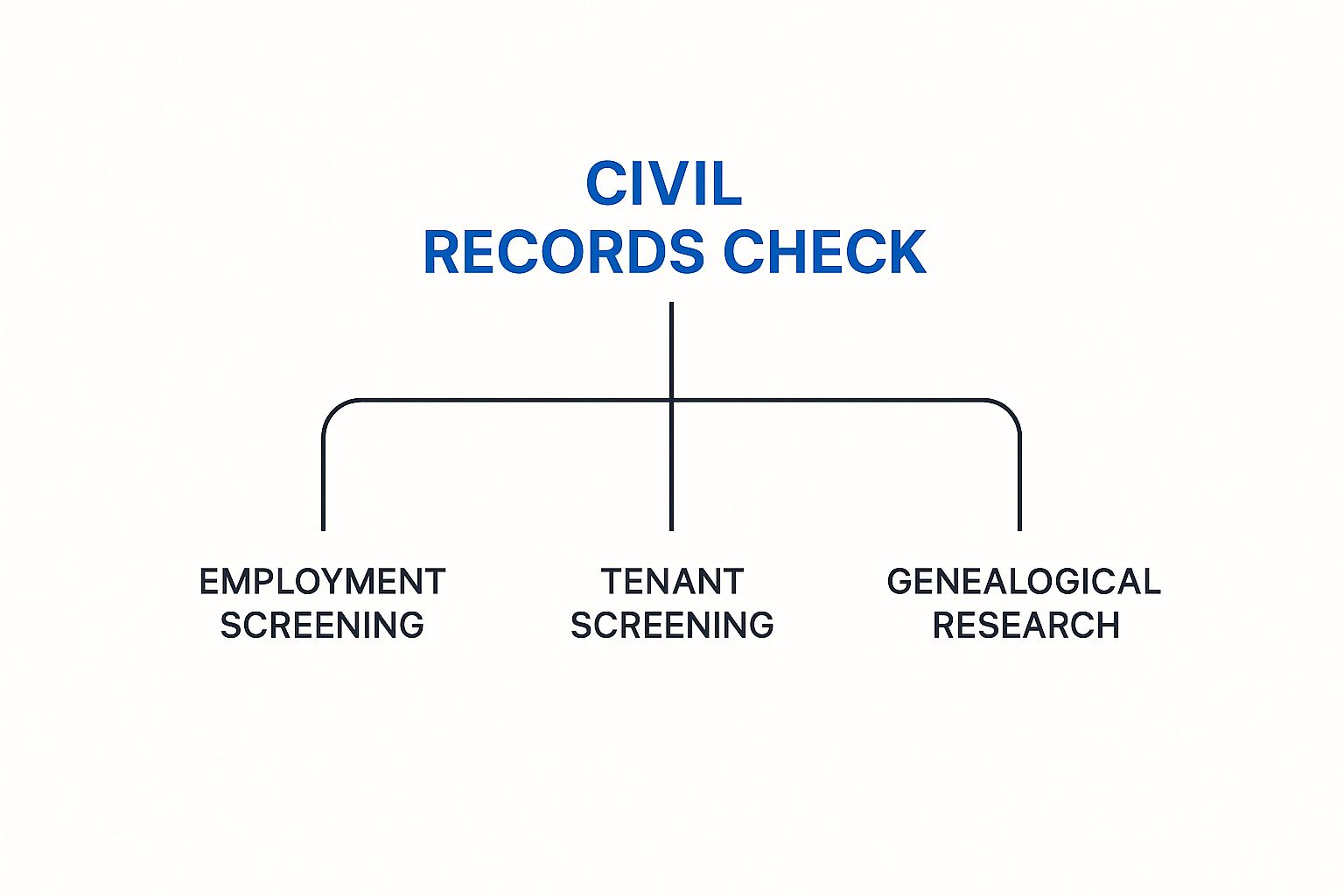
As you can see, this single check serves a whole host of critical functions, from safeguarding your workplace to securing a rental property.
Types of Information Found in a Civil Records Check
To truly grasp what a civil records check offers, it helps to break down the findings into practical categories. This approach turns what could be a simple, confusing list of court cases into a powerful risk assessment tool.
The table below outlines the common types of information a civil records check can unearth, providing real-world context for each finding. This helps you understand not just what you’ve found, but why it might matter to your organisation.
| Record Category | Description | Common Examples |
|---|---|---|
| Financial Disputes | These cases revolve around money, debt, and financial responsibilities. | Lawsuits over unpaid debts, bankruptcy filings, tax liens. |
| Contractual Disputes | Legal actions that stem from someone failing to uphold a formal agreement. | Breach of contract lawsuits with former clients, vendors, or partners. |
| Property & Tenancy Issues | Conflicts related to real estate, covering everything from ownership to rent. | Eviction notices, disputes over property lines, home foreclosures. |
| Personal & Family Matters | Legal actions connected to personal relationships and even identity. | Restraining orders, divorce proceedings, legal name changes. |
Each category tells a different story. A history of financial disputes might be a red flag for a finance role, while contractual disputes could be a major concern for a sales leader.
How to Make Sense of the Results
Finding a record is just the start—the real skill is in the interpretation. A one-off lawsuit over a small consumer debt from ten years ago is a world away from a recent, high-value breach of contract case, particularly if the candidate is up for a senior management role. Context is everything.
The aim isn’t to automatically disqualify someone for a single issue. It’s about building a complete picture. A civil records check gives you objective data that, when considered with other checks, leads to fairer, more informed decisions.
For example, uncovering a legal name change is a crucial piece of the puzzle. This is a fundamental step in confirming who you are actually hiring. You can explore why this is so important in our guide to identity verification checks. Getting the name right ensures all your other background checks are accurate and legally sound, creating a solid foundation for your entire screening process.
Verifying Life’s Milestones with Civil Records
When you hear “civil records,” your first thought might be of courtrooms and legal battles. But the truth is, a civil records check often goes much deeper, touching on the very records that define a person’s legal identity. In India, this all comes down to the Civil Registration System (CRS).
Think of the CRS as the country’s official ledger for life’s biggest milestones. It’s the system that methodically documents births, deaths, marriages, and other foundational life events. These aren’t just bureaucratic formalities; they are the primary, government-backed proof of a person’s existence, age, and legal standing.
The Role of the Civil Registration System
At its core, the CRS is the backbone of identity verification in India. When you need to confirm a candidate’s date of birth or a bank needs to verify a death certificate, it’s the data within this system that provides the answer. It’s the official source of truth.
The CRS has become a vital source of reliable statistics by continuously collecting data from local authorities across the country. The 2022 Report on Vital Statistics showed that while there’s been fantastic progress in getting events registered, some regional gaps still exist. For a closer look, you can dive into the comprehensive CRS data from the Census of India. This constant improvement is what makes these records more and more dependable for any kind of due diligence.
For any organisation, the data from the CRS is critical. It answers the most basic yet crucial question: “Is this person who they claim to be?” Verifying a birth certificate is the first step in ensuring all other checks, from education to employment history, are being run on the correct individual.
Why Gaps in Registration Matter
While India has made incredible progress, the system isn’t perfect just yet. You’ll still find differences in how completely records are registered from one state to another, or between cities and rural villages.
These gaps have very real consequences for anyone running a civil records check. What happens if a candidate’s birth was never officially put on the books? This is exactly why a layered verification strategy is non-negotiable. If you can’t find a primary document from the CRS, you have to get creative and cross-reference details using other reliable sources.
This might mean turning to other documents like:
- Educational Certificates: School leaving certificates or university degrees almost always include a date of birth.
- Government-Issued IDs: An Aadhaar card or PAN card can be powerful tools for confirming personal details.
- Affidavits: In certain situations, a legally sworn statement might be the only way to formally attest to a vital event.
Knowing the strengths and weaknesses of the CRS is essential. It gives you the context you need to accurately interpret the results of a civil records check and build a solid verification process that can handle any potential gaps in the data.
Understanding the Real-World Challenges of Civil Records in India
While a civil records check sounds straightforward, anyone who’s actually done them in India knows the reality is far more complex. The Civil Registration System (CRS) is the official source, but you have to go in with a clear-eyed view of its on-the-ground limitations.
Simply put, the quality and completeness of records can vary dramatically from one state to the next. What might be a quick, digital search in one region could be a manual, time-consuming process in another—or the record might not exist at all. This isn’t just a minor inconvenience; it’s a fundamental challenge rooted in everything from public awareness to administrative backlogs, especially in more rural parts of the country.
Understanding these systemic issues isn’t about blaming the system. It’s about building a smarter, more resilient verification strategy. This insight helps you set realistic timelines and, crucially, avoids mistaking a missing record for a “red flag” when it’s really just an administrative gap.
Navigating the Patchwork of Regional Differences
The inconsistency in registration isn’t just a small statistical blip. Nationally, the numbers look pretty good. In 2019, the CRS captured an estimated 93% of births and 92% of deaths. But dive into the state-level data, and a different story emerges.
Take Manipur, for example, which registered only about 20% of estimated deaths in the same year. That’s a massive gap. You can explore a deeper breakdown of these registration discrepancies on dataforindia.com.
So, what causes these gaps? It usually boils down to a few key factors:
- Low Public Awareness: Many people, particularly in remote areas, don’t realise the long-term importance of registering a birth or death, or they simply don’t know how to do it.
- Administrative Hurdles: The process can feel overwhelming. Think complex forms, a lack of nearby registration centres, and hidden costs that discourage families from following through.
- Socio-Economic Barriers: In some communities, if there’s no immediate benefit—like inheriting property or accessing a government scheme—registration often gets pushed to the bottom of the priority list.
Recognising these realities is the first step to a more effective screening process. It underscores why partnering with a verification expert who gets these local nuances is so important. They know how to navigate the system and when to cross-reference information with other reliable documents.
Effectively managing this landscape is essential for a fair and robust background check program. It ensures every civil records check is as thorough as possible while respecting the local context. To learn more about how to manage these complex requirements, check out our detailed guide on compliance in India.
Right, you’ve got the basics down, but what about the questions that pop up when you’re actually doing the checks? It’s one thing to understand the theory, but another to navigate the practical side of things.
Let’s tackle some of the most common questions we hear from employers about civil records checks in India. Think of this as the “what now?” section to help you move forward confidently.
Is It Actually Legal to Run a Civil Records Check on a Candidate?
Absolutely. Running a civil records check is a perfectly legal and, frankly, a standard part of responsible pre-employment screening in India. But—and this is a big but—it all hinges on doing it the right way.
The golden rule is this: you must get clear, written consent from the candidate before you even think about starting the check. Without that piece of paper, you’re on shaky ground. On top of that, you have to play by India’s data privacy rules. This means the information you find is only for that specific hiring decision, and you need to guard it like Fort Knox.
Remember, a past lawsuit or an ongoing dispute doesn’t mean an automatic ‘no’. The whole point is to get the full picture and make a smart, fair decision—not to punish someone for having a legal issue. Always look at the context.
So, How Long Does This Actually Take?
This is the classic “it depends” answer, and for good reason. The timeline for a civil records check can be all over the map.
If you’re checking records in a major city like Mumbai or Delhi where things are mostly digitised, you might get results back in a few business days.
However, that’s often the best-case scenario. The reality for much of the country involves digging through mountains of physical files in district courts. In these situations, a thorough check can easily stretch from one to three weeks, sometimes even longer. If your candidate has lived in multiple states, you’ll need to factor in extra time for each jurisdiction.
I Found a Lawsuit on a Candidate’s Record. Now What?
First off, don’t panic. Finding a lawsuit isn’t a red flag; it’s a yellow one. It just means you need to slow down and look closer.
Start by asking yourself: what is the lawsuit about, and does it have anything to do with the job they’re applying for? A financial dispute might be a major concern for a potential Chief Financial Officer, but it’s probably not as relevant for a graphic designer.
The next step is crucial: have an honest and open conversation with the candidate. Give them a chance to explain their side of the story. Your goal is to make a fair assessment, and if you’re ever in doubt, it’s always a good idea to chat with your legal counsel. This ensures your final decision is not just fair, but also legally sound.


