

When you hear the term CDD, you might just think of another piece of banking jargon. But the CDD full form in banking—Customer Due Diligence—represents something far more significant. It’s the critical process banks use to really get to know their customers, verifying who they are and understanding their financial habits to prevent the system from being used for illegal activities.
Table of Contents
What Is Customer Due Diligence, Really?
Think of Customer Due Diligence as a bank’s first line of defence against serious financial crime. It’s not just about filling out forms; it’s a mandatory background check that ensures anyone opening an account or using banking services is legitimate and doesn’t pose a threat to the financial system’s integrity.
At its core, CDD is about building a foundation of trust and security. By taking a “know your customer” (KYC) approach, banks can effectively spot and stop illicit activities before they take root, including:
- Money Laundering
- Terrorist Financing
- Fraud and Corruption
This isn’t just a good practice—it’s the law. Regulatory bodies like the Reserve Bank of India (RBI) enforce these rules strictly. For instance, the RBI mandates that full CDD must be completed before an account’s total credits for the year hit Rs. 1,00,000 or the balance goes above Rs. 50,000. Banks are even required to proactively contact customers as they near these limits to get their documents in order.
When you cooperate with these measures, you’re doing more than just ticking a box. You’re playing a direct role in creating a safer, more transparent financial world for everyone.
For a clearer picture, here’s a breakdown of the key components that make up the CDD process.
Key Aspects of Customer Due Diligence
This table summarises the core pillars of the CDD process, giving you a quick overview of what it entails.
| Component | Objective |
|---|---|
| Identity Verification | To confirm that a customer is who they claim to be, using official documents like Aadhaar, PAN card, or passport. |
| Risk Assessment | To evaluate the potential risk a customer might pose based on their profile, occupation, and transaction patterns. |
| Beneficial Ownership | To identify the real individuals who own or control a legal entity, preventing criminals from hiding behind shell companies. |
| Ongoing Monitoring | To continuously watch over customer accounts and transactions to detect any unusual or suspicious activity that deviates from their normal behaviour. |
Each of these steps works together to build a comprehensive customer profile, helping banks make informed decisions and maintain compliance. It’s a dynamic process that protects both the institution and its customers from financial risks.
The Three Essential Pillars of CDD

Knowing that the CDD full form in banking is Customer Due Diligence is the easy part. The real insight comes from seeing how banks actually put it into practice. The entire process rests on three foundational pillars, each one designed to build a complete and accurate picture of who a customer is and how they manage their money.
You can think of these pillars as three distinct security stages. The very first checkpoint is the Customer Identification Programme (CIP). This is where the bank confirms you are who you claim to be. They do this by collecting and verifying official documents like your Aadhaar card, PAN card, or passport. It’s the most basic but crucial first step.
Once your identity is locked in, the bank moves on to the second pillar.
Customer Risk Profiling
This is all about assessing the potential risk you and your account might pose. Banks don’t treat every customer the same; they categorise them into low, medium, or high-risk profiles. This decision is based on factors like your profession, where your money comes from, and the kinds of transactions you’re expected to make.
For instance, a salaried employee with a predictable monthly income is usually seen as low-risk. On the other hand, a business that frequently deals in large cash transactions might be flagged as higher-risk.
This risk-based approach is smart. It allows banks to focus their security resources where they’re needed most, ensuring the level of scrutiny matches the potential risk of financial crime.
This risk category isn’t just a label; it directly influences the final, ongoing part of the CDD process. Indian AML laws, for example, require different levels of diligence—like Simplified, Normal, or Enhanced Due Diligence (EDD). EDD is reserved for high-risk clients, such as Politically Exposed Persons (PEPs), and involves much deeper background checks and screening against international sanction lists.
Ongoing Monitoring
The last pillar, Ongoing Monitoring, is what makes CDD a continuous process, not just a one-off check when you open an account. Banks use sophisticated systems to keep an eye on your account activity, looking for anything that strays from your established risk profile.
A sudden, large international transfer from an account that’s usually quiet, for example, would immediately raise an alert for review. This constant vigilance is key. It helps banks act fast to investigate potential red flags for money laundering or other illegal activities, strengthening their overall banking compliance.
Navigating the Different Tiers of Due Diligence
Not all customers pose the same level of risk, so it only makes sense that they don’t all need the same depth of scrutiny. This is why banks use a tiered, risk-based approach to Customer Due Diligence. It’s a much smarter, more efficient way to focus their resources where they’re needed most.
This approach ensures the level of investigation is directly proportional to the potential risk a customer might represent. It’s best understood by breaking it down into its three distinct levels, each tailored for a specific type of customer.
The process is progressive, with verification steps becoming more detailed as the assessed risk increases.
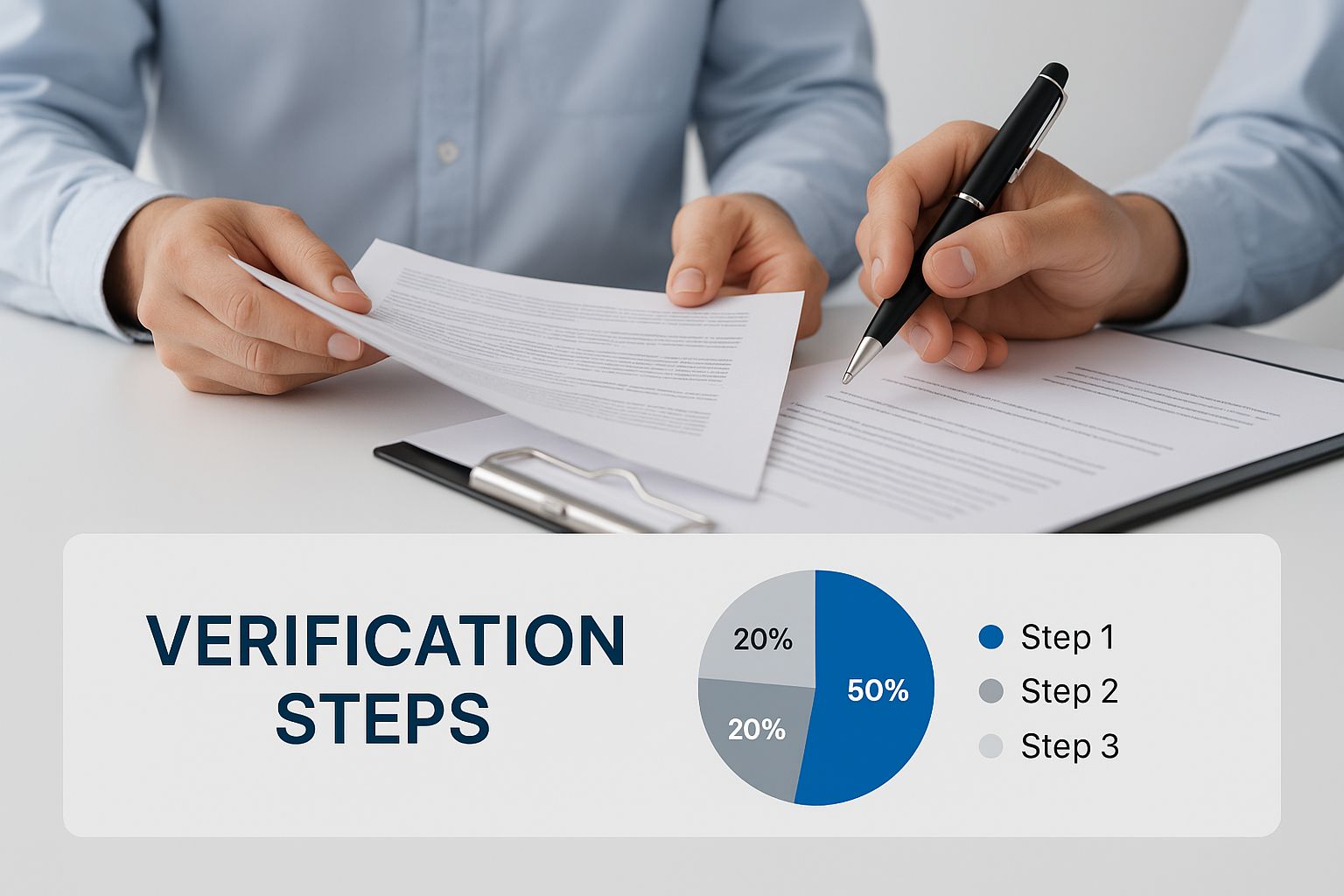
As you can see, basic verification is the bedrock of every level of due diligence, forming the foundation for assessing and managing risk.
Comparing Due Diligence Levels
To truly grasp the differences, it helps to see the three tiers side-by-side. Each level serves a specific purpose, from quick checks for low-risk individuals to deep-dive investigations for high-risk profiles.
The table below outlines who each level typically applies to and the intensity of the checks involved.
| Diligence Level | Applies To | Level of Scrutiny | Example |
|---|---|---|---|
| Simplified Due Diligence (SDD) | Low-risk individuals and entities | Basic identity verification | A local student opening their first savings account. |
| Standard Due Diligence (CDD) | The majority of average customers | Full identity verification, risk profiling | An individual opening a standard current account for their salary. |
| Enhanced Due Diligence (EDD) | High-risk customers | In-depth investigation of wealth, business, etc. | A Politically Exposed Person (PEP) or a business in a high-risk sector. |
This tiered system allows banks to apply a practical and reasonable level of security, ensuring the process is robust without being overly burdensome for the average customer.
Simplified Due Diligence (SDD)
Simplified Due Diligence (SDD) is the first and most basic level, reserved for customers who are clearly very low-risk. Think of a salaried person with a predictable income and transparent financial habits. For these customers, the verification process is quick and minimal.
It’s a bit like showing your ID to enter an office building—a standard check to confirm you are who you claim to be, without needing a full background investigation.
Standard Due Diligence (CDD)
Next up is Standard Due Diligence, often just called CDD. This is the default level for most customers and the one you likely went through when opening your own bank account. It involves the full identity verification process and the creation of a risk profile based on standard information.
This is the baseline for what the cdd full form in banking really means in practice for the everyday person.
Enhanced Due Diligence (EDD)
Enhanced Due Diligence (EDD) is the highest and most intensive level of scrutiny. It gets triggered when a customer is flagged as high-risk. This category typically includes:
- Politically Exposed Persons (PEPs) and their close family or associates.
- Customers who conduct unusually large or frequent cash transactions.
- Businesses that operate in sectors known to be vulnerable to money laundering.
- Individuals or entities from high-risk geographical regions.
If SDD is a quick ID check, then EDD is a full-scale financial investigation. It involves a much deeper dive into the customer’s background, their source of wealth, and the nature of their business relationships to mitigate any significant risks.
How CDD Protects the Entire Financial System
Customer Due Diligence procedures might feel like just another administrative hurdle, but their impact ripples out far beyond your individual bank account. Think of the entire financial system as a complex water supply network. A single contaminated entry point can jeopardise the whole system, and strong CDD acts as the critical filtration process at every tap.
This goes way beyond simply ticking boxes for Anti-Money Laundering (AML) and Combating the Financing of Terrorism (CFT) regulations. These measures are the practical, on-the-ground tools used to stop the banking system from being misused for large-scale criminal activities, from corruption and drug trafficking to terror financing.
Safeguarding National and Global Standing
When banks in India diligently apply CDD, they’re not just following local rules. They’re upholding standards set by global bodies like the Financial Action Task Force (FATF). This isn’t just about avoiding hefty fines; it’s about maintaining India’s credibility and trustworthiness on the world stage.
A country with weak CDD enforcement is seen as a high-risk place to do business. This can directly impact foreign investment and sour trade relationships. On the other hand, strong compliance sends a clear signal of a stable and secure financial environment.
This idea of collective security is central to understanding the cdd full form in banking. Every time you provide your documents for verification, you’re doing your part to build a stronger, more resilient economy that is less vulnerable to criminal exploitation.
This protective layer is especially crucial in the rapidly growing fintech sector. As digital transactions become the norm, robust verification processes are more vital than ever. For a deeper look, you can explore the unique verification challenges and solutions in the fintech industry.
Ultimately, your cooperation with CDD procedures helps build a protective wall around India’s financial infrastructure, keeping it stable and secure for everyone.
The Real-World Impact of Strong CDD Measures

It’s one thing to understand the principles behind Customer Due Diligence, but the real question is: does it actually work? The short answer is yes, and the proof is in the results. The rollout of stricter CDD and KYC norms across India has led to a massive spike in Suspicious Transaction Reports (STRs) being filed.
These reports aren’t just bureaucratic paperwork. They represent actionable intelligence fed directly to the Financial Intelligence Unit (FIU), giving authorities the information they need to spot and stop potential criminal activity. Think of it as plugging the holes in a leaky bucket—strong CDD seals the gaps that criminals constantly try to exploit.
The Power of Data and Digitalisation
The shift towards e-KYC using Aadhaar has been a genuine game-changer. For customers, the verification process is now worlds away from the old paper-based methods—it’s faster and far more convenient. For banks, it has brought in a more secure, biometric-based authentication that is incredibly difficult to forge, strengthening the entire CDD framework.
This increased vigilance has delivered tangible results, especially after major economic shifts. For instance, following the 2010 amendments to AML rules, the number of STRs filed by banks shot up from around 10,000 in 2009 to over 30,000 by 2015. After demonetisation in 2016, banks’ focused CDD efforts helped flag over Rs. 15,000 crore in suspicious transactions for investigation by 2020. You can dig into more data on the benefits of Customer Due Diligence on surepass.io.
This data provides hard evidence that understanding the CDD full form in banking is about more than just definitions. It’s about a proven, active system that protects the financial integrity of the nation.
This progress has also been fuelled by a massive adoption of digital verification. As of 2023, more than 90% of bank accounts in India have been verified using Aadhaar-linked e-KYC, a move that has made the system both simpler for users and stronger against fraud.
Common Questions About Customer Due Diligence
Even with a good grasp of the process, some questions about Customer Due Diligence pop up time and again. Getting clear, straightforward answers can help you understand exactly what the CDD full form in banking really means for you as a customer.
Let’s tackle some of the most common questions head-on.
What Is the Difference Between KYC and CDD?
People often use KYC (Know Your Customer) and CDD interchangeably, but they’re not quite the same. Think of KYC as the overarching policy—the rulebook that requires banks to verify their customers’ identities. It’s the “what.”
CDD, on the other hand, is the active process of following that rulebook. It’s the “how.” This includes the practical steps of checking your documents, figuring out your risk profile, and keeping an eye on your account activity over time. So, while KYC is the requirement to collect your information, CDD is the work of using that information to manage risk.
How Often Do Banks Perform CDD?
Customer Due Diligence isn’t a one-and-done check. It’s an ongoing relationship that starts the moment you open an account. After the initial, in-depth check, banks will periodically review your information to make sure everything is still current.
How often this happens depends entirely on your risk level:
- High-risk customers might get a review every year.
- Medium-risk customers could be looked at every few years.
- Low-risk customers may only need a review every 5 to 10 years.
Unexpected things can also trigger a review, like a massive transaction that’s out of character for you or a major change to your personal details.
This ongoing nature is what makes CDD so effective. It ensures that a customer’s risk profile remains accurate over time, adapting to changes in their financial behaviour.
What Happens If I Fail to Provide CDD Documents?
The consequences here are pretty direct. If you’re a new customer and can’t provide the required documents, the bank simply won’t open an account for you. It’s a strict regulatory requirement with no wiggle room. Many customers wonder how to navigate this, and for some, figuring out how to open a bank account without a Social Security Number is a crucial part of meeting a bank’s CDD rules.
For existing customers, failing to provide updated documents during a review prompts the bank to take action, as mandated by the RBI. They’ll usually start by putting restrictions on your account, like freezing transactions. If you continue to be non-compliant, the bank will eventually have to close your account after giving you fair warning.
Is CDD the Same in All Banks in India?
Yes and no. The core principles of CDD are the same everywhere in India because they’re set by the Reserve Bank of India. Every single bank must follow the same fundamental rules for identity verification, risk assessment, and transaction monitoring.
Where things can differ is in the execution. One bank might have more sophisticated software for flagging suspicious transactions, while another might have a slightly different internal process for classifying risk. Automation is becoming a huge factor, with many banks using API integrations to make their verifications quicker and more seamless.
So, while the goalposts and the rulebook are identical, the way each bank plays the game can feel a little different from a customer’s perspective.
Making informed hiring decisions requires the same level of diligence. SpringVerify offers fast, reliable, and compliant background verification services to help you build a trustworthy team with confidence. Get started with SpringVerify.


