

In today’s competitive business environment, manual processes are more than just slow-they are a significant barrier to growth and scalability. Repetitive tasks, from processing invoices to onboarding new hires, consume valuable employee hours, introduce a high risk of human error, and divert skilled professionals from strategic, high-value work. This operational drag is precisely where business process automation (BPA) provides a critical advantage, fundamentally transforming workflows from liabilities into strategic assets.
The core business process automation benefits extend far beyond simple efficiency gains. Implementing automation creates a more resilient, adaptable, and data-driven organisation prepared for future challenges. In this comprehensive guide, we will explore the eight most impactful advantages of embracing BPA. We will move beyond theory to provide practical, actionable insights and real-world examples for each benefit. You will learn how automating key functions, particularly complex hiring workflows with integrated platforms like SpringVerify, can directly lead to significant cost savings, improved accuracy, and a more engaged workforce, unlocking your company’s full potential. This article breaks down exactly how to turn process improvement into a tangible competitive edge.
Table of Contents
1. Increased Efficiency and Productivity
One of the most significant business process automation benefits is the dramatic boost in operational efficiency and team productivity. By automating manual, repetitive tasks, organisations can accomplish more work in less time and with fewer resources. This fundamental shift frees employees from mundane administrative duties, allowing them to focus on strategic, high-value activities that drive growth.
Automation streamlines workflows by eliminating bottlenecks and redundant steps. Consider the hiring process: manual background checks often involve endless email chains, spreadsheet tracking, and follow-ups. An automated system, however, can trigger verifications the moment a candidate reaches a specific stage, send real-time status updates to recruiters, and generate a final report without human intervention. This not only accelerates time-to-hire but also minimises the risk of human error, ensuring a smoother experience for both the hiring team and the candidate.
Real-World Impact of Automation
The transformative power of automation is evident across various industries. For instance, Amazon’s warehouse automation led to a 300% increase in pick rates, while JP Morgan’s COIN system processes legal documents 360,000 times faster than human lawyers. These examples highlight how automation optimises resource allocation and delivers exponential gains.
The following infographic summarises the monumental efficiency gains achieved by leading companies through automation.
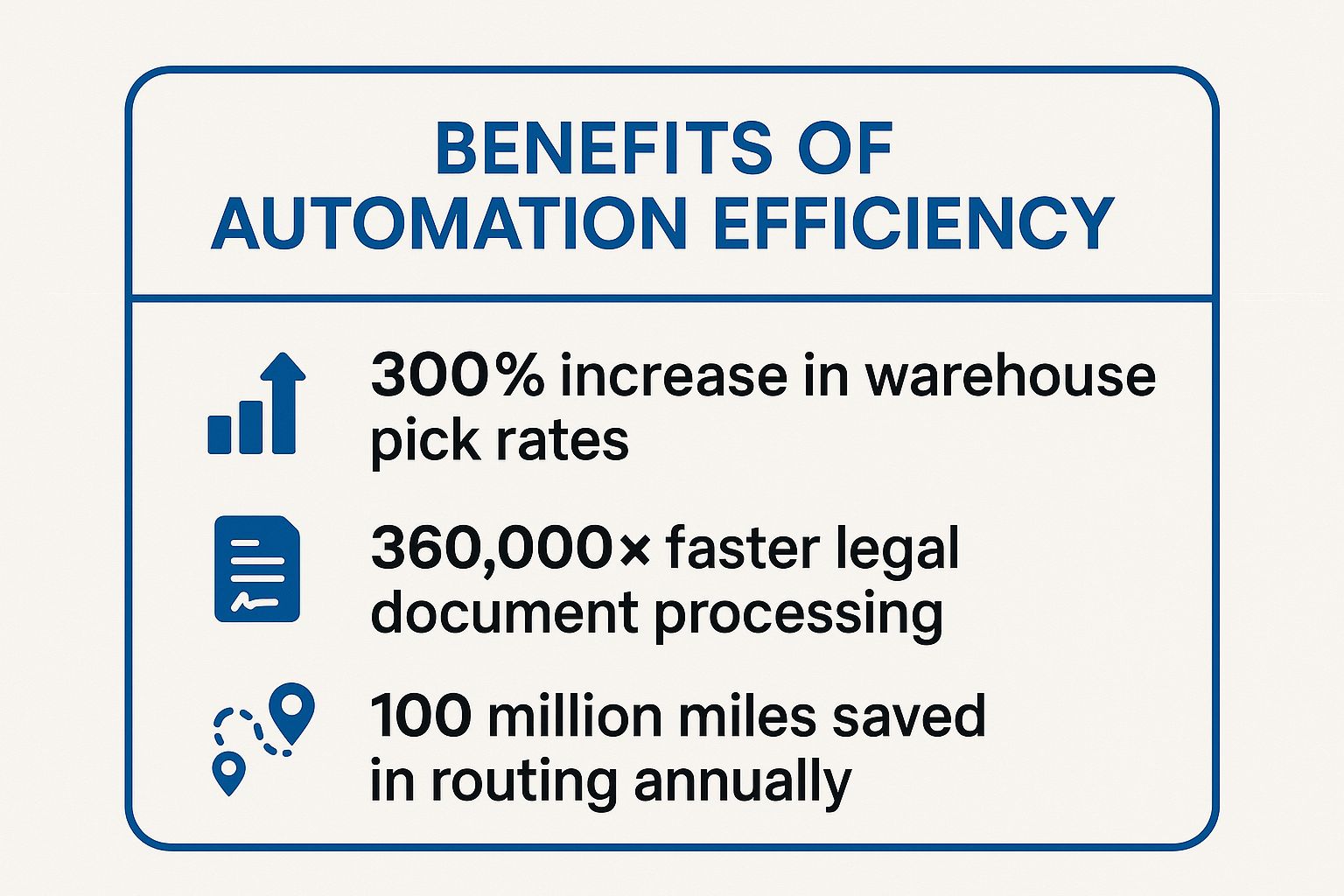
These figures demonstrate that automation isn’t just about incremental improvements; it’s about fundamentally reshaping what’s possible within operational workflows.
How to Implement for Maximum Efficiency
To realise these benefits, a strategic approach is crucial.
- Start Small: Begin by automating high-volume, rule-based processes like data entry or invoice processing.
- Map Workflows: Before implementing any tool, map your current workflows to identify inefficiencies and opportunities for automation.
- Set Clear KPIs: Establish key performance indicators (KPIs) such as “reduction in processing time” or “decrease in error rate” to measure the impact accurately.
- Train Your Team: Ensure employees are trained on the new systems to foster adoption and maximise their utility. With a solution like SpringVerify, HR teams can easily automate background checks, reducing administrative workload by up to 80% and allowing them to focus on candidate engagement.
2. Significant Cost Reduction
Another powerful business process automation benefit is the substantial reduction in operational costs. By taking over labour-intensive tasks, automation directly lowers expenses related to manual work, while also minimising costly human errors and optimising resource allocation. This financial impact allows organisations to redirect capital towards innovation and strategic growth initiatives.
Automation achieves cost savings by streamlining processes that traditionally consume significant man-hours. For instance, manual invoice processing involves data entry, validation, and approval routing, all of which are prone to delays and inaccuracies. An automated system can extract data from invoices, match it against purchase orders, and route it for approval without human touch, drastically cutting down processing time and eliminating the need for costly rework. This operational leanness translates directly to a healthier bottom line.
Real-World Impact of Automation
The financial returns from automation are well-documented across global enterprises. For example, Deutsche Bank reportedly saved approximately $1 billion annually by automating various back-office processes. Similarly, American Express managed to reduce its invoice processing costs by a staggering 70%, showcasing how targeted automation can yield massive savings in specific functional areas. These cases prove that automation is a reliable strategy for significant cost optimisation.
The following infographic summarises the impressive cost reductions achieved by leading companies through process automation.
These figures underscore that automation provides a clear and measurable return on investment, making it a critical lever for financial performance.
How to Implement for Maximum Cost Savings
A deliberate approach is necessary to maximise the financial benefits of automation.
- Target High-Cost Processes: Begin by identifying and automating processes with the highest manual labour costs, such as payroll administration or accounts payable.
- Calculate Total Cost of Ownership: Before investing, analyse the total cost of ownership (TCO), including software licences, implementation, and maintenance, to ensure a positive ROI.
- Monitor Key Metrics: Regularly track cost-saving metrics, such as “cost per transaction” or “reduction in overtime pay,” to quantify the financial impact.
- Leverage Cloud Solutions: Opt for cloud-based automation platforms to minimise upfront infrastructure investment and benefit from scalable, subscription-based pricing models. With a solution like SpringVerify, companies can automate background verifications, reducing the administrative overhead and associated labour costs of the hiring process, ensuring a faster and more cost-effective recruitment cycle.
3. Enhanced Accuracy and Quality
One of the most critical business process automation benefits is the significant improvement in accuracy and output quality. By delegating rule-based, repetitive tasks to software, organisations can virtually eliminate human error, ensuring processes are executed with unwavering consistency and precision. This is particularly vital in sectors like finance, healthcare, and compliance, where even minor mistakes can lead to significant financial loss, legal penalties, or reputational damage.
Automation enforces standardisation by ensuring every step in a workflow is performed the same way, every time. For example, in employee onboarding, manually entering a new hire’s data into multiple systems (payroll, HRIS, IT) creates numerous opportunities for typos or omissions. An automated workflow can capture this information once and populate it across all necessary platforms flawlessly. This not only guarantees data integrity but also ensures a consistent, high-quality experience for every new employee.
Real-World Impact of Automation
The impact of automation on accuracy is transformative and measurable. For instance, Bank of America reduced its loan processing errors by a staggering 90% by automating its workflows. Similarly, Coca-Cola leveraged automated inspection systems to achieve a 99.9% accuracy rate in its quality control processes. These examples underscore how automation minimises risk and elevates operational standards.
How to Implement for Maximum Accuracy
Achieving higher accuracy requires a deliberate and strategic implementation plan.
- Implement Robust Testing: Before a full-scale deployment, thoroughly test the automated process with a wide range of scenarios to identify and fix potential issues.
- Build in Exception Handling: Design workflows that can manage edge cases and anomalies. Create clear protocols for when a task requires human intervention.
- Regularly Audit Processes: Periodically review your automated workflows to ensure they remain accurate and aligned with evolving business rules and compliance requirements.
- Include Human Oversight: For critical decision-making points, maintain a human-in-the-loop to review and approve automated outputs, combining machine precision with human judgement. With a solution like SpringVerify, HR teams can automate the verification process, drastically reducing data entry errors and ensuring background check reports are consistently accurate and compliant.
4. Improved Customer Experience
Another of the core business process automation benefits is the ability to deliver a superior and more consistent customer experience. Automation enables faster response times, 24/7 availability, and uniform service delivery, which are critical for meeting modern customer expectations. By automating customer-facing processes like support tickets, order processing, and personalised communication, businesses can provide immediate and reliable service that boosts satisfaction and loyalty.
This shift allows organisations to handle inquiries and transactions instantly, without the delays associated with manual handling. For instance, when a customer places an order, an automated system can immediately confirm the purchase, send a receipt, and provide tracking information without any human intervention. This not only makes the process seamless for the customer but also frees up service teams to manage more complex, high-touch interactions that require a human element.

Real-World Impact of Automation
The link between automation and customer satisfaction is well-established across industries. For example, Netflix’s recommendation algorithm, a sophisticated form of automation, is responsible for driving 80% of viewer engagement by personalising content suggestions. Similarly, Domino’s pizza ordering automation streamlined the entire purchase journey, contributing to a 30% increase in sales. These cases prove that automation directly enhances how customers interact with a brand.
Even in the hiring context, automation improves the candidate experience. An automated background check process provides candidates with real-time status updates, ensuring they are informed and engaged. This level of transparency and efficiency reflects positively on the employer brand, creating a favourable impression from the very start.
How to Implement for an Enhanced Experience
To leverage automation for better customer interactions, a thoughtful strategy is essential.
- Personalise Interactions: Use customer data to tailor automated communications, making them feel relevant and personal rather than generic.
- Provide a Human Handoff: Always include a clear and easy option for customers to connect with a human agent if the automated system cannot resolve their issue.
- Implement Omnichannel Automation: Ensure a consistent experience by automating processes across all customer touchpoints, from social media chatbots to email support.
- Collect Feedback: Regularly ask for feedback on automated interactions to identify areas for improvement and refine the system’s performance. With a solution like SpringVerify, HR teams can ensure a smooth, transparent, and professional candidate journey, strengthening their employer brand.
5. Better Compliance and Risk Management
Another crucial business process automation benefit is the significant improvement in compliance and risk management. Automation embeds regulatory requirements and internal policies directly into workflows, ensuring consistent, auditable adherence. This systematic approach minimises human error, reduces regulatory risks, and simplifies the otherwise complex process of audit preparation.
By operationalising compliance, organisations can maintain detailed digital trails of every action taken. For instance, in hiring, automated background verification systems ensure that every candidate undergoes the exact same screening process, following all legal protocols for consent and data handling. This removes inconsistencies and creates a verifiable record, demonstrating due diligence to regulators and stakeholders and safeguarding the organisation against potential liabilities.
Real-World Impact of Automation
The power of automation in compliance is evident across regulated industries. Wells Fargo automated its anti-money laundering monitoring, which successfully reduced false positives by 50%. Similarly, Johnson & Johnson leverages automated quality compliance systems across more than 250 facilities worldwide to maintain stringent standards. These examples show how automation makes robust compliance frameworks scalable and efficient.
These applications underscore that automation is not merely a defensive tool but a proactive strategy to build a resilient, compliant operational foundation.
How to Implement for Better Compliance
A strategic approach is essential to harness automation for risk management.
- Embed Rules: Work with legal and compliance teams to codify regulatory rules and policies directly into your automated workflows.
- Implement Access Controls: Use role-based access controls within automated systems to ensure only authorised personnel can view sensitive data or approve critical steps.
- Maintain Audit Logs: Ensure your automation tools generate and maintain comprehensive, tamper-proof logs for every action, which are invaluable during audits.
- Regularly Update and Test: Compliance is not static. Regularly update the rules in your automated systems to reflect new regulations and test them to ensure they function correctly. For a deeper understanding of navigating the complex landscape of statutory requirements, you can explore more about comprehensive compliance.
6. Enhanced Scalability and Flexibility
Another one of the core business process automation benefits is the ability to scale operations up or down without a proportional increase in costs or resources. This enhanced flexibility allows organisations to adapt quickly to market demands, manage peak loads, and support growth efficiently. Automated systems can handle increased volume seamlessly, ensuring consistent service levels and operational control, regardless of the scale.
This agility is crucial for modern businesses. Imagine a retail company during a festive season sale. A manual process for order fulfilment would quickly become overwhelmed, leading to delays and customer dissatisfaction. An automated system, however, can process thousands of orders, update inventory, and trigger shipping notifications without missing a beat. This capacity to scale on demand is a significant competitive advantage, enabling businesses to seize opportunities without being constrained by their operational capacity.
Real-World Impact of Automation
The power of scalable automation is demonstrated by today’s leading technology companies. Netflix, for example, uses sophisticated automation to manage its massive content delivery network, streaming video to over 200 million users worldwide without compromising performance. Similarly, Uber’s automated dispatch system matches millions of drivers and riders daily, scaling effortlessly to meet demand fluctuations in real-time across different cities. These examples prove that automation is the backbone of modern, scalable business models.
How to Implement for Maximum Scalability
Achieving true operational flexibility requires a forward-thinking approach to automation.
- Design for Scale: Build your automated workflows with future growth in mind from the outset, avoiding designs that will become bottlenecks later.
- Leverage Cloud Platforms: Use cloud-based automation tools that offer inherent elasticity, allowing you to pay only for the resources you consume.
- Monitor Performance: Continuously track key performance metrics during periods of high demand to identify potential stress points before they become critical issues.
- Plan for Growth: For HR functions like background verification, scaling manually means hiring more staff. With a solution like SpringVerify, you can increase the number of checks from ten to ten thousand without a linear increase in administrative overhead, ensuring your hiring process can keep pace with company growth.
7. Real-Time Data and Analytics
Another of the core business process automation benefits is the ability to generate and leverage continuous streams of operational data. Automation provides real-time analytics that empower data-driven decision-making, offering organisations unprecedented visibility into their workflows. This constant flow of accurate, up-to-date information allows businesses to respond swiftly to changing conditions and identify optimisation opportunities as they arise.
Without automation, data collection is often manual, delayed, and prone to inaccuracies, making it difficult to get a clear picture of performance. Automated systems, however, capture data at every stage of a process, from initiation to completion. In hiring, this means tracking metrics like time-to-fill, cost-per-hire, and background check turnaround times in real-time. This visibility helps HR teams pinpoint bottlenecks and make informed adjustments to their strategies instantly.

Real-World Impact of Automation
The strategic value of real-time data is demonstrated by global industry leaders. For instance, FedEx leverages automation to track over 15 million packages daily, providing customers and logistics teams with live updates. Similarly, McDonald’s utilises real-time data from its automated kitchen systems across 40,000 restaurants to optimise inventory, staffing, and food preparation, ensuring consistency and efficiency at a massive scale.
These examples show that real-time analytics are not just for reporting; they are a critical tool for active, dynamic operational management.
How to Implement for Maximum Efficiency
To harness the power of real-time data, a structured approach is essential.
- Define Key KPIs: Before implementation, identify the key performance indicators (KPIs) that matter most, such as “candidate drop-off rate” or “verification completion time.”
- Invest in Visualisation Tools: Use business intelligence tools like Tableau or Power BI to transform raw data into intuitive dashboards and reports.
- Ensure Data Quality: Implement validation rules within your automated systems to maintain the accuracy and integrity of the data collected.
- Train Your Team: Equip your team with the skills to interpret analytics and use the insights to drive decisions. By integrating systems, you can achieve a seamless flow of information. Explore how to connect your platforms with SpringVerify’s API integrations.
8. Improved Employee Satisfaction and Engagement
One of the most overlooked business process automation benefits is its profound impact on employee morale and engagement. By automating mundane, repetitive tasks, organisations empower their employees to focus on more meaningful, creative, and strategic work that utilises their unique skills. This shift away from tedious administrative duties leads to higher job satisfaction, increased engagement, and better retention rates.
Automation frees talented professionals from the monotony of tasks like data entry, report generation, and manual follow-ups. In a hiring context, this means recruiters can spend less time chasing paperwork and more time engaging with candidates, building relationships, and making strategic hiring decisions. When employees feel their work is valuable and contributes directly to organisational goals, their sense of purpose and commitment grows significantly.
Real-World Impact of Automation
The link between automation and employee satisfaction is well-documented across industries. For example, Accenture reported that 73% of employees felt more satisfied after automation reduced their manual workload. Similarly, IBM’s automation initiatives led to 85% employee satisfaction with their new, more strategic role responsibilities. These figures show that automation isn’t about replacing people; it’s about elevating their roles.
This improvement in job quality directly translates to a more positive work environment and a stronger company culture. Engaged employees are more innovative, productive, and committed to long-term success, creating a virtuous cycle of growth and satisfaction.
How to Implement for Maximum Engagement
To ensure automation boosts morale rather than causing anxiety, a people-centric approach is vital.
- Communicate Clearly: Proactively communicate the benefits of automation, framing it as a tool to enhance employee roles, not eliminate them.
- Involve Your Team: Involve employees in the process of identifying and designing automation workflows. Their frontline insights are invaluable for success.
- Provide Comprehensive Training: Equip your team with the skills needed to use new automated systems effectively and confidently.
- Create Development Paths: Establish clear career paths that leverage the new skills and strategic capacity unlocked by automation. For HR professionals, leveraging a platform like SpringVerify for automated background checks can be a key step in their professional development, allowing them to master modern human resources technology.
Business Process Automation Benefits Comparison
| Aspect | Increased Efficiency and Productivity | Significant Cost Reduction | Enhanced Accuracy and Quality | Improved Customer Experience | Better Compliance and Risk Management | Enhanced Scalability and Flexibility | Real-Time Data and Analytics | Improved Employee Satisfaction and Engagement |
|---|---|---|---|---|---|---|---|---|
| Implementation Complexity | Medium – initial setup and ongoing updates | High – upfront investment & licenses | High – careful programming & testing | Medium – design for empathy & complexity | High – multi-jurisdiction & constant updates | Medium – infrastructure & planning needed | Medium – requires analytics expertise | Medium – change management & retraining |
| Resource Requirements | Moderate – technology & training investments | High – technology, maintenance, licenses | Moderate – skilled programmers & auditors | Moderate – AI, multi-channel platforms | High – compliance tools & legal input | Moderate – cloud resources & automation tools | Moderate – BI tools & data management | Moderate – training, tools, and change support |
| Expected Outcomes | ⭐⭐⭐⭐⭐ – 300%+ productivity increase | ⭐⭐⭐⭐ – Significant cost savings within 6-12 months | ⭐⭐⭐⭐⭐ – Near-zero errors, high quality | ⭐⭐⭐⭐ – Faster, consistent customer service | ⭐⭐⭐⭐ – Reduced compliance risk & audits | ⭐⭐⭐⭐ – Efficient scaling under demand | ⭐⭐⭐⭐ – Immediate insights & improved forecasting | ⭐⭐⭐⭐ – Higher satisfaction and retention |
| Ideal Use Cases | High-volume, rule-based workflows | Labor-intensive, costly manual tasks | Precision-critical environments | Customer-facing service automation | Regulated industries & audit-intensive processes | Businesses with variable load & growth ambitions | Data-driven decision environments | Workplaces with high manual task burden |
| Key Advantages | Dramatically reduces errors and processing time; scales easily | Cuts operational and labor costs; quick ROI | Consistent, error-free process outputs | 24/7 availability with personalized service | Ensures regulatory adherence and audit readiness | Handles peak loads efficiently; fast adaptation | Real-time monitoring and predictive analytics | Boosts engagement by eliminating tedious work |
Automate Today to Build a Stronger Tomorrow
The journey through the core business process automation benefits reveals a clear and compelling narrative: automation is no longer a futuristic luxury but a foundational element of modern, competitive business strategy. We have explored how automation acts as a powerful catalyst, driving everything from monumental gains in efficiency and productivity to significant, tangible cost reductions across departments. By moving beyond manual, error-prone tasks, organisations unlock a new level of operational excellence.
We’ve seen how this shift enhances accuracy, ensuring a higher quality of output whether in data entry, report generation, or candidate screening. This commitment to precision directly impacts the customer experience, creating smoother, faster, and more reliable interactions that build lasting loyalty. Furthermore, in an era of complex regulatory landscapes, automation offers a robust framework for improved compliance and risk management, embedding necessary checks and balances directly into your workflows. This creates a secure, auditable trail that protects your business and its stakeholders.
From Theory to Action: Your Next Steps
The true power of these concepts lies in their application. The benefits are not siloed; they are interconnected and create a virtuous cycle of improvement. For instance, the enhanced scalability and flexibility provided by automation allow your business to adapt to market changes without the friction of manual process overhaul. Simultaneously, the real-time data and analytics generated by automated systems provide the critical insights needed to make informed, strategic decisions. This data-driven culture, in turn, empowers your teams.
By liberating employees from mundane, repetitive tasks, you foster a more engaging work environment where their skills are dedicated to strategic, high-value activities. This boost to employee satisfaction is not just a secondary benefit; it is a critical driver of innovation and long-term success. The path forward involves a strategic, phased approach:
- Identify High-Impact Areas: Begin by pinpointing rule-based, repetitive processes that are currently bottlenecks. Hiring and onboarding workflows are often prime candidates.
- Evaluate a Pilot Project: Choose one specific process, such as background verification, to automate first. This allows you to measure the impact and build a business case for wider implementation.
- Select the Right Tools: Look for solutions like SpringVerify that are designed for seamless integration, offering a user-friendly interface and robust API capabilities to connect with your existing HRMS or ATS.
Ultimately, the strategic implementation of automation is about building a future-proof business, as detailed in how to automate business processes and boost growth. It is about constructing an organisation that is not only efficient today but also agile, resilient, and prepared for the challenges of tomorrow. The time to transition from discussion to action is now; your future, more productive self will thank you for it.
Ready to unlock the benefits of automation in your hiring process? Discover how SpringVerify can deliver fast, compliant, and fully automated background verifications that integrate seamlessly with your existing systems. Learn more about SpringVerify and take the first step towards a smarter, more efficient recruitment workflow.


