

When you hear “bulk recruitment,” you might think of a frantic rush to hire a large group of people as quickly as possible. But a truly well-executed process is far more strategic. It’s a method for hiring a significant number of employees simultaneously, often within a tight timeframe, without ever sacrificing quality for speed. This is essential for companies scaling up, launching new projects, or handling seasonal peaks in demand.
Table of Contents
Building Your Foundation for Mass Hiring

Before a single job ad is posted, the real work begins. A successful mass hiring campaign is built on an intensive planning phase. This isn’t just about picking a target headcount; it’s about creating a solid strategic framework to prevent logistical nightmares down the line.
Think of it as laying the foundation for a skyscraper. Any crack or flaw in the initial blueprint will compromise the entire structure. This foundational work ensures every new hire directly contributes to your broader business goals.
For instance, a manufacturing firm looking to double its production capacity can’t just hire indiscriminately. They must first forecast their workforce needs accurately. This means getting granular—figuring out not just the total number of new employees, but the specific skills required for roles like machine operators, quality assurance inspectors, and logistics coordinators.
To keep these crucial early steps organised, it helps to map them out. Here’s a quick breakdown of what that looks like in practice.
Key Planning Stages for Bulk Recruitment
| Planning Stage | Key Objective | Example Action |
|---|---|---|
| Workforce Needs Analysis | Move beyond a simple headcount to identify the core skills and competencies needed to achieve business goals. | A tech company launching a new SaaS product needs 50 customer support specialists and defines required skills like CRM familiarity and technical troubleshooting. |
| Candidate Persona Creation | Develop a clear picture of your ideal hire, including their career goals, motivations, and communication style. | Create a persona for a call centre agent that highlights their desire for growth opportunities and a healthy work-life balance. |
| Employer Value Proposition (EVP) Refinement | Sharpen your core message to answer the question: “Why should a great candidate work for us over anyone else?” | Highlight competitive salary, a clear career path, and a supportive work culture in all recruitment marketing materials. |
With this structured approach, your mass hiring campaign starts on solid ground, ready to attract the right people for the right roles.
Defining Your Workforce Needs
The very first step is a thorough workforce needs analysis. This is where you move past simple numbers and dig into the core competencies and skills your organisation needs to hit its future targets. Getting this right prevents costly mismatches later in the hiring process.
Let’s go back to that tech company launching a new SaaS product. They need to hire 50 new customer support specialists. A proper analysis would specify mandatory skills like familiarity with CRM software, proficiency in technical troubleshooting, and excellent communication abilities. This clarity then guides everything that follows, from writing job descriptions to crafting interview questions.
A common mistake is focusing solely on the quantity of hires while neglecting the quality and specific skill sets needed. A well-defined needs analysis acts as your North Star, guiding the entire bulk recruitment process and ensuring you attract candidates who can truly drive your business forward.
Crafting Candidate Personas and Your EVP
Once your needs are clearly defined, it’s time to create detailed candidate personas. These are semi-fictional profiles of your ideal candidates. For a call centre agent, a persona might include details about their career goals, preferred communication style, and what they value most in an employer—like work-life balance or chances for promotion.
At the same time, you need to polish your Employer Value Proposition (EVP). Your EVP is the unique promise of value you make to your employees in return for their skills and dedication. For a mass hiring campaign, your EVP must be powerful enough to resonate with a wide audience. It should instantly answer the question: “Why should I work for you over anyone else?”
A strong EVP might highlight:
- Competitive salary and comprehensive benefits packages.
- A clear path for career progression and skill development.
- A positive and supportive work culture.
- Opportunities for flexible work arrangements.
The evolution of mass hiring, particularly in fast-growing economies like India, highlights just how critical this foundational work is. As companies compete to fill numerous roles, a well-defined plan is a major differentiator. This planning is a core part of modern talent acquisition and is essential for building a successful team.
Crafting a Powerful Candidate Sourcing Engine
When you’re facing a bulk recruitment drive, just posting a job ad and hoping for the best is a recipe for failure. What you really need is a powerful, multi-channel sourcing engine firing on all cylinders. Think of this as your system for proactively finding and engaging talent at scale, making sure a steady stream of qualified people flows into your pipeline.
It’s a bit like fishing. You wouldn’t cast a single line into the ocean and expect to feed a village. You’d use multiple nets, lines, and traps, placing them strategically where you know the fish are biting. Sourcing for mass hiring is no different—it demands a diverse and targeted approach.
The entire engine is built on the foundation of a compelling job description. In a crowded market, generic descriptions just fade into the background. Yours needs to cut through the noise by being clear, concise, and optimised for the platforms your ideal candidates actually use.
Optimising Your Job Descriptions for Volume
Your job description is often the very first interaction a candidate has with your company. It has to sell the role and your culture, and for high-volume roles, clarity and scannability are everything.
Start with simple, straightforward job titles that people actually search for, like “Customer Service Executive” or “Warehouse Associate,” instead of internal company jargon. Next, use bullet points to clearly outline the core responsibilities. Most importantly, tell them what’s in it for them.
Take this example for a manufacturing role in Jaipur:
- Clear Career Path: We offer structured training programmes that can lead to a team lead promotion in as little as 12 months.
- Supportive Environment: Join a team that puts collaboration and safety above all else.
- Competitive Pay & Benefits: Get a top-tier salary package, health insurance, and a performance bonus.
This shifts the focus from a dry list of demands to an attractive opportunity, which is exactly what you need when you’re trying to appeal to a wide audience.
Remember, a job description is a marketing tool. Research shows that nearly half of all candidates hear about job vacancies through word-of-mouth. A clear, compelling description makes it much easier for your own employees and their networks to share the opportunity accurately.
Deploying a Multi-Channel Sourcing Strategy
Once you’ve got your optimised job descriptions ready, it’s time to get them out there. A common mistake is relying on just one source, which severely limits your reach and the diversity of your applicant pool. A truly robust bulk recruitment process blends a mix of online and offline methods.
Here are some of the most effective channels to build into your sourcing engine:
- High-Traffic Job Portals: Platforms like Naukri, Indeed, and LinkedIn are non-negotiable. Use their tools to post in bulk and target specific locations, like the tech hubs in Indore or manufacturing zones near major cities.
- Employee Referral Programmes: Your current employees can be your best source for high-quality candidates. They already understand the company culture and are likely to refer people who will fit right in. Make sure to offer meaningful incentives to get them involved.
- Specialised Staffing Agencies: Partnering with agencies that specialise in your industry can be a real game-changer. For manufacturing or tech roles, these partners often have pre-screened databases of qualified talent, giving you instant access to people who meet your criteria. This can dramatically shorten your time-to-hire.
Activating Localised and Targeted Campaigns
Beyond these core channels, it’s smart to run targeted campaigns to attract specific talent segments. For example, campus recruitment drives at local colleges and vocational institutes can be a fantastic source of enthusiastic, entry-level talent with fresh skills.
You can also run highly localised campaigns. Need to hire tech talent? Launch a targeted social media campaign focused on professionals in cities like Pune and Hyderabad. Geo-targeting ensures your ads are seen by the right people in the right places. For operational roles, walk-in interview drives—promoted heavily through local media and posters—are incredibly effective. They create a sense of urgency and make it dead simple for candidates to apply.
This multi-pronged strategy ensures your sourcing engine isn’t just powerful, but also intelligent. It brings in the right volume of qualified candidates to fuel your entire bulk recruitment process.
Building an Efficient Screening and Assessment Funnel
When a bulk recruitment drive opens the floodgates to thousands of applications, manual screening isn’t just a poor use of time—it’s completely unworkable. The real test is figuring out how to sift through this mountain of resumes to find quality candidates without burning out your recruitment team. The only way to do this effectively is by building a smart, automated, and scalable screening and assessment funnel.
This is where a robust Applicant Tracking System (ATS) steps in to become your mission control. A modern ATS is far more than a digital filing cabinet; it’s the engine that drives your entire screening operation. It can automatically parse resumes, organise candidate data, and filter applicants against the essential criteria you established back in the planning phase.
This initial, automated pass is a lifesaver. By setting up keyword filters for non-negotiable skills (like “machine operation” or “CRM software”) and qualifications, the ATS can instantly pull the most promising applications to the top. This simple step frees up your recruiters to do what they do best: engage with qualified talent, rather than drowning in a sea of irrelevant resumes.
Using Automation for the Initial Filter
To have any chance of managing the sheer volume of a mass hiring campaign, automation is your best friend. AI-powered tools integrated directly into your ATS can handle the heavy lifting of the initial screen, saving your team hundreds of hours of manual work.
These tools are more sophisticated than simple keyword matching. They can understand the context of a resume, spot patterns in work experience, and even rank candidates based on how well they align with your job description. This first layer of intelligent filtering ensures that only the people who genuinely meet your baseline requirements move forward.
A well-configured ATS can slash screening time by up to 75%. This isn’t just about moving faster; it’s about giving your team the bandwidth to handle a massive influx of candidates without letting the quality of your screening suffer.
This infographic gives a clear visual of how a sourcing strategy flows directly into the screening and assessment funnel.
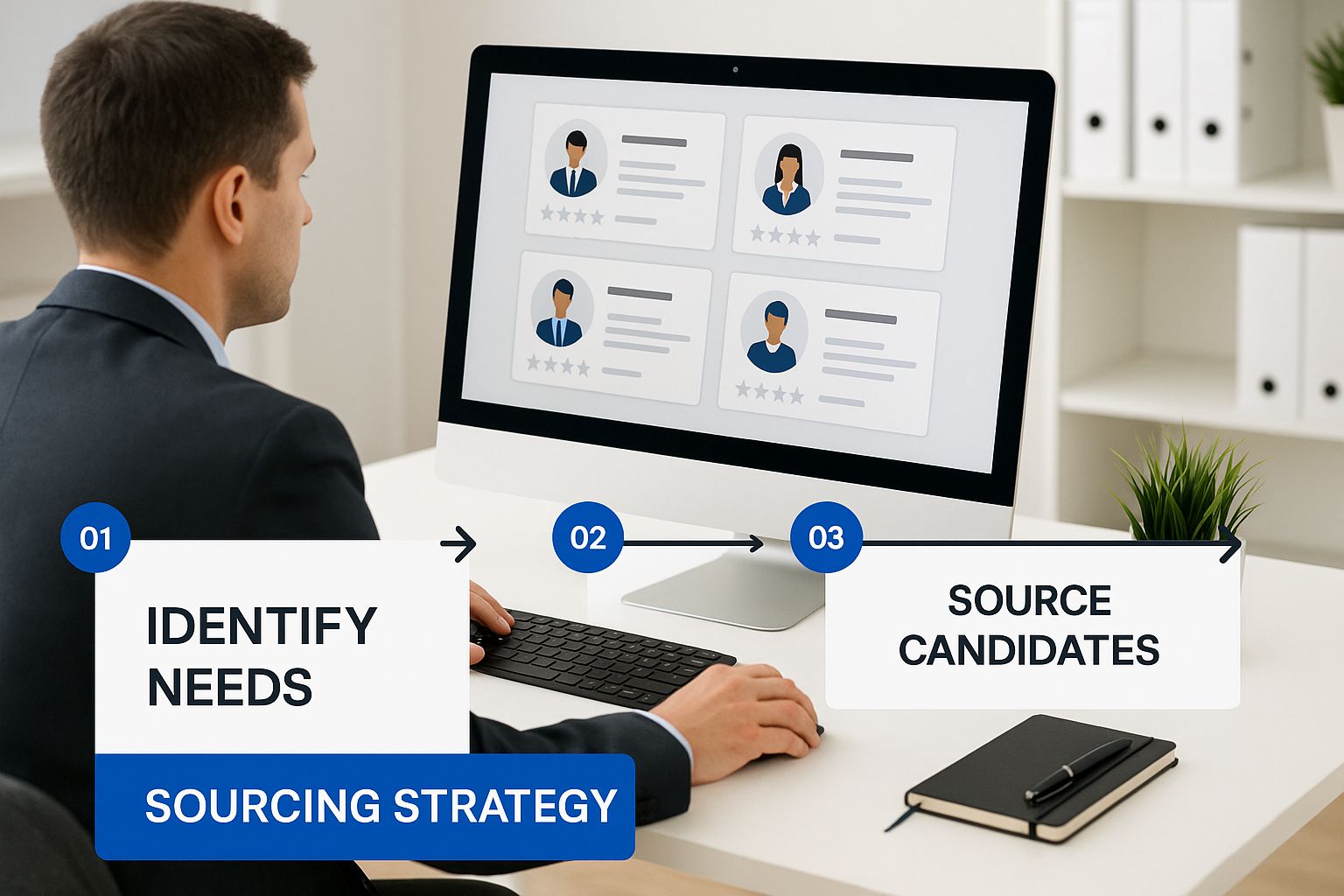
As the image shows, technology is at the heart of managing a high volume of candidate profiles, which is exactly what an efficient screening process is all about.
Designing a Multi-Stage Assessment Process
Once the initial automated screen has thinned the herd, it’s time to dig deeper into the skills and suitability of the remaining candidates. A multi-stage assessment process is perfect for this. It lets you evaluate different skills at each step, gradually narrowing the pool until only the top contenders remain.
This approach is incredibly valuable in sectors like manufacturing, where bulk recruitment is essential as companies expand and modernise. Many Indian manufacturers already partner with bulk recruitment firms that leverage large, pre-screened databases for roles like machine operators and technicians, often using AI to forecast workforce needs and hire quickly.
For high-volume roles, a solid assessment funnel might look something like this:
- Online Aptitude Tests: These are fantastic for checking foundational skills like logical reasoning, numerical ability, and problem-solving. Best of all, they can be sent to thousands of candidates at once.
- Practical Skill Challenges: For any technical or operational role, a short, practical test is worth its weight in gold. Think a simple coding challenge for a junior developer or a simulated task for a customer service position.
- Asynchronous Video Interviews (AVIs): AVIs are a total game-changer for mass hiring. Candidates record answers to your questions on their own time, allowing recruiters to assess communication skills and personality fit far more efficiently than scheduling hundreds of initial phone calls.
Finalising the Shortlist with Verification
Before you move to live interviews, there’s one last critical stage in your assessment funnel: verification. It’s vital to confirm that the information candidates have provided is accurate. This step saves you from wasting valuable interview time on people who don’t meet basic compliance or background standards.
Running a thorough background check is non-negotiable, especially when hiring at scale. This is your chance to confirm past roles, responsibilities, and qualifications. To understand just how important this is, have a look at our detailed guide on the importance of employment verification.
By designing a funnel that intelligently and systematically narrows the field, you ensure that only the most qualified, suitable, and verified candidates make it to the final interview stage. It turns a potentially chaotic process into a structured and effective system for finding great talent, even at scale.
You’ve screened thousands of applicants, and now you’re at the most hands-on part of the bulk recruitment process: interviews and selections. Trying to juggle hundreds of interviews can quickly turn into a logistical nightmare. This stage demands a well-oiled machine to run smoothly, whether you’re organising large-scale walk-in drives or virtual hiring events.

The real goal here is to move past the chaos of scheduling. You need a system that spots top talent without wrecking the candidate experience. Success hinges on meticulous organisation, clear communication, and consistent ways to evaluate everyone.
Organising Large-Scale Interview Events
The first hurdle is managing the sheer logistics of the interviews. Whether you go for a walk-in drive at a specific venue or a virtual hiring fair, you can’t just wing it. A physical event means booking a venue, setting up registration desks, and managing the flow of people to avoid those long, frustrating queues.
For virtual events, you’ll need to pick a reliable platform that can handle multiple interview rooms running at the same time. You also have to assign interviewers smartly, building a schedule that works for them while handling the expected number of candidates. This is where automated scheduling tools are a lifesaver, letting candidates book their own slots based on real-time availability.
A common pitfall is underestimating the resources needed. For every 10 interviewers, you should have at least one coordinator dedicated to troubleshooting technical issues, guiding candidates, and keeping the schedule on track. This ensures a smooth experience for everyone involved.
Creating Consistency with Structured Scorecards
When you have multiple interviewers assessing hundreds of candidates, keeping things consistent is the only way to make fair and unbiased decisions. The best tool for this job? Structured interview scorecards.
These aren’t just simple checklists. They’re detailed guides that spell out the key competencies and skills needed for the role. Each competency is linked to specific, behaviour-based questions, and there’s a clear rating scale (like 1-5) to score the answers.
This approach forces every interviewer to evaluate candidates against the exact same yardstick. It drastically cuts down on personal bias and gives you concrete, data-driven points for comparing people. Before any interviews start, it’s absolutely vital to run a training session with all hiring managers to get them on the same page about using the scorecards and what a “good” answer actually looks like.
In India’s booming tech sector, this level of organisation is a must. For companies scaling up in cities like Bangalore, Hyderabad, and Pune, the hunger for roles like Cloud Engineers and Data Scientists is massive. Speed is everything—a delay of more than three days after an interview often means your top candidate has already taken another offer. This is exactly why a finely tuned bulk recruitment process is so critical. You can learn more about the unique pressures of scaling tech teams in India to get ahead.
Maintaining a Positive Candidate Experience
In the middle of all this volume, it’s surprisingly easy to forget about the individual candidate. But treating people with respect is non-negotiable if you want to protect your employer brand. Remember, even the people you don’t hire could become customers or refer other great talent down the line.
A few simple actions can make a world of difference:
- Set Clear Expectations: Right from the first email, tell candidates about the whole process. Let them know how many rounds there are and when they can expect to hear back.
- Provide Timely Updates: Use automated emails or SMS messages to confirm interview times and send reminders. It’s a small touch that shows you value their time.
- Offer Closure: This one is huge. Communicate the final decision to every candidate who made it to the interview stage. A polite, templated rejection email is infinitely better than complete silence.
By organising this complex phase with precision, you can turn a potentially chaotic process into a powerful engine for finding and hiring the best talent at scale.
Getting a verbal ‘yes’ from a candidate is a great moment, but it’s far from the finish line. The final stage of any bulk recruitment drive—managing offers and onboarding—is where you secure your investment. This is the most delicate part of the process, and handling it smoothly for large groups is the only way to turn promising candidates into engaged, long-term employees.
The first hurdle is simply rolling out offers efficiently. Trying to do this manually at scale is a recipe for errors and delays, which can be incredibly costly. Instead, lean on digital signature tools and automated workflows through your Applicant Tracking System (ATS). This is how you can generate and send out hundreds of personalised offer letters at once.
These systems also give you a real-time dashboard to track acceptances, so you have an immediate view of your hiring success rate. This kind of speed is essential for keeping momentum and quickly spotting any gaps you still need to fill.
Preventing Offer Drop-Offs
One of the biggest headaches in any mass hiring project is the high rate of offer drop-offs. That quiet period between a candidate accepting an offer and their actual start date is a vulnerable one. Competitors might swoop in with counter-offers, or the initial excitement can just fizzle out into uncertainty.
To tackle this, you have to keep your new hires engaged. A simple, automated communication workflow can make a world of difference.
- A Warm Welcome: Send an immediate, warm welcome email from a team leader or department head as soon as they accept.
- Weekly Check-ins: Automate short, friendly emails with fun facts about the company, video introductions to future team members, or links to company social media pages.
- First-Day Info: About a week before they start, send a detailed email covering everything they need to know: where to go, what to bring, and who to ask for on arrival.
This kind of proactive communication makes new hires feel valued and part of the team before they even walk through the door, which dramatically reduces the chances of them backing out.
Designing a Scalable Onboarding Programme
A successful onboarding programme for bulk hires has to be structured, consistent, and built to scale. The goal is to handle all the necessary paperwork, compliance checks, and initial training in efficient batches, all without making the experience feel cold or impersonal.
Onboarding is your first, and arguably best, chance to weave new employees into your company culture. A disorganised or impersonal process can lead to early disengagement and higher turnover within the first few months. A great experience, on the other hand, sets the stage for long-term commitment.
Start by creating digital welcome kits. These can be sent via email and include everything from the employee handbook and policy documents to introductory videos and a welcome message from the CEO. This lets new hires absorb important information at their own pace. You can also explore expert-led resources from the wider human resources community to refine your approach.
Organising Group Sessions and Documentation
When you’re dealing with dozens or hundreds of new starters, batch processing is your best friend. Organise virtual or in-person sessions to handle paperwork, IT setup, and mandatory compliance training all at once.
A clear checklist helps ensure nothing gets missed when onboarding a large cohort.
Onboarding Checklist for Bulk Hires
| Onboarding Phase | Key Task | Tool/Method |
|---|---|---|
| Pre-Boarding | Collect and verify all required documents and personal information. | Use a secure online portal for document submission and an automated BGV platform. |
| Day One Orientation | Introduce company culture, mission, and key leaders to the entire group. | Host a large-group virtual webinar or an in-person all-hands meeting. |
| Initial Training | Deliver role-specific training and introduce them to their direct teams. | Use a mix of e-learning modules for foundational skills and smaller breakout sessions. |
By making every new employee feel welcomed and systematically integrated from day one, you pave the way for better performance and loyalty. Once you’ve successfully brought in this volume of talent, exploring effective strategies for employee retention is paramount to ensure your mass hiring efforts yield long-term success. This final stage transforms a successful bulk recruitment process into a sustainable workforce strategy.
Common Questions About the Bulk Recruitment Process
Even the most seasoned HR leaders have questions when staring down the barrel of a high-volume hiring drive. The sheer scale of a bulk recruitment process brings its own unique set of challenges. Let’s tackle some of the most common queries we hear from teams on the ground.
How Is Bulk Hiring Different from Mass Hiring?
It’s a subtle difference, but an important one. People often use these terms interchangeably, but they aren’t quite the same thing.
Mass hiring is usually about bringing in a large number of people for very similar, often undifferentiated, roles. Think about a new retail store opening and needing to hire a hundred shop-floor assistants.
Bulk hiring, on the other hand, is more about structured, high-volume recruitment across several specific roles at once. For example, a tech company might have an urgent need for 50 cloud engineers, 30 data analysts, and 40 customer support specialists. The total volume is high, but each role requires its own tailored approach to sourcing, screening, and assessment. It’s a coordinated, multi-pronged effort.
What Is the Biggest Risk in a Bulk Recruitment Process?
Without a doubt, the single greatest risk is letting quality slip in the race for speed.
The pressure to fill hundreds of roles is immense. It’s incredibly tempting to cut corners—skipping a screening step here, lowering the bar there—just to hit your numbers. But this almost always comes back to haunt you. You end up with poor performers, disengaged employees, and a spike in early-stage turnover, which completely defeats the purpose of hiring in the first place.
The real challenge is finding that sweet spot between speed and quality. A successful bulk recruitment process isn’t just about filling seats fast; it’s about building a machine that can handle volume without sacrificing the calibre and cultural fit of the people you welcome aboard.
To avoid this pitfall, you have to stick to the plan. Rely on a structured framework that includes:
- Using consistent interview scorecards for every candidate.
- Implementing role-specific assessments at the right stage.
- Never, ever skipping background verification checks, no matter how tight the deadline.
How Can We Maintain a Positive Candidate Experience?
This is tough, but it’s not impossible. Juggling thousands of applications while keeping everyone happy is a huge challenge. But get it wrong, and you risk damaging your employer brand for years to come. Unhappy candidates talk—to their friends, on social media, everywhere.
The secret is clear, consistent, and automated communication. You can’t write a personal email to every applicant, but you can make sure nobody feels like they’ve been ghosted.
- Acknowledge every application: Your Applicant Tracking System (ATS) should fire off an instant confirmation email. It’s a small touch that goes a long way.
- Set clear expectations: Let candidates know the timeline. A simple message like, “We’re reviewing applications and you can expect an update on the next steps within 7 business days,” manages expectations perfectly.
- Give closure to everyone: A polite, automated rejection email is infinitely better than silence. It shows you respect the time and effort they put into applying.
How Do We Avoid Overwhelming Our HR Team?
Recruiter burnout is a very real threat during a bulk hiring campaign. You can’t expect your team to manually sift through thousands of profiles without burning out. The key is to lean heavily on technology and smart process design.
Don’t make your people do what software can do better.
Automate every repetitive task you can think of—from initial resume screening and interview scheduling to sending out those communication emails we just talked about. A modern ATS, especially one with AI capabilities, can filter thousands of applications based on your criteria. This frees up your recruiters to do what they do best: have quality conversations, engage with top-tier talent, and build relationships. Think of technology as a force multiplier for your team.
For instance, one study found that almost half of all candidates first hear about jobs through word-of-mouth. When your process is well-oiled and automated, your team has the breathing room to nurture those valuable referrals instead of drowning in administrative tasks.
Ready to handle your next high-volume hiring drive with confidence? SpringVerify offers reliable and scalable background verification services designed for fast-growing companies in India. Our platform integrates seamlessly with your existing systems to automate checks, ensure compliance, and help you make informed hiring decisions faster. Secure your investment in talent with a partner you can trust.


