

Think of bulk PAN verification as a high-speed quality check for your business’s financial data. It’s the process of validating hundreds or even thousands of Permanent Account Numbers (PANs) all at once, directly against the official Income Tax Department database.
This isn’t just a simple data entry task. It’s a strategic move to ensure every PAN you handle is authentic, active, and correctly matched to the person who holds it. Getting this right is fundamental to preventing fraud and staying on the right side of regulations.
What Is Bulk PAN Verification And Why It Matters
Imagine a huge manufacturing plant. Before any product can be assembled, every single component has to be perfect. One faulty part can bring the entire machine grinding to a halt. Bulk PAN verification plays a similar role in the world of business and finance.
It’s not some repetitive admin chore; it’s a critical shield protecting your company from financial risk, fraud, and hefty non-compliance penalties. In practice, a business can upload a massive list of PANs and get a detailed status report for each one. This report instantly tells you if a PAN is valid, invalid, or maybe linked to a completely different name—giving you vital intelligence for your entire financial ecosystem.
A Strategic Must-Have In A Digital Economy
In an economy that moves at the speed of light, checking PANs one by one just doesn’t cut it anymore. Businesses today are onboarding dozens of vendors, hiring employees in large groups, and processing payments for countless partners. The integrity of the PAN provided is the bedrock of every single one of these interactions.
Here’s why having a solid bulk PAN verification system is no longer a “nice-to-have,” but an absolute necessity:
- Fraud Prevention: It’s your first line of defence against individuals or shell companies trying to use fake or invalid PANs for shady activities.
- Regulatory Compliance: It helps you stick to the strict Know Your Customer (KYC) and Anti-Money Laundering (AML) rules set by bodies like the RBI and the CBDT.
- Data Integrity: It guarantees that your internal records—whether in your payroll system, vendor database, or CRM—are accurate and trustworthy.
- Operational Efficiency: Automating this frees up countless hours of manual work, slashes the risk of human error, and speeds up essential processes like onboarding and payments.
The importance of this process in India’s fight against financial fraud can’t be overstated. With a colossal number of PAN cards in circulation, the risk of duplicate or fraudulent PANs is a serious threat without a strong verification framework in place.
To give you a clearer picture of the advantages, let’s break down the key benefits of implementing a bulk PAN verification system.
Key Benefits of Implementing Bulk PAN Verification
A summary of the primary advantages businesses gain by adopting bulk PAN verification processes.
| Benefit | Business Impact |
|---|---|
| Enhanced Security | Significantly reduces the risk of financial fraud by flagging invalid or mismatched PANs early on. |
| Regulatory Adherence | Ensures compliance with KYC and AML regulations, helping you avoid steep penalties and legal trouble. |
| Improved Efficiency | Automates a tedious manual process, saving time and allowing your team to focus on more strategic tasks. |
| Data Accuracy | Cleans and maintains the integrity of your vendor, employee, and customer databases for reliable operations. |
| Cost Savings | Prevents financial losses from fraudulent transactions and reduces the operational costs of manual verification. |
Ultimately, integrating bulk PAN verification helps build a more secure, efficient, and compliant business from the ground up.
Moving From Reactive To Proactive Protection
Without a proper system, you often find out about a bad PAN only when something goes wrong—a failed transaction, a notice from the tax department, or a stressful compliance audit. This reactive approach is not only inefficient but also incredibly costly.
Bulk verification completely flips the script. It allows you to spot and fix discrepancies before they can cause any real damage. This proactive stance is often a key part of wider due diligence exercises, ensuring the financial information you rely on is solid. For a deeper look into this vital business practice, it’s worth understanding the principles of due diligence.
By making this check a standard part of your operations, you stop putting out fires and start preventing them altogether. It’s a simple shift that safeguards both your financial health and your hard-earned business reputation.
Table of Contents
Choosing the Right PAN Verification Method

Picking the right way to verify PANs is just as important as the verification itself. Your choice directly affects your team’s efficiency, how quickly you can operate, and your ability to scale. Think of it like choosing a delivery service: you wouldn’t use a bicycle courier to ship a truckload of goods, nor would you hire a cargo plane for a single letter.
Each verification method is built for a specific scale and purpose. Getting to grips with these differences is the key to building a smart, cost-effective, and powerful compliance workflow for your organisation.
Let’s break down the three main approaches to bulk PAN verification.
The Three Core Verification Methods
In India, businesses can tap into PAN verification services through three official channels, each with its own capacity and ideal use case. These are categorised as Screen-Based, File-Based, and API-Based verification.
It’s a user-pays model, with annual registration charges usually landing around ₹14,160, inclusive of GST.
Understanding the processing limits is crucial here:
- Screen-Based Verification: You can check up to 5 PANs at a time.
- File-Based Verification: This lets you process a list of up to 1,000 PANs in a single go.
- API-Based Verification: Delivers real-time, individual checks baked right into your software.
This structure allows every business to pick the tool that actually fits their day-to-day reality.
When to Use Screen-Based Verification
Screen-based verification is the most basic of the lot. It involves someone on your team manually typing PANs into a web portal. It’s like sending a quick text message to confirm a detail—fast for a tiny bit of info, but completely impractical for a proper conversation.
Ideal Use Case: This method works best for small businesses or teams that only need to check a handful of PANs every now and then. Think of a small consultancy double-checking a new freelancer’s details or a startup confirming its first few vendor PANs.
Because it caps out at five PANs per check, it’s not built for volume. Trying to use this for anything more than sporadic checks will create instant bottlenecks and open the door to manual data entry errors.
When to Use File-Based Verification
File-based verification is the dependable workhorse for planned, large-batch processing. It involves prepping a structured file (like a CSV or TXT) with up to 1,000 PANs, uploading it to the portal, and then downloading the results. Think of it as sending a scheduled email blast—perfect for hitting a large, defined list all at once.
This is the go-to method for many organisations handling medium-to-large volumes.
- Employee Onboarding: An HR department processing the PAN details of a new batch of 50 hires.
- Vendor Payouts: A finance team verifying all active vendor PANs before a quarterly payment cycle.
- Customer KYC: A financial services firm running a required annual check on a segment of its customer base.
While it’s powerful for batches, it’s not instant. There’s a built-in time lag between preparing and uploading the file and getting the processed report back.
When to Use API-Based Verification
API-based verification is the most advanced and seamless option. It connects your internal business systems—like your HRMS, CRM, or onboarding platform—directly to the PAN database. This is like having a dedicated, high-speed data line that gives you instant, automated answers whenever you need them.
For businesses where speed and automation are top priorities, exploring enterprise solutions from SpringVerify shows just how much an API integration can transform a workflow.
The biggest win here is real-time validation. When a customer or new hire enters their PAN into your system, the API can verify it on the spot. This eliminates manual work, cuts human error down to almost zero, and creates a smooth, frictionless user experience. It’s the clear choice for high-growth companies and enterprises where speed and scale are everything.
How API-Based Verification Transforms Your Workflow

Switching from manual or even file-based methods to an API-first approach isn’t just a technical tweak—it’s a complete overhaul of how your business operates. Think of an Application Programming Interface (API) as a secure, high-speed bridge connecting your internal software directly to the official PAN database.
Imagine your team is still checking PANs one by one. That’s like having to physically walk to a library, find the right book, jot down the information, and walk back every single time you need a fact. An API, in contrast, is like having a direct phone line to the head librarian who gives you instant, accurate answers without you ever leaving your desk.
This direct connection gets rid of the time-consuming, soul-crushing work of manual data entry and clunky file uploads. By automating the bulk PAN verification process, you don’t just speed up your operations; you also slash the risk of human error, which can lead to expensive compliance headaches and financial mistakes.
The Power of Real-Time Validation
The biggest game-changer with an API is its ability to deliver real-time validation. The moment a PAN is entered into your system—whether it’s a customer onboarding form or a vendor registration portal—the API can confirm its authenticity instantly. This completely changes both the user experience and your internal efficiency.
For example, a fintech company can approve a new customer’s KYC in seconds, not hours. This creates a smooth, frictionless onboarding journey that boosts customer satisfaction and sign-up rates. In the same way, a procurement team can validate a new vendor’s PAN on the spot, allowing for immediate approval and integration into the payment system.
This instant feedback loop means your team is no longer bogged down by tedious background checks. Instead, they can focus their energy on higher-value tasks like building customer relationships, negotiating better vendor terms, or analysing financial data for strategic insights.
Unlocking Unprecedented Scalability and Efficiency
As your business grows, so does the number of verifications you need to run. Manual and file-based methods just can’t keep up. While better than manual, file-based verification has its own bottlenecks, often capping out at around 1,000 PANs per file and involving a delay between uploading the file and getting the results.
An API-based system, however, is built for scale. It can handle a massive volume of verification requests without breaking a sweat, ensuring that your growth is never held back by compliance checks. Whether you’re onboarding a hundred new employees or a thousand new customers in a single day, the process remains just as fast and reliable.
API integration turns a mandatory compliance chore into a powerful competitive advantage. By automating real-time checks, businesses can improve operational speed by over 90% compared to manual methods, freeing up thousands of hours and preventing costly errors.
This efficiency translates directly to your bottom line. Automation minimises the operational costs tied to manual labour and fixing mistakes. Figuring out how to implement these systems can be a game-changer; you can learn more about powerful API integrations from SpringVerify to see how they can plug into your existing platforms. This makes your business more agile, secure, and ready to handle any level of growth without compromising on speed or security.
Your Step-by-Step Bulk Verification Workflow
Diving into bulk PAN verification can feel a bit daunting at first. But when you break it down, it’s a pretty straightforward workflow. Think of it less like a mountain of paperwork and more like a simple, logical sequence of steps. Let’s walk through the entire journey, from getting your data ready to putting the results to good use.
The very first fork in the road is deciding how you’ll run the verification. You could go through the demanding process of registering directly with the tax authorities, but honestly, that’s a heavy lift. Most businesses find it far more efficient to team up with an authorised service provider who offers a solid API. This route saves a ton of time and administrative headaches.
With your provider chosen, the next phase is all about the data itself.
Preparing and Uploading Your Data
This is where your attention to detail really pays off. You’ll need to gather all the PANs you want to check into a single file, usually a CSV (Comma-Separated Values) or XML (eXtensible Markup Language) file. Getting this part right is the key to avoiding most common errors and delays down the line.
A tiny mistake—like an extra space or a typo in a PAN—is enough to cause a verification to fail. It’s always a good idea to give your data a quick clean-up first.
- Standardise Format: Make sure every PAN follows the correct 10-digit alphanumeric structure.
- Remove Extraneous Characters: Hunt down and eliminate any sneaky spaces, commas, or special symbols that don’t belong.
- Check for Completeness: Do a final headcount to ensure every PAN you need to verify has made it into the file before uploading.
Once your file is prepped and polished, you’ll upload it securely to your provider’s platform or send it through their API. A secure connection here is non-negotiable to protect the sensitive data inside.
The infographic below gives you a clear picture of how this process flows.
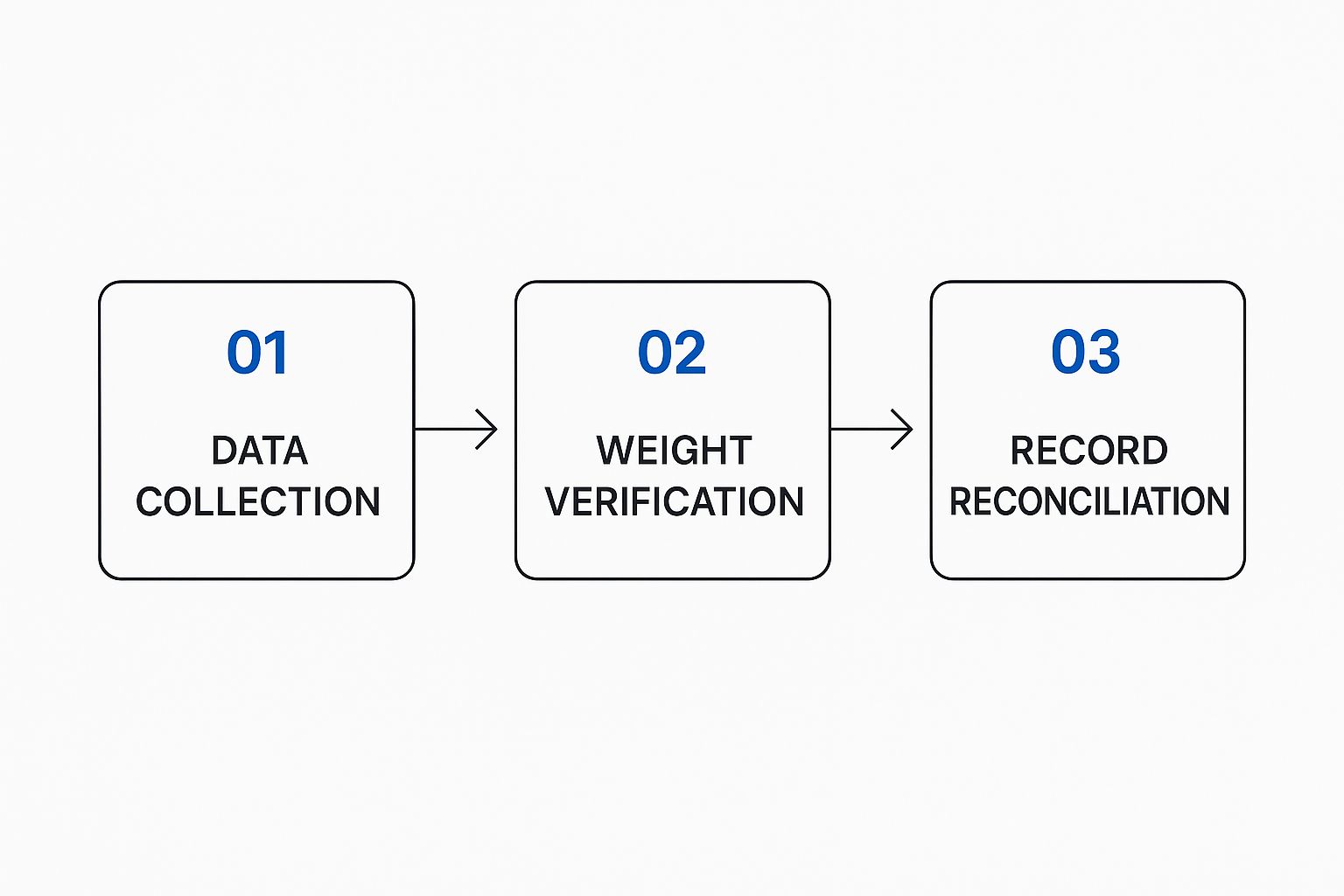
This visual really captures the core logic: collect the data, run the checks, and then reconcile the results. That’s the heart of any bulk verification task.
Interpreting the Verification Results
After the system works its magic, you’ll get a report back with the status of each PAN. This is where the real value lies. The responses are usually simple, but they carry significant weight for your business operations.
To make sense of these responses, it’s helpful to understand what each status code means. They’re not just technical jargon; they’re clear signals about data quality and potential risks.
Understanding PAN Verification Status Codes
| Status Code | Meaning | Recommended Action |
|---|---|---|
| Valid | The PAN is active and exists in the income tax database. | This is the green light. The PAN is authentic. Proceed with the transaction or onboarding. |
| Valid, but Name Mismatch | The PAN is active, but the name provided doesn’t match the one on record. | A common issue. Ask the individual to provide their name exactly as it appears on their PAN card. |
| Invalid | The PAN does not exist in the database. | This PAN is incorrect or fake. Do not proceed. Request the correct PAN from the individual. |
| Deactivated/Deleted | The PAN was once valid but has since been deactivated by the tax authorities. | This PAN is no longer usable. The individual may have been issued a new PAN; ask them for it. |
| Fake | The PAN follows the correct format but is recognised as a known fake number. | An immediate red flag. Reject the PAN and investigate further if necessary. |
Think of these codes as your guide. A ‘Valid’ status means you’re good to go, while anything else is a cue to pause and investigate.
These status codes aren’t just technical feedback; they are direct indicators of risk and data quality. A ‘Valid’ status confirms the PAN exists and matches the name provided, while an ‘Invalid’ or ‘Deactivated’ status is an immediate red flag requiring investigation.
This feedback loop is what allows you to maintain clean, compliant, and trustworthy records across your entire organisation.
Taking Action and Integrating Data
The final piece of the puzzle is putting this verified data to work. This means feeding the results back into your internal systems, whether that’s your CRM, ERP, or HR management software. For instance, a “Valid” status could automatically clear a vendor for payment. An “Invalid” status, on the other hand, might trigger an alert for your compliance team to step in.
Automating this integration closes the loop, ensuring your operational databases are always current with accurate, verified information. This not only keeps your records spotless but also makes things like audits and reporting much, much smoother. When done right, this structured workflow transforms bulk PAN verification from a tedious chore into a seamless, strategic part of your operations.
Navigating the Regulatory and Compliance Landscape

Engaging in bulk PAN verification isn’t like using a public search engine. It’s a regulated activity that demands strict adherence to rules set by Indian authorities. Think of it as being granted special access to a secure government archive—a privilege that comes with serious responsibilities. After all, you’re handling sensitive taxpayer information governed by the Income Tax Department and the Central Board of Direct Taxes (CBDT).
Compliance isn’t just about ticking a box; it’s the very foundation of trust between your business, your partners, and the entire financial system. Getting this wrong doesn’t just lead to operational hiccups. It can trigger severe legal and financial penalties. Understanding this framework is the first step to operating responsibly and confidently.
Who Can Perform Bulk PAN Verification
Direct access to the government’s bulk verification portal is a privilege, not a right. It’s explicitly restricted to a select group of authorised entities, a deliberate security measure to shield taxpayer data from misuse.
The list of eligible organisations typically includes:
- Central and State Government departments
- RBI-approved banks and designated financial institutions
- Recognised autonomous bodies with a legitimate need for verification
Crucially, private companies and individual taxpayers are not permitted to use this direct government service. This is a common misconception that can lead businesses down a non-compliant path. The Indian Income Tax Department provides a regulated web portal for bulk PAN verification, but it’s accessible exclusively to these registered external agencies.
Official guidelines also state that each verification file submitted directly to the portal is limited to a maximum of 100 PAN queries at a time. This is a practical measure to manage system load and bolster security.
Your Obligations for Data Privacy and Security
When you handle PAN data, you become a custodian of highly sensitive information. Your legal obligations go far beyond simply checking if a number is valid. You must guarantee the privacy and security of this data at every single stage.
This means putting robust security measures in place to prevent unauthorised access, breaches, or leaks. Data should be encrypted both in transit and at rest, and access must be restricted to personnel with a clear, legitimate need. Maintaining a detailed audit trail of all verification activities is also a non-negotiable part of demonstrating compliance.
Handling PAN data is a significant responsibility. Failure to secure this information can lead to severe penalties under data privacy laws, damage your company’s reputation, and erode customer trust. It’s a matter of both legal duty and business integrity.
The Consequences of Non-Compliance
The government takes the misuse of PAN data very seriously. The penalties for non-compliance are severe and can have a lasting, negative impact on your business. These consequences aren’t just theoretical; they are actively enforced.
Possible repercussions include:
- Heavy Financial Penalties: Fines can be substantial, directly hitting your bottom line.
- Legal Action: Authorities can initiate legal proceedings against the company and its directors.
- Reputational Damage: A data breach or compliance failure can permanently tarnish your brand, making it difficult to attract customers, partners, and talent.
- Loss of Privileges: Your authorisation to perform verifications could be revoked, disrupting your core business operations.
Navigating this complex environment is essential, and understanding your company’s specific duties is paramount. A deep dive into your compliance obligations with SpringVerify can provide clarity and help ensure your processes are built on a solid legal foundation, protecting your business from these significant risks.
Overcoming Common Bulk Verification Challenges
Even the most organised bulk PAN verification process can hit a few snags. These challenges, while common, can lead to frustrating delays, throw your workflows out of gear, and even compromise your data if you aren’t prepared for them. The real key is to anticipate these roadblocks and have clear, practical solutions ready to go.
Think of it like driving a route you know well but which sometimes has unexpected traffic. If you know the alternative roads and the usual choke points, you can still get where you’re going without much trouble. In the same way, understanding the typical issues in PAN verification helps you build a more robust and efficient system right from the start.
Most problems fall into just a few categories: messy data, confusing results, and the technical quirks of API integration. By tackling these head-on, you can make sure your verification workflow is a powerful asset, not a source of operational headaches.
The Problem of Messy Data
One of the most common hurdles is simply poor data quality. A tiny error in a spreadsheet—an extra space, a misplaced character, or an incorrect PAN format—can cause a verification request to fail. When you’re dealing with hundreds or thousands of records at once, these small mistakes add up fast, leading to a high number of rejections and a lot of manual clean-up.
To sidestep this, get your team into the habit of running a data-prepping checklist before any upload:
- Standardise All PANs: Make sure every single PAN follows the strict 10-digit alphanumeric format.
- Trim Whitespace: Use a simple function to automatically get rid of any leading or trailing spaces in each cell.
- Remove Special Characters: Scan the file and remove any symbols, commas, or hyphens that shouldn’t be there.
This quick pre-flight check can dramatically boost your success rate and save you hours of backtracking later.
Interpreting Vague Verification Results
Sometimes, the response you get back isn’t a simple “Valid” or “Invalid.” You might see a status like “Valid, but Name Mismatch” or “Deactivated,” which can leave your team wondering what to do next. A name mismatch, for instance, often happens when people use initials or slight variations of their legal name.
A “Deactivated” PAN isn’t the same as a fake one. It was a legitimate number that has been cancelled by the tax authorities, usually because the holder was given a new PAN. Understanding this difference is vital for accurate records and deciding on the next steps.
The best way to handle this is to create a clear protocol for your team. A name mismatch should trigger a follow-up asking the individual to provide their name exactly as it appears on their PAN card. A deactivated PAN means you need to ask them for their current, active number.
Managing API Integration Hurdles
For businesses using an API for instant, real-time verification, the technical side can have its own set of challenges. Things like incorrect endpoint configurations, authentication errors, or poor error handling can bring the whole process to a halt.
The solution here is to partner with a verification provider that offers excellent technical support and crystal-clear documentation. As you set up your API, make sure your system has solid error-handling logic built in. This means if a verification call fails, the system should automatically retry or flag the entry for a manual check instead of just crashing. This simple step turns potential system failures into manageable exceptions, keeping your operations running smoothly.
Frequently Asked Questions
As you get to grips with bulk PAN verification, a few common questions always seem to pop up. Let’s clear the air and tackle those head-on, so you can build your verification strategy with total confidence.
Who Is Eligible to Perform Bulk PAN Verification in India?
You might be surprised to learn that direct access to the government’s official bulk PAN verification portal is incredibly restricted. It’s a closed shop, reserved only for specific authorised bodies like government agencies, RBI-approved banks, and certain financial institutions. This is a deliberate security measure to keep sensitive taxpayer data under lock and key.
So, what does that mean for most private companies? The most practical—and compliant—way forward is to team up with an authorised service provider. These partners give you secure and legal access to verification services, usually through a simple API that plugs right into your systems. It’s the smart way to meet compliance needs without the headache of direct government registration.
What Is the Difference Between a Fake PAN and a Deactivated PAN?
Getting this distinction right is crucial for assessing risk properly. They might both be invalid, but they tell very different stories.
- A Fake PAN is a complete fabrication. It’s a number that has never, ever existed in the Income Tax Department’s database. Think of it as a ghost in the system.
- A Deactivated PAN, on the other hand, was once a legitimate number. It was real, but it has since been officially cancelled by the tax authorities, often because an individual held multiple PANs and the duplicates were voided.
While you can’t use either for a transaction, a fake PAN often points to outright fraud. A deactivated PAN is more likely an outdated record that simply needs to be updated.
A “Fake PAN” is a ghost in the system—it never existed. A “Deactivated PAN” is a retired number—once real, now unusable. Knowing which is which helps you assess risk accurately.
How Fast Is Bulk PAN Verification with an API?
Speed is where a verification API truly shines. Modern APIs are built to deliver results almost instantly, typically processing a single PAN query in just a few seconds. This real-time feedback is what makes smooth, frictionless business operations possible.
Imagine being able to onboard a new customer or validate a vendor live, on the spot. That’s the power of API-driven speed. It completely eliminates the frustrating delays that can kill a user’s experience or slow down critical business functions. The ability to handle huge volumes without losing this speed is what makes APIs such a game-changer for growing businesses.
Can I Verify a Single PAN Instead of a Bulk List?
Absolutely. While this guide is focused on large-volume checks, all the methods we’ve discussed—Screen, File, and API—are perfectly capable of handling single PAN lookups too. APIs are especially good for this, as they can be integrated right into your apps and forms.
This allows for on-the-spot verification the moment a user types in their PAN number, making it perfect for those one-off checks during customer sign-ups or employee data entry. This flexibility ensures you always have the right tool for the job, whether you’re checking one PAN or one thousand.
Ready to transform your verification workflow? With SpringVerify, you can automate PAN checks, eliminate manual errors, and onboard with confidence. Learn more and get started today at https://in.springverify.com.


